UK baby banks supported 400,000 children in 2025, an 11% rise on the year before, according to new research from the Baby Bank Alliance. The figure, drawn from a March 2026 survey of 225 baby banks, equates to an average of 1,096 children helped every day across the country. The alliance says it cannot keep absorbing the impact of child poverty on this scale.
Sophie Livingstone, the alliance’s chair and chief executive of the London network Little Village, called the new data “pretty damning.” The numbers are landing months after the government scrapped the two-child benefit limit, a policy it estimates will lift 450,000 children out of poverty by 2029-30.
An 11% Jump in a Single Year
The Baby Bank Alliance surveyed 225 baby banks in March 2026 about their 2025 activity. Together they reported supporting 210,000 families and 400,000 children in 2025, an 11% rise on the previous year.
That works out at 1,096 children a day, or 46 an hour, helped by a network that did not exist in its current form a decade ago. The alliance was set up by Save the Children UK, Purposeful Ventures, Little Village and the Baby Bank Network Bristol to give baby banks a single voice. In July 2024, its first published figure counted 199,180 children helped by 148 banks in 2023. The new count, two years on, is more than double that, and the bank count has also grown.
The pattern extends across every category the alliance measures. Tubs of baby formula handed out rose 26% year on year. Cots, cot beds and travel-cot support rose 20%. Items of clothing distributed rose 21%. Nappies, by volume the single biggest line, rose 8% to 9.4 million.
- 400,000 children supported by UK baby banks in 2025
- 11% rise on 2024
- 1,096 children helped per day on average
- 210,000 families supported in 2025
- 225 baby banks surveyed in March 2026
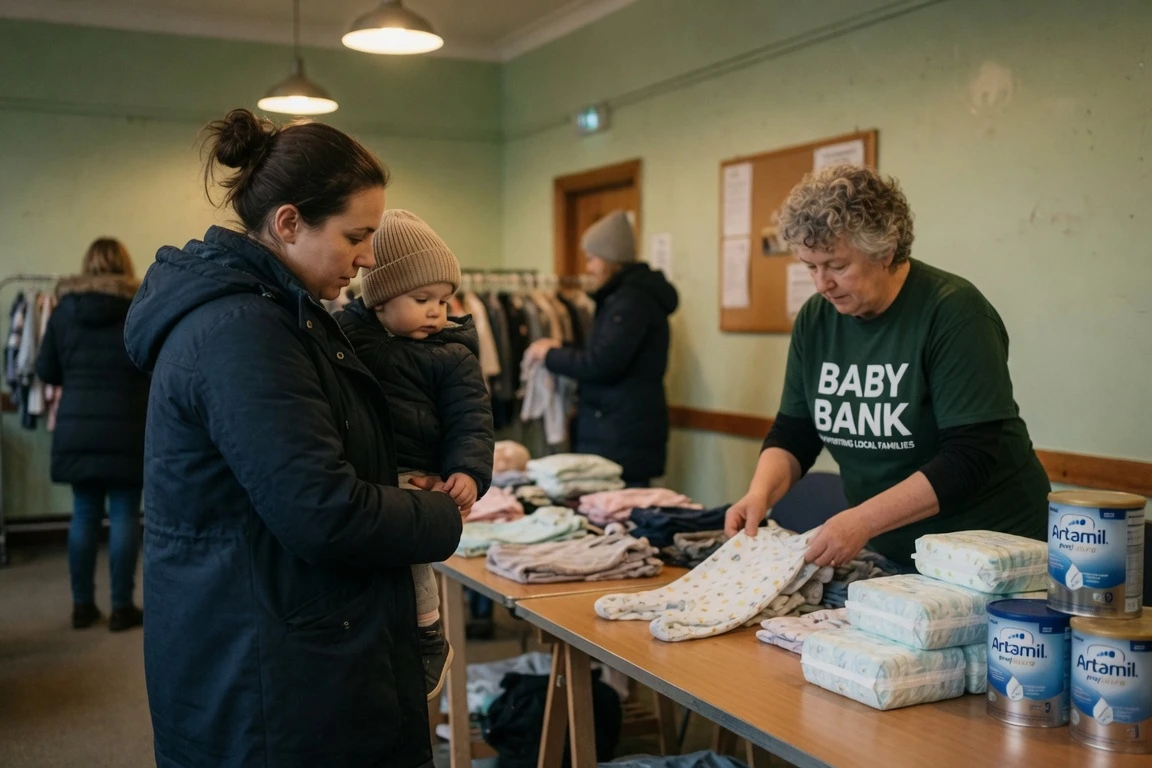
The Items That Show the Strain
The alliance’s figures translate demand into concrete objects. In 2025 its members handed out 16,000 cots, cot beds and travel-cot packages, 24,000 tubs of baby formula, 9.4 million nappies and 6.4 million items of clothing. The 26% jump in formula alone is the steepest of the four lines, and a tub costs from about £12 to £20 in UK shops.
The Reverend Caroline Hewitt, who runs the Little Lighthouse baby bank in Wythenshawe, Manchester, said the money saved on a single tub “might feed the rest of the family for two days.” Demand for cots and beds has climbed alongside it, with families in cramped or temporary accommodation turning up without a safe place for a baby to sleep.
- Cots, cot beds and travel-cot packages: 16,000, up 20% on 2024
- Tubs of baby formula: 24,000, up 26%
- Nappies: 9.4 million, up 8%
- Items of clothing: 6.4 million, up 21%
Little Lighthouse, Wythenshawe, on a Tuesday Morning
Little Lighthouse sits in a church hall in Wythenshawe, set up by Hewitt in September 2019. On the day a Guardian reporter visited, toddlers were reading books and playing while parents drank tea and sifted through tables of baby clothes laid out for them to take.
Laura, 39, has been coming to Little Lighthouse for nearly three years. She arrived pregnant, looking for people having children at the same time, and stayed on as a volunteer with her partner Daniel, 46, a self-employed fire technician. “I intended to breastfeed but I struggled because I wasn’t producing enough milk. The midwife said, ‘You’re going to have to use formula,'” she said. “We struggled in the start because my partner wasn’t working. We used to get milk and baby wipes from here.”
The couple would like another child. They have decided against it. “We wouldn’t want to have another child knowing that we’d struggle financially,” Laura said. “The costs for absolutely everything are just skyrocketing.”
Livingstone said the families walking through Little Village’s doors in London look similar. About 75% of families supported by alliance members point to unsuitable or insecure housing as a pressure they face, and the London network often sees children’s clothes that have to be replaced because they have been “rotted by mould.” One mother told the Guardian her rent rose from £795 a month to more than £1,500 over a few years. Livingstone said Little Village “never has enough large nappy sizes,” which she ties to cramped housing and longer potty-training timelines.
Where Baby Banks Run Out of Stock
The growth in need has outrun what the sector can supply. According to the alliance’s March 2026 survey, 53% of baby banks said they had waiting lists for essential items like prams. 44% said shortages of items were the single biggest barrier to helping families. 57% said they had been unable to fulfil referrals from professionals such as health visitors and social workers, down from 65% in 2024.
An estimated 20% of referrals received in 2025 were repeat visits from families the banks had already supported. Hewitt said Little Lighthouse now sees families who will not miss a referral appointment, a pattern she did not see in 2019. “Some families just cannot cope if they do not come to the baby bank,” she said.
Some families stay in the system for years. Hewitt said Little Lighthouse is still supporting families it first referred before a baby was born, two years on, with nappies and clothes. “It makes me wonder what they would do if we weren’t here,” she told Made for Mums.
- 53% of baby banks have waiting lists for items like prams
- 44% say shortages of items are the biggest barrier to helping families
- 57% cannot fulfil all referrals from health visitors and social workers, down from 65% in 2024
- 20% of 2025 referrals were repeat visits
Scrapping the Two-Child Cap, and What It Cannot Reach
Earlier in 2026, the government abolished the two-child benefit limit, the policy introduced in 2017 that restricted universal credit support to a family’s first two children. The chancellor Rachel Reeves said at the time the cap “pushes kids into poverty more than any other” and had “made almost no difference to the size of families.” The Office for Budget Responsibility estimated the reversal will cost £3bn a year by 2029-30, and the government expects it to lift 450,000 children out of poverty by the end of this parliament. Around 1.6 million children live in families affected by the old policy.
Save the Children called the move a “good first step.” The charity’s own data, published in March 2026, put the number of UK children in poverty at 4 million under the DWP’s revised methodology, with London at the top of the regional table at 38% and the North West and West Midlands tied at 32%. The new method better captures benefit income that was under-reported in earlier years, and the overall rate has remained steady at around 4 million for the last two years.
What the Alliance Is Calling For
The Baby Bank Alliance is asking for more. Its chair has been blunt about the limits of charity work, and wants the scrapping of the cap treated as a first step and to follow it with more action.
Livingstone, who also chairs the End Child Poverty coalition, has been pressing the alliance’s case in public this month. In a statement released with the survey, she warned that baby banks cannot keep filling the role of a state safety net. Her wider ask is for sustained investment in housing, work, energy and food security. Baby banks, she said in the same statement, should not be “solely run in the context of families being in crisis.”
Baby banks are doing everything they can to provide a crucial safety net and stop families from falling through the cracks, but charities alone cannot continue to absorb the impact of child poverty on this scale. It’s time the government took the impact of poverty in children’s early years more seriously.
Livingstone is the chief executive of Little Village and the chair of the Baby Bank Alliance. The Guardian’s reporting at Little Lighthouse in Wythenshawe, where she did not visit on this occasion, captures the on-the-ground side of the warning. Hewitt, who runs that baby bank, told the Made for Mums site that going to the baby bank has become “as normalised as going to the food bank.” “That is a tragedy in 21st-century UK,” she added.
Frequently Asked Questions
What is a baby bank?
A baby bank is a charity that collects and distributes donated or second-hand baby essentials, including clothes, nappies, formula, cots, toys and books, to families with young children who cannot afford them. Most operate on referral from a health visitor, social worker or other professional, though many also accept self-referrals. The Baby Bank Alliance, formed by Save the Children UK, Purposeful Ventures, Little Village and the Baby Bank Network Bristol, now represents more than 400 of them across the UK.
How many children do UK baby banks support?
According to the Baby Bank Alliance’s March 2026 survey of 225 banks, 400,000 children and 210,000 families were supported by UK baby banks in 2025, an 11% rise on 2024. The alliance said 1,096 children were being helped on an average day.
Why has demand risen 11% in a year?
The alliance points to a combination of factors: 4 million UK children in poverty under the DWP’s revised 2024-25 figures, the rising cost of formula and nappies, unsuitable or insecure housing (cited by 75% of the families alliance members support), and the lingering effects of welfare reform. About a fifth of 2025 referrals were repeat visits from families the banks had already supported.
What did scrapping the two-child benefit cap change?
From April 2026, families with three or more children can claim Universal Credit for all of them, rather than only the first two. The government expects the change to lift 450,000 children out of poverty by 2029-30 and to cost £3bn a year by then, according to the Office for Budget Responsibility. Around 1.6 million children live in families affected by the old policy.
What are baby banks asking the government to do next?
The alliance is pressing ministers to see the policy change as a first step on child poverty, with more to follow. Its chair has called for big levers on housing, work, energy and food security, and for sustained investment in early years so that baby banks are no longer solely run in the context of families being in crisis.