
UK Athletics was fined £350,000 on Tuesday for the corporate manslaughter of Paralympic athlete Abdullah Hayayei, who died in 2017 when a metal practice cage that had never once been assembled correctly toppled onto his head at a London leisure centre. The governing body must also pay £44,000 in costs, with the full sum spread over six years.
The cage had stood without its stabilising base plates for roughly five years. An identical one had already collapsed once, in 2012, before anyone was hurt. Judge Richard Marks KC (King’s Counsel, the senior barrister rank) called the death “tragic, untimely and wholly avoidable”.
The Cage That Was Never Built Right
Abdullah Hayayei was 36 and preparing to throw for the United Arab Emirates (UAE) at the 2017 World Para Athletics Championships in Stratford. On the afternoon of July 11, he was training inside a five-metre portable discus cage at Newham Leisure Centre in east London, supervised by his UAE team coach and an assistant.
A gust of wind moved the whole structure. The bar across the top came down on his head.
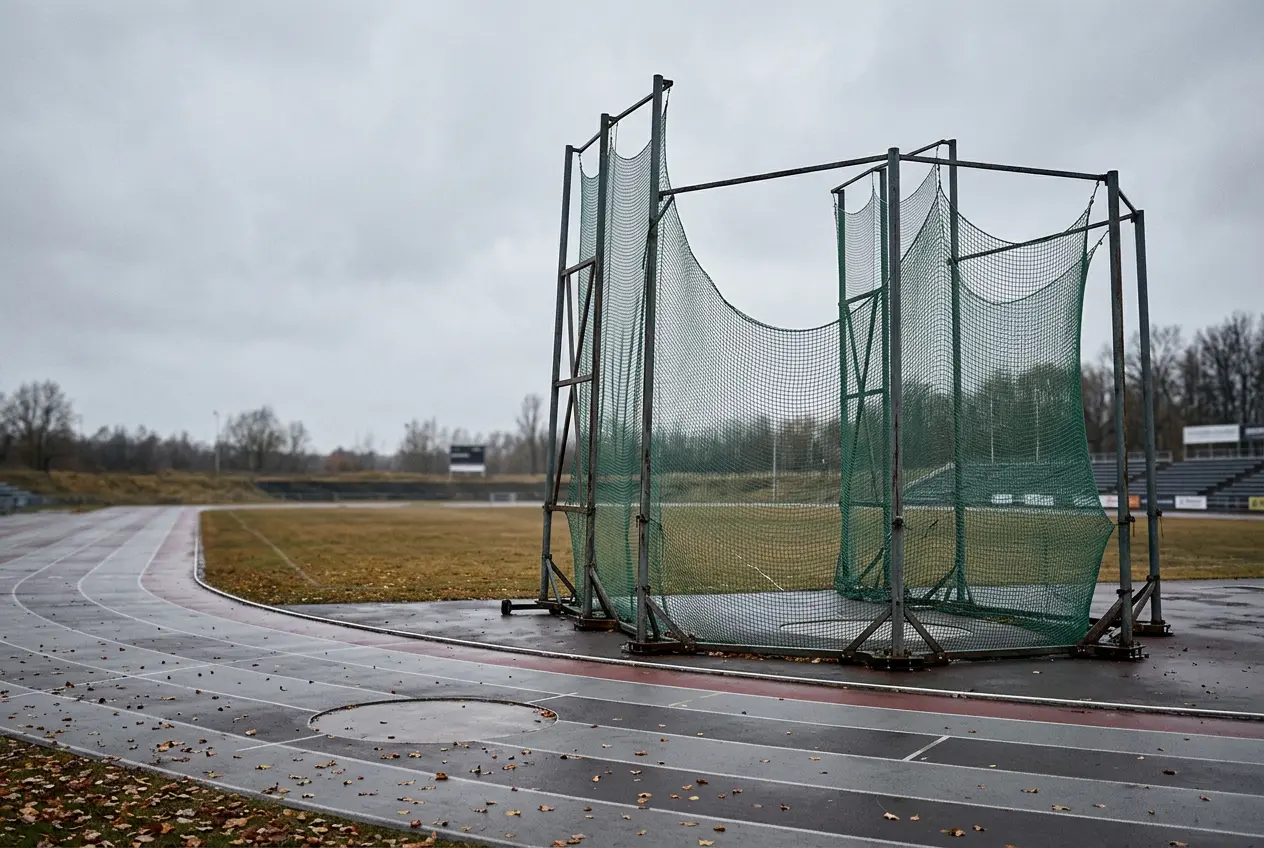
The cage weighed up to 440lb (about 200kg) and was free-standing, designed to be held in place by a metal lattice of base plates. Those plates were missing. So were the ten ladder-like connectors that linked the cage bases to its posts. Without them the frame became dangerously unstable in any real wind, which is exactly what happened. Hayayei collapsed instantly, had to be cut free from the netting, and never regained consciousness despite efforts to revive him.
- 36 years old, a wheelchair user with cerebral palsy, due to compete in para shot put
- 5 children, aged between two and 14 when their father died
- £394,000 total payable by UK Athletics in fine and costs
- £180,000 to £20 million, the guideline span for a corporate manslaughter fine
The Crown Prosecution Service, the body that brought the case, set out the failings in detail in its account of the prosecution of UK Athletics for corporate manslaughter. UK Athletics owned the cage and ran safety at the event.
Why £350,000 Sits at the Floor of a £20 Million Range
Corporate manslaughter carries one of the widest sentencing spans in English law. Under the sentencing guideline for corporate manslaughter, a court can impose anything from £180,000 to £20 million, and the upper limit is in practice unlimited. UK Athletics pleaded guilty and was fined a figure barely above the bottom of that scale.
The reason sits in how the guideline works. After fixing a starting point for culpability and harm, the court must step back and weigh the offender’s finances, including the impact a fine would have on the organisation’s ability to keep operating and to make amends. Judge Marks accepted that the failings here were not a one-off, yet he also noted that any heavy penalty would weaken UK Athletics’ capacity to support individual athletes and grassroots clubs. That is how a death described as wholly avoidable produces a fine smaller than many road-traffic settlements.
| Defendant | Charge | Plea | Sentence |
|---|---|---|---|
| UK Athletics | Corporate manslaughter | Guilty | £350,000 fine plus £44,000 costs over six years |
| Keith Davies, 79 | Health and safety offence | Guilty | Community order, 175 hours unpaid work |
The fine equals roughly $475,000 at June exchange rates. For an organisation that runs the sport at national level, the judge’s logic was that a larger figure would punish the athletes the body exists to serve.
The 2012 Collapse Nobody Acted On
This is where the case stops being an accident and becomes a reckoning. UK Athletics had acquired two identical cages, originally used at the 2012 London Olympics. In the five years that followed, neither was ever correctly assembled with its base plates fitted. One of them had collapsed once before, in 2012, although nobody was hurt that time.
Prosecutor John Price KC told the court the danger ran for years. “Over this period, very many athletes will have been within the cages and many more standing or passing close by,” he said. “It was a perennial hazard, or to use a familiar phrase, an accident waiting to happen.”
- 2012: UK Athletics acquires two cages used at the London Olympics; one collapses, with no injuries.
- 2012 to 2017: Neither cage is ever assembled with its base plates fitted.
- July 11, 2017: The bar falls on Abdullah Hayayei during shot put training.
- After the death: A prohibition notice bars both cages from further use.
- Then: UK Athletics asks for the notice on the second cage to be lifted; the request is rejected.
- June 2, 2026: Sentencing at the Old Bailey.
Price called the attempt to lift the prohibition notice a “remarkable feature” of the case. A cage from the same batch, with the same missing parts, and the response after a man had died under one of them was to try to get the other back into use.
Badriah Hayayei Spoke From the UAE by Videolink
Before sentencing, the athlete’s widow, Badriah, joined the hearing by videolink from the UAE. She described what the loss had done to a household of five children who were aged between two and 14 when their father did not come home.
I hope the court takes a just stance against everyone who caused this, because what happened was not just a simple mistake but the result of negligence, gross negligence, that could have been avoided if safety procedures were adhered to. My husband went out to represent his country and raise the name of the UAE, but he returned as a corpse because of this negligence.
Badriah Hayayei asked the court to weigh the scale of the harm done to her family. Her husband, she said, was a father and a husband with responsibilities, dreams and a future, not only a name on a charge sheet.
Keith Davies and the Base Plates He Said Never Came
Alongside the corporate charge, one individual was sentenced. Keith Davies, 79, a retired PE teacher who served as head of sport for the 2017 championships, admitted a health and safety charge and received a community order of 175 hours of unpaid work. He had been involved in buying the cages before the 2012 Olympics and oversaw their use up to the fatal day.
Davies had maintained that UK Athletics was never provided with base plates. The court heard that this was proven to be false. The judge told him he knew, or should have known, that the plates were an integral part of the cage’s construction, and that after the earlier collapse he had been on notice. Individual convictions of this kind remain unusual in cases brought under the prosecutor’s guidance on corporate manslaughter offences, where the organisation rather than a named manager usually carries the charge.
“This was an accident which sooner or later was waiting to happen,” the judge said of the years the plates went unfitted.
What UK Athletics Says It Has Changed Since 2017
UK Athletics issued a statement after the hearing, calling it a significant moment and saying its thoughts remained with Hayayei’s family. “The failings identified in this case should never have happened, and UK Athletics is deeply and genuinely sorry for what occurred,” it said, adding that substantial changes had been made to how safety, governance and event operations are managed across the sport.
The body said it respectfully accepted the court’s decision and would keep working to strengthen standards. Whether those changes hold is the kind of question the law was built to force. The Corporate Manslaughter and Corporate Homicide Act 2007 exists precisely so that an organisation, and not just a junior employee, answers for a death that systems failed to prevent. Convictions under it are still rare, which is part of why a national sports body pleading guilty carries weight beyond athletics.
The investigation was run by the Metropolitan Police and the London Borough of Newham health and safety team. It took nearly nine years to reach sentence.
The £394,000 will be paid over six years. Abdullah Hayayei’s five children were aged between two and 14 when the cage came down.