Africa’s mobile money industry moved $1.432 trillion in 2025, the largest annual haul in its history, according to new GSMA figures. That is nearly two thirds of everything the world moved through mobile wallets last year.
Most of the accounts behind that total never moved at all. Only 347 million of the continent’s roughly 1.2 billion registered accounts saw a transaction in a typical month in 2025, leaving about seven in ten sitting idle. Fraud, new transaction taxes and a stubborn digital divide are the reasons growth and actual use keep pulling apart.
Africa’s Mobile Money Machine Crossed $1.4 Trillion Last Year
Nearly $1.432 trillion flowed through mobile money accounts in Africa in 2025, up roughly 27% from 2024, according to the State of the Industry Report on Mobile Money 2026, published by the GSMA (Global System for Mobile Communications Association, the global trade body for mobile network operators). The continent accounted for close to two thirds of the $2.091 trillion that moved through mobile wallets worldwide, itself a 23% jump year on year.
Global transaction value has now doubled in just four years. It took the industry two decades to first cross $1 trillion a year; it needed only four more to reach $2 trillion. Africa also handled roughly 92 billion of the world’s 125 billion mobile money transactions, about 74% of the global total.
| Region | 2025 Transaction Value | Share of Global Total |
|---|---|---|
| Worldwide | $2.091 trillion | 100% |
| Sub-Saharan Africa | $1.432 trillion | About 66% |
| East Africa | $806 billion | About 39% of global value |
| West Africa | $498 billion | About 24% of global value |
Merchant payments jumped nearly 50% to merchant payments surging to $155 billion in 2025, the fastest growing category the GSMA tracks. “Mobile money has become one of the world’s most impactful financial services,” said Vivek Badrinath, GSMA’s director general, in the report’s release.
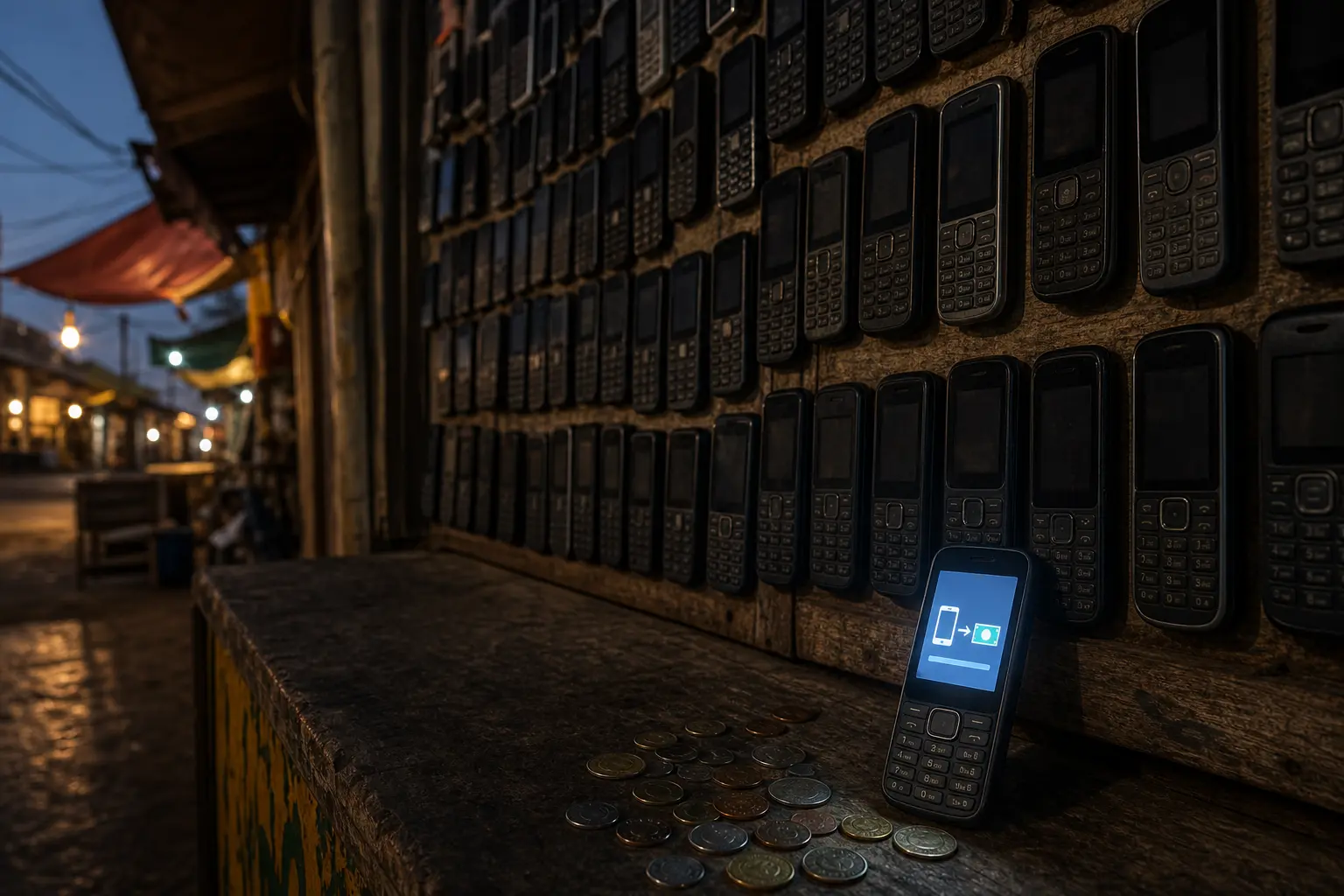
Three in Four Accounts Sit Idle Every Month
The scale is real. So is the gap underneath it.
- 2.3 billion mobile money accounts were registered worldwide by the end of 2025, up 268 million from a year earlier.
- 593 million of those accounts moved money at least once in a typical 30-day window, a 15% increase.
- 25.7% is the resulting global monthly activity rate, the highest since 2021, though still barely one account in four.
- 347 million Africans used their accounts monthly, out of roughly 1.2 billion registered on the continent.
The GSMA put the shortfall plainly in the same release that registered accounts jumped by 268 million in a single year.
This still leaves almost 75% of accounts inactive monthly, with fraud remaining widespread and transaction taxes often encouraging users to revert to cash in the countries where they’re in effect, negatively impacting financial inclusion.
The gap has a gender shape too. In Nigeria, mobile money ownership among women climbed 21 percentage points, yet usage still lags behind men’s. In Uganda, 29% of male account holders received a mobile-enabled loan in the past month, against just 16% of women.
Why Do Scammers Drain Billions From African Wallets Each Year?
Researchers estimate cybercriminals siphon roughly $4 billion a year out of Africa’s mobile money system, exploiting SIM swaps, agent collusion and social engineering scams that trick people into handing over one-time passwords. GSMA’s own provider survey found identity fraud hit 90% of mobile money providers in 2025, while social engineering schemes affected 88%.
SIM swapping alone accounts for roughly 43% of all mobile money fraud on the continent, an investigation published by Technext24 found, with agent-assisted fraud responsible for another 38%. The mechanics are simple: a fraudster gathers a victim’s name, ID number and phone number, often from a data breach or a bribed store employee, then convinces a mobile operator to reissue that number on a new SIM card. Every password reset and transaction code then flows straight to the attacker’s phone.
In Kenya, online theft cost users an estimated $883 million in 2023. Law enforcement has started pushing back. Interpol announced in February 2026 that a coordinated sweep across the continent led to 651 arrests and the recovery of $4.3 million, including 27 arrests in Kenya tied to fake investment schemes and 58 arrests in Côte d’Ivoire linked to mobile loan fraud rings.
- SIM swap scams – a fraudster convinces an agent or operator to move a victim’s number onto a new SIM, then intercepts the codes needed to empty the account.
- Agent-assisted fraud – some agents collude with criminals to process unauthorized transactions for a cut of the proceeds.
- Social engineering – phishing calls, texts and fake promotions trick users into revealing PINs or one-time passwords themselves.
Practical guidance on protecting mobile money accounts from takeover still comes down to basics: never share a one-time code, and confirm an agent’s identity before handing over a phone.
Governments Keep Taxing Users Back Into Cash
Cameroon added a 0.2% tax on mobile money transfers and withdrawals in 2022. Mali went further in February 2025, raising the tax on mobile operators’ revenue from 8% to 10% and layering on a new 1% levy on mobile money withdrawals. Kenya’s Finance Bill 2026 has since proposed extending 16% VAT to the fees mobile money providers charge, a move the country’s banking and business sectors have publicly opposed.
Ghana already ran this experiment. Its e-levy on mobile money transfers was abolished in April 2025 after three years of weaker usage and revenue that fell well short of projections. The International Monetary Fund had earlier warned, in an assessment of Cameroon’s economy, that such levies could be “fiscally inequitable” and could slow a still-early stage of financial inclusion.
Where the tax debate splits:
- Governments – see transaction levies as a fast, low-friction way to raise domestic revenue from a large and growing tax base.
- The GSMA – argues that taxing mobile money at the transaction level effectively taxes poverty, since the heaviest users are often the poorest.
- The IMF – has separately warned that such levies can be fiscally inequitable and can undercut inclusion gains that are still fragile.
Every one of these levies pushes in the same direction: back toward cash, and away from the accounts the industry spent two decades building.
PAPSS Bets on Local Currencies to Fix Cross-Border Payments
The Pan-African Payment and Settlement System, known as PAPSS, launched in January 2022 to let traders settle transactions in local currencies instead of routing them through the US dollar or euro. It is a system built to span 50-plus countries and roughly 40 currencies, a scale that dwarfs earlier regional efforts; the Economic Community of West African States has pursued a single regional currency, the ECO, since 2003, and that plan would have covered only 15 countries.
Early 2026 brought a concrete test. An analysis by the Bloomsbury Intelligence and Security Institute described the launch of the first wallet-based outbound payments corridor between Nigeria and Ghana, built through a partnership between PAPSS and Onafriq, the pan-African digital payments network formerly known as MFS Africa. The goal is a transfer that settles in hours rather than days, without either side needing to first buy dollars.
The push toward shared rails echoes a broader move toward open banking’s consumer-first interoperability standards taking hold across other digital finance markets. Fragmented licensing rules between countries remain the biggest drag on how fast that promise turns into daily use.
Credit Replaces Cash as Africa’s Next Fintech Wave
Africa is the fastest-growing fintech market in the world, with revenues revenues projected to expand 13 times by 2030, according to Boston Consulting Group. The first wave of African mobile money was about getting people into the formal system. The one now forming is about what happens after that: credit, savings and insurance layered onto wallets that used to just move cash.
The gap is still wide. Even in advanced markets like Ghana, Kenya and Uganda, more than half of all borrowing still runs through semi-formal or informal channels, BCG found. Closing that gap increasingly rests on alternative credit scoring built from transaction histories rather than traditional bank records, much of it powered by Africa’s growing AI talent pipeline reshaping banking for lenders far beyond the continent.
Telecom operators and banks are increasingly partnering rather than competing, using banking-as-a-service arrangements that pair the telcos’ reach with banks’ regulatory standing. Safaricom’s M-Pesa has spent the past year and a half building out credit, insurance and savings products on top of what began as a simple transfer tool, a shift industry watchers compare to Ant Group’s build-out in China, albeit under very different regulatory constraints.
What Will It Take to Wake Up a Billion Dormant Accounts?
Closing Africa’s usage gap needs cheaper smartphones, better digital literacy and more affordable data, not just more registered accounts. Only about a third of adults in sub-Saharan Africa own a full smartphone capable of running banking apps, and low digital financial literacy remains, in GSMA’s own words, a major obstacle to deeper use.
In Ethiopia, among people who know mobile money exists but have never opened an account, 60% of women and 54% of men say they simply do not know how to use it. In Egypt that figure is closer to a fifth, and in Nigeria about a fifth of both men and women cite the same barrier. The International Telecommunication Union has pushed for cheaper entry-level smartphones, installment payment plans for handsets, and digital skills built into school curricula.
Seven in ten of Africa’s 1.2 billion mobile money accounts still won’t move a shilling, a cedi or a naira this month.
Frequently Asked Questions
How Much Money Moved Through Mobile Wallets in Africa in 2025?
Sub-Saharan Africa processed nearly $1.432 trillion in mobile money transactions in 2025, up about 27% from 2024 and equal to roughly two thirds of the $2.091 trillion moved through mobile wallets worldwide. For scale, the GSMA measured global mobile money flows at about $2.7 million a minute back in 2023; by 2025 the pace had grown well beyond that.
Why Does USSD Still Dominate Mobile Money Transactions?
USSD (Unstructured Supplementary Service Data) runs over basic 2G signal without needing a smartphone, an app or an internet connection, which is why it still carries about 63.5% of mobile money transaction volume across Africa. In the WAEMU region (West African Economic and Monetary Union, the eight-country bloc that shares the CFA franc), roughly 89% of mobile money interactions still happen over USSD rather than a smartphone app.
Which Companies Run Africa’s Biggest Mobile Money Platforms?
Safaricom’s M-Pesa, MTN’s MoMo, Airtel Money, Orange Money and Wave are the continent’s largest networks. M-Pesa has operated since 2007 across eight countries including Kenya, Tanzania and Ethiopia, while MTN MoMo runs in 14 markets stretching from Ghana to Uganda. Newer entrants such as Wave have pushed transfer costs close to zero across francophone West Africa.
Why Are Some Governments Taxing Mobile Money Transactions?
Cash-strapped treasuries in Cameroon and Mali have added levies on mobile money transfers and withdrawals to raise domestic revenue, while Kenya’s Finance Bill 2026 has proposed extending 16% VAT to the fees mobile money providers charge. Ghana tried a similar levy and abolished it in April 2025 after three years of weaker usage and revenue that fell short of projections.
How Is PAPSS Different From a Normal Bank Transfer?
PAPSS settles cross-border trade in local currencies instead of routing payments through the US dollar or euro, and it nets out balances rather than moving the full amount every time. If one country’s traders export $10 million to a neighbor while importing $8 million back, PAPSS only moves the $2 million difference across the border, which is how it undercuts the fees and delays of correspondent banking.
Can Fraud on Mobile Money Actually Be Stopped?
Providers have had measurable success with targeted fixes rather than blanket restrictions. Biometric verification programs in Kenya have been linked to a 72% reduction in fraud, and agent training programs in Tanzania were tied to a 51% decline, though both carry tradeoffs, including higher false-positive rates and the risk of excluding rural customers without formal identification, according to peer-reviewed research on mobile money fraud in Africa.