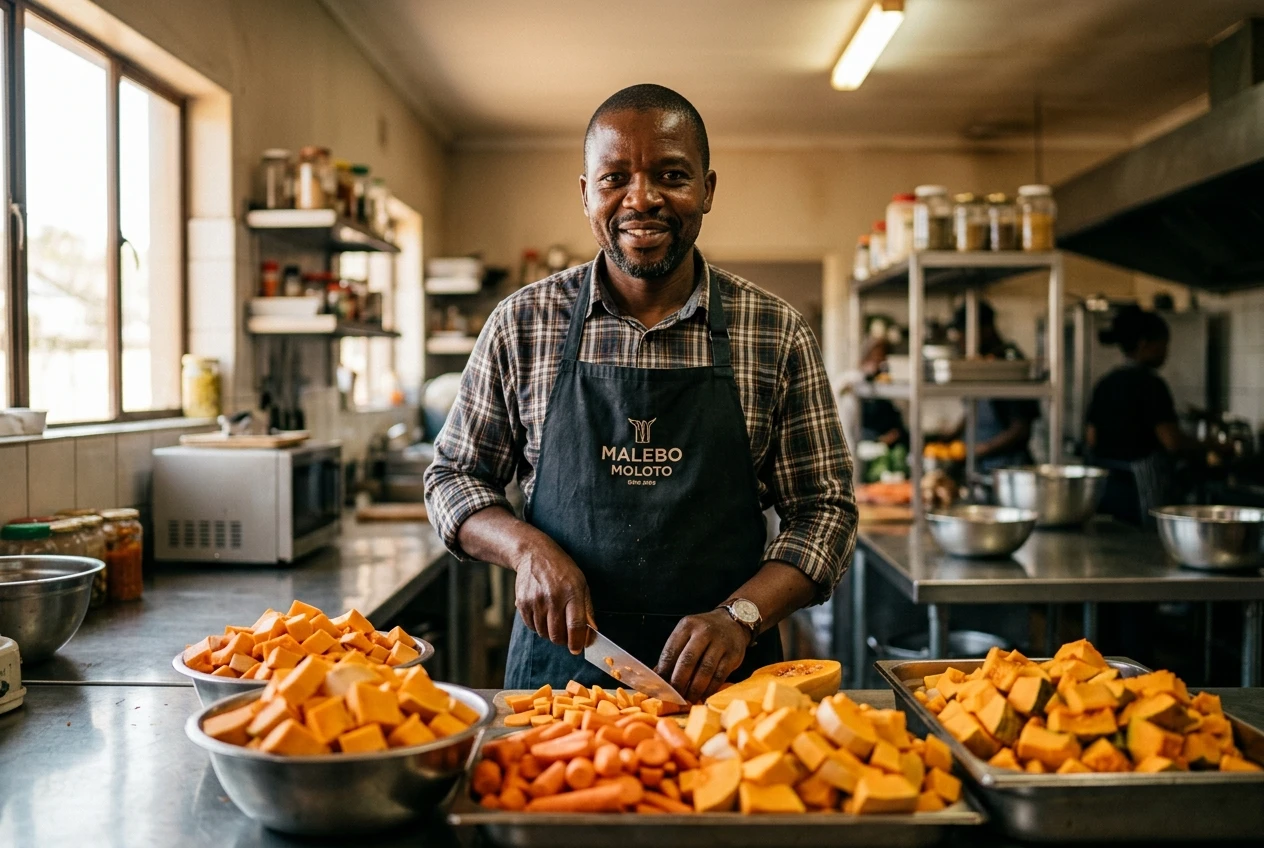
A 34-year-old Soweto entrepreneur who lost about R150,000 when Covid-19 wiped out his online appliance business now supplies fresh-cut vegetables, salads and fruit packs to eight supermarkets and turns over more than R300,000 a month. Malebo Moloto’s Thumbchef grew out of a single piece of advice and a community survey that pointed him toward a product he knew nothing about.
The pivot from kitchen appliances to pre-cut carrots, pumpkin and potatoes sounds like a hard turn, but Moloto frames it as a quiet lesson in listening. “Someone asked me, ‘Why don’t you ask your community what they want instead of trying to guess?’ That was probably the best business advice I’ve ever received,” he told Sowetan.
The Appliance Business That Wasn’t
Before Thumbchef, Moloto ran an online business selling kitchen appliances through a dropshipping model. The setup looked tidy on paper: stock the website, advertise it, let suppliers ship the orders. Covid-19 broke every link in the chain.
Suppliers ran out of stock, leaving him unable to fulfil customer orders. People were ordering products that weren’t available anymore, and Moloto was refunding payments, paying transaction fees, and watching his Google Ads costs climb. By the time he saw what was happening, the damage had already been done. The business collapsed, costing him about R150,000.
A Community Survey, Three Grocery Categories
The appliance loss left Moloto in a hard place. “I was really struggling. I even thought about getting a job because things were rough,” the 34-year-old said.
A piece of advice turned him around. Moloto took it literally, building a simple survey asking residents what they spent their grocery money on each month. The responses pointed to three categories: meat, pantry items and vegetables.
Meat was the obvious prize but came with capital demands Moloto could not meet. He wanted to sell meat because that was where people spent the most money, but he didn’t have a car or refrigeration. Pantry goods needed too much capital because he would have had to stock so many different products. Vegetables were the only thing he could realistically start with, though he knew nothing about them.
How Vegetables Are Priced
Moloto did what he could not afford to skip. He spent weeks at the Johannesburg fresh produce market, studying prices and learning how the industry worked, a process that took almost two months. One day carrots would cost one price, and the next day they’d be completely different.
He kept going because sitting at home wasn’t going to change his situation. With the basics sorted, he started selling vegetable combo packs door-to-door in Kibler Park. The packs were priced between R99 and R190. The early months were modest, generating about R12,000 a month.
When Customers Asked Him to Cut the Pumpkin
The bigger product was hiding inside the question customers kept asking. “You’d be surprised how many people don’t know how to cut a pumpkin,” Moloto laughed.
People kept asking him, “Can you cut the pumpkin? Can you cut the carrots?” That’s when he realised convenience was the real product. That insight transformed the business.
Working from the back room of his home, Moloto and his mother spent nights washing, peeling and cutting vegetables for deliveries the next morning. His mother helped him a lot. Sometimes he’d even borrow her salary to buy stock and pay her back a few days later. She also let him use her car because he didn’t have one.
He credits his mother with carrying the early business through. “The little she had as she worked as a social worker took us very far, especially my business,” he said.
The SPAR Manager’s First Audit
The breakthrough arrived when Moloto walked into a SPAR supermarket in Kibler Park carrying prepared vegetables. He pitched the manager on the cut vegetables, asking if the store would buy his supply. The manager said, “Bring them.”
What came back was a checklist of missing pieces: packaging, branding, barcodes, and shelf-ready presentation. Moloto went home and researched every requirement. He came back with professionally packaged products. His first supermarket order was worth just R200.
That manager taught me everything I needed to know about retail. Looking back now, I realise he wasn’t rejecting me; he was preparing me.
The audit pushed Thumbchef from a back-room prep into a shelf-ready product.
From One Supermarket to Eight
The R200 order marked the start of a slow compounding run. One supermarket soon became two, then three, and today Thumbchef supplies to eight supermarkets. The business now employs 10 people and turns over more than R300,000 a month. Each new store added another small contract, the same way the SPAR order had started.
- 8 supermarkets supplied
- 10 employees
- R300,000+ monthly turnover
- R12,000 first monthly revenue, from door-to-door sales
- R200 first supermarket order
The Thumbchef range reaches fresh-cut fruit, vegetable and salad aisles in the stores it supplies.
The Accountant Who Wanted Tech
Technology was the field he wanted, not business or accounting. His mother didn’t see a future in tech and asked how he would make money there. She didn’t support that choice, so he ended up studying accounting at the University of Johannesburg.
He finished the degree but never warmed to it. He’s the sort of person who likes to finish what he starts, so he saw it through. But deep down, he knew accounting wasn’t where he belonged. Years later, after failure and a comeback, his calling is building a business that solves everyday problems for ordinary people.
Go and ask people what they need. Your customers will always tell you exactly what they want. If you listen carefully, they’ll build the business for you.
Moloto has also said he wants to return to his roots by bringing door-to-door vegetable deliveries back to Soweto, where he has never sold directly.
Frequently Asked Questions
What is Thumbchef?
Thumbchef is a Soweto-based business founded by Malebo Moloto that supplies fresh-cut vegetables, salads and fruit packs to supermarkets. According to Sowetan, the business grew out of a community survey Moloto ran in his area to find out what residents spent their grocery money on.
How many supermarkets does Thumbchef supply?
Thumbchef supplies fresh-cut produce to eight supermarkets, Moloto told Sowetan. The retail relationship started with a single SPAR in Kibler Park, where his first order was worth R200.
Who founded Thumbchef?
Malebo Moloto, a 34-year-old accounting graduate from the University of Johannesburg, founded Thumbchef. He is from Meadowlands, Soweto, and built the business after his previous online appliance venture collapsed during Covid-19.
What happened to Malebo Moloto’s first business?
Moloto ran an online kitchen-appliance dropshipping business before Thumbchef. Covid-19 disrupted the supply chain, leaving him unable to fulfil orders. He was refunding customers and paying transaction fees while Google Ads costs climbed. The collapse cost him about R150,000.
What is Malebo Moloto’s advice for new entrepreneurs?
Moloto’s advice centres on listening. “Go and ask people what they need. Your customers will always tell you exactly what they want. If you listen carefully, they’ll build the business for you,” he told Sowetan. He also points to the SPAR manager who pushed him on packaging, branding and barcodes as a turning point.