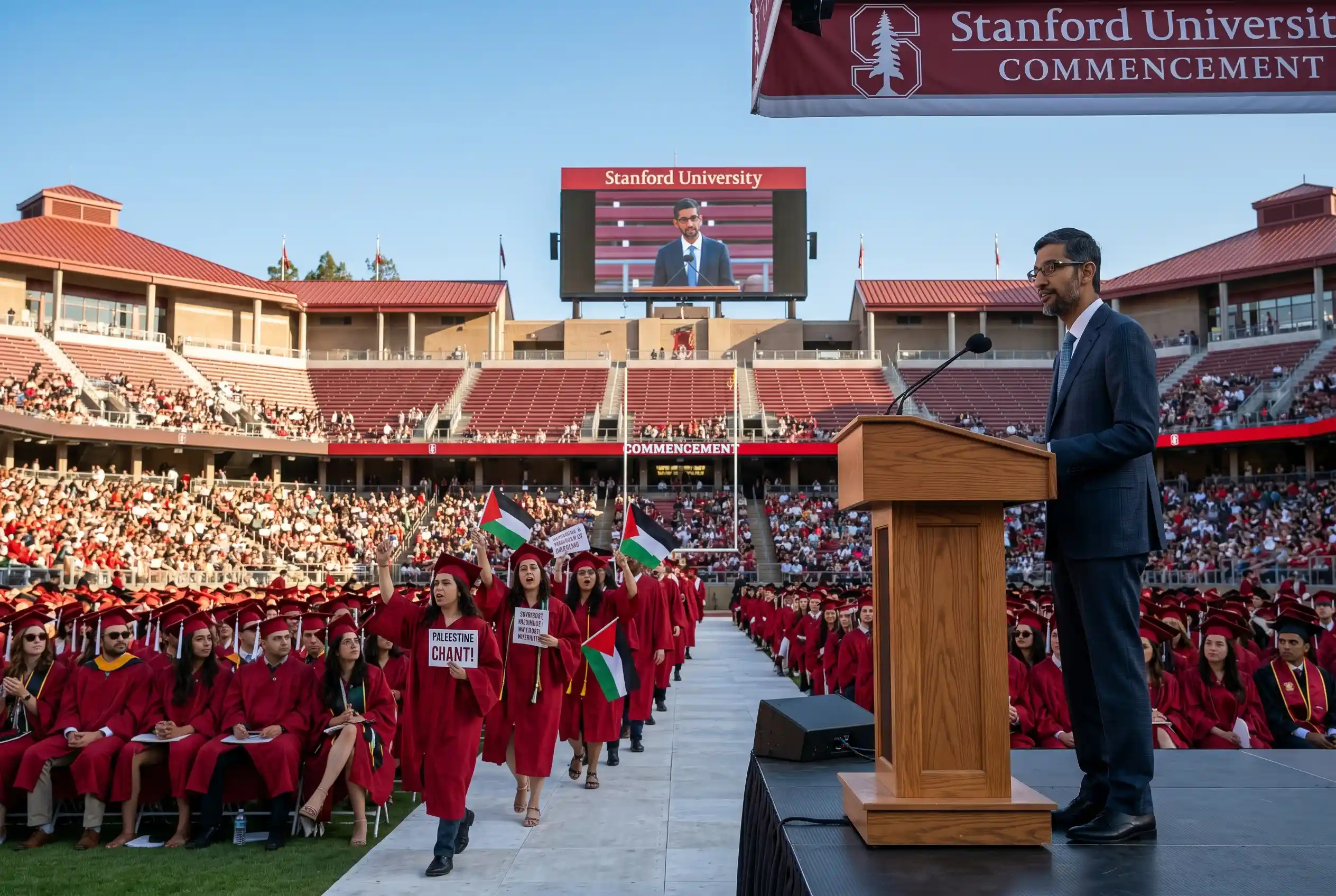
Stanford University graduates turned their own commencement into a protest on Sunday, with around 200 students walking out as Google CEO Sundar Pichai stepped to the lectern to deliver the keynote address. The graduates streamed out of Stanford Stadium chanting “free, free Palestine” and waving flags, objecting to Google’s $1.2 billion Project Nimbus cloud contract with the Israeli government. The walkout came in a season in which tech leaders invited to graduation stages have met with open pushback from students.
Pichai, a Stanford alumnus, appeared unfazed as he took the stage. He told the seated audience, “What I see in front of me is how graduation should be,” while the rest of his classmates exited the stadium.
The Walkout That Opened the Ceremony
The day began as a typical Stanford celebration, with thousands of onlookers gathering beneath a cloudless sky to watch the graduates process in the school’s decades-old Wacky Walk tradition. Students rode inflatable horses and wore cardboard mock-ups of Lightning McQueen and Caltrain on their way to their seats. A few male graduates walked in only Stanford-red briefs and sunglasses beneath their gowns.
Stanford President Jonathan Levin, introducing Pichai, called him a model of “thoughtfulness, humility and determination in leadership and in making decisions of consequence to Google into the world.” Even as Levin welcomed the CEO of “one of the most innovative companies in the world,” many students responded by booing. As Pichai took the stage, scores of students stood and walked out of the stadium, some chanting or booing as they left, according to the initial account of the Stanford walkout. The vast majority of the graduates remained seated. Pichai pressed on with his address.
The Independent reported that around 200 students walked out, a figure higher than the “scores” cited in the initial Bay Area News Group account. Reports described attendees blowing whistles and waving Palestinian flags as they exited the stadium.
- ~200 graduates walked out, per The Independent
- $1.2 billion Project Nimbus contract value
- 7 years initial term of the Nimbus deal
Pichai’s Speech, Built to Sidestep the Controversy
Pichai earned a master’s degree in materials science and engineering from Stanford in 1995 before joining Google in 2004, where he played a key role in the development of Google Chrome. He later became CEO of Google and its parent company, Alphabet, leading one of the world’s most valuable companies. His Sunday address stuck to personal advice, the kind of broad guidance typical of commencement season.
He distilled his message into three ideas, drawn from his own life and career. Pichai acknowledged the AI debate that has shadowed other tech-heavy commencement addresses this year without directly addressing Project Nimbus. Former Google CEO Eric Schmidt was met with boos at the University of Arizona when he began talking about the rise of AI. “People have been giving me a lot of advice … about what not to say,” Pichai said, hinting that it was the “last two letters of my last name.”
- “choosing optimism”
- “when you have the choice to work on something hard, say yes”
- “when all else is equal, do what excites you”
Project Nimbus: A 2021 Deal on a 2026 Stage
The contract at the center of the walkout is five years old. Project Nimbus is a $1.2 billion cloud-computing agreement between Google, Amazon, and the Israeli government, signed in 2021. It provides cloud computing infrastructure, artificial intelligence, and other technological services to the Israeli government and military.
Leaked Israeli government documents, published in a joint investigation in October 2025, revealed an unusual mechanism embedded in the deal: a winking system in which the companies would send coded payments to Israel if forced to hand over Israeli data to foreign law enforcement. The contract runs for an initial seven years, with the possibility of extension, and prohibits Google or Amazon from revoking Israel’s access to the technology, even if its use is found to violate the companies’ own terms of service. Both Google and Amazon have denied circumventing any legal obligations. “The idea that we would evade our legal obligations to the US government as a US company, or in any other country, is categorically wrong,” a Google spokesperson told the October 2025 investigation into Nimbus’ winking mechanism.
Asked about the project during internal protests in 2024, Pichai said Google maintained “a culture of vibrant, open discussion” but was not a place to “fight over disruptive issues or debate politics.” “This is too important a moment as a company for us to be distracted,” he told employees at the time, according to The Independent.
- Signed in 2021 by Google, Amazon, and the Israeli government
- $1.2 billion in total value
- Provides cloud computing, AI, and other technology to the Israeli government and military
- Initial seven-year term, with the possibility of extension
- Bars the companies from suspending Israel’s access, even if the use is found to violate their own terms of service
The People’s Commencement
The walkout did not end at the stadium exits. Many of those who left gathered under oak trees elsewhere on campus for what organizers called the People’s Commencement, a parallel ceremony with its own stage, banners, and keynote speaker. A banner reading “ICE Spies with Google AI” hung near the lectern, alongside a Palestinian flag, and the event opened with an acknowledgment that the university sits on the ancestral land of the Muwekma Ohlone people. Eva Jones, a Stanford teaching assistant who had just graduated with a master’s degree and leads a group called Tech for Liberation, helped organize the event and described its purpose. Dr. Mohammed Subeh, an emergency physician who had recently returned from treating patients in Gaza, also spoke.
The people here have worked so hard to achieve this, and we want to celebrate the radical possibility of education … rather than listen to an advertisement by Stanford and its corporate benefactors.
Jones, a 2026 Stanford master’s degree recipient and a People’s Commencement organizer, addressed the crowd under the oaks. The keynote was Mahmoud Khalil, a Columbia University graduate and pro-Palestinian activist who spent 104 days in U.S. Immigration and Customs Enforcement detention in 2024.
A Year of Pressure Behind the Walkout
The walkout was the latest flashpoint in more than a year of campus activism around the war in Gaza and demands that Stanford divest from entities supporting Israel’s military action there. In June 2024, 13 people were arrested during a sit-in at the university’s administrative offices, and Santa Clara County District Attorney Jeff Rosen filed felony vandalism charges against 12 of them. The case ended with a deadlocked jury, and a judge later disqualified Rosen and his office from retrying it, per the trial of the Stanford sit-in defendants.
Last year, three dozen students and staff took part in a hunger strike in solidarity with Palestinians, calling for divestment and other policy changes. The strike ended in June 2025 after the university refused to negotiate, according to KQED.
In 2025, Stanford became one of 60 universities placed under investigation by the U.S. Department of Education’s Office for Civil Rights for alleged antisemitic discrimination and harassment on campus, per the Bay Area News Group account of the commencement. The probe followed a wave of campus protests tied to the war in Gaza. The 60-university list of federal investigations is the latest pressure point in a years-long clash between Stanford administrators, students, and federal authorities.
The Office for Civil Rights is reviewing whether the universities violated Title VI of the Civil Rights Act, which prohibits discrimination on the basis of race, color, or national origin. The federal letters warned the colleges of potential enforcement actions if the schools failed to address the alleged harassment of Jewish students. The investigation runs alongside the 2024 felony case and the new pressure from the commencement protest. Mahmoud Khalil, the People’s Commencement keynote speaker, also called out Stanford Five, a group of students facing criminal charges for allegedly vandalizing a university office in 2024. Stanford is now facing overlapping federal, criminal, and student-led pressure at the same time.
The Booing Spreads Across the Commencement Circuit
The Stanford walkout came in a season when tech leaders invited to graduation stages have met with repeated pushback. Former Google CEO Eric Schmidt was booed at the University of Arizona when he turned to the rise of AI. The pattern has put a sharper question in front of the speakers who follow: whether AI commentary, or the politics of tech contracts, will follow them to the lectern.
Pichai, asked in an interview with The New York Times’s Hard Fork podcast about what he would do if booed, said graduates would be “both, going to be a big part of driving that progress and also dealing with the impact of technologies.” He added that the next generation would “rise to the challenge” and that he would share his own experiences with them. On Sunday, the response included a walkout and a parallel ceremony under the oaks, another off-script entry in a season of commencement protests. Pichai, on stage, kept delivering his speech.