The Special Olympics Southern California Summer Games returned to Cal State Long Beach this weekend, drawing hundreds of athletes from across the region for three days of competition, free health screenings in seven medical disciplines, and a Young Athletes development program for children as young as two. Law enforcement officers lined the Saturday morning arrival route as competitors checked in for the championship’s two main competition days, which followed Friday evening’s cauldron lighting at the LSB Financial Credit Union Pyramid, concluding a 1,100-mile Law Enforcement Torch Run that had started in Chula Vista on May 26.
Competition Across Seven Events
The championship ran across seven event categories on Saturday and Sunday, with swimming held at the Monte Nitzkowski Aquatics Center at Long Beach City College, a new venue this year per SOSC’s Summer Games event information. Track and field, basketball, bocce, and flag football filled the main campus grounds at Cal State Long Beach, joined by Unified versions of both bocce and flag football.
Unified Sports puts athletes with intellectual disabilities alongside partners without intellectual disabilities on the same competition team, matched at similar skill levels. Special Olympics Unified Sports research found that majorities in nine out of ten countries surveyed believed people with intellectual disabilities could not play competitive sport alongside those without them. Unified teams put both groups in the same competitive lineup.
The 2026 Summer Games sport categories:
- Athletics (track and field)
- Basketball
- Bocce
- Unified Bocce
- Flag Football
- Unified Flag Football
- Swimming
Summer Games is the championship of Special Olympics Southern California’s (SOSC) spring training season, with athletes qualifying through regional competitions held across the preceding months. For many competing at Long Beach this weekend, that path started in county-level programs months ago, coaches calibrating each athlete’s event roster to match their training progress. County-level Special Olympics invitationals run the same qualifying-to-championship structure across the country, including in Girard, Ohio last month where 167 athletes from five counties competed at Arrowhead Stadium under the same format.

Seven Disciplines, Zero Cost
The Healthy Athletes stations ran in parallel with competition across the weekend, offering free medical assessments in seven disciplines to SOSC athletes. Volunteer healthcare professionals and students staff the screenings, conducting non-invasive assessments and issuing follow-up referrals when a clinician identifies something worth further evaluation. Coaches could pre-register their teams ahead of the Games to schedule athlete appointments at the stations.
People with intellectual disabilities face multiple barriers to routine healthcare: cost, communication challenges, difficulty finding providers with relevant experience, and a lack of adapted clinical resources in many communities. The Healthy Athletes model addresses several of these at once by bringing screenings to the athlete, in a sports setting they already attend, staffed by volunteer clinicians who accept no payment.
Those barriers carry documented consequences. When Special Olympics first offered on-site health screenings at the 1995 World Games, a significant share of athletes had conditions that day serious enough to require emergency room referrals, a finding that prompted the formal launch of the Healthy Athletes program in 1997.
What the Screenings Cover
SOSC’s event materials named six of the seven disciplines offered at this year’s Summer Games. Each targets a clinical area where people with intellectual disabilities face elevated rates of undetected or untreated conditions, according to Special Olympics Northern California’s clinical program data.
| Discipline | Area of Health Screened |
|---|---|
| Fit Feet | Podiatric health; foot and ankle conditions |
| FUNfitness | Physical therapy; flexibility, strength, and balance |
| Health Promotions | Bone density, blood pressure, and BMI |
| Healthy Hearing | Audiology; hearing loss and ear health |
| Special Smiles | Dental health and oral care |
| Strong Minds | Emotional wellness and mental health |
The Fit Feet station addresses podiatric conditions that often go untreated outside a clinical setting. Undetected hearing conditions are another consistent finding at events like Summer Games, where athletes sometimes discover for the first time that routine auditory support could improve how they communicate with coaches and teammates during competition.
A Training Ground for Clinicians
The screenings work in both directions. Athletes move through the stations and receive referral paperwork if a clinician flags something worth following up. The volunteer healthcare professionals and students staffing those stations accumulate hands-on clinical experience with a patient population that most medical and dental training programs address minimally. Data published by Special Olympics Northern California shows that less than 20 percent of healthcare professionals have specific training to treat patients with intellectual disabilities, which means events like Summer Games serve as one of the few structured environments where that clinical training happens at scale.
Athletes who receive a referral at a Healthy Athletes station are connected to local healthcare providers for follow-up evaluation, giving the program a care-continuity function that extends beyond the competition weekend. The cumulative reach of that work, across events like Summer Games around the country and worldwide, shows up in Special Olympics’s global Healthy Athletes program data:
- 2 million+ free health screenings delivered globally since 1997
- 300,000 health professionals and students trained to work with patients with intellectual disabilities
- 50% of Special Olympics athletes have preventable or treatable foot conditions affecting sport performance
- 15% of athletes screened at the 1995 World Games needed urgent emergency care referrals on the day of screening
The Youngest Athletes on Campus
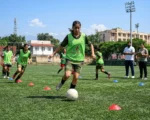
A designated area of the campus served children ages 2 to 7 through SOSC’s Young Athletes program. The activities ran motor skills drills, hand-eye coordination exercises, and sports skills demonstrations, structured as a first experience of organized athletic activity and a preview of what SOSC’s programs look like as children grow older.
The program is designed specifically for early childhood entry, built on the principle that children with intellectual disabilities benefit from structured physical and social activity at the same developmental stages as children without. Families are integral to the design: parents and caregivers participate alongside their children rather than watching from the sideline, giving the format a joint discovery structure. SOSC frames the area as the earliest rung of the competitive pathway that leads to Summer Games competition.
Children who move through the Young Athletes area begin building the physical habits and familiarity with the Special Olympics format that carry into formal competitive eligibility later on. Summer Games is one of the few events where the full range of SOSC’s programming appears in one location, and families attending could move between the competition venues, the health screening stations, and the Young Athletes area, with all three running simultaneously across the campus grounds.
How the Torch Got to Long Beach
The cauldron that opened Summer Games on Friday evening had covered roughly 1,100 miles before arriving at the LSB Financial Credit Union Pyramid. The Law Enforcement Torch Run (LETR) for SOSC left Chula Vista on May 26, with more than 300 law enforcement agencies carrying the Flame of Hope in relay legs across Southern California over two weeks. Friday’s opening ceremony at 5:30 p.m. included the Parade of Athletes before the cauldron lighting, which concluded the relay at its Summer Games destination.
The route that led to Long Beach also served a larger purpose. The relay’s passage through Los Angeles on June 1, which ran from a pep rally at Crypto.com Arena to the LA Memorial Coliseum, was part of the Final Leg of the 2026 Special Olympics USA Games Torch Run. That national relay is headed to Minnesota’s Twin Cities, where the 2026 USA Games will open on June 20, uniting 3,000 athletes for competition through June 26.
In Southern California, the LETR program raised $1.2 million in 2024, with more than 200 law enforcement agencies and stations involved. Every dollar raised directly covers costs like transportation, uniforms, equipment, and venue fees for athletes, ensuring that participation in SOSC’s programs remains free. More than 3,000 officers participated in this year’s Southern California relay.
Those same officers showed up at the Saturday competition, with scores of them positioned along the entry corridor at Cal State Long Beach as athletes arrived for competition day.
A Festival Beyond the Track
SOSC organized a family festival alongside the competition, with live music, interactive games, and activity booths run by partner companies and community groups. A fan zone gave supporters materials to make signs and cheer athletes through their events during the day.
An art display featuring work by SOSC athlete Samantha Roman ran across the weekend in a dedicated exhibition area. Roman is the athlete-featured artist for the 2026 Summer Games, and her display ran through both competition days. SOSC merchandise, including hats, water bottles, shirts, and sweatshirts, was also available on site.
Kelly Pond, president and CEO of Special Olympics Southern California, issued a statement for the event.
The athletes inspire us every day with their energy, determination, confidence and spirit.
Pond’s statement described Summer Games as the direct expression of SOSC’s mission to empower individuals with intellectual disabilities through the life-changing impact of sports.
The Season That Led Here
Summer Games closes the spring competitive season for SOSC, which runs 12 sports across four seasons and reaches nearly 25,000 athletes in community and school-based programs across 11 Southern California counties. More than 50 full-time employees and thousands of volunteers support those programs alongside corporate partners and individual donors.
The organization’s four seasons cover a year-round calendar, with sports ranging from aquatics and athletics to bocce, basketball, golf, and winter sports. Athletes can enter SOSC’s programs at any skill level, with training designed to build toward competition across each season.
The next season opens June 13, when bowling begins and runs through August. Admission to all competition venues at this weekend’s Summer Games was free to the general public.