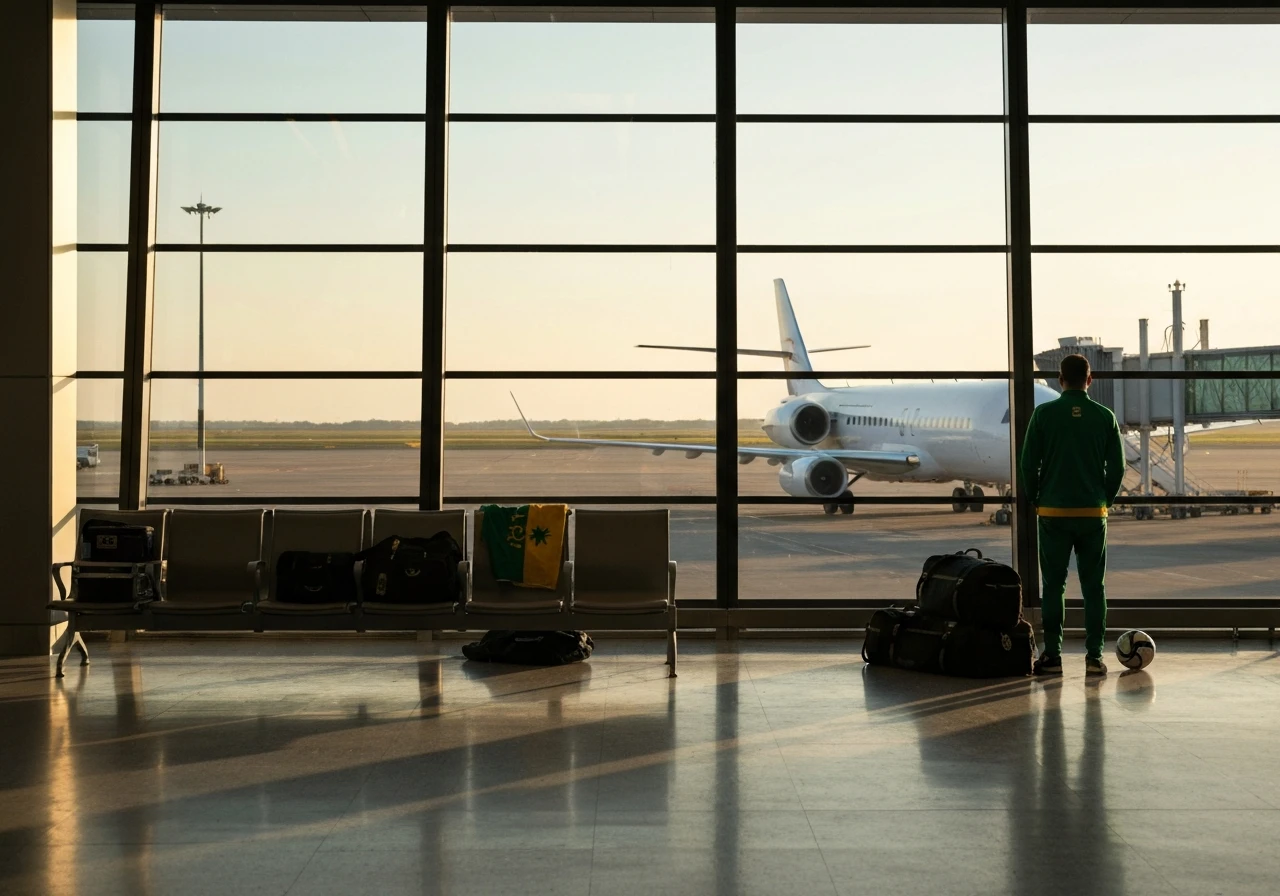
South Africa’s World Cup squad was grounded in Johannesburg for two days before boarding its charter flight on Monday, after some players and backroom staff failed to secure the visas needed to reach a tournament split across three host countries. Bafana Bafana open against co-host Mexico on June 11 in Mexico City, then cross into the United States for their second group game in Atlanta.
Sports Minister Gayton McKenzie called the hold-up an embarrassing administrative blunder and demanded a report from the federation. South Africa is also at least the fourth national team to slam into a visa or entry wall in the weeks before the first World Cup staged by three countries at once.
What Grounded the Bafana Bafana Charter
The squad was due to leave Sunday morning on a chartered flight bound for its training base in Pachuca, Mexico. It stayed on the tarmac. The South African Football Association (SAFA, the country’s governing body for the sport) held an emergency meeting on Sunday night and said afterward that it had secured visas for all of the players.
Four members of the backroom staff were still without documents, according to McKenzie: an assistant coach, the team doctor, the head of security and an analyst. The federation said it hoped their papers would be finalized in time to join the same Monday flight, and that the Foreign Ministry and the US Consulate in Johannesburg had stepped in to help untangle the mess.
The minister did not hide his anger about how the country looked.
We are being made to look like fools.
McKenzie wrote that line on X and blamed team officials rather than either host government, saying the squad needed visas for both Mexico, where it opens and trains, and the United States, where it plays once in the group stage. The federation apologized for the delay.
A Pattern Bigger Than One Delayed Flight
South Africa’s scramble landed in a crowded field. Iran has spent weeks waiting on US visas, a Haiti player is stuck on the island without one, and the Democratic Republic of Congo was cleared to play only after a health scare. Put together, the cases describe a tournament whose biggest opponent so far is the immigration counter.
| Team | The holdup | Status |
|---|---|---|
| Iran | US visas for players and officials; placed on banned-country list | Based in Tijuana, Mexico; awaiting clearance for US group games |
| Haiti | US travel restrictions on Haitian nationals | One island-based player and several officials still waiting |
| DR Congo | Federal health mandate tied to an Ebola outbreak in the region | Team cleared to play; many supporters locked out |
| South Africa | Visas for Mexico and the US delayed | Players cleared; four staff pending Monday flight |
The Iran case is the sharpest. The team will be based in Tijuana, just south of the California border, and play all three of its group games on US soil, in Los Angeles and Seattle. Its ambassador to Mexico said the players are not preparing on equal terms, and Mexico’s President Claudia Sheinbaum offered to host the squad after US processing stalled.
Haiti’s problem is one player and a passport stamp. Woodensky Pierre, the only squad member based in the country, plays for Violette AC in Port-au-Prince and was still waiting on a US visa while teammates trained in Florida. Washington imposed sweeping restrictions on Haitian nationals in mid-2025.
The Three-Country Border Math
The 2026 World Cup is the first hosted by three nations at once, with 48 teams and 104 matches scattered between Mexico, the United States and Canada, and a single group can mean repeated international crossings mid-tournament. South Africa’s own route shows the strain.
- June 11: South Africa vs Mexico, Estadio Azteca, Mexico City
- June 18: Czechia vs South Africa, Mercedes-Benz Stadium, Atlanta, United States
- June 24: South Africa vs South Korea, Estadio BBVA, Monterrey, Mexico
Two countries, one group stage, and a travel party that has to clear both, as the official Group A fixtures lay out. The commercial machinery is moving faster than the paperwork; even Colombian banks chasing World Cup customers have turned the event into a marketing tournament of their own while squads wait on consulates.
Where Washington Drew the Lines
The backdrop is a US immigration regime that has tightened hard over the past year, and the World Cup walked straight into it.
The Travel-Ban List
On January 1, 2026, the United States expanded visa restrictions to roughly 39 countries, with full suspensions for 19 and partial limits for 20 more. Four qualified World Cup nations sit on the banned list: Iran, Haiti, Cote d’Ivoire and Senegal. Athletes, coaches and necessary support staff are exempt; fans are not.
The exemption has limits that nobody has fully defined. When Iran’s federation applied for nine delegation members, only four were approved, with no public explanation, according to an explainer on the tournament’s immigration restrictions. That ambiguity is exactly what leaves staff visas, like South Africa’s four, hanging late.
Bonds and the Priority Lane
- $5,000 to $15,000 in refundable visa bonds can be required of some B1/B2 (visitor) applicants under an expanded pilot program
- Four qualified nations on the bond list, including Senegal and Cote d’Ivoire, won exemptions for World Cup ticketholders
- 39 countries face full or partial visa suspensions as of the start of the year
FIFA built a workaround to ease the crush. FIFA PASS (the Priority Appointment Scheduling System) lets fans who buy tickets directly and opt in jump the interview queue for a B1/B2 visa, a fast lane laid out in the State Department’s World Cup visa guidance.
Teams Clear Customs, Fans Hit the Wall
The exemptions show who the system protects. Players and staff from banned countries can generally still travel; ordinary supporters from those same countries cannot, even with match tickets in hand. The opening rounds will be played in front of crowds that, in some sections, were filtered by nationality before kickoff.
That gap has a recent echo in other sports, where US visa denials that benched Cuba’s volleyball team from a regional event showed how quickly access can vanish. DR Congo’s supporters face a federal entry mandate tied to the Ebola outbreak that runs until at least June 17, locking many out of the entire group stage.
If the remaining staff visas land in time, South Africa’s stumble becomes a footnote by the opening whistle in Mexico City. If the wider pattern holds across 48 squads and millions of ticket holders, the first three-country World Cup will spend its opening weeks explaining who got through the gate and who did not.
Frequently Asked Questions
Why was South Africa’s World Cup squad delayed?
The team could not secure all the visas it needed for Mexico and the United States in time for its scheduled Sunday departure. Players were cleared after an emergency meeting, four staff members were still pending, and the squad flew out on Monday.
Do fans need a visa to attend the 2026 World Cup?
Yes, in most cases. Fans from visa-required countries need a valid B1/B2 visitor visa to attend US matches, and a FIFA match ticket is not a visa or a guarantee of entry into any host country.
Which World Cup teams’ countries face US travel bans?
Iran, Haiti, Cote d’Ivoire and Senegal are qualified nations on the US banned list. Athletes, coaches and essential support staff are exempt from the bans, but ordinary fans from those countries are not.
What is FIFA PASS?
FIFA PASS, the Priority Appointment Scheduling System, lets supporters who buy tickets directly from FIFA and opt in secure earlier B1/B2 visa interview slots, helping them beat long consulate wait times before the tournament.
When does South Africa play its group games?
South Africa opens against Mexico on June 11 in Mexico City, faces Czechia on June 18 in Atlanta, and meets South Korea on June 24 in Monterrey, Mexico.