A joint Armenian-Italian archaeological expedition has wrapped its 2026 field season at the Shamiram archaeological site in Armenia’s Aragatsotn Province. The work, conducted from May 26 to June 25, produced the strongest evidence yet that the fortified plateau hosted a wealthy Late Bronze Age elite whose burials included a ritually sacrificed horse. Beneath those tombs, the team also exposed the most complete pre-Urartian sequence recovered at the site to date.
The Armenian-Italian Archaeological Mission has been digging at Shamiram, on a triangular promontory between the villages of Shamiram and Aruch, as part of a long-running partnership between Armenia’s Institute of Archaeology and Ethnography and Italy’s International Association for Mediterranean and Oriental Studies (ISMEO). The 2026 campaign focused on four zones: the central cemetery, a tower on the Urartian fortification, the Wall 2 gate complex, and a post-Urartian sector labelled Area 7. Archaeologists say the combined results confirm Shamiram as one of central Armenia’s most important multi-period sites, with occupation stretching from the Late Bronze Age into the post-medieval era. The recovered artifacts are now headed for laboratory analysis.
What the 2026 Season at Shamiram Turned Up
The 2026 field season ran from May 26 to June 25 at the Shamiram archaeological site, a fortified rocky plateau in Armenia’s Aragatsotn Province that has been lived on continuously for thousands of years. The site sits on a triangular promontory above two shallow valleys, and the dig focused on refining its chronology across multiple occupation periods.
The expedition is the Armenian-Italian Archaeological Mission, a long-standing scientific collaboration between the Institute of Archaeology and Ethnography of the National Academy of Sciences of Armenia and the Rome-based International Association for Mediterranean and Oriental Studies (ISMEO). Co-director Varduhi Melikyan leads the Armenian side of the work. Co-director Roberto Dan leads the Italian side. The mission has rotated through Shamiram year after year, and the 2026 results build on periodic excavations that began at the site under Yerevan State University in 1975.
Three threads of the 2026 work stand out: the Late Bronze Age tomb in the cemetery, a pre-Urartian sequence behind one of the fortress towers, and new detail on the Urartian-era walls and gates themselves.
Inside Tomb 3 and the Buried Horse
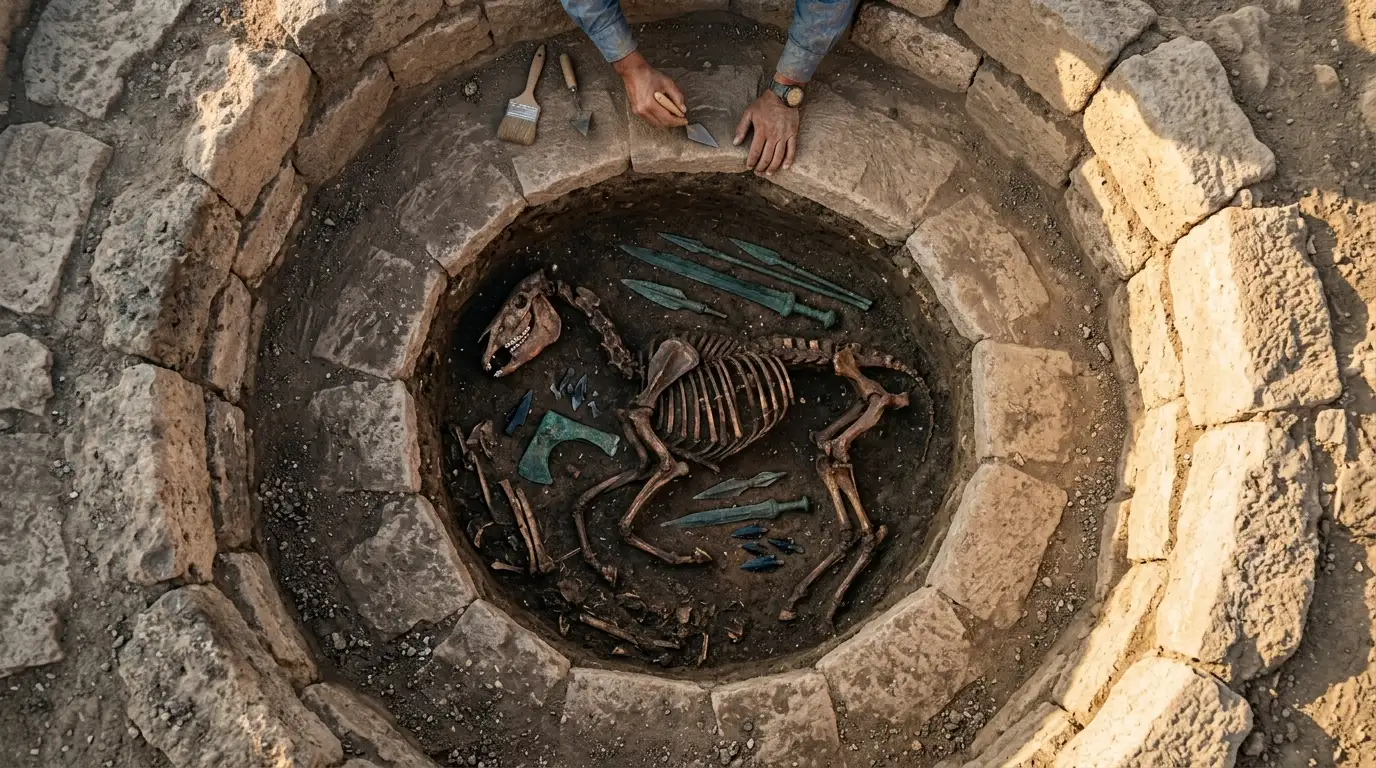
The season’s most striking find came from continued excavation of Tomb 3, a monumental Late Bronze Age burial complex set within the cemetery south of the fortress. Archaeologists uncovered a central stone burial chamber, a stone cist that held the principal interment, surrounded by a set of concentric stone rings. The arrangement is consistent with high-status Late Bronze Age burial practice, with the rings acting as a visible marker on the ground above the burial chamber.
The chamber held a rich set of grave goods and the partial remains of a single horse. The team catalogued them as follows:
| Type of find | What it was |
|---|---|
| Bronze weapons | Multiple pieces placed with the burial |
| Metal arrowheads | Part of the projectile kit |
| Obsidian arrowheads | Local and trade-linked material |
| Horse remains | A single animal, interpreted as a ritual sacrifice |
| Other offerings | Rich grave goods reported by the team, exact list not detailed in the institute’s statement |
Researchers say Tomb 3 offers fresh evidence about the burial customs and social status of local elites during the Late Bronze Age. The placement of a sacrificed horse alongside weapons and arrowheads fits a wider pattern in the South Caucasus, where horses carried symbolic weight in elite mortuary rituals. The find parallels the kinds of Bronze Age surprises turning up in other parts of Europe right now, from the Bronze Age finds dug from a Cardiff sports field to new excavations across the Armenian highlands.
The Armenian Report, which carried the original image of the dig, frames the burial as a window on ritual life in Armenian societies more than 3,000 years ago. The institute’s own statement stops short of dating the deposit in calendar years and treats the horse sacrifice as evidence for the symbolic role of the animal in these communities.
The Sleeper Beneath the Tower
The real sleeper of the 2026 season sits behind one of the towers of the Urartian fortress, where the team dug through later Urartian levels into something older. They exposed a Middle Iron Age room showing clear traces of fire and destruction, a single rectangular structure burned and buried under the rising fortification. Below the floor of that room lay an earlier burial that predates the construction of the Urartian defensive circuit entirely.
Stacked in one place, that sequence gives researchers something they rarely get in the South Caucasus: a sealed transition from a local Iron Age settlement to an Urartian fortress, with destruction layers caught in the middle. The institute describes the find as offering a rare opportunity to examine the transformation of a local Iron Age center in central Armenia before and during the expansion of the Kingdom of Urartu.
It also tightens what can be said about the Urartian takeover locally. Earlier Iron Age deposits on the Armenian plateau are often flattened or built over by later fortification work, so a preserved room-and-burial stack beneath a tower is a small treasure. The team’s reading is that the local Iron Age community at Shamiram was already established, and likely significant, before the Urartians reorganised the hilltop.
The 2026 work confirmed that occupation at the site stretches through a long sequence of distinct periods, in this order:
- Late Bronze Age
- Iron Age
- Urartian
- Post-Urartian
- Hellenistic
- Late Antique
- Medieval
- Post-medieval
For a fuller accounting of how the 2026 results fit into earlier seasons, the institute’s full statement on the 2026 Shamiram excavation sets out the season’s scope and the periods it confirmed.
Urartian Walls and a Hellenistic Rebuild
Work on the Urartian fortification itself produced the clearest picture of the kingdom’s engineering at Shamiram. Cleaning and excavation at Tower 3 confirmed a well-preserved megalithic structure measuring approximately 8.5 by 8.5 meters, built from large blocks of tuff that the Urartians had to quarry, dress and lift into place.
At the Wall 2 gate complex, the team concluded that the visible L-shaped entrance was most likely rebuilt in the Hellenistic period, sitting on top of an earlier Iron Age gateway. The Hellenistic rebuild did not replace the Urartian wall, it reorganised the access point into a corner-turning entrance, a layout the Hellenistic builders favoured for defence.
The Urartians built their circuit at Shamiram to last, and the 2026 results show that later occupants kept reshaping the same walls rather than abandoning them. The Hellenistic-era reorganisation of Wall 2 is one of the cleanest examples at the site of how each new generation negotiated the fortifications it inherited.
A Plateau That Never Stopped Being Useful
The Shamiram plateau covers about 10 hectares, set between the villages of Shamiram and Aruch, and overlooks two shallow valleys. Attached to the south side of the fortress is a cemetery holding more than more than 5,000 tombs, one of the largest Iron Age burial grounds in the region and a key reason the cemetery zone keeps producing new material each season.
The 2026 campaign also opened new windows on the centuries after Urartu collapsed. In Area 7, the team exposed rooms with column bases, architectural structures built directly against the Urartian towers, and well-preserved medieval installations, a clear record of how the ancient fortification kept shaping the site’s spatial organisation long after the kingdom fell. Earlier campaigns at the cemetery turned up, among other things, a Mitanian seal, anthropomorphic monuments and a cauldron, finds that connect Shamiram to the wider political world of the early first millennium BC. Periodic excavation at the site has run since 1975 under Yerevan State University. The castle itself was abandoned at the end of the 9th century BC or the start of the 8th century BC, after an attack, and the territory was later resettled in the post-Urartian period. For a longer view of the site’s layout, archaeology and excavation history, the site’s layout, archaeology and excavation history compiles the regional research record.
Who’s Digging, and Who’s Paying
The mission is co-funded by the Italian Ministry of Foreign Affairs and International Cooperation, with the support and coordination of the Embassy of Italy in Yerevan. Co-direction by Varduhi Melikyan on the Armenian side and Roberto Dan on the Italian side keeps the work split between Yerevan and Italy.
The results of this season confirm Shamiram as one of the key archaeological sites for understanding the long-term history of central Armenia, from Bronze Age funerary traditions and Iron Age communities to Urartian monumental architecture and later phases of reuse and transformation.
The Institute of Archaeology and Ethnography of the National Academy of Sciences of Armenia issued the statement quoted above at the close of the 2026 field season, naming the institute as the speaker. Fieldwork has finished for the year. The next stage is laboratory: anthropological, archaeozoological and further archaeological analyses of the recovered materials will run in the coming months. The institute says those studies will deepen understanding of Shamiram and its place in the ancient landscape of Armenia.
Frequently Asked Questions
Where exactly is the Shamiram archaeological site?
The site sits on a triangular promontory in Armenia’s Aragatsotn Province, on the south-western edge of the village of Shamiram and between the villages of Shamiram and Aruch. The plateau covers about 10 hectares and rises above two shallow valleys.
What was the Kingdom of Urartu?
Urartu was the Iron Age kingdom whose expansion across the Armenian plateau in the early first millennium BC is recorded in the fortification walls the 2026 team is exposing at Shamiram. The kingdom collapsed late in that period, and the 2026 work shows the local fortress at Shamiram was abandoned at the end of the 9th century BC or the start of the 8th century BC, after an attack.
Why does the pre-Urartian layer at Shamiram matter?
The pre-Urartian sequence behind one of the Urartian fortress towers is rare because later fortification work often flattened or buried earlier Iron Age deposits. A sealed Middle Iron Age room with fire traces, sitting above a burial that predates the Urartian wall, gives researchers a rare stratigraphic window on the local community that was there before the kingdom expanded into the Ararat region.
Who is funding the excavation?
The project is co-funded by the Italian Ministry of Foreign Affairs and International Cooperation, with the support and coordination of the Embassy of Italy in Yerevan. The work is run jointly by the Institute of Archaeology and Ethnography of the National Academy of Sciences of Armenia and Italy’s ISMEO association.
What happens to the artifacts now?
The artifacts recovered in 2026 are headed for laboratory analysis. The institute says anthropological, archaeozoological and further archaeological studies will run in the coming months to refine what the team can say about Shamiram’s local elites, the symbolic role of the sacrificed horse in Tomb 3, and the timing of the Urartian takeover at the site.