
Playback singer S. Janaki, the voice widely called the Nightingale of South India, died at a private hospital in Mysuru on July 11, 2026, at the age of 88. Two of the longest-serving figures in South Indian cinema, composer Ilaiyaraaja and singer P. Susheela, paid tribute within hours of each other the next day, in separate recorded video messages. Both said Janaki had no one left to match her.
Ilaiyaraaja and Susheela are the surviving witnesses of a tradition now visibly thinning. Tamil filmmakers K. Bhagyaraj and Bharathiraja both died in the weeks before Janaki, and The Hindu’s coverage of Sunday’s tributes called her passing “the latest blow” in the same season of departures. Her tributes came from the two pillars still standing on either side of an empty stage.
The Day She Died in Mysuru
Janaki was admitted to Apollo BGS Hospitals in Mysuru on 11 July 2026 at 12:49 pm and was in critical condition on arrival, according to the hospital bulletin on Janaki’s final hours. Doctors moved her to the intensive care unit, where she suffered multiple cardiac arrests during treatment despite advanced cardiopulmonary resuscitation. She was declared deceased at 7:30 pm the same evening.
Her granddaughter Apsara Vydyula confirmed the death on social media, saying Janaki “left us peacefully, surrounded by the love of her family.” Karnataka Chief Minister D.K. Shivakumar directed that her final rites at her farm in Kaniyanahundi, Mysuru, be held with full state honours. The body was kept for public viewing at Maharaja College Ground in Mysuru the following morning. Prime Minister Narendra Modi, actors Rajinikanth, Vijay, and Chiranjeevi, and political leaders across South India issued condolence messages in the hours that followed.
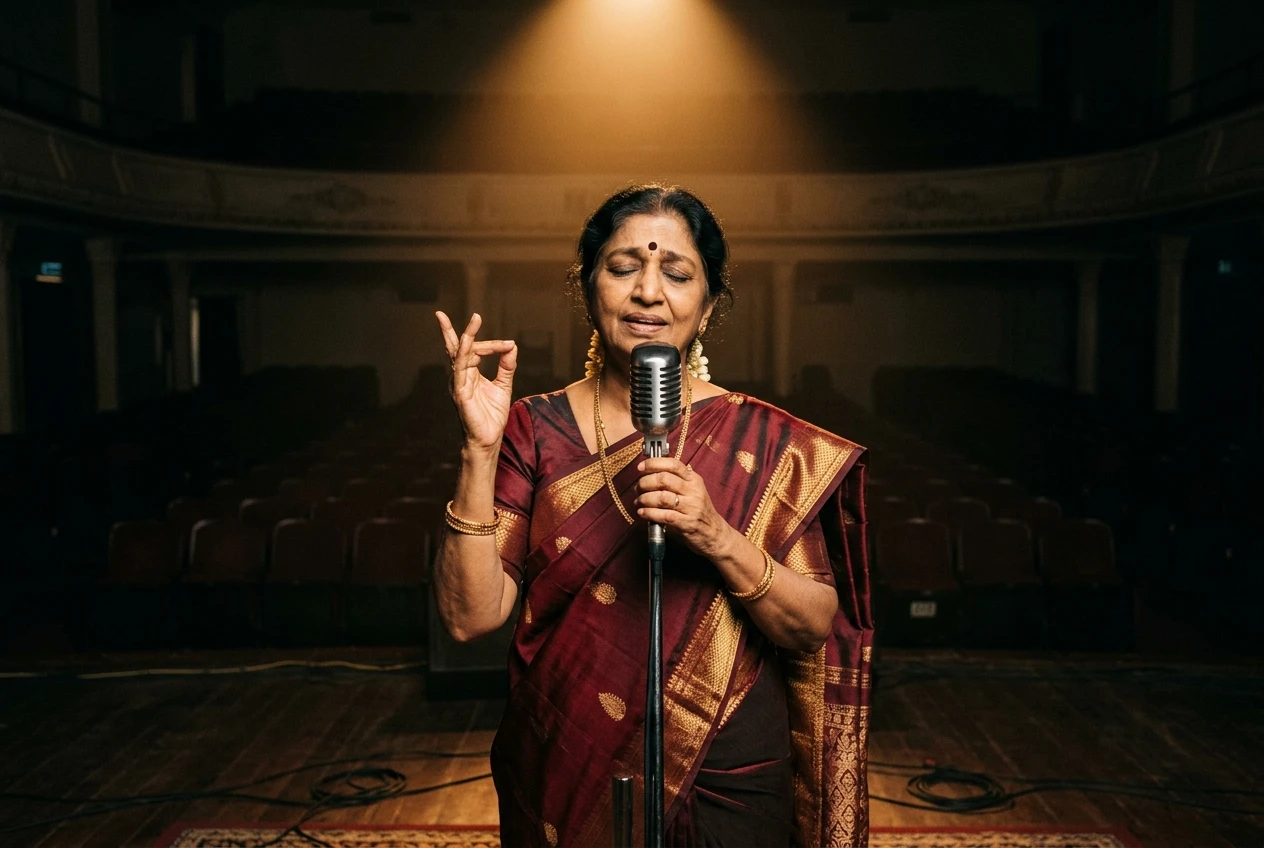
What Ilaiyaraaja Said
Ilaiyaraaja’s tribute was the most personal. He collaborated with Janaki from his debut film Annakili (1976) and through decades of Tamil classics after it, according to S. Janaki’s six-decade recording career. On 12 July 2026, in a recorded video message posted on his official social media, he said Janaki had proved through every song she sang that she was “second to none in talent.” He called the news “a great shock” and “painful” given the personal tragedies she had endured.
What struck him most was her discipline in the studio. “Just as I strove relentlessly to make the fullest use of every instrument in my compositions, Janaki amma always put in more effort than I expected whenever I taught her a song,” Ilaiyaraaja said. He recalled that the singer would never settle for a first take, refining the song until it matched what he had heard in his head.
He also praised her work outside playback: devotional bhajans she had composed and written herself, a smaller catalogue that took her beyond the recording studio. “Her death is a great loss to Indian film music,” he said in closing.
What Susheela Said
Susheela’s tribute was the most measured. The senior singer, who shared six decades of work alongside Janaki in the studios of South Indian cinema, recorded her own video message on 12 July 2026. She spoke of an unmatched vocal range and an unmistakable expressive signature, pointing out that no singer in Tamil cinema could match Janaki’s versatility. P. Susheela named her the Nightingale of South India, and said the loss will leave a gap the present generation cannot close.
There is no one who can match her. Unfortunately, we do not have singers of her calibre today.
The quoted words came from P. Susheela’s recorded video message, posted on her own social media on 12 July 2026. She pinpointed one song as Janaki’s Tamil-cinema breakthrough, Singaravelane Deva from Konjum Salangai (1962), calling it the song that took Janaki “to the pinnacle of playback singing.” She closed with a quieter register: “Tamil Nadu was blessed by your arrival,” and “I wish she is born again, but perhaps one lifetime is enough.” P. Susheela’s recognition of Janaki ran in parallel with her own: Susheela holds the Guinness record for the most recordings in Indian languages (17,695 verified on 28 January 2016), and the two singers had crossed paths repeatedly across Telugu, Tamil, Kannada, and Malayalam.
The Career in Six Decades
Janaki’s career was defined by sheer reach. She began at 19 in the Tamil film Vidhiyin Vilayattu (1957) and, in that same year, recorded songs in six languages, including Kannada and Tamil.
Across more than six decades, she recorded over 48,000 songs in films, albums, television, and radio, across more than 20 Indian languages and a handful of foreign ones, with the highest count in Kannada. Her awards included 4 National Film Awards for Best Female Playback Singer, 33 different State Film Awards, and 10 Kerala State Film Awards for Best Playback Singer between 1970 and 1984. She recorded for nearly every major South Indian composer across generations, from T. Chalapathi Rao, M.B. Srinivasan, K.V. Mahadevan, and M.S. Viswanathan to Ilaiyaraaja, A.R. Rahman, and Hamsalekha. The breadth meant she sang for every South Indian industry in turn and crossed into Hindi, Bengali, Odia, Sinhala, and one song each in Japanese, German, and English. Her voice became part of an everyday AIR cue: when the announcer noted the next song was by Janaki, listeners in the South already knew what was coming.
Her National Film Award came for the song Senthoora Poove from 16 Vayathinile (1977), the debut directorial venture of Bharathiraja, whose own recent death is part of the same thinning of the era. Janaki retired from playback in 2016 but returned in 2018 for the Tamil film Pannaadi, ending a run that began at 19 and lasted six decades, as documented in Janaki’s life story and Padma Bhushan refusal.
The single-line tally of her standing as a singer looked like this:
- Over 48,000 songs recorded
- Recorded in more than 20 Indian languages
- 4 National Film Awards for Best Female Playback Singer
- 33 different State Film Awards
- 10 Kerala State Film Awards (1970 to 1984)
The Padma She Refused
The one award she did accept and then publicly declined was the Padma Bhushan. On the eve of Republic Day in 2013, the Government of India named Janaki for the country’s third-highest civilian honour. Within days, she made it clear she would not accept it.
Janaki said the recognition had arrived too late, after she had already been singing successfully for 55 years, and that she deserved nothing less than the Bharat Ratna, the highest civilian honour, which Lata Mangeshkar had received in her own lifetime. She also framed the refusal as a protest for South Indian singers, who she said had long been denied the same national recognition given to their Hindi-cinema counterparts. She composed devotional bhajans of her own, the side of her craft Ilaiyaraaja singled out in his Sunday tribute. The Padma Bhushan has remained declined to this day.
A Tradition Reckoning With Itself
Tamil filmmakers K. Bhagyaraj and Bharathiraja died in the weeks before Janaki, and the dual video tribute from Ilaiyaraaja and Susheela that ran in The Hindu on Sunday called her passing “the latest blow” to the same generation. P. Susheela’s recorded tribute put the same point in one sentence: there is no one to match Janaki in today’s Tamil playback, she said. State condolences landed the same day, framing her as the singer who could carry a film from opening title to closing frame.
Kerala Chief Minister V.D. Satheesan said Janaki’s voice could express devotion, love, joy, and sorrow with rare depth and grace. Telangana Governor Shiv Pratap Shukla described her as a golden voice that touched millions, while Chief Minister Revanth Reddy called her an enduring symbol of melody, devotion, and artistic excellence. Susheela singled out Singaravelane Deva from Konjum Salangai (1962) as the song that took Janaki to the pinnacle of Tamil playback. That song is still taught to singers learning the South Indian classical style.
P. Susheela’s own standing was settled independently of Janaki’s: she is the first woman to win the National Film Award for Best Female Playback Singer (1969) and holds the Guinness record for the most recordings in Indian languages. Ilaiyaraaja is the composer whose work has defined modern Tamil film music for nearly half a century. The two of them, both still active, eulogized the same colleague on Sunday in separate video messages released within hours of each other.
Frequently Asked Questions
When did S. Janaki die, and what was the official cause?
S. Janaki died on 11 July 2026 at Apollo BGS Hospitals in Mysuru, where she had been admitted at 12:49 pm the same day in critical condition. The hospital’s bulletin said she suffered multiple cardiac arrests despite advanced CPR and was declared deceased at 7:30 pm.
How many songs did S. Janaki record, and in how many languages?
Her official tally exceeded 48,000 songs across films, albums, television, and radio in more than 20 Indian languages, alongside a handful of foreign-language recordings. The largest single share of her catalogue was in Kannada.
Why did S. Janaki decline the Padma Bhushan in 2013?
She said the recognition had arrived after 55 years of active singing and that she deserved the Bharat Ratna, not the Padma Bhushan. She also pointed to what she described as the long under-recognition of South Indian playback singers on the national honours list.
Which song is widely considered her Tamil-cinema breakthrough?
P. Susheela pointed to Singaravelane Deva from the 1962 Tamil film Konjum Salangai, calling it the song that took Janaki to the pinnacle of Tamil playback. Wikipedia’s record of her earliest work confirms the song’s role in establishing her in the Tamil industry.
Who were the principal figures paying tribute to her?
Composer Ilaiyaraaja and singer P. Susheela both released video messages on 12 July 2026 calling her peerless. Prime Minister Narendra Modi, actors Rajinikanth, Vijay, and Chiranjeevi, and chief ministers across Kerala, Telangana, and Karnataka also issued public condolences.