The herring disappeared in the early 1960s. By the early 1970s, stocks had completely collapsed in the North Sea, and the boats that had worked Norway’s northwest coast for generations came ashore for the last time.
For most fishing towns, that moment was the end. On Norway’s coast around the town of Ålesund, it turned out to be the start of something else. Almost 200 companies now employ more than 15,000 people within a few hours’ drive of each other, generating annual revenues of around NOK 85 billion (about $8 billion). Industry leaders compare the cluster with Silicon Valley, not for what it looks like but for what it does. Generation after generation, it turns local know-how into globally competitive technology.
From Herring Stocks to a Cluster of 200 Companies
The numbers describe a regional industrial system, not a single company. Shipyards, equipment makers, software developers, battery specialists, robotics firms, research institutions and startups all sit inside the same fjord-cut geography, with the full maritime value chain within a few hours of one fjord.
The Blue Maritime Cluster, the network that represents the group, was granted Global Centre of Expertise status in 2014. Through the cluster, more than 200 member companies collaborate across the maritime value chain with academic and supporting partners nationally and internationally.
That density came from history, not from policy targeting. When the herring disappeared, the families who had fished the coast began building boats for other purposes: first for cargo, then for offshore oil service, then for deep-water subsea work, then for floating wind. Each generation of vessels drew on the same kind of skills as the one before, and the firms that could supply those skills stayed in business.
Norway can build a ship very fast, but it’s the know-how, the trust, and ability to compress it that is exceptional here. If you have respect for the maritime cluster, the world is your oyster.
Richard Inkster, who moved across from Shetland to work inside the cluster, framed it that way in a recent interview. The cluster’s edge is not any single piece of technology. It is the speed at which everyone in the network can pick up a new brief and ship a working vessel.
Fosnavåg and the Sævik Family’s Patience
Fosnavåg, a small coastal town south of Ålesund, sits at the centre of the herring story. Vegard Sævik, chief executive of Havila Holdings, grew up listening to his father’s descriptions of the old trade.
“Fosnavåg was at the centre of the herring industry,” Sævik said. “The fishing mentality is still part of the philosophy around here: get your cash, save it and invest it, make it safer and bigger and better. The entire region took knowledge from centuries of fishing and applied it to shipbuilding and offshore shipping.”
The Sævik business is a working example of that philosophy. Per Sævik bought his first fishing boat aged 15 with money he had earned working on other vessels. When the herring stocks collapsed, he sold the boat, founded his own company and eventually built Havila Shipping. He retired as chairman in 2025, past 85 years old, and still drops by the Fosnavåg office most mornings, where he watches the family ships sail past just before 8 a.m.
His sons now run a business whose interests span offshore shipping, tourism, real estate, renewable energy and maritime services. Havila Holdings is the majority shareholder in Havila Voyages, one of only two companies the Norwegian government has licensed to operate the Coastal Route between Bergen and Kirkenes. The family also owns 40 per cent of a local hotel in Fosnavåg, a stake taken, Vegard Sævik said, because “we felt it was needed to attract business and help keep the maritime industry here.” The full family story, from that first 1957 fishing boat onward, is told on the company’s own history of the Havila group.
What the Yards Build Now
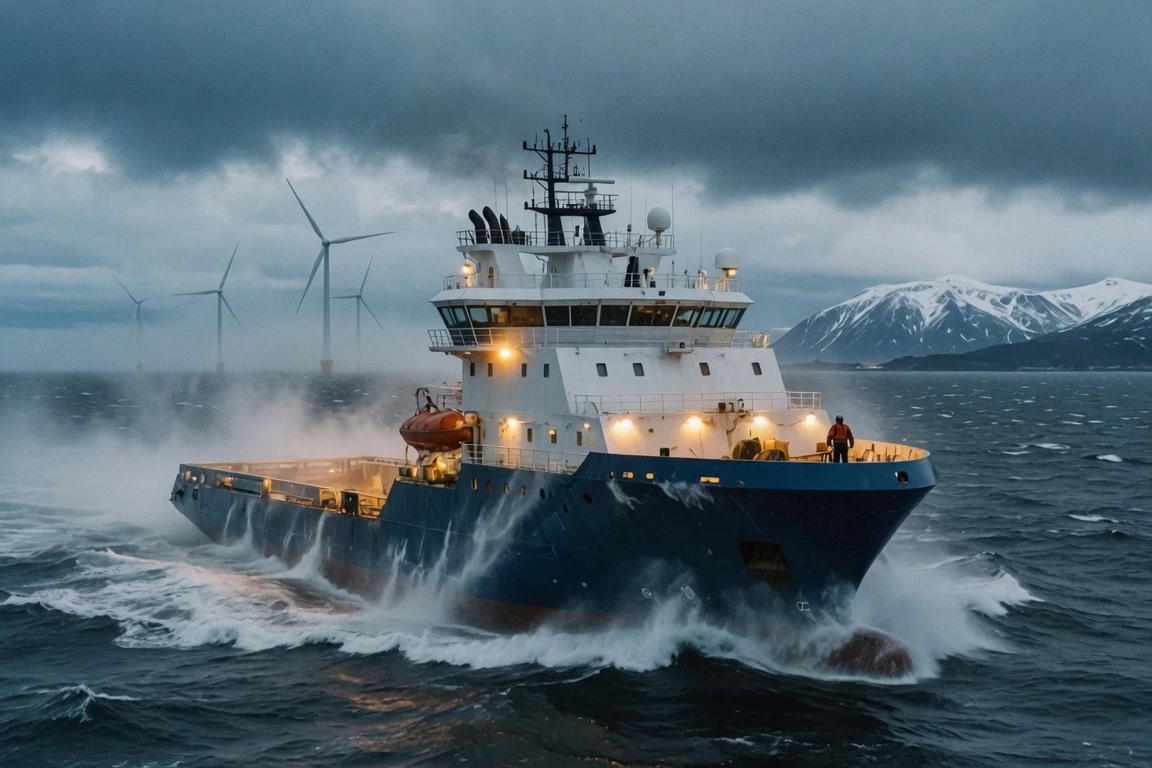
The boats leaving the region’s yards today look nothing like the herring drifters of Per Sævik’s youth. The same firms that once built trawlers now deliver some of the world’s most sophisticated offshore support vessels, research ships, expedition cruise vessels, cable layers and Arctic icebreakers. Companies such as VARD have become global leaders in highly specialised vessels, integrating advanced automation, digital systems and energy-efficient propulsion technologies.
Few people embody the change better than Stig Remøy. When Remøy bought his first fishing boat in 1978, the richest grounds sat close to the Norwegian coast. As fish stocks shifted over the following decades, vessels ventured further offshore, and the industry’s expertise moved with them. Today Remøy runs Olympic Subsea, whose fleet supports both offshore oil and gas and the rapidly expanding renewable energy sector.
Olympic’s own ships have changed with the brief. The Olympic Boras uses four-wheel drive to move with less power, magnets have replaced the propeller shaft, and a large battery pack means the vessel needs only one additional engine. Olympic had already started diversifying into alternative energy by 2012, before the offshore wind sector began to scale up. “Even before the downturn in oil and gas, we had started working with renewable energy companies,” Remøy said. “At the time, many people believed there would always be enough oil and gas.”
Olympic vessels now provide essential services for the Hywind Tampen floating wind farm, which sits between Equinor’s Snorre and Gullfaks oil and gas fields in the Norwegian North Sea off Bergen. The work is technically demanding. The cluster’s offshore fleet has gone from shallow water to operating at depths of 2,000 to 3,000 metres. “We want to be in the blue ocean, not the red,” Remøy said.
Energy efficiency is the choice, and the bridge to the next stage, regardless of who the next U.S. president is.
Remøy, who has run Olympic since the 1990s, made the comment in a recent interview with Forbes. The strategy behind the line is simple: lower the energy cost of every offshore task, and the next market shows up on its own.
The Battery-Powered Coastal Route
The cluster’s industrial reach is most visible on the passenger ships sailing Norway’s own coastline. Havila Voyages, majority-owned by the Sævik family, took delivery of its first ship in December 2021 and now runs four vessels on the Bergen to Kirkenes route. Each one carries the world’s largest battery pack ever installed on a passenger ship, large enough to sail through vulnerable fjords such as the world heritage Geirangerfjord for four hours straight with zero emissions.
The batteries charge on clean hydropower ashore. When they are not in use, the ships run on LNG, and the combination of battery and hybrid operation cuts CO2 emissions by around 35 per cent and NOx emissions by 90 per cent compared with equivalent ships on the same route. Havila Capella won the Next Generation Ship Award at Nor-Shipping 2022 for the design. The Coastal Route is the cluster’s most photographed advertisement: a 130-year-old government contract now served by ships designed and largely built inside the same fishing communities that lost the herring two generations ago.
The Other Side of the North Sea
The contrast with Aberdeen is hard to miss. The former Scottish oil capital has suffered thousands of job losses and economic stagnation following the decline of North Sea oil and gas, and has struggled to build the same momentum in offshore wind and hydrogen.
According to the EY ITEM Club’s Scottish Autumn Forecast, Aberdeen is one of the few local authority districts in Scotland with fewer jobs in 2023 than in 2010. The city has lost nearly 18,000 jobs, equivalent to 10 per cent of its 2010 workforce, “largely due to the ongoing decline in the locally important oil and gas industry.”
Aberdeen is now pinning part of its bet on Great British Energy, the UK government’s state-owned clean energy company, which has been chosen to base its headquarters in the city. The Scottish Government has also trebled its budget for offshore wind capital funding. The setup is closer to a state-led pivot than to a private-sector cluster, and it is starting from a much smaller base.
In Norway, that transition began some 20 to 25 years ago. The companies on the northwest coast did not wait for oil and gas to run out. They used the cash flow from offshore oil to build the automation, the software and the hull forms that offshore wind and hydrogen would later demand. The result is a labour market that can pivot with the customer. The same skills that once sent boats to fish now keep them at work in deep water, on floating turbines and under polar ice.
The 2030 Ocean Economy Window
The OECD’s 2025 outlook puts a number behind the opportunity. The ocean economy doubled in real terms over 25 years, from USD 1.3 trillion of gross value added in 1995 to USD 2.6 trillion in 2020. The OECD projects it could double again by 2030, reaching over USD 3 trillion, driven by offshore energy, marine and coastal tourism, fishing and aquaculture, and maritime transport. The full 2025 outlook on the trillion-dollar ocean economy lays out the policy levers required.
Capturing that growth will require new technologies, but it will also require industrial ecosystems capable of developing and commercialising them. On Norway’s northwest coast, that ecosystem is already in place, and it has had more than half a century to harden. The fish never came back to the herring grounds around Fosnavåg. The ingenuity did. The question for other coastal regions is whether the same patience, the same willingness to reinvest cash into the next boat, the next fuel and the next depth, can be reproduced before the next commodity shock forces the issue.
Frequently Asked Questions
What is the maritime cluster on Norway’s northwest coast?
Around Ålesund and Fosnavåg, the cluster groups almost 200 companies and more than 15,000 workers in shipyards, equipment makers, software developers, battery and robotics specialists, research institutions and startups. Annual revenues come in at around NOK 85 billion (about $8 billion). The Blue Maritime Cluster network was granted Global Centre of Expertise status in 2014.
Why did herring stocks collapse around Norway in the 1960s and 1970s?
Overfishing pushed North Sea herring stocks to complete collapse by the early 1970s, ending a fishery that had sustained coastal communities on Norway’s northwest coast for generations. The boats that lost their main catch were repurposed, sold or retired, and the families behind them moved into offshore shipping and shipbuilding.
How does Norway’s maritime cluster compare with Aberdeen?
Aberdeen, the former Scottish oil capital, has lost nearly 18,000 jobs since 2010, according to the EY ITEM Club Scottish Autumn Forecast, largely because of the decline of its locally important oil and gas industry, and has struggled to build momentum in offshore wind and hydrogen. On Norway’s coast the transition started some 20 to 25 years ago and produced the Ålesund cluster instead.
How large is the global ocean economy?
The OECD’s 2025 outlook puts the ocean economy at USD 2.6 trillion of gross value added in 2020, up from USD 1.3 trillion in 1995. The OECD projects it could double again by 2030, reaching over USD 3 trillion, in a business-as-usual scenario.
What kinds of ships are built in the Norwegian cluster today?
The cluster produces offshore support vessels, research ships, expedition cruise vessels, cable layers, Arctic icebreakers, and the battery-hybrid coastal ships operated by Havila Voyages on the Bergen to Kirkenes route. VARD, Ulstein, Olympic Subsea and a long tail of suppliers share the same harbours and engineering base.