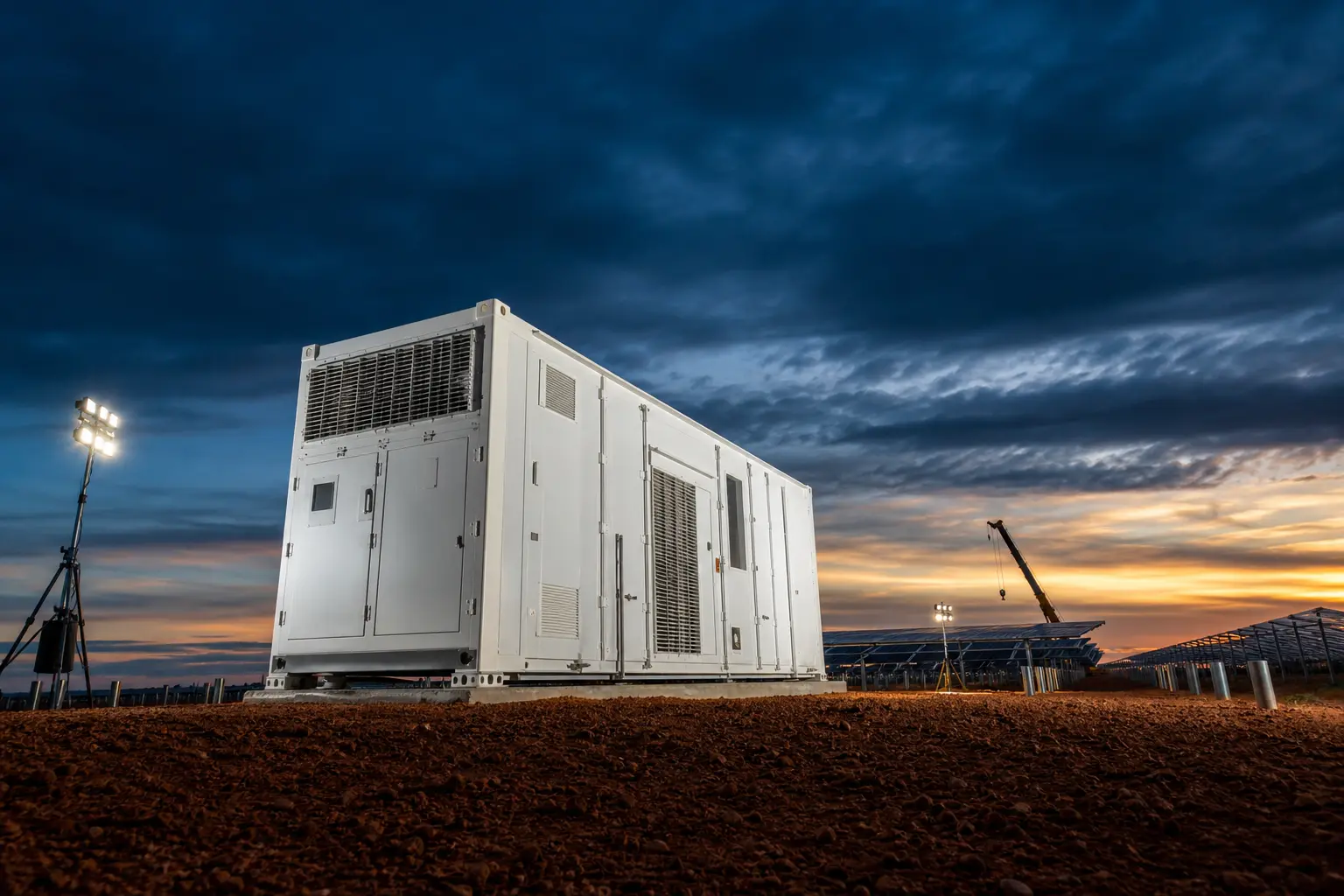
Google’s biggest clean energy order yet has gone to a battery maker building in Michigan, Ohio, Tennessee and Canada. LG Energy Solution will supply every battery for the Steel River Energy Center, the solar and storage complex that broke ground Tuesday in Wilson, Arkansas. Google calls it the largest solar and battery project in its global portfolio, growing to 2.9 gigawatt-hours of storage by 2029.
The order lands as LG Energy Solution’s core electric vehicle battery business posts a quarterly loss and Washington tightens rules on battery supply chains tied to China. Grid storage has become the business pulling the company’s American factories through the slump, according to industry sources cited Wednesday by The Korea Herald.
The Groundbreaking in Wilson, Arkansas
Cypress Creek Energy, a U.S. renewable power developer and independent power producer, and Google broke ground Tuesday on the first two phases of Steel River Energy Center in Mississippi County. Local officials, project partners and elected leaders joined the ceremony.
Those first two phases will add 1.6 gigawatts of solar generation and 1.9 gigawatt-hours of battery storage to the regional grid. A third phase due by 2029 brings the total to 2.5 gigawatts of solar and 2.9 gigawatt-hours of storage, enough to power more than 315,000 Arkansas homes a year.
Some people still question whether a domestic solar supply chain is possible. This project is proof.
Kevin Smith, chief executive officer of Cypress Creek Energy, said in the companies’ joint announcement. Will Conkling, Google’s head of data center energy, called Steel River an investment in both the company’s clean energy commitments and its commitment to Arkansas.
Officials expect the site to generate roughly 700 construction jobs per phase and about $300 million in local tax revenue over the project’s life, split between Rivercrest School District, Mississippi County and the town of Wilson. Google and Cypress Creek are also funding $8 million combined in community programs, including a $400,000 gift toward a new playground at Rivercrest.
Google’s Electricity Appetite Is Growing Fast
Steel River is not an isolated bet. Google’s electricity consumption rose 37 percent last year and Microsoft’s rose 24 percent, according to BloombergNEF, as both companies race to power AI workloads. Google, Meta, Amazon and Microsoft together signed 49 percent of the world’s corporate renewable energy purchase agreements last year.
- 37% jump in Google’s electricity consumption last year, per BloombergNEF.
- 24% rise in Microsoft’s power use over the same period.
- 49% share of global corporate clean-power purchase agreements signed last year by Google, Meta, Amazon and Microsoft combined.
- $300 million in local tax revenue Steel River is projected to generate over its lifetime.
Google is already building nearby demand for that power. It broke ground last October on a $4 billion data center in West Memphis, about 40 miles south of Wilson. The batteries let Steel River store daytime solar output and feed it back to the grid when demand peaks, Google said.
LG Energy Solution Trades an EV Slowdown for a Grid Boom
LG Energy Solution posted 6.6 trillion won in first-quarter revenue and an operating loss of 207.8 billion won, a result the company tied to new ESS plant costs and softer North American sales of pouch-type electric vehicle cells, the format built at its joint-venture plants with Stellantis and Honda.
Those same joint-venture lines are now temporarily building grid battery cells instead of car cells, part of a plan to push global ESS production past 60 gigawatt-hours this year, with more than half of that capacity based in North America.
The company’s other battery line is not struggling at all. LG Energy Solution logged more than 100 gigawatt-hours of new orders for its cylindrical electric vehicle cells in the quarter, and its backlog for that cell format topped 440 gigawatt-hours by April. The slack in pouch-cell capacity is what Google, DTE Energy and other grid customers are now filling with battery orders of their own.
LG Energy Solution signed a similar deal with Michigan utility DTE Energy in May, worth 6 gigawatt-hours of storage, and a 5 gigawatt-hour agreement with Hanwha Qcells’ project arm in February. Steel River’s 2.9 gigawatt-hours trails both in raw battery capacity. Landing Google’s name is still the bigger prize for a supplier chasing hyperscale customers.
| Customer | Announced | Storage Scale | Note |
|---|---|---|---|
| Google / Cypress Creek Energy | July 2026 | 2.9 GWh by 2029 | Largest solar-plus-storage project in Google’s global portfolio |
| DTE Energy | May 2026 | 6 GWh | Michigan utility, data-center-linked grid contract |
| Hanwha Qcells project arm | February 2026 | 5 GWh | Delivered through LG ES Vertech, the integrator unit |
Measured strictly in battery volume, Google is not even LG Energy Solution’s biggest customer this year. Measured in headlines, it is the one that matters most.
Why a Made-in-America Battery Won the Order
Industry analysts point to one reason LG Energy Solution beat out cheaper alternatives: it built North American factories years before this order existed. That early localization push looks decisive now that U.S. rules increasingly penalize battery supply chains linked to China.
LG Energy Solution currently runs battery plants at four North American sites, with a fifth coming online this year.
- Holland, Michigan – a standalone plant and one of the company’s first U.S. lines making grid storage cells.
- Lansing, Michigan – a second standalone plant, scheduled to begin ESS production later this year.
- Ohio – a joint-venture plant supplying grid battery cells alongside electric vehicle output.
- Tennessee – a second joint-venture plant doing the same.
- Canada – a joint-venture site rounding out the network.
LG Energy Solution is not alone in chasing this shift. General Motors has pushed its own sodium-ion battery and bidirectional EV grid storage plan, betting that car batteries can double as backup power for the same grid Steel River is trying to strengthen.
The Grid Strain Batteries Alone Cannot Fix
Steel River is built to answer a problem that is already straining the country’s power system. Data centers account for roughly 4 percent of U.S. electricity demand today, a share the U.S. Department of Energy expects to reach 9 percent by 2030. Seven in 10 Americans oppose data center construction in their own communities, a Gallup survey found, with half citing water and power use as their top concern.
The buildout is also outrunning the wires meant to carry it. The country needs roughly 5,000 miles of new high-voltage transmission a year to keep pace with demand, yet only 888 miles were completed in 2024, according to an analysis by Grid Strategies. Joe Bowring, president of grid monitor Monitoring Analytics, told CNBC he has never seen the grid under so much projected strain.
Ireland has already lived through a tighter version of that same collision, where Ireland’s AI-driven energy supply crunch forced regulators to ration new data center grid connections.
Steel River’s own answer to that strain will not be finished until 2029. LG Energy Solution’s Lansing, Michigan plant, the fifth link in its North American ESS network, is due online before this year is out.
Frequently Asked Questions
What is the Steel River Energy Center?
Steel River Energy Center is a solar-and-battery storage complex being built by Cypress Creek Energy in Wilson, Arkansas, with Moss serving as the engineering, procurement and construction contractor. Google is buying the output of the first two phases, which together add 1.6 gigawatts of solar and 1.9 gigawatt-hours of storage, ahead of a third phase due in 2029.
How much is LG Energy Solution’s Steel River battery contract worth?
Seoul Economic Daily estimated the deal at around 200 billion won, or roughly $145 million at current exchange rates, while other reports described it only as worth several hundred billion won without a precise figure. LG Energy Solution trades on the Korea Exchange under the ticker 373220.
How is Steel River Energy Center being financed?
Cypress Creek closed $3.5 billion in construction financing for the project’s first two phases in June 2026, arranged by Barclays, BNP Paribas, Santander and Wells Fargo. Total capital costs across all three phases are expected to exceed $4.5 billion by the time the site is fully built in 2029.
Why did a Korean battery maker win over Chinese suppliers?
Tightening U.S. rules on battery supply chains linked to China have made North American manufacturing a deciding factor in large contracts like this one. LG Energy Solution’s batteries for Steel River are made in the United States and Canada and then assembled in Arizona, a domestic-content edge that Chinese-made lithium iron phosphate cells cannot match under current rules.
How big is Cypress Creek Energy’s overall project portfolio?
Cypress Creek has commercialized 19 gigawatts of projects since it was founded and currently operates or is building 6.8 gigawatts of assets across 24 states, according to the company. Steel River is the largest single project in that portfolio.
When will Steel River Energy Center be fully operational?
The project’s third and final phase is scheduled for completion in 2029, when the site reaches its full 2.5 gigawatts of solar and 2.9 gigawatt-hours of storage. Construction on the first two phases began this week and is expected to support about 1,400 jobs combined.