
ENTERTAINMENT
Why the Greatest Horror Movie Endings All Trace Back to 1920
Horror movie endings run four recurring plays, the twist, the downer, the ambiguous fade, and the final scare, a blueprint set by a 1920 silent classic.

Horror movie endings carry more weight than any other genre’s final scenes, because one weak closing shot can wipe out ninety minutes of carefully built dread. The strongest ones tend to run one of four plays: a sudden twist, a bleak downer, an ambiguous fade to black, or a last-second scare. And the blueprint is older than sound itself, tracing back to a German silent film released in 1920.
That is why a clever monster or a sharp first act so rarely guarantees a classic. Films as well-regarded as It Follows and Insidious get marked down by fans for finales that fizzle, while smaller pictures punch far above their weight on the strength of a single final reel.
How a 1920 Asylum Twist Wrote the Rulebook
The film usually credited as cinema’s first true horror picture is also the one that handed the genre its first great twist. The Cabinet of Dr. Caligari, directed by Robert Wiene and premiered in Berlin on February 26, 1920, spends most of its runtime as a murder mystery. Francis (Friedrich Feher) tracks a string of killings carried out by a sleepwalker named Cesare (Conrad Veidt), who is controlled by a sinister showman, Dr. Caligari (Werner Krauss).
Then the floor drops out. The final scene reveals Francis as an inmate in an asylum, with Caligari recast as the institution’s head doctor. Everything the audience just watched may have been a delusion. The “it was all imagined” reveal is normally a storytelling cheat, yet here it works, partly because the warped, painted sets play like a nightmare from the first frame.
What made the close radical was the trust it broke. For what film historians believe was the first time, viewers were told they could not rely on the narrator or the evidence of their own eyes. That instability is the engine behind a century of horror finales since, from Psycho to Hereditary. The centenary appraisal of Caligari’s influence from the British Film Institute (BFI, the United Kingdom’s national film body) places its shadow over generations of filmmakers who followed.
The critic Paul Rotha summed up the arrival of the film in a line that still gets quoted a hundred years on.
Caligari hit the silver screen like a drop of wine in an ocean of salt water.
Rotha wrote that as a film historian surveying early cinema, and the metaphor holds. One small, strange gesture changed the taste of everything around it.
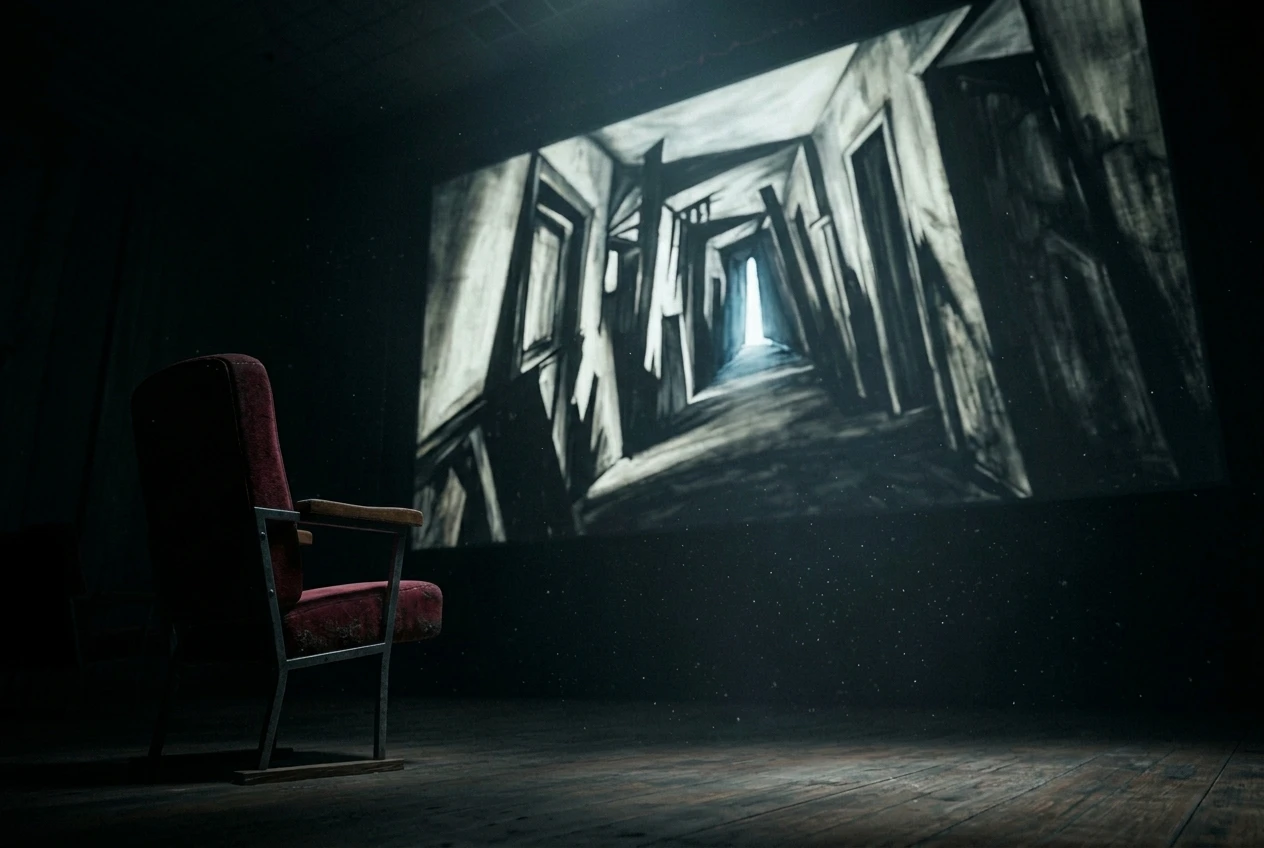
The Four Endings Horror Keeps Reaching For
Strip away the gore and the jump scares, and most memorable horror conclusions fall into one of four shapes. Each does a different job, and each carries its own way of failing. The genre has been mixing and re-running these four since the silent era, which is why a viewer who pays attention can often feel the shape of an ending coming before it lands.
The table below lays out the four plays, what each one is built to do, a film that nails it, and the trap that sinks weaker attempts at the same move.
| Ending type | What it does | Classic example | The risk |
|---|---|---|---|
| The twist | Re-reads the whole film with one reveal | The Cabinet of Dr. Caligari (1920) | Feels like a cheat if the clues were never there |
| The downer | Denies the audience the rescue they expect | The Mist (2007) | Reads as cruelty for its own sake |
| The ambiguous fade | Cuts to black with the threat unresolved | The Birds (1963) | Frustrates instead of haunts |
| The final scare | One last jolt after the apparent calm | Carrie (1976) | Cheapens the film if it is pure reflex |
The best finales often blend two of these. Se7en (1995) pairs a downer with a twist; the box arrives, and the bleakness and the revelation hit in the same beat. The films that age into classics tend to be the ones where the ending pays off something the script planted hours earlier, rather than reaching for shock alone.
The Downer Ending Became Horror’s Signature Move
If one shape now reads as distinctly horror, it is the downer. Other genres earn their catharsis; horror often refuses it, sending the audience home unsettled rather than relieved. That refusal became a defining trait through a handful of films that dared to kill the hope they had spent the whole runtime building.
Three endings did more than most to make the bleak finish respectable:
- Night of the Living Dead (1968). Ben (Duane Jones) survives the siege only to be shot dead by a posse who mistake him for a ghoul, his body tossed onto a pyre. The gut-punch lands harder for arriving after he has outlasted everyone else.
- The Mist (2007). Writer-director Frank Darabont has David (Thomas Jane) mercy-kill his son and companions moments before rescue arrives. He, and the viewer, are left to sit with the knowledge that five more minutes of waiting would have produced a happy ending.
- The Wicker Man (1973). Sergeant Howie’s entire investigation turns out to be the bait; the islanders have lured him in as the virgin sacrifice their harvest requires, and the camera leaves him burning inside the giant effigy.
Notably, The Mist was darker on screen than on the page. Stephen King’s original novella ends on ambiguity, and King publicly approved Darabont’s grimmer rewrite. The 1968 Library of Congress preservation record for Night of the Living Dead marks how far that once-shocking finish has traveled into the canon.
When Studios Flinch and Rewrite the Last Reel
Not every famous ending was the one the filmmakers first shot. The last reel is where nerves fail, test audiences revolt, and studios reach for the rewrite. Sometimes the change ruins a film; sometimes it accidentally creates the version everyone remembers.
The Frame Forced on Caligari
The twist that made Caligari historic may not have been the writers’ idea. The asylum frame was added during production, layered over a script that originally presented the murders as real. The change softened a story the studio considered too disturbing, and in doing so it invented the unreliable-narrator reveal almost by accident. The lesson echoes through the decades: a commercial flinch can produce a structural breakthrough.
Get Out’s Two Endings
Jordan Peele has said he shot a far bleaker close for Get Out (2017), in which police arrive and arrest Chris after he escapes the Armitage house, sealing the film’s argument about Black men and American institutions. Peele swapped it for the version where Chris’s friend pulls up instead, judging that audiences needed a release valve. The reversal shows how much an ending depends on the moment it meets the public. Hollywood’s habit of reshooting finales after preview screenings stretches well beyond horror, and it has reshaped some of the genre’s most quoted closing scenes.
The Letdowns That Sink an Otherwise Strong Film
The flip side proves the rule. A film can earn near-universal praise for its atmosphere and still leave viewers cold at the finish, and that gap between dread and payoff is the genre’s most common wound. The complaint that trails It Follows and Insidious is not that they are bad films; it is that their closing minutes do not match the tension they spent so long building.
That tension is the whole point. The most effective horror works by sustained pressure rather than spectacle, a quality shared by many of the most intense films of the past two decades, where mood does the heavy lifting. When a finale releases that pressure too neatly, or too vaguely, the spell breaks and the audience remembers the disappointment rather than the dread.
This is why the closing scene gets disproportionate scrutiny from filmmakers themselves. Directors working in the current wave of independent horror craft and its on-set secrets talk about the ending as the part they sweat over most, precisely because everything before it is hostage to those final frames.
An anticlimax is rarely a failure of imagination. More often it is a failure of nerve, the moment a film chooses comfort over commitment and gives the monster, or the meaning, an easy way out.
Why the Last Five Minutes Outlive the Film
The endings that commit, in any of the four shapes, are the ones that get remembered, restored, and preserved. The United States government keeps a running list of films deemed worth saving, and horror is heavily represented among them.
- Up to 25 films are added to the National Film Registry each year by the Library of Congress, chosen as culturally, historically, or aesthetically significant.
- 1999 was the year Night of the Living Dead, with its bleak posse finale, was selected for preservation.
- Multiple genre landmarks already sit in the archive, among them Psycho, Halloween, Alien, The Exorcist, and The Shining, each carrying a closing image that lodged in the culture.
The full National Film Registry of preserved American cinema reads, in its horror entries, like a catalogue of finales that refused to blink. From the painted asylum corridors of 1920 to a father weeping on a roadside in 2007, the through line is the same: the films that survive are the ones brave enough to let the last five minutes hurt.
Frequently Asked Questions
What is considered the first twist ending in horror film history?
The Cabinet of Dr. Caligari (1920), directed by Robert Wiene, is widely cited as cinema’s first major twist ending. Its closing reveal that the entire story may be the delusion of an asylum inmate broke the audience’s trust in the narrator in a way no earlier film had attempted.
Why do so many horror movies have unhappy or downer endings?
Horror trades on dread, and a downer ending preserves that feeling instead of dissolving it with a tidy rescue. Films like Night of the Living Dead and The Mist showed that denying the audience catharsis can make a film more memorable and unsettling than a conventional happy resolution.
What are the main types of horror movie endings?
Most fall into four shapes: the twist, which re-reads the whole film with one reveal; the downer, which withholds the expected rescue; the ambiguous fade, which cuts to black with the threat unresolved; and the final scare, one last jolt after apparent calm. Many strong endings combine two of these.
Did The Mist have a different ending in the original story?
Yes. Stephen King’s original novella ends ambiguously, with the survivors still on the road and the outcome uncertain. Writer-director Frank Darabont wrote a much bleaker finale for the 2007 film, and King publicly endorsed the change.
Why was Get Out’s ending changed?
Jordan Peele has said he originally shot an ending in which police arrest Chris after his escape, a bleak conclusion underscoring the film’s themes. He replaced it with the version where a friend rescues Chris, deciding audiences needed a moment of relief given the social climate at release.
Are classic horror films preserved by the US government?
Yes. The Library of Congress adds up to 25 films a year to the National Film Registry for their cultural, historical, or aesthetic significance. Horror titles including Night of the Living Dead, Psycho, Halloween, Alien, and The Exorcist are among those preserved.

The Court Revisits the Climate Nuisance Door It Left Open

ChatGPT Now Compiles Live Interfaces With GPT-6

A Tanker Attack Moves the War Into Qatar’s Waters

Personio Buys Circula to Own the DATEV Channel

Bluesky Files for .bsky and Enters the Registry Queue

Musk’s $914 Billion Lead Is a Public SpaceX Bet

Microsoft’s 96% Cyber Score Sits at 86.3% on the Board

Endgame Encore’s $86 Million Trial for Infinity Vision

Free Live Sports Streaming in 2026: What to Watch Without Cable

Andrew Garfield’s Spider-Man Films Are No Longer Free
-
 BUSINESS4 months ago
Musk’s $914 Billion Lead Is a Public SpaceX Bet
-
 NEWS2 months ago
Microsoft’s 96% Cyber Score Sits at 86.3% on the Board
-
 SPORTS3 months ago
Free Live Sports Streaming in 2026: What to Watch Without Cable
-
 ENTERTAINMENT3 months ago
Endgame Encore’s $86 Million Trial for Infinity Vision
-
 ENTERTAINMENT2 years ago
Andrew Garfield’s Spider-Man Films Are No Longer Free
-

 NEWS4 months ago
Singapore’s 3×3 and Surfing Debuts Miss the Medal Stand
-

 ENTERTAINMENT1 month ago
Sterling Point Holds No. 2 on Prime Video After 32 Days
-

 NEWS6 months ago
White Sands Footprints Put People in Ice Age New Mexico