
NEWS
Flagstar Bets Its Merger Stack Is Worth Owning
Flagstar trademarked S2 and patented StarIQ after stitching three banks together, then still picked Fiserv’s Finxact as the ledger underneath.

Flagstar Bank applied in June 2026 to trademark its S2 Platform and filed a provisional patent on StarIQ, the AI layer it built after absorbing two other banks. The Hicksville, New York, lender had $87.7 billion in assets at June 30, 2026, and is still moving Flagstar, New York Community Bank, and Signature Bank onto one stack.
Chris Higgins, chief information and operations officer, said his job is “to create optionality.” He would not say whether other lenders might one day license the work. Two months after those filings, the same S2 banner named Fiserv’s Finxact as the ledger underneath.
Flagstar Files to Own the Stack It Built
On June 15, 2026, Flagstar announced the S2 trademark and StarIQ patent as proof it was building technology instead of only buying it. S2 stands for Simple and Sophisticated. The bank describes it as the foundation that folds three legacy banking environments, six data centers, and mismatched systems into one modern base.
The USPTO record for FLAGSTAR S2 PLATFORM SIMPLE SOPHISTICATED carries serial 99246850 and a June 23, 2025 filing date, almost a year before the public notice. A shorter FLAGSTAR S2 mark was filed on April 17, 2025. The June release still spoke in the language of an application, not a finished registration.
Higgins framed the paperwork as a signal to the market, regulators, and customers, not only as legal cover. Jason Pope, the chief technology officer, said the pending StarIQ patent shows work inside the bank that is differentiated and defensible.
Protecting the intellectual property behind our transformation is about more than legal defensibility
Christopher Higgins, EVP and Chief Information and Operations Officer, Flagstar Bank June 15, 2026 release
He has also said, in a later interview, that the point of the filings is optionality. Asked whether S2 could become a fee business if Flagstar licensed it, he declined to lay out a plan.
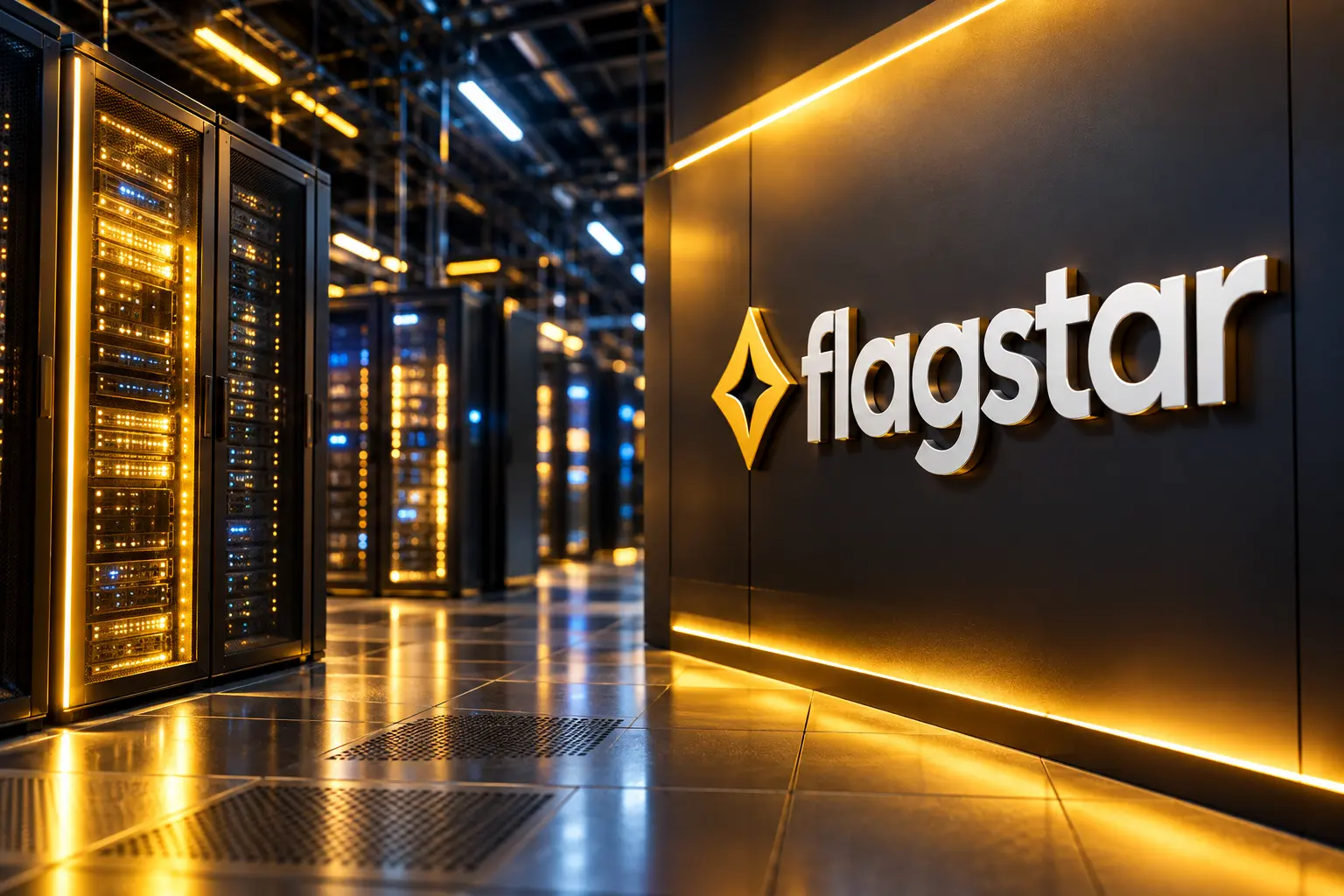
Three Banks, Six Data Centers, One Stack
The stack exists because the bank does. New York Community Bancorp closed its merger with Flagstar Bancorp on December 1, 2022. On March 20, 2023, Flagstar Bank, N.A. took about $38 billion of Signature assets from the FDIC after Signature failed, including about $25 billion in cash and about $13 billion in loans, and assumed about $36 billion in liabilities, including about $34 billion in deposits. It also took the 40 former Signature branches.
Each of those shops came with a primary and a backup data center. Higgins joined on October 29, 2024, and inherited six of them. Joseph Otting, executive chairman and chief executive officer, later said the bank closed those six sites and moved onto two co-location centers. Mphasis, named as the modernization partner on August 1, 2025, said the first phase included standing up the new rooms and moving hundreds of applications with no downtime.
Higgins has said that work finished in a year. At U.S. Bank he had already run 13 post-merger system conversions covering 1.2 million customers and 57 systems. Otting hired him to do a version of that job at a smaller shop that had just been through a near-failure and a three-bank stitch.
THE BUILD FROM SIGNATURE TO S2
- December 1, 2022: New York Community Bancorp completes its merger with Flagstar Bancorp.
- March 20, 2023: Flagstar assumes Signature deposits, loans, and 40 branches from the FDIC.
- October 29, 2024: Higgins is named chief information officer, reporting to Otting.
- April 17, 2025: Flagstar files the FLAGSTAR S2 and S2 SIMPLE SOPHISTICATED marks.
- June 23, 2025: The full FLAGSTAR S2 PLATFORM SIMPLE SOPHISTICATED application is filed as serial 99246850.
- Early 2026: StarIQ goes live on Amazon Web Services.
- June 15, 2026: The bank makes the trademark application and the StarIQ provisional patent public.
- August 17, 2026: Flagstar names Fiserv’s Finxact as the next core under S2.
By March 31, 2026, the bank reported $87.1 billion of assets, $60.7 billion of loans, $66.8 billion of deposits, and $8.1 billion of equity. Three months later those figures were $87.7 billion, $61.2 billion, $67.5 billion, and $8.1 billion, with about 340 locations in nine states. The ticker is FLG.
StarIQ Puts Four Models on One Meter
StarIQ is the generative AI layer that sits on S2. Flagstar says it was built for a regulated bank, with security and compliance in the first design, and that it went in during early 2026. It routes work across Anthropic’s Claude, Meta’s Llama, Mistral, and Amazon Titan, runs on Amazon Web Services, and is fenced by Palo Alto Networks tools, including Prisma AI firewalls.
The provisional patent is titled “Techniques for Secure Enterprise Generative Artificial Intelligence Orchestration.” The bank’s own description is not a chatbot. It is a governed switch that can call more than one model, meter usage instead of seats, log sources, and put a human approval chain in front of anything that touches customer data.
STARIQ’S FOUR PATENT CLAIMS
- Multi-model switch: Several AI vendors sit inside one governed platform on a consumption meter, so the bank does not buy a seat for every user.
- Security layer: Palo Alto Networks Prisma AI firewalls watch in real time for sensitive data patterns, prompt-injection attempts, and policy breaks.
- Citation pipeline: A custom retrieval-augmented generation path lets staff query documents and policies with full source tracking and access-controlled knowledge bases.
- Governance chain: Business-case filing, regulatory review, and multi-level approvals live in one auditable system.
Higgins has described the setup as self-contained, built so personally identifiable information stays inside the bank’s own pattern. That is a narrower bet than the open internet agents many companies are wiring up. It is also the part Flagstar thinks a peer cannot buy off the shelf and drop onto a core from FIS or Fiserv.
What the PaaS Class Leaves Open
The trademark filing is the quieter tell. Flagstar said the mark would cover three buckets: computer and software services, financial services, and technology platform services, including non-downloadable software and Platform-as-a-Service offerings for financial and business management. Those map onto USPTO international classes of goods and services 009, 036, and 042.
A purely internal tool does not need a PaaS listing. Class 042 is where a bank would stand if it ever wanted to run the same platform for someone else. Higgins has not said that is the plan. The application leaves the door on the latch.
S2 TRADEMARK CLASSES
| Class | USPTO bucket | What Flagstar listed |
|---|---|---|
| 009 | Software products | Downloadable apps for accounts, payments, and business management |
| 036 | Financial services | Banking services delivered through the platform |
| 042 | Computer services | Non-downloadable platforms and PaaS for banking and business management |
Serial 99246850 is still an application. First-use dates on the public record were blank when the mark was filed. The legal claim is a name and a set of classes, not a shipped product catalog. For a regional bank of this size, even that paperwork is unusual. Most peers license a vendor brand and stop there.
Fiserv Still Gets the Ledger
The June release said Flagstar architected a purpose-built foundation rather than relying on third-party solutions. On August 17, 2026, the bank selected Finxact as the system of record and called it a key pillar of S2. Finxact is Fiserv’s cloud-native core. It will replace the legacy cores in phases and become the transaction engine under the trademarked stack.
Otting had already told investors the bank was running two cores, with two of the old shops on one provider and the third on another, and that the intent was to be on one core by July 2027. He put the run-rate save at about $40 million once that cutover is done. The August deal names the vendor for that job. It does not put a public date on the first conversion.
Finxact will give us the freedom to move faster, grow smarter, and deliver the kind of real-time, seamless experiences that today’s customers expect.
Christopher Higgins, Chief Information and Operations Officer, Flagstar Bank, Fiserv announcement, August 17, 2026
That sentence sits beside the June claim that Flagstar was building, not buying. Both can be true if S2 is a wrapper. StarIQ, the data-center pair, the trademark, and the governance chain are what the bank wants to own. The deposit ledger, the thing examiners and customers actually settle against, still comes from a vendor that already sells cores to half the industry.
Public chatter after the Finxact note treated it as a Fiserv contract. Almost no one talked about the patent. That is the easy misread. A named core is a headline a stock trader can file. A PaaS class on a regional-bank trademark is a bet that only pays if the wrapper is real.
Software Costs Rose While Other Bills Fell
Higgins would not size the S2 and StarIQ outlay. He said only that it is “significant for a company of our size.” The closest public line is software expense, which is not the same as the project budget but is the line that moved.
SOFTWARE EXPENSE, RECENT QUARTERS
| Period | Software expense | Compared with a year earlier |
|---|---|---|
| Three months ended June 30, 2025 | $38 million | Baseline |
| Three months ended March 31, 2026 | $47 million | Not stated in the release |
| Three months ended June 30, 2026 | $49 million | Up 29% |
| Six months ended June 30, 2026 | $96 million | Up 20% from $80 million |
The bank’s second-quarter software expense of $49 million was up 4% from the first quarter. Total operating expenses went the other way, to $427 million from $441 million, a 3% drop, and were down 10% from $472 million a year earlier. Occupancy and equipment fell to $46 million. Compensation fell too. The software line is the one that climbed while the rest of the cost base was being cut.
When Higgins arrived he said he came to recruit a technology team and, in his words, “rebuild the bank.” The rebuild now has a brand, a provisional patent, a PaaS class, two data centers, and a Fiserv core with no conversion date on the calendar. Finxact cutovers are still ahead. The StarIQ filing is still provisional. Higgins has not said when, or whether, anyone else will run on S2.
Disclaimer: This article is news reporting and analysis of Flagstar Bank’s technology filings, vendor contracts, and published financials. It is informational only and is not investment advice, a recommendation to buy or sell FLG or any other security, or a solicitation of any banking product. Readers who are considering a position in the stock, or a banking relationship tied to these systems, should consult a licensed financial adviser or other qualified professional who can review their own facts. Asset totals, expense lines, trademark statuses, and conversion plans are taken from the cited company releases and filings as of the dates on those documents and may change.

The Court Revisits the Climate Nuisance Door It Left Open

ChatGPT Now Compiles Live Interfaces With GPT-6

A Tanker Attack Moves the War Into Qatar’s Waters

Personio Buys Circula to Own the DATEV Channel

Bluesky Files for .bsky and Enters the Registry Queue

Microsoft’s 96% Cyber Score Sits at 86.3% on the Board

Musk’s $914 Billion Lead Is a Public SpaceX Bet

Free Live Sports Streaming in 2026: What to Watch Without Cable

The Odyssey’s IMAX Film Run Hit a 41-Theater Limit

Andrew Garfield’s Spider-Man Films Are No Longer Free
-
 NEWS3 months ago
Microsoft’s 96% Cyber Score Sits at 86.3% on the Board
-
 BUSINESS5 months ago
Musk’s $914 Billion Lead Is a Public SpaceX Bet
-
 ENTERTAINMENT3 months ago
The Odyssey’s IMAX Film Run Hit a 41-Theater Limit
-
 SPORTS4 months ago
Free Live Sports Streaming in 2026: What to Watch Without Cable
-
 ENTERTAINMENT2 years ago
Andrew Garfield’s Spider-Man Films Are No Longer Free
-
 ENTERTAINMENT4 months ago
Endgame Encore’s $86 Million Trial for Infinity Vision
-

 NEWS5 months ago
Singapore’s 3×3 and Surfing Debuts Miss the Medal Stand
-
 NEWS1 month ago
An AI Lung Drug Shifted Biological Age Clocks in Patients