Dead, White and Blue, Mike Davis’s satirical sci-fi comedy now streaming free on Tubi, was assembled from more than 300 U.S. government films (military training reels, FBI procedurals, anti-drug shorts, nuclear test footage) without a single original shooting day, location permit, or clearance fee. Federal copyright law bars any federal agency from holding copyright on what it produces, which puts the entire archive in the public domain and open to anyone who wants it.
Davis calls the technique a “green movie.” His Los Angeles production company, Stag Films, has built three features this way since 2008, and the government’s archive is nowhere near exhausted. The puzzle is why so few filmmakers followed him into it.
The Archive That Belongs to Everyone
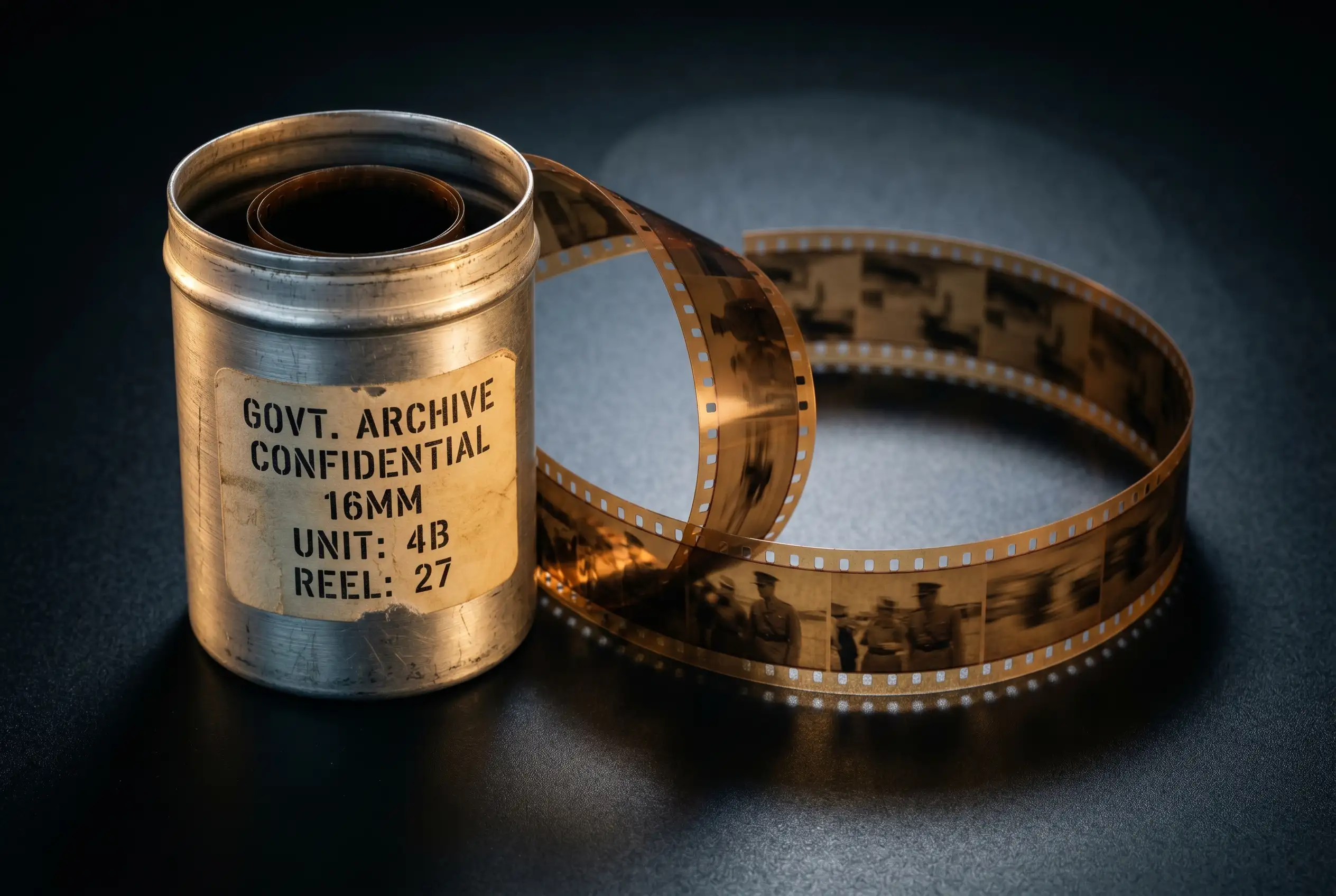
The National Archives and Records Administration (NARA, the federal body that preserves U.S. government records) holds more than 360,000 reels of film dating from the 1890s through the late 20th century, assembled under the Federal Records Act, which requires agencies to transfer their non-current records when they’re retired. Its online catalog describes approximately 200,000 individual items, but only about 35,000 of those have an accessible remote viewing copy. For the remainder, a researcher must travel to Washington, D.C., and work in person in the Motion Picture, Sound and Video Research Room.
- 360,000+ film reels in NARA’s motion picture holdings, dating from the 1890s
- 200,000 items catalogued in NARA’s online database
- 35,000 with an accessible remote viewing copy
- 40+ military record groups, from WWI Army Signal Corps footage through Air Force reels of the 1980s
The military collections run deepest. The Army Signal Corps record group alone carries more than 12,000 titles covering maneuvers and battles from the First World War through the 1980s. The U.S. Navy’s audiovisual holdings (Record Group 428) run to approximately 13,300 reels spanning from before World War I to the early 1980s. Law enforcement and domestic agency records extend the reach further: training films for FBI procedures, civil-order protocols, weapons qualification, and drug-awareness programs that generated their own peculiar visual vocabulary. Davis found Sonny Bono hosting one of the anti-drug productions. He also found footage of nuclear test towns with mannequins melting under simulated blast effects and medical training sequences that exist in a category of their own.
The legal foundation is 17 U.S.C. 105, which holds that works produced by U.S. federal employees as part of their official duties are not eligible for copyright protection in the United States. NARA’s permissions page for its motion picture holdings confirms the agency charges no royalties and does not license its content. Nuances apply: donated materials from private sources within NARA’s collection may carry restrictions, and the agency cautions that researchers bear responsibility for confirming the status of individual items. For films produced directly by federal agencies, the archive is free.
The International Documentary Association has documented a steady decline in researchers visiting NARA’s film reading rooms, even before the COVID-19 disruption. Davis spent two years inside that archive for one movie.
Making Film in Reverse
The Silent Cut
Davis’s workflow breaks the standard production sequence entirely. He starts with existing footage, combs through it for anything weird, visually striking, or usable, and assembles a rough visual edit before a word of script is written. The result is something like a silent film: a sequence with a loose beginning, middle, and end but no dialogue, no locked characters, no fixed story. He calls this phase “making a film backwards.”
Building a consistent character from government archive material requires creative substitution. Davis identifies someone who appears in multiple government productions, collects every frame of that person he can find, then supplements with stand-ins: other footage shot from behind, or at similar angles, with comparable hair or build, close enough to serve as a cutaway. The cast was assembled this way across a source collection that would ultimately demand far more raw material than working from a feature-length skeleton ever had.
Writing the Script You Don’t Have Yet
Once the rough visual cut exists, Davis writes the script against it. The footage dictates what the story can be. He can’t write a scene he has no footage for, so he writes into what he already has, and the archive keeps offering material that a clean-sheet process would never arrive at.
I can’t imagine something that I don’t have footage for. So I’ll come up with a sort of a loose general plotline and then just put all this footage together in a way that makes some kind of sense. Not a lot of sense, but at least could hopefully work as a story with a beginning and middle and an end with somewhat consistent characters.
Davis, the writer-director behind Stag Films, made the point in an interview with KPBS Cinema Junkie host Beth Accomando.
With the script complete, he brings in voice actors, records the full dialogue track as a standalone audio performance without the footage present, then lays that audio over the existing visual cut, tightening the edit around it. He compares the process to animation production, where voice recording precedes animation and the visuals are built to fit the performance. Here the order reverses: the visuals exist first, the audio is recorded against the script, and the edit reconciles the two. His son worked as editor on the film. The rest of the production was Davis alone, in his home workspace, over roughly two years.
The Stag Films Green Canon
Sex Galaxy (2008), Davis’s first green movie, used the 1968 science-fiction film Voyage to the Planet of Prehistoric Women as a structural skeleton: a feature-length spine with consistent characters onto which he grafted government shorts and additional stock footage. President Wolfman (2012) followed the same logic, pulling the 1973 political horror film The Werewolf of Washington as its base and assembling more than 100 additional source films around it.
| Film | Year | Structural Spine | Source Count | Streaming |
|---|---|---|---|---|
| Sex Galaxy | 2008 | Voyage to the Planet of Prehistoric Women (1968) | Not specified | Various VOD |
| President Wolfman | 2012 | The Werewolf of Washington (1973) | 100+ | Various VOD |
| Dead, White and Blue | 2025 | None; all-fragment construction | 300+ | Tubi, Fosum (both free) |
For his third film, Davis dropped the spine entirely. Building every scene from fragments without a feature-length anchor required nearly triple the source material of President Wolfman; character continuity came entirely from his editing instincts, with no pre-existing film’s structure to borrow. The film ran the festival circuit through 2025, appearing across the United States and at the Babylon Kino in Ghent, Belgium. It screens tonight at the Art Theater Long Beach. Tubi carries it for free.
Birth of a Nation Reversed
The KKK as Tech Company
The plot opens with a racist white cop shooting a Black man. A modernized Ku Klux Klan and the U.S. military both want the incriminating bullet retrieved from the body, and the Klan’s preferred tool is a high-tech shrink ray. In Davis’s version, the organization has rebranded as something closer to a Silicon Valley company: slick conference presentations, product launch events, promotional videos. An Atlanta mayor goes missing as the FBI and the military converge on the same case.
Davis has been direct about the political origin. The resurgence of organized white nationalism over the past decade and more, and his anger about it, drove the premise. Blaxploitation cinema of the 1970s provided the tonal register: heightened, funky, knowingly over the top, and committed to its point of view. Government training footage from that same era gave him the visual vocabulary to work with: the grain, the flat institutional lighting, the earnest bureaucratic delivery of people who believed in what they were filming.
Two specific archive sources supply the KKK sequences. Part of the footage comes from D.W. Griffith’s Birth of a Nation, the 1915 silent film that was both one of cinema’s technical milestones and an explicit piece of Klan propaganda in which the organization is portrayed as America’s heroic defenders. The film sits in the public domain, confirmed through a legal ruling upheld by the Supreme Court in 1976 and under U.S. copyright law for works published before January 1, 1931. The second source is actual federal surveillance documentation: records of Klan activities that government investigators collected, now held in the federal archives.
Davis is using the primary artifact of cinematic white supremacy as raw material for a film mocking it. The choice of source footage is the argument made visible at the level of method.
Recording Without Watching
The voice cast records in a studio without footage in front of them. Davis directs line by line, the actors take two passes on each, and he lays the finished audio track over the existing visual cut, tightening the edit around what they gave him. Performers don’t need to see what their character is doing, he has found. They need the tone and the context of the scene.
The sync is imperfect, and Davis frames this as a deliberate aesthetic choice. Flat-affect, slightly off-timed delivery makes the absurdist writing hit harder. A punchline delivered with clinical government-film deadpan is already funny; dubbed over footage that doesn’t quite match, it becomes funnier still. The model is Woody Allen’s What’s Up, Tiger Lily?, the 1966 comedy in which Allen redubbed a Japanese spy film to entirely different comic effect, a film Davis cites as a direct influence. Once audiences accept the convention in the opening minutes, the gap between audio and image stops reading as error.
Why Didn’t Anyone Else Follow?
Davis has been explicit since the President Wolfman era that part of the goal was to inspire other filmmakers. The premise of Stag Films’ green movie catalog is demonstrably sound: build a narrative feature with crowds, explosions, military hardware, and multiple locations without a studio, a budget, or a set. A portion of the government archive is searchable online through the Internet Archive’s U.S. government film collection, free from any browser, with no trip to Washington required.
The constraint Davis describes is creative, not financial. You need what he called “a twisted brain” to hold the method’s logic together across hundreds of source films while building a story that can only go where the footage permits. That’s a genuine demand, and it’s the only meaningful cost in the method.
The production cost Davis very little monetarily but took roughly two years of sustained attention. That trade is the method’s core offer: time and ingenuity in exchange for production infrastructure. The green movie approach removes the financing dependency entirely, which has been Davis’s argument since Sex Galaxy proved the concept in 2008.
Davis is already pulling footage for “Hot Heat Hawaii,” his next green movie, a drug-smuggling surfing adventure. The government’s archive isn’t running out.