The Google Fitbit Air is a $99 screenless fitness band with a 7-day battery charge, designed for passive health and sleep tracking. The Pixel Watch 4 starts at $349 for the 41mm model, runs Wear OS 6, and includes standalone GPS and ECG. Neither device requires a subscription to use its core health features.
The old Fitbit app enforced a one-device limit, requiring users to unpair one tracker before connecting another. Google removed that constraint on May 19, 2026, when it rebranded the Fitbit app as Google Health, and for the first time a Fitbit Air and a Pixel Watch 4 can stay connected to the same Google account at once.
Two Trackers, One App
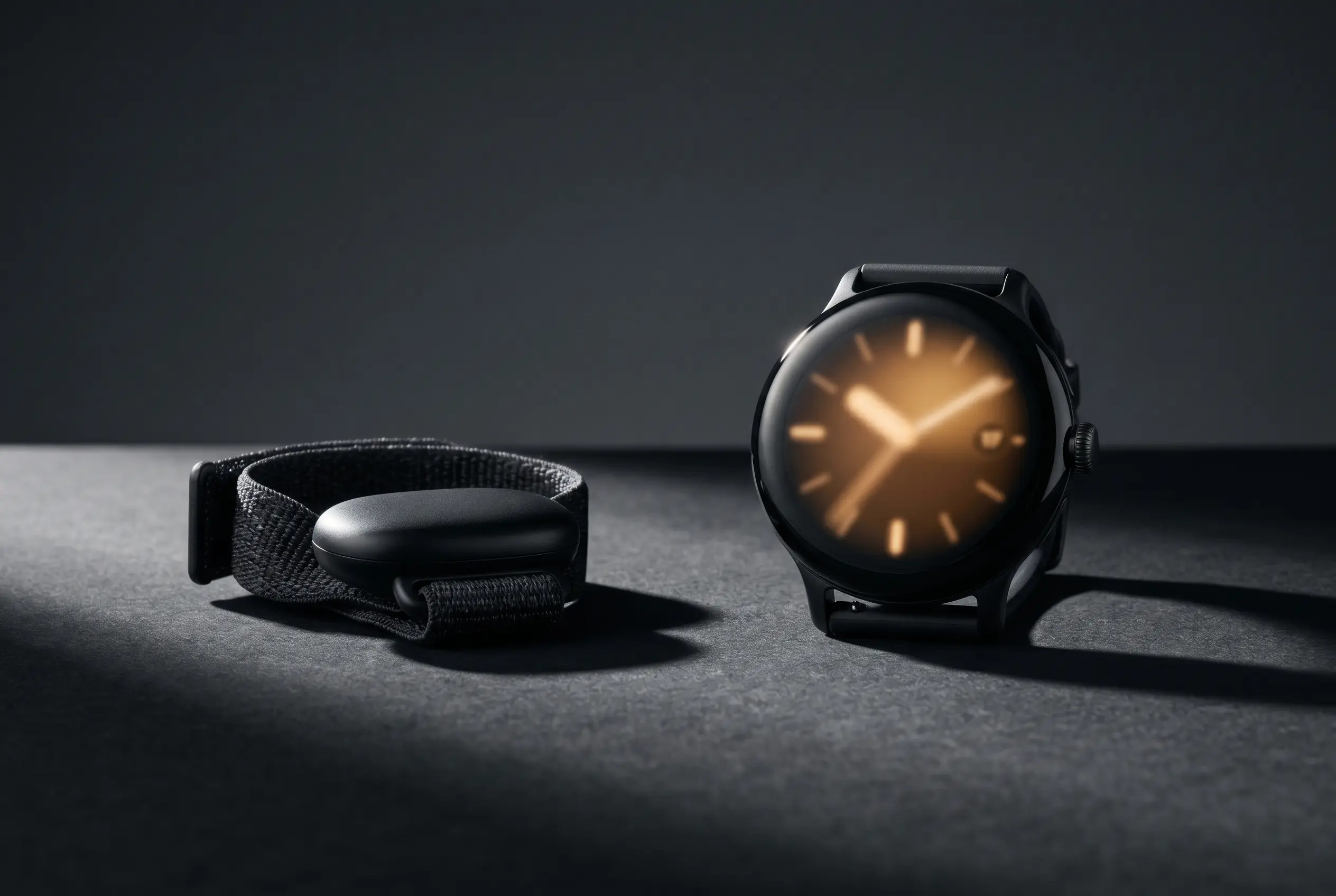
The Fitbit Air is a passive health monitor with no display and no standalone apps. Everything it records feeds into the Google Health app on a connected phone. Google announced the Fitbit Air on May 7, 2026, with retail availability beginning May 26. The oval-shaped pebble tracker measures 34.9 x 17 x 8.3mm and weighs 5.2 grams without its band, putting it lighter on the wrist than a Whoop strap. It ships with a fabric Performance Loop band at $99.99, or a Stephen Curry Special Edition at $129.99. Accessory Active silicone and Elevated Modern bands start at $34.99.
The Pixel Watch 4 launched October 9, 2025, at $349 for the 41mm Wi-Fi model and $449 for the 41mm LTE version. It runs Wear OS 6 on a Qualcomm Snapdragon W5 Gen 2 chip with a Cortex M55 co-processor, 2GB of RAM, and 32GB of onboard storage. Both size variants (41mm and 45mm) share a 12.3mm case thickness; the 41mm weighs 31 grams without a band. Its Actua 360 AMOLED LTPO display reaches 3,000 nits of peak brightness across both models.
| Specification | Fitbit Air | Pixel Watch 4 (41mm) |
|---|---|---|
| Price | $99.99 | $349 Wi-Fi / $449 LTE |
| Display | None | 1.33" AMOLED LTPO, 3,000 nits |
| Battery life | Up to 7 days | 30 hrs (AOD) / 48 hrs (Battery Saver) |
| Fast charge | 5 min = full day | 15 min = 50% |
| Weight (no band) | 5.2 g | 31 g |
| GPS | None (phone required) | Dual-frequency (standalone) |
| OS | None (app-dependent) | Wear OS 6 |
| iOS compatible | Yes (iOS 16.4+) | No (Android 11+ only) |
| Water resistance | 50 meters | IP68, 5ATM |
| Included trial | 3 months Health Premium | 3 months Health Premium |
What Each Device Measures
The Fitbit Air’s Sensor Set
The Fitbit Air carries an optical heart rate monitor running 24/7, red and infrared sensors for SpO2 blood-oxygen readings, a skin temperature sensor, and a three-axis accelerometer with gyroscope. Those sensors enable AFib (atrial fibrillation) heart rhythm alerts, HRV (heart rate variability) tracking, breathing rate monitoring, cardio load and readiness scoring, and automated workout detection. Sleep stages log continuously through the night. A vibration motor handles Smart Wake alarms, and a double-tap gesture blinks an LED to show remaining battery.
The Pixel Watch 4’s Additions
The Pixel Watch 4 carries all the Air’s sensors plus a cEDA (continuous electrodermal activity, a physiological stress response measure) sensor, ECG capability, an altimeter, barometer, magnetometer, and ambient light sensor, along with a compass. Its dual-frequency GPS combines Galileo, GLONASS, and Beidou signals and tracks outdoor routes without a phone. Five capabilities detailed on the Pixel Watch 4’s official specification page aren’t available on the Fitbit Air:
- Loss of Pulse Detection: detects when pulse stops and prompts a call to emergency services
- Satellite SOS: connects to emergency services via satellite when no cellular or Wi-Fi signal is available (LTE models only)
- ECG: on-demand electrocardiogram readings
- Fall and Crash Detection: automatically contacts emergency services after a detected fall or crash
- Gemini Raise to Talk: hands-free access to Google’s Gemini AI by lifting the wrist
Google Health’s New Multi-Device Logic
Before May 2026, the Fitbit app enforced a one-active-device rule. Pairing a Fitbit Air would displace a Pixel Watch from the account, and vice versa; users had to pick one or manage the swap manually each time. The rebranded Google Health app, which went live on May 19, 2026, dropped that restriction entirely.
The app’s sync engine now compares timestamps from both devices, merges activity data, and avoids double-counting steps or active minutes when both trackers are on the wrist simultaneously. Google’s announcement of the Health platform’s data approach describes the app as a hub aggregating inputs from wearables, smart scales, and medical records, with data portability as a design principle. That openness extends beyond Google hardware: Apple Watch, Oura Ring, Garmin, and Whoop can all connect through Health Connect or the Google Health APIs.
The Gemini-powered Google Health Coach draws on that aggregated data to generate readiness scores and personalized workout plans. It requires Google Health Premium at $9.99 per month or $99.99 per year. Both devices include a three-month trial with purchase. Heart rate monitoring, sleep scores, AFib alerts, and workout detection don’t require a subscription after the trial ends.
Does the Fitbit Air Fix the Pixel Watch 4’s Overnight Gap?
The Pixel Watch 4’s battery marks a genuine generational step. The 41mm model runs 30 hours with always-on display active, or 48 hours in Battery Saver mode. The 45mm extends those figures to 40 and 72 hours respectively, and a 15-minute charge delivers 50% battery on the 41mm. For most wearers, overnight charging is still the practical default.
Sleep is where the data gap opens. Overnight skin temperature variation, HRV, sleep stages, and breathing rate all require continuous wrist contact, which the charging window interrupts. The Fitbit Air’s 7-day battery removes that scheduling conflict: five minutes on its proprietary charging connector provides a full day of use, and a complete charge takes 90 minutes. The trade-off is a separate cable. The Fitbit Air uses a different connector from the Pixel Watch 4’s magnetic Quick Charge Dock, so someone running both travels with two chargers rather than one.
Screenless Trackers Before This One Required a Subscription
The closest competitor in the screenless fitness band segment is Whoop. Whoop bundles its hardware into a subscription starting at $199 per year, with no option to buy the strap outright. The Fitbit Air at $99.99 is the first widely available screenless tracker in that form factor that doesn’t require ongoing payment to use its core features.
Both the Fitbit Air and the Pixel Watch 4 include a three-month Google Health Premium trial with purchase. Core health features, including AFib alerts, sleep scoring, and cardio readiness, don’t lock behind the subscription when the trial ends.
- $99 – Fitbit Air, device purchase, no mandatory subscription
- $199/year minimum – Whoop, subscription-only model, hardware not sold separately
- $9.99/month – Google Health Premium, optional coaching add-on for either device after the free trial
The Pairing Case
Three situations favor the Fitbit Air on its own. Someone without interest in a smartwatch gets continuous health monitoring, AFib awareness, and sleep scoring for $99. Someone on iOS can pair the Fitbit Air via the Google Health app (iOS 16.4 or later), since the Pixel Watch 4 is Android-only. Someone already wearing a Samsung, Apple, or Garmin watch can add the Air as a dedicated sleep companion without swapping their primary device. The pattern of Google Pixel hardware building its best features around Android exclusives means the Pixel Watch 4 returns the most to users already running Pixel phones and Android services.
The Pixel Watch 4 is the necessary choice when standalone GPS accuracy matters, when Wear OS app access, Google Wallet, or real-time workout data on a screen are priorities, or when the safety features drive the purchase. Loss of Pulse Detection, Satellite SOS, and Fall and Crash Detection have no equivalent on the Fitbit Air.
For an existing Pixel Watch 4 owner, the addition is a straightforward $99 question. The Air fills the overnight window, charges during the hours the watch already needs power, and the Google Health app consolidates both in a single dashboard. Combined hardware spend comes to around $450 for the 41mm Wi-Fi Pixel Watch 4 and the standard Fitbit Air. Google has built the sync infrastructure to handle both without data gaps or duplicate counts, and that infrastructure is what makes the combination worth considering rather than a simple one-or-the-other pick.
Frequently Asked Questions
Does the Fitbit Air work with iPhone?
Yes. The Fitbit Air pairs with iOS 16.4 or higher via the Google Health app, and a Google account is required to set up the device. The Pixel Watch 4 requires Android 11 or later and has no iOS support.
Can the Fitbit Air and Pixel Watch 4 run on the same account at once?
Yes, as of May 2026. The rebranded Google Health app allows both devices to stay connected to a single Google account simultaneously. The previous version of the Fitbit app enforced a one-device limit and required unpairing before adding a second tracker.
Is a subscription required to use either device?
No. Both the Fitbit Air and the Pixel Watch 4 include a three-month Google Health Premium trial with purchase. After that, heart rate monitoring, AFib alerts, sleep scores, and workout detection remain free. Google Health Premium unlocks Gemini-powered coaching at $9.99 per month or $99.99 per year.
Does the Fitbit Air have GPS?
No. The Fitbit Air has no GPS hardware. Tracking a run or ride with route mapping requires a connected phone. The Pixel Watch 4 includes dual-frequency GPS that operates independently without a phone present.
How does the Fitbit Air battery compare to the Pixel Watch 4?
The Fitbit Air lasts up to 7 days per charge; five minutes on the charger provides a full day of use. The Pixel Watch 4 41mm lasts 30 hours with always-on display active, or 48 hours in Battery Saver mode. The 45mm model extends those figures to 40 and 72 hours respectively.
What health features does the Pixel Watch 4 have that the Fitbit Air doesn’t?
The Pixel Watch 4 adds ECG readings, Loss of Pulse Detection, Fall and Crash Detection, Satellite SOS (LTE models only), Gemini Raise to Talk, a cEDA body response sensor, altimeter, barometer, and dual-frequency GPS. Both devices support AFib alerts, HRV, SpO2, sleep stage tracking, and cardio readiness scoring.