African sailors training for the Dakar 2026 Youth Olympic Games wrapped a week on Tangier Bay this weekend, but the most valuable thing to come out of the camp was not the on-water coaching. It was a set of windsurfing boards, loaned by a manufacturer and handed to the athletes to carry back home rather than returned to a warehouse.
That single detail explains why World Sailing keeps running these camps at all. The drills sharpen race craft for a fortnight. The equipment keeps a sport alive on coasts where access to boards has always been the real bottleneck.
What Happened on Tangier Bay
The Morocco camp, held from 22 to 31 May, was the third of four sessions funded through the International Olympic Committee’s Olympic Solidarity (the IOC’s development fund for athletes and national federations) and organised by World Sailing. It brought together 13 young sailors and eight coaches drawn from across the continent for a week built around one goal: closing the technical gap before November.
Two expert coaches from the Techno293 Class (the windsurfing board used in youth racing) ran four days of on-water sessions focused on technical refinement and tactical race preparation. Organisers reported a clear jump in boat handling, tactical awareness, and confidence as the week wore on.
The roster reflected how far the program has reached. Seven nations sent sailors, two of them taking part for the first time:
- Algeria, Egypt and Tunisia, the North African core that has anchored these camps from the start
- Morocco, the host nation, working on home water
- Madagascar, extending the program into the Indian Ocean
- Angola and South Africa, both joining a camp of this kind for the very first time
Why the Loaned Boards Matter More Than the Drills
Equipment is the quiet wall in front of African sailing. Boards are expensive, hard to ship, and harder still to replace once a season ends. A coach can teach a turn, but without a board to practise on, that lesson evaporates the moment the camp closes.
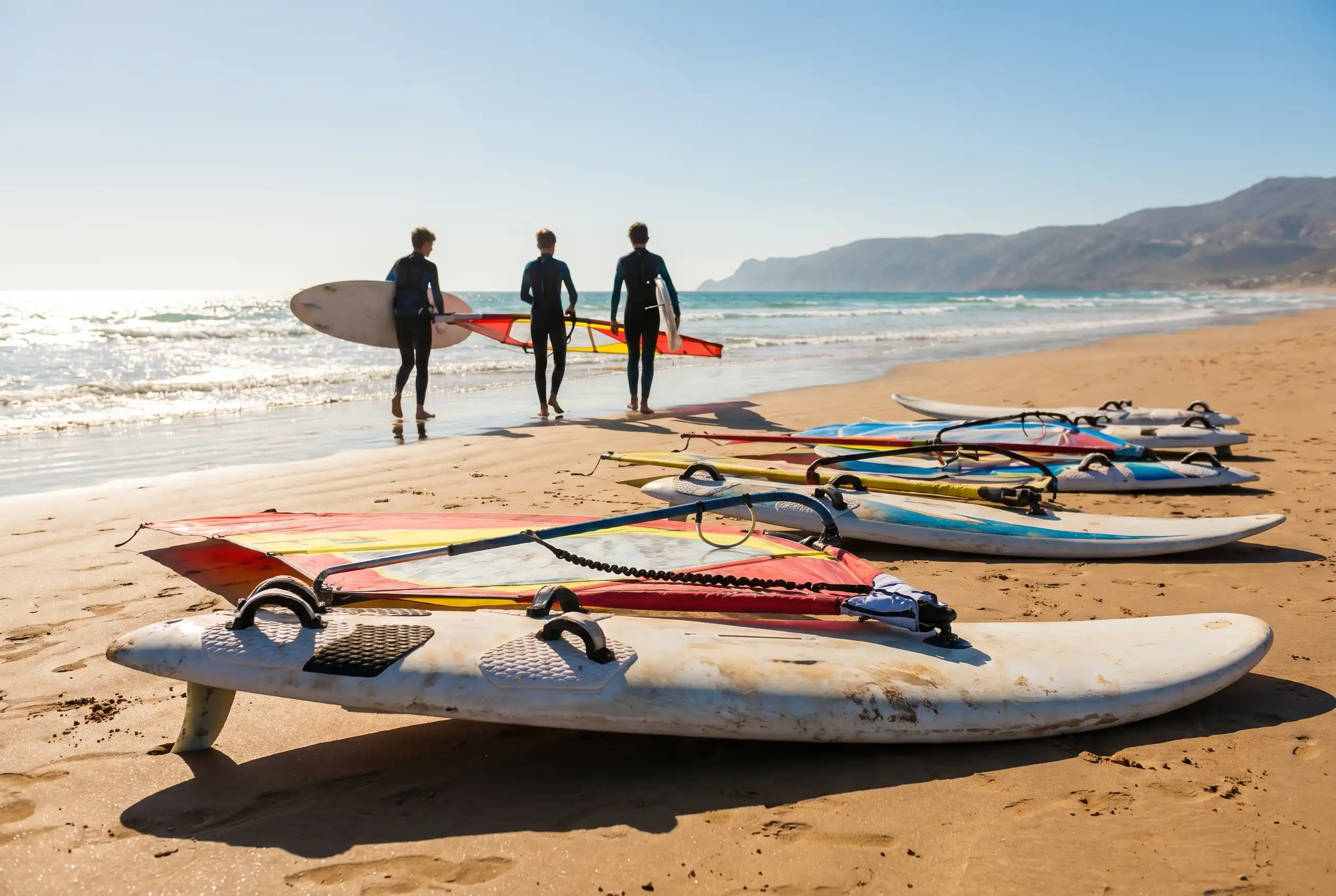
This time the camp attacked that problem directly. Through a partnership with equipment maker Tahe Outdoors, ten windsurfing boards were loaned and distributed to the participating nations, then sent home with the sailors. That continuity is the point. It lets athletes keep a structured training routine on their own waters and gives national coaches the gear to build consistent local programs rather than waiting for the next funded gathering.
By providing access to equipment, coaching, and high-performance training, we are investing not only in athlete development, but in the future growth and sustainability of sailing within the region.
That was Fiona Kidd, World Sailing’s Head of International Development, on why the body keeps pouring resources into a region with few medals to show for it yet. The boards turn a short camp into something that compounds between camps.
A First Olympic Event on African Soil
The urgency comes from the calendar. Dakar 2026 runs 31 October to 13 November 2026 in Senegal, and it carries weight far beyond youth sport. It will be the first Olympic sporting event held in Africa, a Games first awarded for 2022 and pushed back four years after the COVID-19 pandemic reshuffled the entire Olympic schedule.
The scale is real for a youth edition. Roughly 2,700 athletes are expected across 25 sports over 13 days, with participation open to 206 National Olympic Committees and prioritised entry for all 54 African NOCs. Sailing sits at Saly, on the coast south of the capital, where the windsurfing program will run two events.
The board itself is a deliberate choice for emerging fleets. The Techno293 has a daggerboard for stability and performs in light wind, which makes it forgiving for athletes aged 14 to 16 who are still learning to read a course.
World Sailing has leaned on that history before. “The Techno293 is part of sailing heritage at the Youth Olympic Games, and this generation of young sailors have the opportunity to make history in Senegal,” said Jim Morris, World Sailing’s Director of Events, when the confirmed windsurfing equipment for the Senegal Games was announced.
The Map Keeps Widening
Tangier was not a one-off. It is the third stop on a four-camp pathway running through the 2025 and 2026 seasons, each one adding nations and coaching depth before the fleet reaches Saly. The geography of who shows up has grown camp by camp.
| Camp | Location | Timing | Notable expansion |
|---|---|---|---|
| First | Hammamet, Tunisia | September 2025 | Launched the pathway |
| Second | Tangier, Morocco | November 2025 | Added Libya and Senegal to the mix |
| Third | Tangier, Morocco | 22 to 31 May 2026 | Angola and South Africa debut |
| Fourth | To be confirmed | Before the Games | Final tune-up ahead of Dakar |
The camps slot into a wider development machine. World Sailing’s Youth Emerging Nations Programme, a six-month coaching and competition initiative running since 2021, has now served sailors from 33 nations across Africa, South America, the Caribbean, Oceania and Europe, with a place at the Youth Sailing World Championships waiting at the end. You can read the full structure on the body’s emerging nations sailing pathway page.
Seen together, the camps and the year-round program are trying to do the same thing from two directions: hand athletes the gear and the racing miles that wealthier sailing nations take for granted.
The Logistics Nobody Sees on the Results Sheet
A camp that pulls sailors from seven countries into one Moroccan port is mostly an administrative feat before it is a sporting one. Visas, flights, accommodation and ground transport all have to line up, and any one of them can keep an athlete off the water.
The Royal Moroccan Sailing Federation, as host, was central to clearing those hurdles, particularly on visa processing and smooth local delivery. On the ground, Nuno Reiss of the PROW Group worked alongside the secretary and coach of the Royal Tangier Yacht Club to manage lodging and transport, while the club opened its facilities to the group each day.
None of that shows up in a race result. It is the difference between a camp that runs and a camp that collapses, and it is the part of the model that has to travel to every new nation the program reaches.
The Gap Between a Camp and a Podium
For all the progress, the arithmetic stays sobering. Thirteen sailors trained in Tangier. Each Dakar windsurfing event carries up to 24 athletes per event, and those slots fill with sailors from across the world, many of them backed by federations that never had to loan a board to keep a fleet afloat.
So the honest read is split. The week delivered exactly what a development camp should: better technique, two new flags, and equipment that does not vanish when everyone flies home. Whether that converts into competitive results at a home-continent Games, or simply into a stronger base for the cycle after it, is the question the boards were bought to answer.
By the time the fleet lines up at Saly in November, the test will not be how many African sailors qualify. It will be how many are still training in March, on boards that stayed.