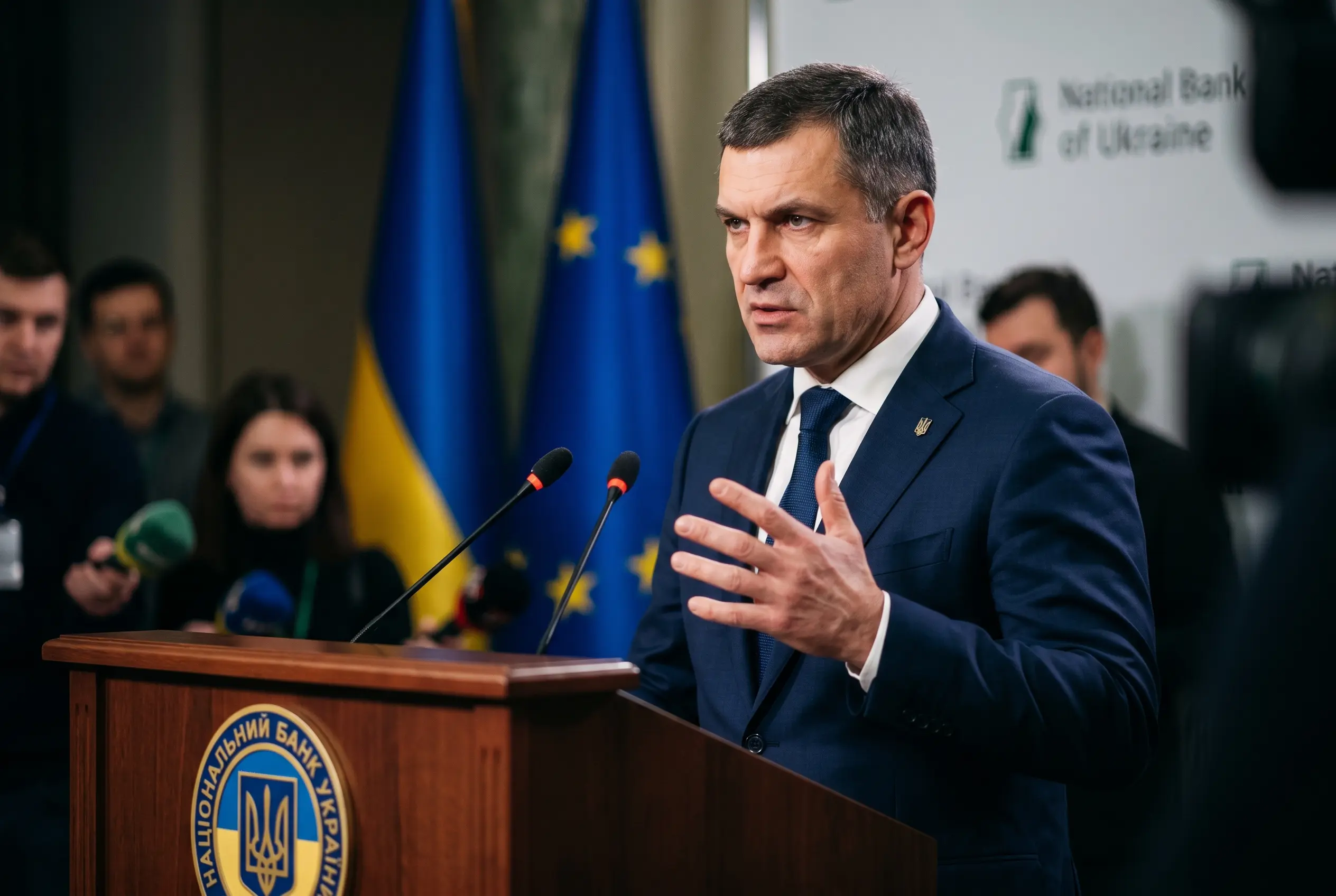
Ukraine’s banking rules are 78% aligned with EU standards, the head of the National Bank of Ukraine said, with the central bank preparing more than 50 new laws and regulations to close the rest of the gap. Governor Andriy Pyshnyy told Reuters the work has to continue “despite military risks.” The reform push is moving at wartime speed.
The reform push runs in parallel with a February 2026 reconstruction assessment that puts Ukraine’s recovery needs at almost $588 billion over the next decade. That sum is what the central bank is trying to put within reach of private capital.
The 78% Number, and What It Doesn’t Cover
Pyshnyy’s accounting of the EU gap puts Ukraine’s banking regulations at roughly 78% compliant with EU requirements. The insurance sector lags further, at about 55% compliant. The asymmetry between the two sectors is where most of the unfinished reform sits, and where the new legislation is being drafted.
Banking rules cover capital, supervision, disclosure, resolution, and stress testing, and the figure is a blended measure across all of them. The remaining gap is the work of fine-grained alignment: notification procedures, supervisory practice, the technical text of the rulebook. Closing that gap is what the new legislation is for. The framework is already in place, and the work is in the details.
Insurance is the laggard for a reason. It started from a lower base and has had less NBU attention since the 2022 invasion, and the central bank is now redesigning its oversight from the ground up.
| Sector | EU compliance | Reform direction |
|---|---|---|
| Banking regulations | ~78% | Capital, supervision, resilience |
| Insurance sector | ~55% | Transparency, stability, attractiveness |
What Those Fifty Laws Are Supposed to Do
Pyshnyy said Ukrainian authorities are preparing more than 50 new laws and regulations to bring the financial system closer to EU rules. The package is meant to strengthen regulation, raise capital requirements for banks, and improve the operational resilience of financial institutions. None of it is a small change.
We have a large-scale European integration program.
That was Pyshnyy, the central bank governor, in an interview with Reuters, and the framing is also the central bank’s pitch to outside investors. Capital rules and resolution planning sit at the centre of the pipeline, alongside disclosure and governance changes modelled on the EU’s own bank rulebook. The insurance reforms are aimed at increasing transparency, stability, and investment attractiveness, three of the same qualities the EU regime demands of insurers. The 50-law list is also the lever the government plans to use to restart its stock market and gradually restore the free movement of capital. That last piece is what makes private capital possible in the first place.
Why Private Capital Is the Real Prize
The World Bank, the European Commission, the United Nations, and the Ukrainian government together put the country’s reconstruction and recovery needs at almost $588 billion over the next decade, nearly 3 times Ukraine’s projected nominal GDP for 2025. Prime Minister Yulia Svyrydenko called it “the total cost of Ukraine’s reconstruction and recovery” in a statement accompanying the February 2026 release. The bill is what the central bank is matching its reform drive against.
The $588 billion is concentrated in transport (over $96 billion), energy (nearly $91 billion), housing (almost $90 billion), commerce and industry (over $63 billion), and agriculture (over $55 billion). The line item for explosives management and debris clearance is almost $28 billion on its own. Housing alone is the third-largest line item after transport and energy. The sectors are the same ones the reform pipeline is supposed to make bankable.
The central bank cannot fund that bill on its own. Pyshnyy put the case plainly: “We need private capital. And private capital needs infrastructure.” The first half of the sentence is the macro argument: aid and donor programmes cover part of the gap, but not most of it. The second half is the political one: foreign investors will not deploy capital into a market that does not look like the markets they already operate in. The answer, in Pyshnyy’s framing, is EU alignment. The pipeline is being matched against the bill, and the scale of the reconstruction need is what the private side has to reach.
The OECD reached a similar conclusion in its March 2026 review: “Vast amounts of capital will be needed to finance the reconstruction of the economy, which the banking sector and official support may not be able to provide on their own.” The central bank is reading the same bill.
Public money is part of the stack, too. The Government of Ukraine’s 2026 recovery priorities include public investment projects and essential recovery support programs, totaling more than $15 billion. At least $20 billion in needs have already been met since February 2022, per the World Bank-led assessment. Private capital, in the NBU’s framing, is the foreign portfolio and direct investment that does not flow into a country at war with currency controls and a wartime rulebook. The 50-law pipeline is the door it walks through, in Pyshnyy’s framing.
The reconstruction bill, by the numbers
- $195 billion: direct damage to Ukraine as of December 2025
- over $96 billion: transport sector reconstruction need
- nearly $91 billion: energy sector reconstruction need
- $20 billion: needs already met since February 2022
- 14%: share of housing in Ukraine damaged or destroyed as of December 2025
Cleaner Books in the Middle of a War
The Ukrainian banking sector has held up since Russia’s full-scale invasion in 2022. The NBU says banks remain profitable, liquid, and well-capitalized, and the level of non-performing loans is near historic lows.
The resilience is policy-built, not accidental. Banks have run the “Power Banking” initiative since 2022, a network of branches that keeps retail banking services going through missile-induced power cuts. Under martial law, all individual bank deposits are fully guaranteed by the Deposit Guarantee Fund of Ukraine, a backstop that has held through branch damage and power loss. The framework is part of a broader wartime operating regime the NBU put in place to keep the system running under fire. The OECD’s March 2026 review credits “prudent policy-setting and continued support from international donors and partners” with the result.
That is the backdrop the central bank is selling to outside investors. The same banks that are reporting profits and cutting non-performing loans are the channels that have to lend into reconstruction. The OECD’s March 2026 financial system framework report runs the same case, in OECD language, for the same audience. The point is that resilience is the product, not a coincidence.
The OECD’s review is the most detailed external roadmap. Its March 2026 chapter lists 15 specific recommendations for Ukraine’s financial system across capital markets, banking, finance access, and digital finance. The NBU is named as a responsible authority in 8 of the 15, and the National Securities and Stock Market Commission in 5.
When the War-Era Capital Controls Come Off
Ukraine still has currency restrictions imposed at the start of the full-scale invasion. The central bank is shifting from emergency controls to a more flexible, risk-based approach. That is the operational meaning of the second half of Pyshnyy’s private capital argument: foreign investors will not move money into a market where repatriation is uncertain, and the NBU knows it. The change is incremental, not abrupt, and it is tied to security conditions as much as to the rulebook.
Stock market reforms sit in the same pipeline as the 50 laws. The NBU and the National Securities and Stock Market Commission are preparing the legislative changes that would let new issuance and trading recover from wartime lows. Pyshnyy’s argument is that a market that looks like a European one will draw European money, and the central bank is working on the rulebook and the market plumbing at the same time.
Frequently Asked Questions
What share of Ukraine’s banking rules are aligned with EU standards?
The National Bank of Ukraine says its banking regulations are approximately 78% compliant with EU requirements, according to Governor Andriy Pyshnyy in a Reuters interview. The insurance sector is approximately 55% compliant, the NBU says, and is the laggard in the reform drive.
What does Ukraine’s reconstruction actually cost?
A February 2026 joint assessment by the Ukrainian government, the World Bank, the European Commission, and the United Nations puts the total reconstruction and recovery need at almost $588 billion over the next decade, nearly 3 times Ukraine’s projected nominal GDP for 2025. The largest line items are transport, energy, housing, commerce and industry, and agriculture.
What are the 50 new laws and regulations for?
The package is meant to close the remaining gap between Ukrainian and EU financial rules. Pyshnyy said the new laws and regulations are intended to strengthen regulation, raise capital requirements for banks, and improve the operational resilience of financial institutions, alongside insurance-sector reforms targeting transparency, stability, and investment attractiveness.
How have Ukrainian banks performed during the war?
The NBU says banks remain profitable, liquid, and well-capitalized, with non-performing loans near historic lows. The sector has held up through the “Power Banking” branch network designed to keep retail services running during power cuts, and a wartime deposit guarantee from the Deposit Guarantee Fund of Ukraine covering individual deposits in full.
When will Ukraine lift its wartime capital controls?
Ukraine is shifting from emergency currency controls imposed at the start of the 2022 invasion to a more flexible, risk-based approach. The full restoration of free capital movement is tied to security and macroeconomic stability, and the central bank is pairing the relaxation with the broader EU-alignment reform pipeline rather than treating it as a separate decision.