Nintendo spent early 2024 suing the Yuzu emulator into a $2.4 million settlement. By October of that year, a phone call from Nintendo’s lawyers had shut down Ryujinx too. Two years later, retro gaming on old hardware has never looked better.
A new wave of frontends, from the long-running ES-DE to a brand-new Android launcher called iiSU, is turning dusty PCs and forgotten phones into polished, working game libraries complete with scraped box art and cross-device save syncing. None of them touch the fight that ended Yuzu and Ryujinx. That split took two years of lawsuits, takedown notices and one nonprofit’s preservation study to harden into place.
A Fresh Crop of Frontends for Old Hardware
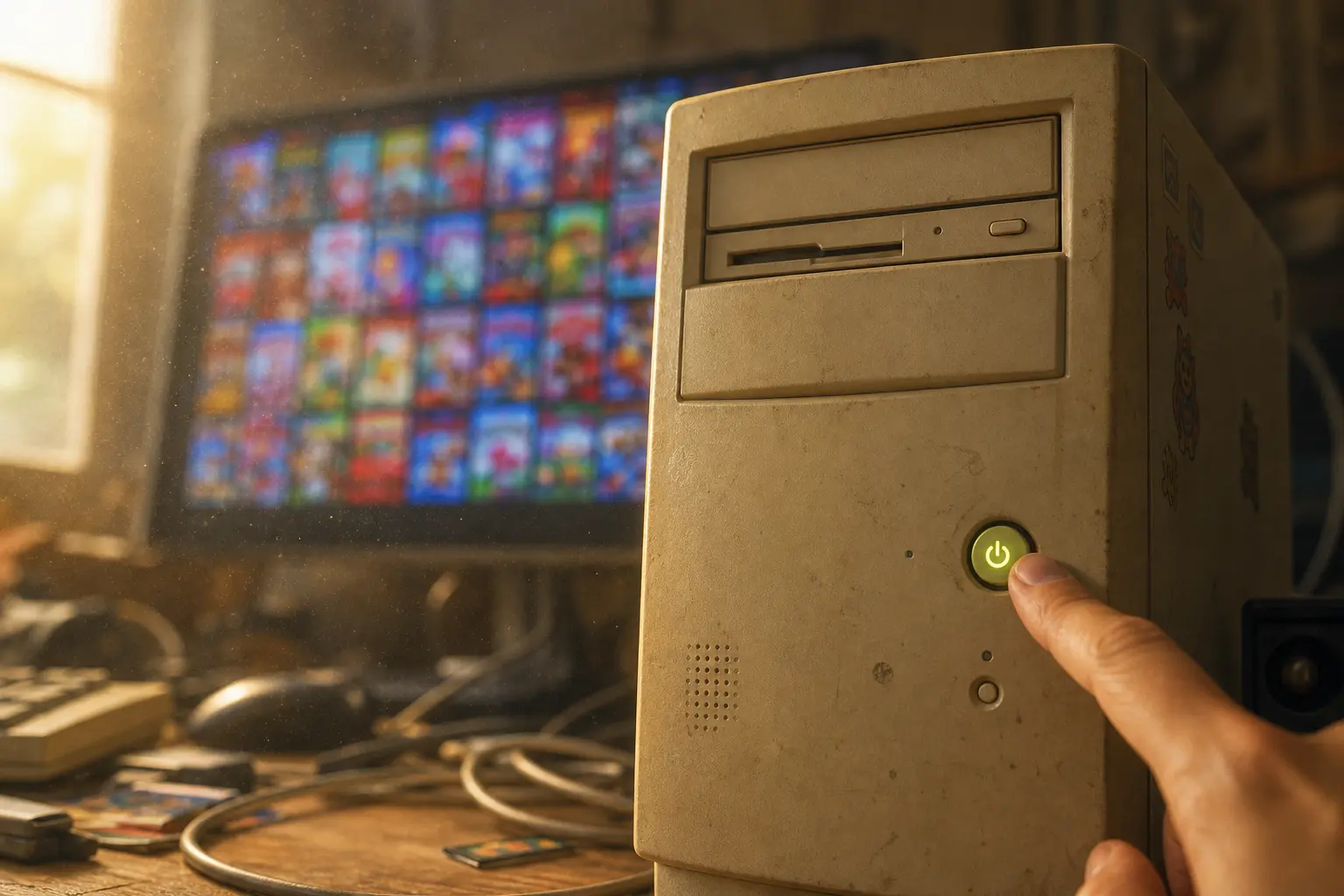
XDA Developers rounded up the current crop of tools in a piece published July 19, mapping out four approaches for anyone with a forgotten PC or phone gathering dust. EmulationStation Desktop Edition, known as ES-DE, is the frontend most of these setups build on: a library manager for Windows, macOS and Linux that scrapes box art, descriptions and trailers for whatever games a user already owns.
EmuDeck and RetroDeck build on top of it, automatically installing the emulators ES-DE itself does not include. EmuDeck covers Windows, Linux and Android; RetroDeck is Linux only, tuned for devices like the Steam Deck. Batocera goes further still, replacing the operating system entirely with a stripped-down Linux build that boots straight into a game library and nothing else, which is why it runs so well on genuinely old, weak machines.
The newest entrant is iiSU, an Android frontend still in early alpha with a UI modeled on Nintendo’s own Wii U menu, down to Discord messaging and RetroAchievements tracking built in. iiSU ships with zero emulators of its own; it expects the user to supply whatever emulator they already trust for each platform. RetroAssembly takes a different shape altogether, running as a Docker container on a home server or spare PC, organizing a library and streaming it, save files included, to any browser on the network.
| Tool | Platform | What It Does | Emulators Included |
|---|---|---|---|
| ES-DE | Windows, macOS, Linux | Scrapes box art and metadata into one library frontend | No, bring your own |
| EmuDeck | Windows, Linux, Android | Automates ES-DE setup with themes included | Yes, auto-installed |
| RetroDeck | Linux only | Same automation, tuned for Steam Deck style hardware | Yes, auto-installed |
| Batocera | Dedicated Linux OS | Replaces the operating system for a single-purpose console | Yes, bundled |
| iiSU | Android | Wii U style UI with Discord and RetroAchievements links | No, zero included |
| RetroAssembly | Docker, any PC | Streams a self-hosted library and save data to any device | Depends on setup |
All six of those tools are organizers and library managers. None of them decrypts a single byte of a modern Nintendo console.
The Nine Days That Ended Yuzu
Nintendo of America filed suit against Tropic Haze, the Rhode Island company behind Yuzu, on February 26, 2024, in federal court. The complaint leaned on the Digital Millennium Copyright Act’s anti-circumvention rules, pointing to leaked copies of The Legend of Zelda: Tears of the Kingdom that were downloaded more than a million times before its release.
Tropic Haze did not fight. Nine days after the filing, Chief Judge John J. McConnell Jr. signed the federal docket ordering Yuzu’s shutdown, a permanent injunction requiring Tropic Haze to pay Nintendo $2.4 million, destroy every copy of Yuzu’s code and hand over the yuzu-emu.org domain. In its own court-mandated statement, the studio admitted that “our projects can circumvent Nintendo’s technological protection measures,” conceding the exact point Nintendo needed to win. Citra, a 3DS emulator built by the same lead developer, shut down as collateral damage since it shared Tropic Haze’s corporate umbrella.
- February 26, 2024: Nintendo of America sues Tropic Haze over the Yuzu emulator in federal court in Rhode Island.
- March 6, 2024: A judge signs the settlement and permanent injunction; Yuzu and Citra both shut down for good.
- October 1, 2024: Nintendo contacts Ryujinx’s lead developer directly; the project’s GitHub organization disappears within hours.
- June 2025: Nintendo launches the Switch 2, closing the hardware flaw that made Switch 1 emulation possible in the first place.
- February 2026: A fresh DMCA sweep hits Switch emulator forks including Kenji-NX and MeloNX, whose website goes offline.
Ryujinx lasted seven more months before its own reckoning arrived. On October 1, 2024, Nintendo of America contacted lead developer gdkchan directly. Former team member riperiperi confirmed the news on Discord, writing that “gdkchan was contacted by Nintendo and offered an agreement to stop working on the project.” The project’s confirming the shutdown within hours of contact post went up the same day, and the GitHub organization vanished shortly after.
The future of game preservation depends on individuals.
Riperiperi wrote that line in Ryujinx’s farewell Discord message on October 1, 2024.
Why Didn’t Nintendo Come for These Tools Too?
Nintendo’s legal campaign has targeted software that decrypts its games, not software that organizes them. ES-DE, Batocera, EmuDeck, RetroDeck, iiSU and RetroAssembly never touch a Switch file or Nintendo’s encryption, which keeps every one of them on the safe side of a DMCA claim that has already produced one settlement and a string of takedown notices.
Three things separate these frontends from the emulators Nintendo has gone after.
- None decrypts a current-generation Nintendo console; they target systems that are already retired, whose protections are long broken or simply irrelevant.
- None of them bundles copyrighted ROM files; users are expected to supply their own game backups.
- iiSU goes a step further and ships with no emulator cores at all, leaving that legally sensitive layer entirely up to the user.
Two years of DMCA notices taught every developer still building in this space to keep that architecture in place. Legal precedent from console emulation fights in the early 2000s, involving Sony against Bleem and Connectix, already established that emulator software itself is not automatically unlawful. What changes the calculus is decryption and unauthorized distribution, not the act of imitating hardware.
Why 87 Percent of Classic Games Are Already Gone
The Video Game History Foundation, a nonprofit dedicated to preserving game history, published a study with the Software Preservation Network that sampled 1,500 games released in the United States before 2010. Only 13 percent were still available to buy in any form, whether an original cartridge, a digital reissue or a retro compilation.
The rest, 87 percent, were out of print entirely. VGHF library director Phil Salvador, who led a random sample of 1,500 pre-2010 games, said the point was to settle an argument the industry kept avoiding, noting simply that “we need an accurate understanding of where things stand right now.”
That scarcity is exactly the gap frontends like ES-DE and RetroAssembly step into. A scraper pulling box art for a decades-old racing game is not mere decoration; for most classic titles, a personal backup and an emulator are the only way left to play them outside a research library. The frontends filling that gap remain the most practical way most of this catalog survives at all.
The Current-Gen Fight Nintendo Hasn’t Won
One layer up from ES-DE and Batocera, the war Nintendo started in 2024 is still going. Yuzu’s and Ryujinx’s open-source code lived on in forks. Suyu, Sudachi, Citron, Eden, Kenji-NX, Ryubing and MeloNX all trace back to one codebase or the other.
Most of those names are already gone or wounded. Sudachi shipped its final release in July 2025 before its own developer publicly recommended Eden as a replacement. Citron collapsed in early 2026 after internal conflict, taking its servers and repository down with it. Nintendo’s February 2026 DMCA sweep hit Kenji-NX and MeloNX directly. MeloNX’s website went offline soon after, while Kenji-NX kept shipping updates anyway.
By mid-2026, Eden had become the most actively developed successor, built with its compatibility list spanning thousands of Switch titles released between 2017 and 2025. Ryubing serves as the steadier, less adventurous alternative for desktop users.
Switch 2 emulation barely exists by comparison. Nintendo’s newer console, launched in June 2025, closed off the hardware flaw that made Switch 1 hacking possible in the first place. Without an equivalent exploit, developers cannot examine the console deeply enough to build a working emulator.
Nintendo’s last confirmed DMCA sweep landed in February of this year. The frontends built for its retired hardware still have not received one.
Frequently Asked Questions
Is it legal to emulate retro video games?
Emulator software itself has been treated as legal in the United States since console emulation fights in the early 2000s involving Sony, Bleem and Connectix. What creates risk is cracking a console’s copy protection or downloading copyrighted ROM files a person does not already own. Frontends like ES-DE and Batocera do neither, which is why Nintendo’s DMCA campaign has left them alone so far.
What exactly happened to the Yuzu and Ryujinx emulators?
Yuzu had more than 200,000 members on its Discord server when Nintendo of America sued developer Tropic Haze in February 2024; the case ended in a settlement within nine days. Ryujinx, which supported more than 3,200 playable games, shut down that October after Nintendo contacted its lead developer directly and its GitHub organization disappeared within hours.
Can I still download Yuzu or Ryujinx today?
No. Both are permanently discontinued under the terms of Nintendo’s settlement and cannot legally return under those names. Their open-source code lives on through forks. Eden and Ryubing are the most actively maintained descendants as of mid-2026, though Nintendo has hit several other forks, including Kenji-NX and MeloNX, with DMCA notices of their own.
Will Nintendo Switch 2 games be playable on emulators soon?
Not for years. Switch 2, launched in June 2025, already plays the entire Switch 1 library natively through official backward compatibility, so there is no waiting on emulation for those games. Zero commercial Switch 2 exclusive titles run on any emulator as of mid-2026, and the furthest-along attempt, a project called Pound, warns on its own page that working games are a decade away at best.
Does RetroAssembly need a home lab to work?
Not strictly, but it helps. RetroAssembly runs as a Docker container, so whatever PC hosts it needs to stay powered on for the library to stay reachable from other devices. Without an existing home lab, that usually means dedicating an old machine to run around the clock, though it can just as easily host other self-hosted services at the same time so the power draw is not wasted on one app alone.