India switched on a fiber based national clock last week that keeps banks, telecom carriers and one stock exchange running on time even when GPS signals overhead go dark. Union minister Pralhad Joshi commissioned the White Rabbit Technology based Indian Standard Time network on July 16 at a government metrology lab in Bengaluru, built to distribute time without leaning on satellites at all.
Officials framed the launch around digital sovereignty and self-reliance. Government data adds a sharper detail: the same GPS signals this network is meant to backstop have been faked or jammed more than 465 times over Indian skies since late 2023.
A Demonstration Network With One Specific Test
Joshi inaugurated the system at the Regional Reference Standards Laboratory (RRSL) in Jakkur, a suburb of Bengaluru. The project is a joint effort of the Department of Consumer Affairs, the government run CSIR-National Physical Laboratory (CSIR-NPL) and the Indian Space Research Organisation (ISRO). It disseminates Indian Standard Time traceable to UTC(NPLI), the country’s official time reference, using Precision Time Protocol (PTP) based White Rabbit technology.
The centerpiece of the launch was not the ceremony. It was a completed verification test that sent a secure time signal between the Bengaluru lab and the National Stock Exchange’s (NSE) facility in Chennai, done in coordination with the Securities and Exchange Board of India (SEBI) and state run carrier BSNL (Bharat Sanchar Nigam Limited). That link is the first concrete proof the system works outside a lab bench.
| Institution | Role in the Network | Sector Represented |
|---|---|---|
| Department of Consumer Affairs (Legal Metrology Division) | Nodal agency running the project | Consumer protection and regulation |
| CSIR-National Physical Laboratory | Maintains India’s reference clock, UTC(NPLI) | Metrology |
| ISRO | Builds the indigenous dissemination hardware | Space and satellite systems |
| SEBI | Verified the Bengaluru to Chennai time link | Financial market regulation |
| NSE | Hosted the Chennai facility used in testing | Stock exchange operations |
| BSNL | Provided the telecom backbone for transmission | Telecommunications |
The ministry’s own statement lists five sectors it expects to lean on the network eventually. A CSIR-NPL research paper on the same technology names some of the specific jobs those sectors need it for.
- Banking – core systems and digital payment rails that timestamp every settlement
- Telecommunications – mobile networks that hand calls and data between towers in sync
- Power grids – phasor measurement units that track electricity flow across the national grid
- Transportation – signaling and logistics systems that depend on one shared clock
- Digital governance – government platforms that log citizen transactions with a traceable timestamp
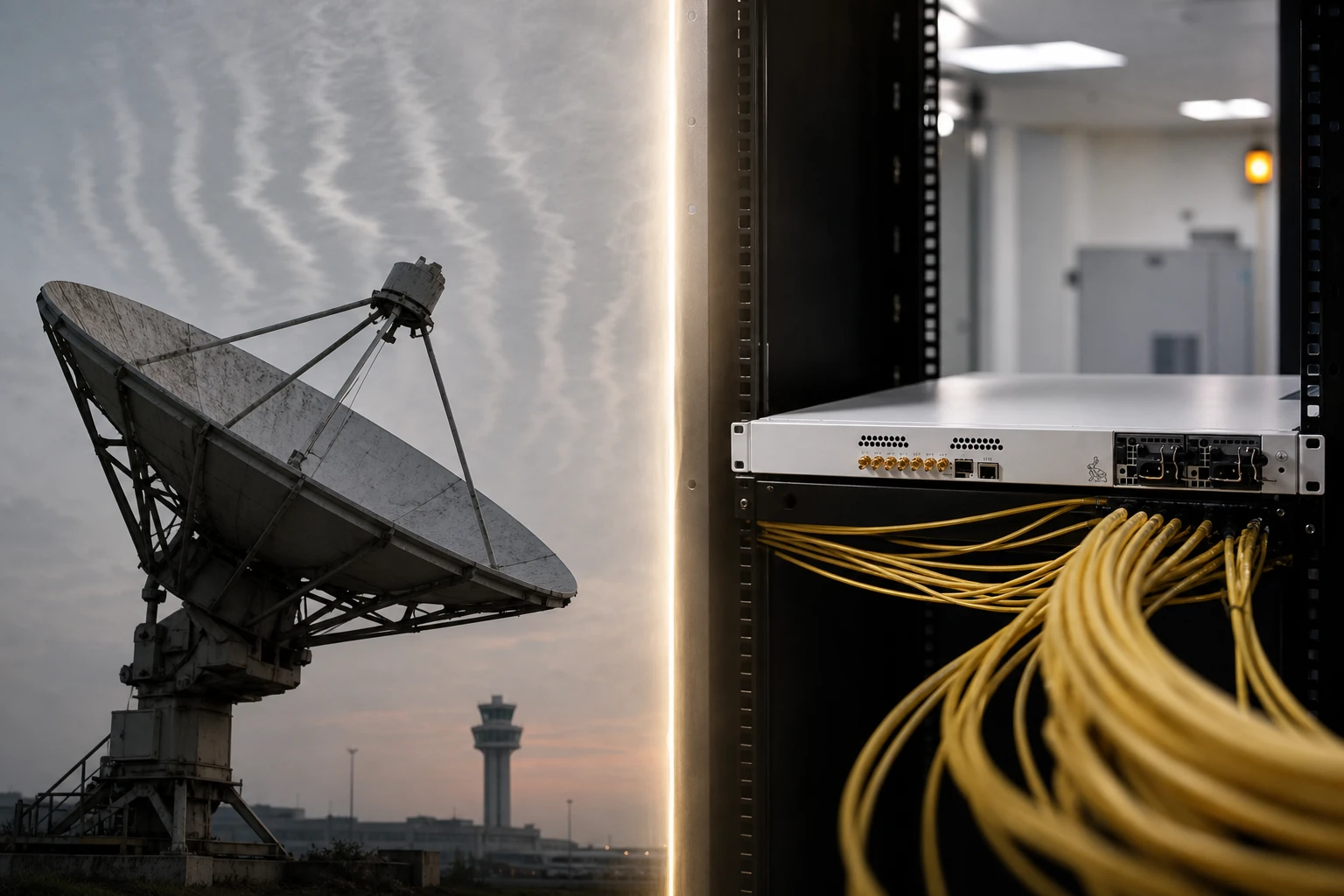
Hundreds of Fake Signals Over Indian Skies
Figures given to the Lok Sabha, the lower house of India’s Parliament, in March 2025 counted more than 465 incidents of GPS interference and spoofing in the Amritsar and Jammu air corridors between November 2023 and February 2025, the Observer Research Foundation reported.
The threat did not stay confined to the border. In November 2025, seven flights diverted to Jaipur after spoofed signals hit Delhi, and the Navigation Integrity Category value, a standard measure of GPS accuracy, fell from a normal reading of 8 to 0, ThePrint reported.
These are not merely technical glitches; they are acts of warfare, executed with a silent precision that can cripple economies and undermine sovereignty without a single shot being fired.
Jitin Prasada, union minister of state for electronics and information technology, put it that bluntly at an Indian Navy seminar, according to ThePrint. He was talking about spoofing broadly, not this network specifically, but the line captures why a fiber based alternative to satellite timing suddenly reads as urgent rather than academic.
An Indigenous Label on a CERN Blueprint
Officials repeatedly called the new network indigenous and sovereign. The protocol carrying its signal did not start in India.
- White Rabbit – an open-source, Ethernet-based timing protocol that CERN and partner labs began building in 2009 to run the Large Hadron Collider’s control systems, precise enough to hold clocks within a fraction of a billionth of a second of each other.
CERN, the European Organization for Nuclear Research, describes White Rabbit as a project built to interconnect switches and nodes using the Precision Time Protocol, released under an open hardware license so any institution can build on it for free. That openness is precisely why it spread so far beyond particle physics. National metrology labs, financial data centers and telescope arrays on several continents now run on the same base design. A 2025 paper out of the United States Air Force Research Laboratory even used White Rabbit switches to synchronize quantum networking testbeds in New York state, underlining how far the protocol has traveled from its original job of timing subatomic collisions.
None of that makes India’s engineering work fake. CSIR-NPL and ISRO still had to build the hardware, run the fiber and prove it holds up over a live link to a stock exchange. But the raw timing science underneath a project sold as proof of self-reliance is a shared international commons, not a patent India holds alone.
Why Does an Exchange Need Nanosecond Precision?
Stock exchanges match buy and sell orders in the sequence they arrive, and algorithmic trading systems now place thousands of orders inside a single second. If two servers disagree on which order came first by even a millisecond, regulators cannot reliably prove who traded first, and disputes over front running become nearly impossible to settle.
A technical paper from the United States’ National Institute of Standards and Technology (NIST) lays out exactly this problem for American markets. It explains why accurate time is necessary for fair and equitable financial markets, and notes that a timestamp resolution coarser than an exchange’s actual trading speed lets the same instant get recorded twice, with no way for an auditor to later prove which order truly landed first. European regulators addressed the same gap through MiFID II (the Markets in Financial Instruments Directive II), which forces trading firms to prove their clocks trace back to a verified reference rather than a bare satellite reading.
NSE’s participation in the Bengaluru to Chennai test puts India’s exchange inside that same conversation. A verified, traceable domestic time source gives SEBI a stronger paper trail if two brokers ever dispute the order of trades during a volatile session, something a satellite signal alone cannot guarantee if it has been jammed or spoofed.
Four Years of Quiet Groundwork at NPL
This did not start with a ministerial ribbon cutting. Researchers at CSIR-NPL had already published a peer-reviewed study on fiber based White Rabbit time transfer in January 2024, examining exactly the kind of long distance optical links the Bengaluru to Chennai test now uses. The paper explicitly lists time stamping of financial transactions and stock exchanges among the technology’s target applications, alongside mobile network base stations and power grid monitoring, more than a year before Joshi’s inauguration.
The demonstration network sits inside a larger government program called One Nation, One Time, run through the Consumer Affairs Ministry’s Legal Metrology Division, the same office that certifies weighing scales and fuel pump meters nationwide. Nidhi Khare, the department’s secretary, said the initiative would strengthen consumer confidence and ease business operations, tying it to ongoing reforms in legal metrology rules rather than to the aviation or telecom ministries that might seem the more obvious home for a national timing security project.
The Network Still Ends at One Lab
For now, the system is exactly what its name says: a demonstration. It runs through one laboratory in Jakkur and one verified link to one exchange facility in Chennai. GPS and NavIC, India’s own regional satellite navigation system, remain the default timing and positioning tools for nearly everything else, from mobile phones to most of the aviation sector still contending with the spoofing incidents logged since 2023.
Joshi said the broader Indian Standard Time Dissemination Project would help the country reduce its dependence on foreign timing sources and position itself among leaders in precision time distribution. Getting from one verified fiber link to a national backbone covering banking, telecom and power infrastructure is the harder, longer project still ahead.
Frequently Asked Questions
What is White Rabbit technology?
White Rabbit is an open-source, Ethernet-based timing protocol that CERN, the European particle physics laboratory, began developing with partner institutes in 2009 to control the Large Hadron Collider. It layers extra hardware precision onto the Precision Time Protocol so networked clocks stay synchronized to within a fraction of a billionth of a second, a level of accuracy now used at physics facilities, telescope arrays and financial data centers on multiple continents.
Is GPS being switched off in India because of this project?
No. The demonstration network runs through one metrology lab in Bengaluru and one link to NSE’s Chennai facility. GPS and India’s own regional satellite system, NavIC, remain the primary timing and navigation tools for most sectors, and officials have described the fiber network as a resilient backup rather than a full replacement at this stage.
Has India’s GPS signal actually been attacked before?
Yes. Beyond the hundreds of interference cases logged near the Pakistan border, the Indian Air Force reported in March that its own aircraft carrying earthquake relief supplies to Myanmar had to fall back on backup navigation after encountering GPS spoofing, according to ThePrint, showing the problem reaches beyond civilian airports.
What is the One Nation, One Time initiative?
It is the government’s broader effort, run out of the Consumer Affairs Ministry’s Legal Metrology Division, the same office that certifies weighing scales and fuel pump meters, to give every digital clock in the country a single legally traceable reference tied to UTC(NPLI) instead of scattered local or foreign sources. The White Rabbit demonstration is one piece of that wider project.
Does this replace SEBI’s existing rules on trading system clocks?
Not yet. SEBI already oversees exchanges’ obligation to keep trading system clocks aligned to a common national reference, which is part of why the regulator joined the Bengaluru to Chennai verification test in the first place. That test simply proves the same reference can travel over a tamper resistant fiber link instead of a satellite signal alone.