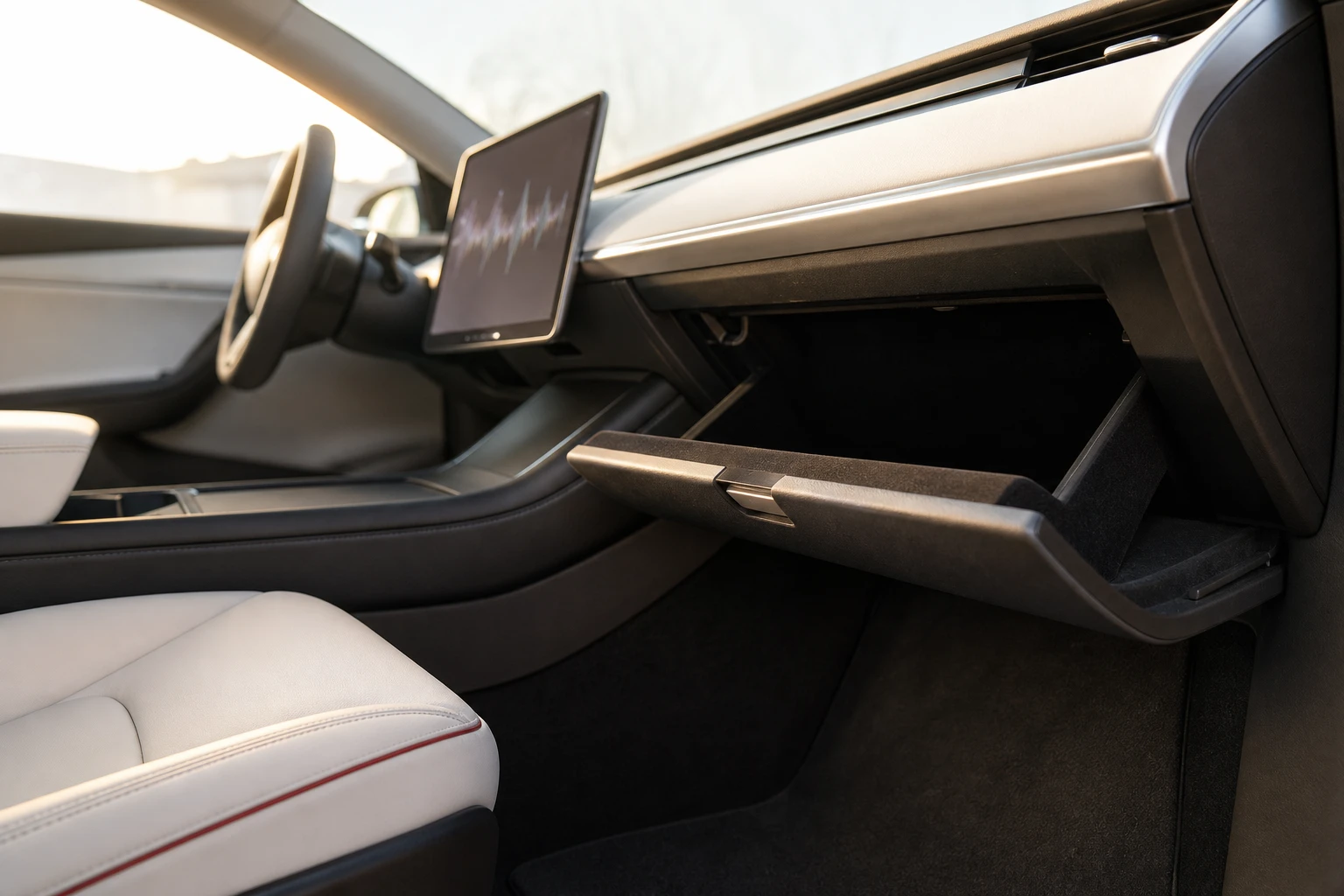
Tesla started pushing its Summer 2026 software update this week, and for the first time, Grok can reach past the touchscreen and actually touch the car. The in-car assistant can now place phone calls, find and play music, adjust the cabin temperature, and pop open the glovebox, all by voice.
That is the update most owners will notice. The one most will not: the same software handing Grok its first real hardware access rides on top of a corporate structure that turned a $2 billion Tesla board decision into a stake in a rocket company, while the automaker’s own filings show hundreds of millions of dollars a year flowing to the AI lab behind Grok.
Grok Finally Gets Its Hands on the Tesla Cabin
Tesla published the full rundown in its Summer 2026 release notes thread on X. The headline change is Grok moving from a chatbot bolted onto the dashboard to something that can actually operate parts of the car.
| New Grok Capability | What Changed | Before This Update |
|---|---|---|
| Phone Calls | Grok places and manages calls by voice | Not possible; Grok could only converse |
| Music Search and Playback | Finds and queues songs, including from Apple Music | Limited to navigation voice commands |
| Climate Control | Adjusts cabin temperature and fan speed on request | Required the touchscreen |
| Glovebox | Opens the glovebox on a spoken command | First physical actuator Grok could trigger |
| Vehicle Questions | Answers questions about the car’s own systems and specs | General knowledge queries only |
Electrek, which first published the notes in detail, called the added voice control of calls, media, climate and the glovebox the piece Grok was missing, and framed it as the biggest functional jump for the assistant since it arrived.
The update also reworks the mobile app, adding self-driving statistics such as total miles logged under the feature. Tesla is not the only company patching self-driving software in public: Waymo recently pushed a fix after a San Francisco power outage stalled its robotaxis citywide.
Inside the cabin, Caraoke now keeps score for singers, and Automatic Navigation has gotten smarter. Beyond Home, Work and calendar events, the car can now suggest and route to places a driver visits often, like a school drop-off on the way to work or the gym on the way home. Owners can also apply custom wraps to the digital replica of their car shown on the dash, and lock the rear display so back-seat passengers cannot change what is on screen.
Tesla listed several smaller polish items alongside the bigger changes:
- Find Superchargers by name when searching for a destination
- Add Apple Music songs to the queue from search and artist pages
- Set a preferred zoom level for the Self-Driving visualization
- Browser now supports camera and microphone access
- New intro animations for Model 3 and Model Y
The rollout is happening in waves, as Tesla software always does, so it can take weeks to reach every eligible vehicle.
The Line Tesla Said It Would Not Cross
Grok’s climb toward hardware control did not happen overnight. It followed a fairly deliberate sequence, expanding country by country and capability by capability.
- July 2025: Grok debuts in North American Teslas as a pure conversational chatbot with zero control over vehicle functions, a chatbot bolted onto the screen.
- February 2026: Grok reaches European Tesla vehicles through update 2026.2.6, months later than the US, after Tesla worked through General Data Protection Regulation (GDPR), Digital Services Act (DSA) and EU AI Act reviews.
- April 2026: The Spring Update adds the hands-free “Hey Grok” wake word and location-based reminders, but voice commands still work for navigation only.
- July 2026: The Summer Update gives Grok hardware access for the first time, covering calls, media, climate and the glovebox.
One Tesla-focused outlet, Basenor, put it bluntly, noting Grok touching vehicle hardware crosses a line Tesla explicitly did not cross earlier this year. The same report speculated that windows, the trunk, the frunk, the charge port and Sentry Mode toggling are the logical next expansions once Grok proves it can be trusted with a glovebox latch.
Elon Musk has already hinted at where this goes next. In June, he told a Tesla owner that letting Grok issue voice commands to Full Self-Driving is coming in roughly three months, putting a rough target on the calendar for around September 2026.
Grok’s Owner Just Became a $1.25 Trillion Company
While Tesla was teaching Grok to open a glovebox, the company behind Grok was being absorbed into something enormous. In March 2025, xAI acquired X, Musk’s social platform, in a $33 billion all-stock deal. Then, on February 2, 2026, SpaceX acquired the combined xAI-X entity outright.
CNBC described the SpaceX-xAI combination, valued at roughly $1.25 trillion, as the largest merger of all time, with SpaceX itself valued near $1 trillion and xAI near $250 billion. Despite earlier chatter about folding Tesla into the same structure, Tesla was not part of the deal.
It is not the first time Musk has consolidated his own companies this way. In 2015, Tesla acquired SolarCity, a solar business founded by Musk’s cousins where he chaired the board, a deal that drew years of shareholder litigation. The xAI-X-SpaceX rollup follows a similar pattern, just at a scale roughly forty times larger.
Grok’s own numbers help explain why distribution through hundreds of thousands of Tesla dashboards matters. xAI’s annual recurring revenue sits at an estimated $500 million against that $230 billion standalone valuation, a multiple with little precedent, and the company is reportedly targeting $2 billion in ARR by the end of 2026.
A Vote That Failed, and a Check That Cleared Anyway
Tesla shareholders actually tried to slow this down. In November 2025, they cast a nonbinding vote on whether to let the board authorize an investment in xAI. Bloomberg reported 1.06 billion votes in favor against 916.3 million opposed, yet Tesla’s bylaws count abstentions in a way that left the measure short of passing.
consider next steps in light of this level of shareholder support
Tesla General Counsel Brandon Ehrhart said that in the days after the vote, signaling the board was not done with the idea.
It was not. On January 28, 2026, Tesla told shareholders it was investing $2 billion in xAI’s Series E round anyway, smaller than the up to $5 billion once floated, structured as preferred stock alongside a collaboration framework. The round valued xAI at $230 billion and drew other backers including Valor Equity Partners, Fidelity, the Qatar Investment Authority, Nvidia and Cisco.
Tesla’s own annual report noted that any xAI investment would be treated as a related party transaction under its governance policy, a nod to how closely the deal sat to Musk’s own interests. Tesla completed the $2 billion investment on March 12, 2026. By then, SpaceX had already absorbed xAI, so Tesla’s preferred shares converted into SpaceX Class A common stock instead, reportedly worth less than 1 percent of SpaceX.
Hundreds of Millions in Megapacks
Set the equity swap aside, and the cash flowing between Tesla and Musk’s AI operation is its own story. The numbers climbed fast:
- $198.3 million in 2024 transactions with xAI, of which about $191 million was Megapack purchases, per Tesla’s proxy filing
- $430 million in 2025 revenue that Tesla recognized from xAI for Megapack sales, per its 10-K
- $269 million in Megapack purchases by xAI in April 2026 alone, more than all of 2024 combined, per SpaceX’s amended IPO filing reported by Electrek
- Roughly $1 billion in total Megapack spending by xAI since 2024
The relationship runs both directions. SpaceX bought $131 million worth of Cybertrucks at MSRP in 2025, a purchase that padded Tesla’s Cybertruck sales figures, and separately obtained $147 million in goods and services from Tesla that year, up from just $4 million in 2024. Add it up and Tesla booked $573 million in revenue from xAI and SpaceX combined in 2025.
What Do Tesla Owners Actually Give Up?
Grok is now allowed to hear more of a driver’s life, and the tradeoffs are worth naming plainly. Tesla says conversations with Grok stay anonymous and are not tied to a vehicle or account unless a user separately signs in to sync history, and the assistant auto-dismisses after about 15 seconds of inactivity to limit background listening.
Regulators have not taken that at face value everywhere. Grok’s European rollout was delayed for months while Tesla worked through GDPR, the Digital Services Act and the EU AI Act, and only launched once vehicles with the right hardware and a Premium Connectivity or WiFi connection cleared those reviews. Grok has also drawn separate scrutiny this year, including CNBC reporting that the chatbot faced criticism for generating sexualized images on the X platform, a reminder that the assistant now gaining access to a family’s glovebox and phone calls carries a trust record built somewhere else entirely.
That does not change what just shipped. Grok can genuinely do more for Tesla owners than it could a week ago. But the $2 billion Tesla’s board committed over shareholder objections did not end up funding an AI company at all. It ended up converted into a sliver of SpaceX, the same SpaceX that now owns the AI voice learning to open a glovebox in millions of driveways.
Frequently Asked Questions About Tesla’s Summer 2026 Update
Which Tesla Models Support the New Grok Controls?
The hardware voice controls need an AMD Ryzen-based infotainment computer, standard in Tesla vehicles built from around December 2021 onward, across Model S, 3, X, Y and Cybertruck. A Premium Connectivity subscription or an active WiFi connection is also required, since Grok’s processing happens off the car.
Does Using Grok in a Tesla Cost Extra?
No new charge has been announced beyond what owners already pay. Grok works over Premium Connectivity, Tesla’s roughly $10 monthly connectivity package, or a WiFi connection at no additional fee for the voice features themselves.
Can Grok Control Full Self-Driving Yet?
Not yet. Musk said in June 2026 that voice commands for Full Self-Driving are coming in about three months, putting a rough arrival around September 2026, separate from the calls, climate and glovebox controls in this update.
Is Grok Recording Conversations Inside the Car?
Tesla states that conversations are processed anonymously and are not linked to a specific vehicle or Tesla account unless a driver manually signs into a separate Grok account to sync history across devices. The assistant also automatically closes itself after roughly 15 seconds of inactivity.
When Will Every Tesla Get the Summer 2026 Update?
The rollout began in early July 2026 and is moving in waves, with Tesla reportedly targeting broad fleet coverage by the end of the month. Based on past release patterns, some vehicles could still take a few additional weeks to receive it.