Tây Ninh Province wants to be Vietnam’s next high-tech farming powerhouse. Billions of đồng are pouring into automated hatcheries, robotic dairy barns and drone-mapped sugarcane fields. The province asking investors to trust its paperwork is, legally, barely a year old.
Long An merged into Tây Ninh on June 12, 2025, roughly doubling its map overnight. Now the companies building automated chicken complexes, expanding dairy herds and running AI-guided sugar mills say the biggest obstacle to their multi-trillion-đồng plans is not competition or weather. It is land certificates, site clearance and a provincial bureaucracy still finding its footing.
A Province That Doubled Overnight
Vietnam’s National Assembly passed Resolution 202/2025/QH15 on June 12, 2025, with a near-unanimous vote, folding the entire territory and population of Long An into Tây Ninh under the Tây Ninh name. The reform consolidated the country from 63 provinces to 34, and a two-tier local government structure took over provincial administration on July 1, 2025.
The old Tây Ninh brought an international border with Cambodia, an industrial base and livestock know-how. Long An brought Mekong Delta rice paddies, dragon fruit orchards and pineapple farms. Combined, the new province now stretches from the Mộc Bài border gate to the delta, with four countries’ worth of trade routes running through it.
| Category | Former Tây Ninh | Former Long An | Merged Tây Ninh Today |
|---|---|---|---|
| Region classification | Southeast Vietnam | Mekong Delta | Southeast Vietnam, under the 2025 national master plan |
| Signature agriculture | Rubber, sugar plantations, livestock | Rice, dragon fruit, pineapple, sugarcane | Combined livestock, crop and export corridor |
| Key connectivity | Mộc Bài international border gate | Tân An capital, Mekong waterways | Border gate, port access and new HCMC expressways |
The scale is already showing up in investment data. In the first nine months of 2025, the merged province licensed 157 new FDI projects worth $815 million, spanning food processing, textiles, machinery and electronics. Agriculture is meant to be the flagship of that growth, not a side note.
Hùng Nhơn’s Bet on Halal Chicken and Breeding Eggs
Vũ Mạnh Hùng, chairman of Hùng Nhơn Group, a Vietnamese agribusiness conglomerate, is building the DHN Tây Ninh High-Tech Agriculture Complex. It comprises eight projects worth several trillion đồng, two of which are already running.
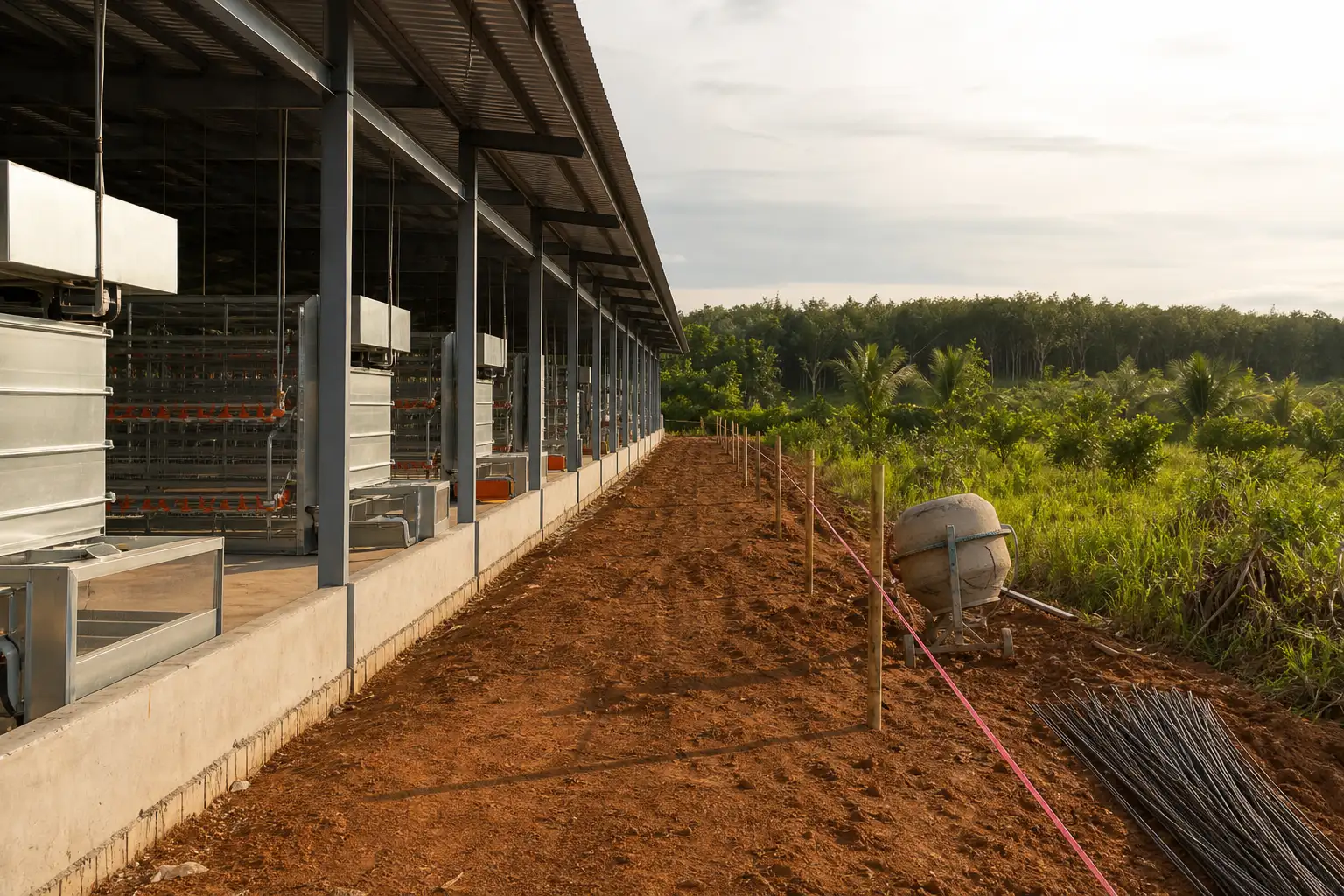
The DHN Tây Ninh High-Tech Livestock Farm in Tân Hội Commune cost VNĐ200 billion ($7.6 million) and produces around 20 million breeding eggs a year. DHN Tây Ninh 5, in Tân Thành Commune, cost the same and houses about 196,000 breeder chickens, supplying roughly 28 million breeding eggs annually. Both run on closed-house systems that track temperature, humidity, feeding and water automatically, under Industry 4.0 controls.
Once the full complex is finished by 2030, Hùng Nhơn expects it to supply, every year:
- More than 20,000 parent breeding pigs
- Over 10 million chicks
- Around 30,000 tonnes of chicken meat
- Approximately 500 million eggs
The complex sits inside a much larger bet. Hùng Nhơn’s partnership with De Heus, a Dutch livestock nutrition company, has already produced 15 projects across Tây Ninh and the Central Highlands. Executives from both companies met Vietnam’s agriculture minister in May 2026 to present a 2026 to 2036 roadmap targeting $2 billion in revenue, built on 200 million day-old chicks and 25 million export broilers a year.
The export target behind that math is halal certification, aimed at a market of more than two billion Muslim consumers. Hùng has said the closed-chain model is meant to fix a longstanding weakness in Vietnamese farming.
Stable, high-quality production benefits not just businesses, but also farmers and consumers.
Vũ Mạnh Hùng made that case for the closed-loop model, which he says ties biosecurity and traceability standards directly to farmer incomes rather than treating them as separate goals.
Why Are 3.7 Hectares Holding Up a Slaughterhouse?
Roughly 3.7 hectares of uncleared land are stalling one of Hùng Nhơn’s own approved projects, leaving a fragmented construction site and a delayed timeline. That single number captures the gap between Tây Ninh’s investment pitch and its administrative reality.
Hùng said some projects that already hold investment approval still need several months to secure land use rights certification. DHN Tây Ninh 6 is the clearest case: construction cannot proceed cleanly while that patch of land sits in limbo.
A separate decision, to split the site for a high-tech slaughterhouse away from the food processing complex, has cut into the efficiency of a chain that was designed to run as one integrated, internationally certified operation. Land clearance and site planning were supposed to be settled before ground broke. Instead they are running in parallel with construction, at a facility meant to feed exports the province is counting on.
All of this is happening while the province’s own governing apparatus is still less than a year removed from absorbing an entire second province, its staff and its backlog of paperwork.
Vinamilk Races the Rainy Season to Double Its Herd
Đoàn Quốc Khánh, executive director for raw material development at Vinamilk, Vietnam’s largest dairy producer, says the company’s Green Farm in Tây Ninh represents an investment of more than VNĐ1.2 trillion ($45.8 million) across 685 hectares in Long Khánh Commune, Bến Cầu District.
The farm is not new. Vinamilk’s own history shows the site was approved to operate in December 2013, more than a decade before the provincial merger. What is new is the expansion Vinamilk wants approved now.
The farm currently milks more than 8,000 cows, with average yields between 28 and 30 kilograms per cow per day. Robotic feed pushers, electronic health chips, automated milking systems, biogas power and recycled water for organic rice cultivation all run on site. Khánh said the company wants authorities to speed up legal procedures so urgent construction can start before the rainy season arrives.
Two projects are waiting on that approval: a second phase that would double the herd to around 16,000 cows, and a new 13.6-hectare dairy processing plant. Neither can break ground on Vinamilk’s preferred schedule without faster paperwork than the current system has delivered.
TTC AgriS Leans on Drones as Land Runs Short
Đặng Huỳnh Ức Mi, chairwoman of Agris Tây Ninh JSC, is developing close to 18,000 hectares of sugarcane, producing around 1.1 million tonnes of cane each harvest. She expects that area to grow to almost 20,000 hectares in the 2026-27 crop season.
Two sugar mills process about 1.5 million tonnes of cane a year, yielding roughly 345,000 tonnes of sugar alongside biomass power, solar energy and organic fertiliser. The company’s AgriOS platform layers artificial intelligence, remote sensing, drones, drip irrigation and electronic farm records over that operation, cutting the manual guesswork out of a 18,000-hectare growing area.
Mi’s own list of obstacles reads differently from Hùng Nhơn’s or Vinamilk’s: shrinking agricultural land, fragmented farm ownership, incomplete irrigation infrastructure, complex administrative procedures and a shortage of young skilled workers. Technology can route around some of that. It cannot manufacture more contiguous farmland or settle disputed plot boundaries on its own.
Agris Tây Ninh’s parent company, publicly traded as TTC AgriS on the Ho Chi Minh Stock Exchange, has set a VNĐ60 trillion revenue target by 2030, alongside a $2.7 billion market capitalisation goal. That ambition sits inside a wider wave of high-tech livestock and crop investment moving through southern Vietnam, including rival efforts such as a 1 million pig herd goal by 2028 from a separate partnership in the southern provinces.
The Province’s Side of the Bargain
Despite operating in three different sectors, breeding chickens, milking cows and cutting cane, the businesses arrived at nearly identical requests: faster administrative processing, simplified investment procedures, better shared infrastructure, stronger support for land consolidation and more favourable long-term investment policies.
- Faster administrative processing for approvals already in the pipeline
- Simplified investment procedures for multi-phase projects
- Better shared infrastructure around concentrated farming zones
- Stronger support for consolidating fragmented land parcels
- More favourable long-term investment policies
Đinh Thị Phương Khanh, deputy director of Tây Ninh’s Department of Agriculture and Environment, said high-tech agriculture would remain a strategic priority as the province works to raise productivity and build a greener farming sector. Her department is pushing mechanisation, digital transformation and production area codes for crops and livestock, while also helping cooperatives with branding, financing access and traceability.
Huỳnh Văn Sơn, vice chairman of the provincial People’s Committee, has pointed to the merged province’s location connecting the Southeast region with the Mekong Delta, its border gates, international port and expanding transport links as the foundation for large-scale, export-linked agriculture. He has pledged to keep addressing investor obstacles as they come up.
The numbers on the table stretch out over a full decade, from the merger that redrew the map to the revenue targets companies are chasing on the far side of it.
- June 12, 2025: The National Assembly passes Resolution 202/2025/QH15, merging Long An into Tây Ninh effective immediately.
- July 1, 2025: The merged province’s two-tier local government structure begins operating.
- 2026-27 crop season: Agris Tây Ninh’s sugarcane area is set to expand toward almost 20,000 hectares.
- 2030: Target year for the DHN complex’s full output, the province’s 60 percent and 90 percent tech-adoption goals, and TTC AgriS’s revenue and market-cap targets.
- 2036: Target year for the Hùng Nhơn and De Heus partnership’s $2 billion annual revenue goal.
By 2030, Tây Ninh wants 60 percent of its key crop production areas farming with high-tech methods, and 90 percent of concentrated livestock farms running advanced technology. Those targets assume the land certificates, site clearances and shared infrastructure get resolved well before the decade is out.
Frequently Asked Questions
How many of Vietnam’s provinces have merged since 2025?
Vietnam’s National Assembly cut the country’s provincial-level units from 63 to 34, made up of 28 provinces and six centrally run cities, in a resolution passed on June 12, 2025 with roughly 99 percent approval among deputies. Long An and Tây Ninh were one of 23 newly formed pairings in that reform.
Can pork from Tây Ninh’s livestock complexes carry halal certification?
No. Halal certification applies to the poultry and processed chicken products moving through the DHN complex and De Heus’s partner farms, not to pork or pig products, since pigs are not halal animals under Islamic dietary law. The pig-breeding side of these projects targets domestic and other export markets instead.
Does TTC AgriS operate outside Vietnam?
Yes. Beyond its roughly 17,000 to 18,000 hectares of sugarcane in Tây Ninh, the company’s raw material areas stretch across more than 72,000 hectares total, including operations in Laos, Cambodia and Australia, according to the company’s own reporting.
Do these mega-farm projects create local jobs?
Each Hùng Nhơn and De Heus project reportedly creates around 100 stable local jobs, with technical training in Global GAP, ISO and halal standards offered to workers, including in border communities with large ethnic minority populations.