A six-year-old named Zoey tilts her head back against a switch mounted behind her seat, and a robotic arm lifts a bite of food to her mouth. Zoey uses a wheelchair and ventilator after a car accident, and the arm belongs to Obi, a feeding robot that is one of dozens of devices inside a new demonstration home in Maumee, Ohio.
Sunshine Communities, a nonprofit that supports people with developmental disabilities across northwest Ohio, opened the space on July 15. Nothing inside the Tech House is for sale. Nationally, close to a third of assistive devices bought without a trial run are later abandoned, according to decades of rehabilitation research.
The House Runs on Switches, Not Salespeople
Zoey and the Robotic Arm
Zoey uses adaptive switches placed behind her head to control several pieces of equipment inside the house, including a computer and Obi. By tilting her head back and pressing a sensor, she can eat a meal or play games on a screen.
The Obi helps me pick up all sorts of food that I want to eat.
Zoey said, describing the device that now sits at her spot during meals inside the demonstration home. She added that other equipment in the house lets her play games, including one modeled on jumping Hello Kitty game boards.
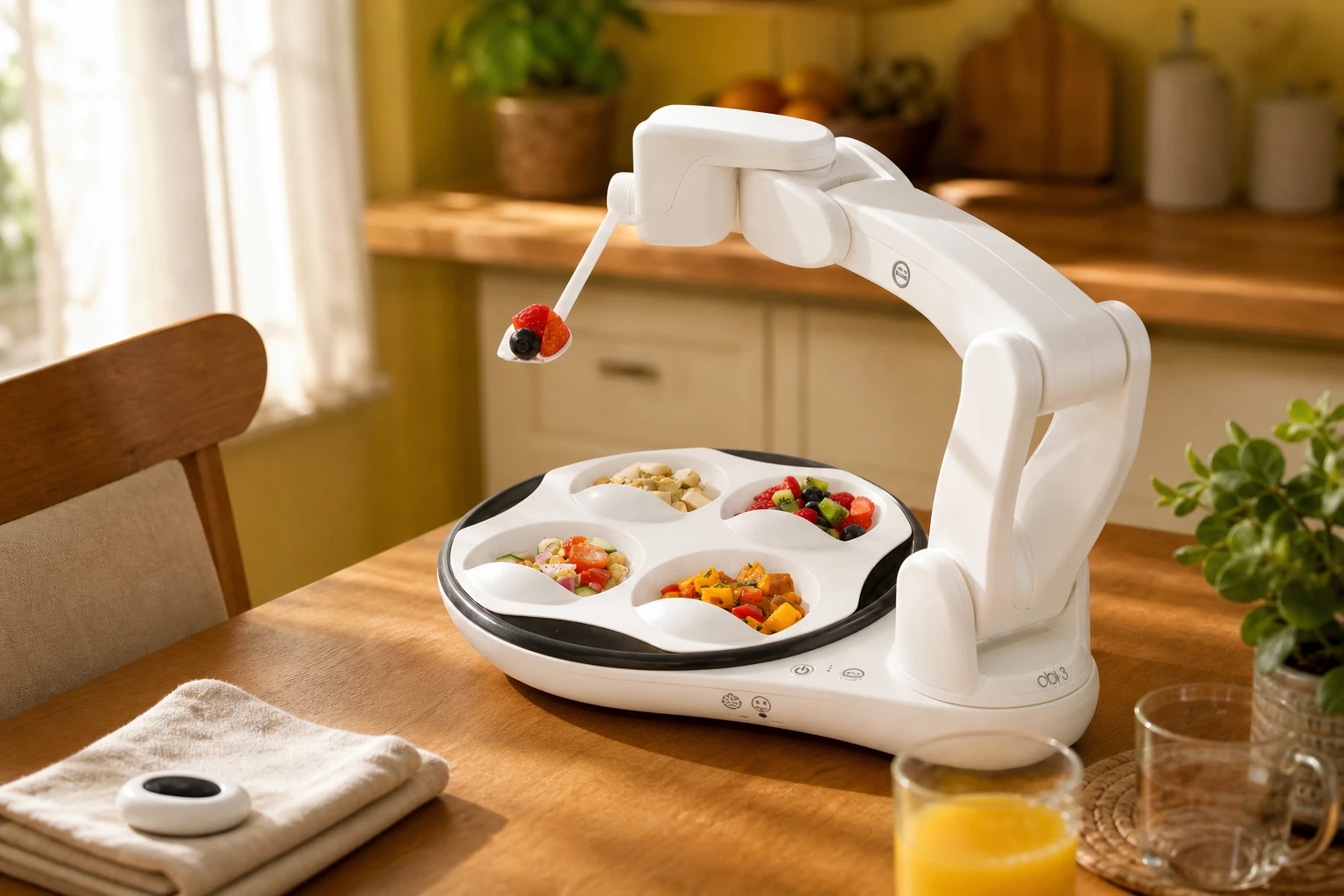
Obi scoops food from one of four compartments and delivers it to the same spot near a diner’s mouth every time, a motion it learns once and repeats from then on. The newest version ships with four food compartments and switch based controls that let almost any part of the body trigger a bite, whether that is a head tilt, a hand press or a sip and puff tube.
A Microwave That Reads Barcodes
The house also includes a microwave and an air fryer built around scan to cook technology. Audrey King, Sunshine’s manager of technology integration, said a visitor only needs to scan a food package’s barcode with an app, and the appliance sets its own cook time automatically.
King said the broader goal is awareness. Much of the technology on display is new enough that most families, and even many professionals, have never encountered it. The house is built to close that gap across a wide range of needs, from communication to mobility to daily meals.
A $6,000 Robotic Arm and the Cost of Guessing Wrong
Obi’s manufacturer does not publish a retail price and typically routes buyers through a funding consultation instead. One user who documented his own purchase of the device, made after losing arm mobility, put the cost at roughly six thousand dollars, in line with similar robotic feeders on the market.
That price tag is exactly why a room where people can try a device before committing to it carries weight. A frequently cited 1993 survey of 227 adults with disabilities found that 29.3% of all devices were completely abandoned, with mobility equipment abandoned more often than any other category and failure rates highest in the first year of ownership.
“The Tech House gives people the opportunity to experience technology before making important decisions,” King said. Touring the home-like layout, she said, helps visitors gain confidence in choosing solutions that support independence and safety instead of guessing from a catalog page.
Research on device abandonment spans several categories of assistive technology, and feeding aids are far from the only one.
| Device Category | Reported Abandonment | Source |
|---|---|---|
| All assistive devices, general population | 29.3% completely abandoned | 1993 survey of 227 adults with disabilities |
| Hearing aids | Up to 78% | Cited across multiple rehabilitation abandonment reviews |
| Low vision optical devices | 17% to 50% | Frontiers in Digital Health review, 2025 |
| Mobility aids for older adults | 20% to 50% discontinuation | ECOCAT study of a French geriatric cohort |
The same 1993 study identified four recurring causes behind abandonment: little consideration of the user’s own opinion during selection, procurement that was too easy or rushed, poor device performance once in use, and needs that changed after the purchase. A showroom that lets someone test a device for an afternoon addresses the first cause directly.
Ohio’s Tech House Joins a Program Already Serving Millions
The Maumee house did not invent the try-before-you-buy model. It is a local outpost of a federal framework that has existed in some form since the 1990s and was most recently reauthorized as the 21st Century Assistive Technology Act.
Under that law, every state, four territories, the District of Columbia and Puerto Rico, 56 grantees in all, run programs built around four core activities.
- AT Demonstration – hands-on device comparisons guided by a trained specialist, the same format Sunshine built into its house
- AT Device Loan – short-term borrowing, typically 30 to 45 days, to test a device in real daily routines before buying
- AT Reutilization – refurbished devices resold or donated at steep savings once an original owner no longer needs them
- State Financing – low-interest loans or alternative financing once a family has decided which device fits
The Association of Assistive Technology Act Programs, the national group that coordinates the state offices, says its members have served more than 6.5 million people since 2014, leveraging $291 million in outside funding along the way. Ohio runs its own version of this system, separate from the specific grant that funded the Maumee house.
Who Paid for Maumee’s Tech House?
The Ohio Department of Developmental Disabilities, known as DODD, funded the project through its Innovative Technology Solutions Grant, a program built to integrate emerging technology into services for Ohioans with developmental disabilities. The Lucas County Board of Developmental Disabilities, known as Lucas DD, partnered with Sunshine Communities to run the house day to day.
Lucas DD serves more than 4,500 individuals across the county through service coordination, Medicaid administration, provider support and early intervention, per the July 15 grand opening event listing. Michele Myerholtz, the agency’s superintendent, described the partnership as a significant investment in expanding local access to assistive technology.
More Than 4,500 Families Fall Within Reach
The grand opening on July 15 ran from 1 to 5 p.m. at Building I, 7223 Maumee Western Road, and organizers opened it to providers, health care professionals, educators, community partners, families and the general public. Ongoing visits work differently. Anyone who wants to try the equipment now has to schedule an appointment first.
That reservation system is deliberate. Instead of one large group tour, each visit can focus on a single family’s actual situation, whether that means a child learning switch access for school or an older parent exploring smart home controls for the first time.
King said the range of new assistive technology remains something many people simply do not know exists, and that unfamiliarity, more than cost or eligibility, is often the first barrier the Tech House was built to remove.
Frequently Asked Questions
What Is an Assistive Technology Act Program?
It is a federally funded state office, one in all 50 states plus several territories, that runs free or low-cost device demonstrations, short-term loans, refurbished equipment reuse and financing help. Short-term loans typically run 30 to 45 days before a device must be returned, giving a family a real trial period rather than a single appointment.
Can Veterans Get Obi at No Cost?
Qualifying military veterans can receive the device through VA benefits because the manufacturer lists Obi on the federal Supply Schedule, according to the company’s own veterans program information. Processing is typically handled directly between the veteran, the VA and Obi’s team.
Does a Visit to the Tech House Cost Anything?
The July 15 grand opening was free and open to the public. Ongoing visits require scheduling an appointment in advance, and Sunshine Communities has not published a separate fee for standard tours.
What Other Assistive Devices Exist Beyond What Is in Maumee’s House?
State-run demonstration centers elsewhere stock far more than kitchen gadgets. Minnesota’s Lighthouse Center, for example, lends smart home devices that operate lights and televisions by voice command, along with computers, tablets and specialized keyboards for telehealth visits.
Where Can Someone Outside Ohio Find a Similar Program?
Every state and several U.S. territories run a federally funded AT Act program offering free demonstrations or loans. A national directory maintained by the AT3 Center, the technical assistance hub for every state program, can point residents to their local office regardless of where they live.