
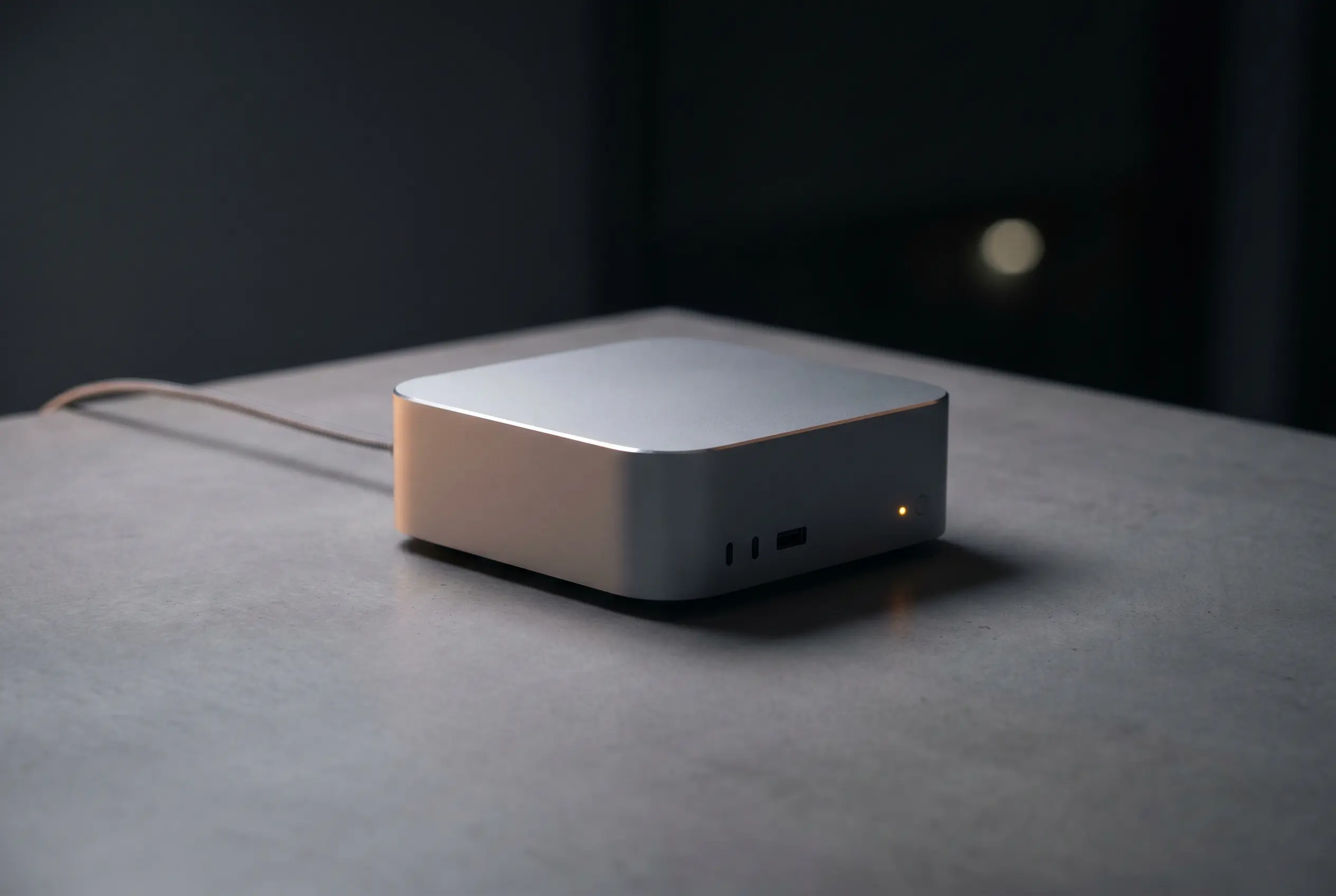
Perplexity has started shipping free Mac minis to a small group of tech creators, a giveaway that lands just as Apple’s smallest desktop has become its hardest to keep in stock. The AI startup confirmed to Business Insider that it sent the machines to people “interested in getting the maximum use case out of Personal Computer in the Perplexity Mac app,” the company’s new agent software. Free hardware to influencers is a familiar play in consumer tech, and on its own it would be a footnote.
Behind the unboxing posts sits a real shift in how a budget desktop is being used. The same Mac mini that started at $599 last year now starts at $799, Apple has dropped its lowest-storage version entirely, and chief executive Tim Cook has told investors the device could stay scarce for months. The marketing stunt is the surface. The repricing of Apple’s entry desktop is the part worth reading closely.
A Free Desktop Lands on Tech Creators’ Desks
The posts began appearing in May. “Officially joined the Mac mini club. Thanks to @perplexity_ai for sending this over,” one creator captioned a photo of the unboxed machine. Several others in the tech-content world followed with similar thank-you notes, the kind of organic-looking endorsement that money usually buys.
Perplexity confirmed it handed out a handful of units. Jesse Dwyer, Perplexity’s chief communications officer, told Business Insider he runs his own Mac mini constantly, controlling it remotely from his other Apple devices. The pitch is that the desktop sits in a corner and keeps working while the user walks away.
The tactic copies a well-worn route. Meta seeded its Ray-Ban smart glasses to creators for unboxing videos; phone makers send review units months ahead of launch. What makes this one unusual is the object being gifted. A desktop computer is not a wearable or a phone. It is a tool you set up once and leave on, which is exactly the use case Perplexity is selling. The company’s chief executive, Aravind Srinivas, has been candid about where his product still trails rivals, telling launch audiences that Google still handles everyday search better than Perplexity. Owning the desktop layer is one way to change that equation.
- $799 is the Mac mini’s new starting price after Apple discontinued the cheaper configuration.
- $200 is the jump from the previous $599 entry point.
- $8.4 billion in Mac revenue landed in Apple’s March quarter, up 6 percent year over year.
What Personal Computer Asks of a Mac mini
Personal Computer is an expansion of Perplexity Computer, the company’s agent that runs tasks across the web. The desktop version reaches into local files and native Mac apps, so it can read a folder, draft from it, and act inside iMessage, Apple Mail, and Calendar. It rolled out to the company’s top-tier Max subscribers on April 16, 2026, and opened to all Mac users in early May.
The software runs on any Mac with macOS 14 Sonoma or later. Perplexity recommends a Mac mini anyway, and the reason is structural rather than promotional. An agent that watches your files and apps is only useful if the machine is always on. A laptop sleeps, travels, and runs on battery. A small desktop bolted to a desk does not.
That is the line Perplexity has pushed since the launch. “On a mini, Personal Computer stays available 24/7 for work that needs a persistent machine or secure local access to your files and native apps,” the company wrote in an April blog post. You can read the framing on Personal Computer’s official Mac product page, and the company laid out the same case in its Personal Computer announcement on X.
Stripped of the marketing, the agent leans on a few specific things a Mac mini does well:
- It stays powered and connected around the clock without a battery to manage.
- It can be reached remotely from a phone, tablet, or laptop while it keeps working.
- It holds local files on the device, so sensitive data never has to leave the machine.
- It runs quietly and sips power, which matters for hardware meant to never switch off.
Apple’s Cheapest Desktop Became Its Hardest to Buy
Apple saw this demand before Perplexity’s giveaway. On the company’s fiscal second-quarter earnings call on April 30, Cook said the Mac mini and Mac Studio had become magnets for AI builders, and that supply could not keep pace.
Both of these are amazing platforms for AI and agentic tools and the customer recognition of that is happening faster than what we had predicted, and so we saw higher than expected demand.
Cook, speaking on the call, said it would take several months to bring the two desktops back into supply and demand balance. He pinned the squeeze on the advanced chip nodes that make Apple’s silicon rather than on memory alone. The same surge hit the company’s new budget laptop, the recently launched MacBook Neo, which sold out with multi-week shipping delays. Mac revenue still reached $8.4 billion for the quarter ended March 28, part of a company total of $111.2 billion, up 17 percent year over year.
The $200 Price Floor and the Memory Crunch Behind It
Apple’s response to a sold-out cheap desktop was to stop selling the cheap version. In early May the company pulled the 256GB Mac mini from its store worldwide and made the 512GB model the new entry point. The 512GB unit always cost $799; what changed is that $599 is no longer an option. For a buyer, that is a flat $200 increase to get into the lineup.
The timing is not a coincidence. A global memory shortage, driven by AI data-center buildouts, has pushed component costs to records. Research firm TrendForce revised its outlook sharply upward for early 2026, expecting conventional DRAM (dynamic random-access memory, the working memory in computers) contract prices to climb 90 to 95 percent quarter over quarter, far above its earlier 55 to 60 percent estimate. The detail is in the firm’s first-quarter memory price outlook.
| Attribute | Previous entry Mac mini | Current entry Mac mini |
|---|---|---|
| Starting price | $599 | $799 |
| Storage | 256GB | 512GB |
| Availability | Discontinued | Constrained, months to balance |
| Chip and memory | M4, 16GB | M4, 16GB |
The wider math is unforgiving for cheap hardware. Every wafer a memory maker pours into high-bandwidth memory for AI accelerators is a wafer not going into consumer parts, and analysts expect AI to swallow roughly a fifth of total DRAM output this year. That is the squeeze that turned a $599 desktop into a $799 one, recorded across the industry in Apple’s own fiscal Q2 results release and echoed by rival PC makers raising prices in step.
Why Power Users Want a Box That Never Sleeps
Perplexity is not the only reason the Mac mini sells out. A bigger pull is the rise of local AI, where models and agents run on a user’s own machine instead of a rented cloud server. Privacy, lower latency, and the steep cost of cloud inference all point the same way.
The clearest example is OpenClaw, an open-source agent that turns a Mac mini into a private, always-on assistant. It connects local tools, manages workflows, and on a base mini runs around the clock on roughly 8 to 15 watts, quiet enough to leave under a desk. Because it lives on macOS, it can even send and receive iMessages through the owner’s iCloud account, so the agent answers in the same chat thread as friends and family.
That combination, a cheap, silent, low-power box that holds your data and never logs off, is why the Mac mini keeps showing up in the same sentence as AI agents. Perplexity’s giveaway simply attaches a recognizable brand to a trend that was already moving. The status-symbol framing is real, but the substance underneath is a hardware category finding a new job.
If local agents keep maturing through the back half of the year, the constraint stops being software and becomes the box itself, and Apple keeps booking the demand whether or not Perplexity ships another unit. If the local-AI wave cools and most agents settle back into the cloud, the Mac mini goes back to being a modest desktop and the $799 floor starts to look like a tax buyers will not pay.
Frequently Asked Questions
Why is Perplexity giving away Mac minis?
Perplexity sent a small number of Mac minis to tech content creators to showcase Personal Computer, its agent software that runs best on an always-on desktop. The company confirmed the giveaway to Business Insider, framing it as a way for users to get maximum use out of the Mac app.
Does Perplexity Personal Computer require a Mac mini?
No. Personal Computer runs on any Mac with macOS 14 Sonoma or later. Perplexity recommends a Mac mini because the agent is designed to stay on 24/7 with local access to files and apps, which suits a persistent desktop better than a laptop that sleeps and travels.
Why did the Mac mini’s starting price go up to $799?
Apple discontinued the 256GB Mac mini that started at $599 and made the 512GB model, priced at $799, the new entry point. The change followed surging demand and a global memory shortage that has pushed component costs to record highs in early 2026.
What is OpenClaw and why does it need a Mac mini?
OpenClaw is an open-source AI agent that runs locally on your own machine instead of a cloud server. A Mac mini suits it because it is compact, quiet, and runs on roughly 8 to 15 watts around the clock, and macOS lets the agent integrate with native apps like iMessage.
When will Mac mini supply return to normal?
Tim Cook said on Apple’s April 30 earnings call that it would take several months to bring the Mac mini and Mac Studio back into supply and demand balance, citing constrained advanced chip production rather than memory alone.