India has wired its villages into the formal banking system. The Finance Ministry told the Lok Sabha that 99.92% of villages now sit within five kilometres of a banking outlet, counting bank branches, banking correspondents and India Post Payments Bank points, as of March 6, 2026. On the metric of physical access, the country is effectively done.
The Reserve Bank’s own scorecard tells a more complicated story. Its inclusion index reads 67 out of 100, and access is only the lightest of the three things that index measures. The frontier has moved from putting an outlet near every household to getting those households to use it.
What the 99.92% Figure Counts, and What It Leaves Out
The number comes from the Jan Dhan Darshak app, a Geographic Information System (GIS, a mapping tool that plots service points against population) used to track where banking touchpoints exist. A village clears the bar if any of three kinds of outlet sits inside a five kilometre radius. The minister of state for finance, Pankaj Chaudhary, gave the figure in a written reply, and noted that the union territory of Dadra and Nagar Haveli has reached full coverage.
What qualifies as an outlet is broader than a brick branch, which is exactly why the figure climbed so high:
- Bank branches, the traditional staffed offices that remain thin on the ground in remote districts.
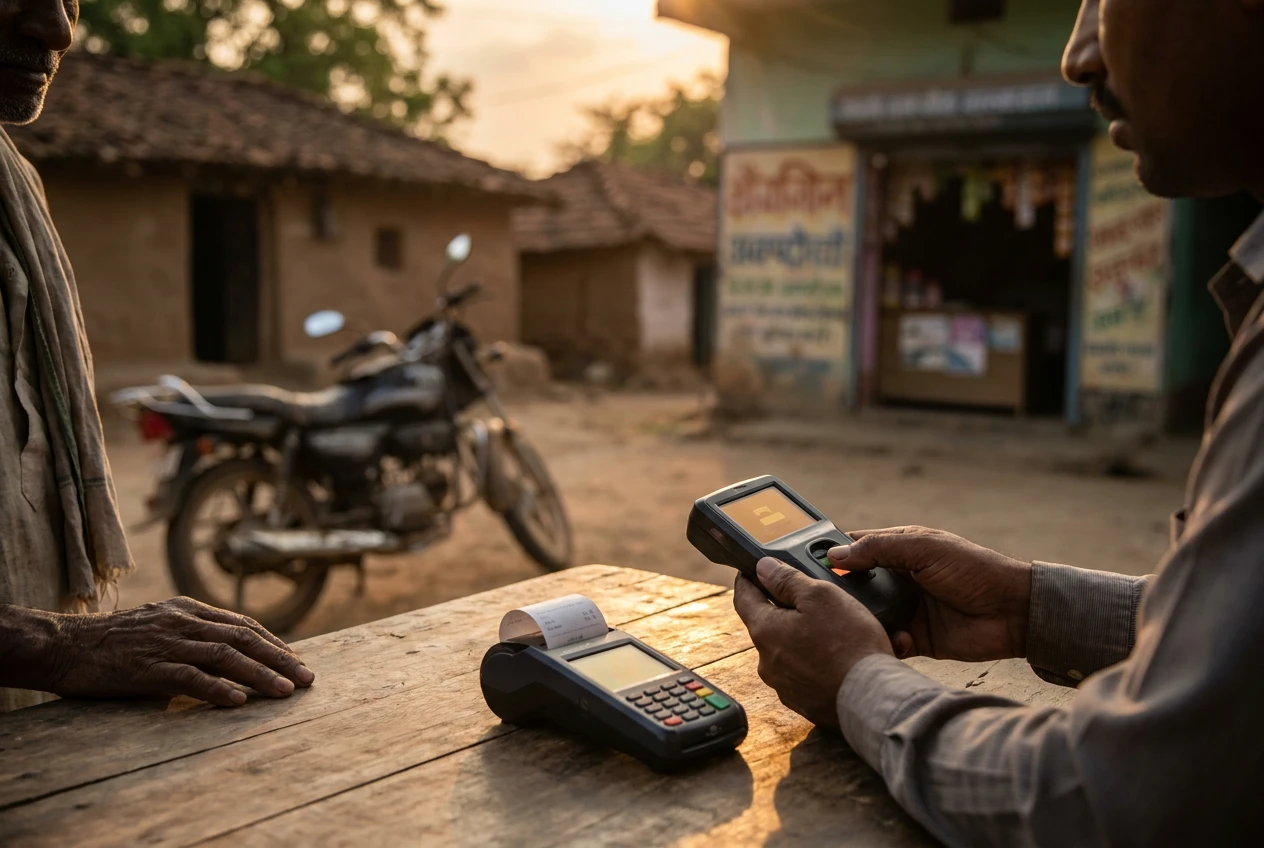
- Banking correspondents (BCs), local agents who carry a micro-ATM and a fingerprint scanner and act as a human counter for cash in, cash out and account opening.
- India Post Payments Bank (IPPB) access points, which turn post offices and postmen into banking channels.
So the headline measures presence, not depth. A single roving correspondent visiting once a week can tick a village green on the map. That counts, and it matters for someone who once travelled half a day to reach a counter. It is also a long way from the everyday convenience a city customer takes for granted. You can read the full village banking coverage statement to Parliament for the exact wording.
Why Access Was the Easy 35%
To see why a near perfect coverage figure sits next to a middling inclusion score, look at how the score is built. the Reserve Bank’s Financial Inclusion Index for March 2025 blends three sub-indices into a single value between zero and 100. Access is one of them, and it is the smallest slice.
The index rose to 67 out of 100 for the year ending March 2025, up from 64.2 a year earlier, a gain of about 4.3%. The RBI said the improvement came mostly from the usage and quality dimensions, not access. That is the tell. Access has little room left to climb because the outlets are already there.
Here is how the weighting works and where each piece stands.
| Sub-index | Weight | What it measures | Current state |
|---|---|---|---|
| Access | 35% | Branches, ATMs, correspondents, digital touchpoints | Near saturation at 99.92% of villages |
| Usage | 45% | Active accounts, formal credit, insurance, transaction frequency | Rising, the biggest drag on the score |
| Quality | 20% | Financial literacy, consumer protection, equity of service | Improving slowly from a low base |
Usage carries the most weight at 45%, almost half the score, and that is the part a banking correspondent map cannot fix on its own. An account that exists but never moves money does nothing for the usage line. The country built the easy 35% first because concrete and contracts scale faster than habits do.
The Dormant Accounts Nobody Puts in a Press Release
The gap between an open account and a used one is not abstract. By official counts, around 11.3 crore Jan Dhan accounts had gone inactive, with roughly 12,000 crore rupees sitting idle in them. An account is treated as inactive once it records no customer transaction for two years, and the Department of Financial Services has said it issued no order to close them, only advice to banks to coax holders back.
That dormancy is the quiet counterweight to the coverage milestone. Outlets reached the villages; the money inside many accounts simply stopped moving.
- 58.26 crore Jan Dhan accounts opened since the scheme began in August 2014.
- 3.01 lakh crore rupees held across those accounts as of May 20, 2026.
- Around 11.3 crore accounts classed as inactive, with about 12,000 crore rupees lying dormant.
- Roughly 5,000 rupees, the average balance per account once total deposits are spread across every account.
From Building Branches to Building Habits
The Pradhan Mantri Jan Dhan Yojana (PMJDY, the no-frills account scheme launched in 2014) was always meant to be a doorway, not a destination. The plan paired free basic accounts with RuPay debit cards, small overdrafts and a rail for direct benefit transfer (DBT, the system that pays subsidies and wages straight into accounts).
That rail is where usage actually grows. When a cooking-gas subsidy, a pension or a wage lands in an account, the holder has a reason to open the app or visit the correspondent. The Jan Dhan scheme reports 40.50 crore RuPay cards issued, a sign of how many of those accounts now carry a usable payment tool. The headline totals appear in the Jan Dhan scheme’s latest account data.
Digital payments did much of the heavy lifting. The Unified Payments Interface (UPI, India’s instant phone-based transfer network) turned a basic account into something a shopkeeper or a daily-wage worker could tap several times a day, which is precisely the transaction frequency the usage sub-index rewards.
Banks, though, do not earn much from these thin balances, and that shapes how hard they push to activate them. Lenders have warned that the comfortable margins of the past decade are under pressure, a backdrop covered in our report on profit margins at Indian banks set to shrink.
So the work ahead is less about steel and signage and more about behaviour. Getting a dormant account to transact even once a month is harder, slower and far less photogenic than cutting a ribbon on a branch.
Where the Last Gaps Still Sit
The uncovered sliver is small in percentage and stubborn in geography. The remaining 0.08% tends to cluster in hilly, forested and sparsely settled pockets where even a weekly correspondent visit is hard to sustain, and where mobile signal, the thing that makes a micro-ATM work, can be patchy.
The deeper gap is the one the coverage map never shows: people who have an account but do not trust it, do not understand it, or lack the literacy to use it without help. When formal channels feel distant, households fall back on informal ones, which is part of why gold-backed borrowing keeps climbing, as our coverage of the surge in gold loans across Indian households showed.
If the next phase lifts the usage and quality sub-indices the way the last decade lifted access, the 67 score will keep climbing toward the milestone the coverage number already hit. If activation stalls and dormant accounts keep piling up, the country ends up with a banking network that reaches everyone and serves a narrower slice of them than the map suggests.
Frequently Asked Questions
What does 99.92% village banking coverage actually mean?
It means 99.92% of villages have at least one banking outlet, a bank branch, a banking correspondent or an India Post Payments Bank point, within five kilometres, as of March 6, 2026. It measures physical access, not how often residents use those outlets.
Why is India’s financial inclusion index only 67 if access is near complete?
Because access is just 35% of the Reserve Bank’s index. Usage counts for 45% and quality for 20%, and both lag behind access. The index reached 67 for the year to March 2025, driven mostly by gains in usage and quality rather than further access.
How many Jan Dhan accounts are inactive?
By official counts, around 11.3 crore Jan Dhan accounts are classed as inactive, with roughly 12,000 crore rupees lying idle. An account becomes inactive after two years with no customer transaction.
Will inactive Jan Dhan accounts be closed?
No. The Department of Financial Services has said it issued no instruction to banks to close inactive Jan Dhan accounts. Banks have instead been advised to contact holders and encourage them to reactivate their accounts.
How many Jan Dhan accounts exist and how much do they hold?
The scheme reports 58.26 crore accounts holding about 3.01 lakh crore rupees as of May 20, 2026, with 40.50 crore RuPay debit cards issued since the programme launched in August 2014.
What is a banking correspondent?
A banking correspondent is a local agent appointed by a bank who carries a micro-ATM and a biometric scanner to offer cash deposits, withdrawals and account openings in areas without a full branch. They are central to how rural coverage reached near saturation.