Davao City logged 45,621 business permit applications in January, up about 3% from a year earlier, and officials are crediting reliable water for the surge. Nearly all of that January total, though, lands inside a mandatory annual renewal window that applies to every existing business in the city, not just new ones opening their doors.
The bulk water deal behind that reliability locks in guaranteed, exclusive revenue for 30 years. The venture is backed in part by BlackRock, the world’s largest asset manager, even as Davao households absorb some of the steepest water rate increases in the utility’s history.
The Permit Count Behind Davao’s Confidence Claim
The Davao City Business Bureau logged 45,621 permit applications between January 1 and 31, 2026, up from 44,410 in the same stretch of 2025, according to figures the bureau shared with Mindanao Times this month. “Most of our registrations are coming from retail and services, sari-sari stores, groceries, distributors, and all kinds of service contractors,” said Maribel T. Paguican, head of the Business Bureau.
That single month very nearly matches an entire year’s worth of filings from earlier in the decade. The city logged 52,219 permit applications across all of 2024, a record at the time, up from 50,792 in 2023 and 49,935 in 2022. Of that 2024 total, only about 12%, or 6,496 filings, were genuinely new businesses.
The rest were renewals, and Davao requires every existing business to file one every January or pay a 25% penalty. The renewal of business permits for 2026 ran from January 5 to 31, the same window covered by the bureau’s headline number. That citywide filing deadline, more than any wave of new store openings, fills January’s tally.
| Period | Permit Applications | Change |
|---|---|---|
| Full year 2022 | 49,935 | Baseline |
| Full year 2023 | 50,792 | +1.7% |
| Full year 2024 | 52,219 | +2.8% |
| January 2025 only | 44,410 | Baseline |
| January 2026 only | 45,621 | +3.0% |
Set side by side, the growth looks steady rather than explosive, and it tracks a predictable renewal calendar more than a rush of new entrants.
Two Days Without Water, Then None
For businesses that lived through Davao’s old water problems, the numbers matter less than the tap. Evelyn del Campo runs a carinderia, a small roadside eatery, in Barangay Indangan. Speaking in Cebuano, she described what service used to look like.
We really had problems before because the water would be gone for two days at a time, so we had to fetch water ourselves. Sometimes, it would suddenly stop without warning, which really stressed us out. Now, we hardly experience any water interruptions, and the pressure is strong again.
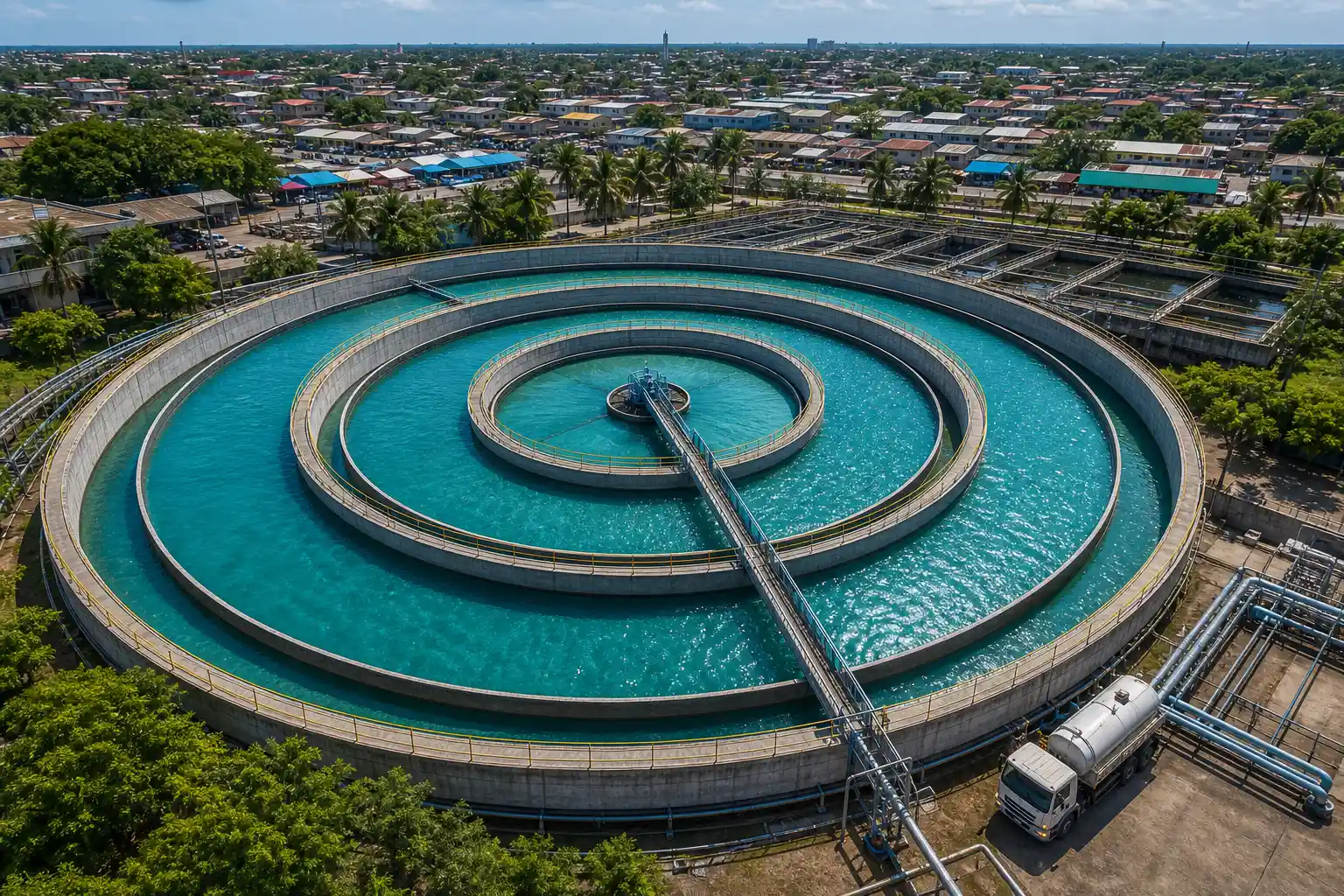
Del Campo’s relief traces to a single project. The Davao City Bulk Water Supply Project, a public-private partnership between the Davao City Water District (DCWD) and Apo Agua Infrastructura, Inc., treats surface water drawn from the Tamugan River and delivers up to 300 million liters a day into DCWD’s network. DCWD has cited more than two years of consistent 300-million-liter days since the plant came online in December 2023.
Who Owns Davao’s Water Pipeline?
Apo Agua Infrastructura is a 70:30 joint venture between Aboitiz InfraCapital, the infrastructure investment arm of the Aboitiz Group, and J.V. Angeles Construction Corporation. Aboitiz InfraCapital itself is partly owned by BlackRock, the world’s largest asset manager. BlackRock holds a 40% stake spanning Philippine airports, water and telecom assets, acquired through its Global Infrastructure Partners platform.
The company’s own account of its ownership structure confirms the joint venture setup. The DCWD arrangement runs 30 years, with terms that shield Apo Agua from a lot of the risk a typical business carries.
- Exclusivity – Apo Agua cannot sell any treated water to a buyer other than DCWD.
- Penalty clause – the company owes a 6% penalty if it fails to deliver its committed daily volume, a floor on performance, not a ceiling on payment.
- Project cost – the facility was built under a bulk water supply agreement valued at roughly 10 billion pesos.
- Investor exposure – a 40% stake in Aboitiz InfraCapital now sits with BlackRock, tying a Davao utility contract to one of the largest pools of capital on Wall Street.
Bulk water partnerships are built to attract exactly this kind of capital. Thirty-year, government-linked contracts offer the predictable cash flow institutional investors chase, and Apo Agua’s revenue holds steady whether Davao’s permit count rises 3% or dips next January.
The Bill That Came with Reliability
Reliability has a price, and DCWD has been raising it steadily since 2022. The utility has stacked several rate adjustments on top of each other, with more scheduled through 2027, and a separate proposal now under review would make the total increase since 2022 one of the steepest in the utility’s history.
- 12.5% – rate adjustment DCWD implemented in March 2026.
- 15% – additional increase scheduled later in 2026.
- 15% – further increase penciled in for 2027.
- 90% – cumulative rise in Davao water rates since 2022 if a pending 30% increase wins approval.
DCWD has defended the increases as necessary to develop new water sources, expand production wells, upgrade pipelines and cut water lost to system leaks. Critics are not convinced the math holds. A Mindanao-based advocacy group has warned of sustainability risks in DCWD’s bulk water strategy. Business groups have separately pressed the utility on the 30% proposal, questioning whether fuel costs and financing terms were fully accounted for.
Why Davao Still Looks Like the Exception
Set against the rest of the Philippines, the rate hikes read as the price of staying ahead of a supply crisis other cities are still fighting. Metro Cebu is producing about 263,941 cubic meters of water a day against demand of roughly 280,000, a daily shortfall of 16,059 cubic meters. That gap has forced the Metropolitan Cebu Water District into rationing in parts of Talisay City and Cebu City.
Cebu’s water district spent early 2026 bracing for an even deeper hole: a projected deficit of 43,000 cubic meters a day, about 15% of its total output, as the dry season peaked. Its response has leaned on water trucks, new wells and a proposed 7 billion peso dam program with the national Department of Public Works and Highways. Funding approval is still pending, and construction is not expected before 2027.
Davao, by contrast, has run a fixed 300-million-liter daily supply for more than two years. That gap is the backdrop against which Paguican made her case. “Davao City continues to maintain a secure and resilient water supply system, making it one of the key factors that enable businesses to operate efficiently, expand confidently, and invest in the city,” she said, adding that reliable water reinforces the city’s standing as a competitive, business-friendly destination.
A Template Now Headed for Iloilo
Apo Agua’s Davao arrangement is turning into a template rather than a one-off. Local reporting in Iloilo has pointed to the Davao project as a reference model for that city’s own bulk water ambitions, the same exclusivity terms and long-dated contract structure that now run under Davao’s streets.
It mirrors a pattern already visible in Philippine broadband: Converge ICT’s cofounders saw their fortunes surge as the company built out infrastructure marketed as a national connectivity good, with private capital capturing the upside of what was pitched publicly as an essential service rollout.
Davao’s businesses are, for now, getting what they asked for: fewer outages, steadier pressure, a bureau chief with genuinely good numbers to cite. The taps run steadier than they have in years. The bill for that reliability is still being written, one rate hike at a time.