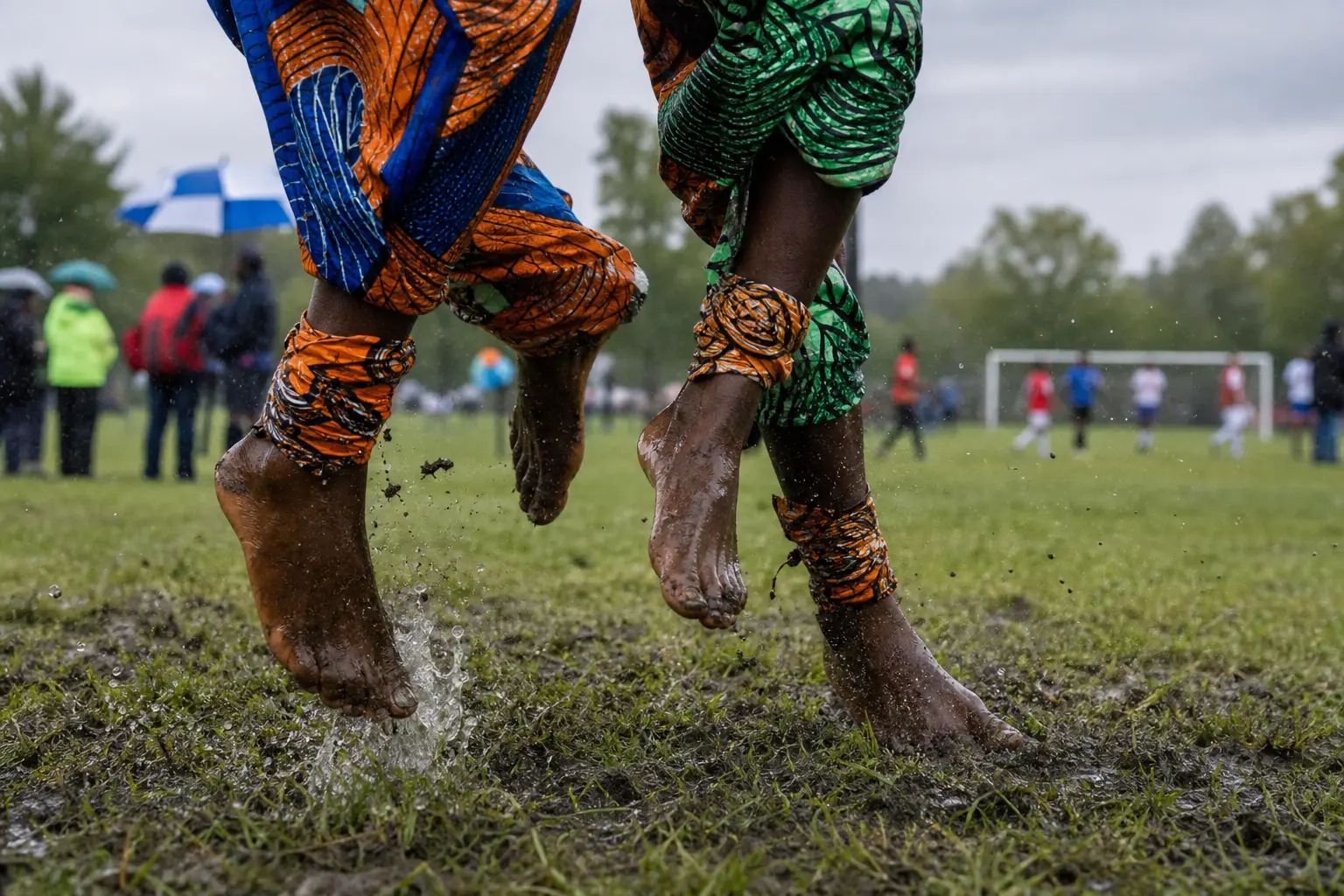
Rain soaked Kennedy Park on May 30, but it did not stop dozens of Portland, Maine, families from turning the muddy field into a soccer pitch and a Nzango court. Nzango is a traditional Congolese foot game built from dance, chanting and fast footwork, and organizers paired it with soccer to pull two audiences, and two generations, onto the same grass.
The afternoon itself was modest: one park, one field of mud, a crowd thinned by weather. But it sat inside something far larger. Portland has spent the past decade becoming one of the fastest demographically shifting small cities in the country, driven largely by arrivals from the Democratic Republic of Congo and Angola, and days like this one are quietly doing integration work that city and state programs have struggled to keep pace with.
Soccer for the Men, Nzango for the Women
Amjambo Africa, a Portland-based outlet covering the region’s immigrant and refugee communities, first reported the gathering, which was organized by Landry Mungoma. His goal was simple: give neighbors who share a city but not much else a reason to stand on the same field.
“We wanted to bring communities together, create a space where everyone can meet, get to know each other, and discover different cultures,” Mungoma said. “We all live here, but we don’t always have the chance to interact. Sport naturally creates those connections.”
He built the program around two tracks. Men played soccer. Women played Nzango, a two-team contest of synchronized foot movements, jumps and chants scored by a referee. “We want to share our culture with our neighbors and friends,” Mungoma said. “Nzango is a traditional game from the DRC, but many people here don’t know it. This event was an opportunity to show that our traditions can also bring people together and be enjoyable.”
Curiosity carried past the Congolese families who came expecting it. One American attendee said she had never seen anything like it. “There was so much energy, coordination, and joy,” she said. “The participants looked genuinely happy.” Another visitor called the format itself useful for a city like Portland. “These activities allow people to discover different cultures in a positive way,” he said. “This is exactly what our communities need today.”
Portland’s Population Is Turning Over, Fast
Portland’s own newspaper put a number on that shift this spring, tracking how much of the city was actually born in Maine across two generations.
| Year | Share of Portland Residents Born in Maine |
|---|---|
| 1980 | 72% |
| 2000 | 59% |
| 2026 | 40% |
Most of that slide has landed since 2019, the same year hundreds of Congolese and Angolan asylum seekers began arriving in Portland within days of each other, overwhelming a city of roughly 68,000 people. Statewide, Maine’s foreign-born population grew to 66,000 residents by 2024, up from 50,000 a decade earlier, according to USAFacts. That is still a small slice of the state, under five percent, but the growth rate outpaces almost anywhere else in New England.
A Migration Policy Institute study of roughly 53,000 Maine immigrants found the state’s newcomers skew heavily working age, arriving as the native workforce ages out, filling gaps in health care, manufacturing and aquaculture. Twenty percent of that population traces to Africa, and Congo and Angola now rank among the top countries of origin for people entering Maine’s immigration courts. None of that growth is evenly spread. Roughly 28,100 of the state’s immigrants live in the Portland metro area alone.
Portland already had scaffolding for this before Mungoma’s event. The Congolese Community Association of Maine runs an office downtown, and a separate Congolese Brazzaville Community of Maine serves families from the other side of the river that splits the two Congos. What Kennedy Park added was something those service groups rarely have the staff or time to run: an afternoon built purely around culture and play, not paperwork.
Why Did Organizers Put Women at the Center of the Day?
Mungoma scheduled Nzango, not soccer, as the day’s anchor because the mothers in Portland’s Congolese and Angolan households often get no dedicated time away from work and child care. Soccer ran alongside it, but the program’s center of gravity was built for women, and it showed in who turned out despite the rain.
“Many women sometimes feel isolated,” Mungoma said. “They take care of their children and rarely have time for themselves. Staying indoors can affect morale. We wanted to give them an opportunity to come out, move, laugh, and build new friendships.”
In Congo, we used to play Nzango often. I even participated in competitions. Playing here in Portland felt like reconnecting with a part of my country. It brought back many memories and made me happy.
Karine, one of the participants, said the game was both a workout and a return trip. “I loved this activity!” she said. “Nzango is great for health because it helps us stay active and take care of our bodies.”
Others described the same pull of memory. Several women said they wanted to found the state’s first standing Nzango team, something that does not yet exist in Maine. “We would really like to form a team,” one participant said. “It would allow us to play regularly, stay in shape, and maintain our cultural connection.” Another framed the benefit in plainer terms: “When we play, we forget stress. We move, we laugh, we meet people. It’s good for both body and mind.”
A recurring worry was generational. Children raised in Portland have little exposure to games their parents grew up with. “Our children are growing up here,” one participant said. “Many don’t know our traditional games. A Nzango team would allow them to discover their cultural heritage and understand where their parents come from.”
From a Schoolyard Game to an Olympic Pitch
Nzango began in the schoolyards of northern DR Congo before the country’s 1960 independence, a game invented, according to one 2015 wire account, by girls from the same countries now driving Portland’s newest arrivals, tired of watching boys claim all the sporting fun. Its name simply means foot game in Lingala.
What began as recess grew into something official. The Democratic Republic of Congo recognized Nzango as a national sport in the early 2000s. Across the river, Congo-Brazzaville built its own federation, Feconza, in 2014 under president Blanche Akouala, who told reporters the game had already become “a codified sport like all the others.” The following year, it reached its biggest stage yet, with five DR Congo teams performing as a demonstration event at the 2015 All-Africa Games in Brazzaville. Nazaire Issie, a Feconza official, said at the time the federation’s ambitions went further still: “Our aim is to become an Olympic sport.”
The game’s mechanics have stayed fairly constant as it professionalized:
- Teams and pitch – two sides of 11 players plus six reserves face off on a court measuring roughly 8 by 16 meters.
- Scoring – points are called feet, awarded when a player matches or beats an opponent’s foot position on a designated advance.
- Match length – games run two 25-minute halves, with a referee issuing yellow and red cards for rule violations.
- Reach today – it is played across the Democratic Republic of Congo, the Republic of Congo, the Central African Republic, Cameroon, Gabon and Burundi.
Beyond the scoreboard, Nzango has long carried a peacemaking function at home, used in Congolese communities to smooth over disputes between neighborhoods by turning rivals into competing, then celebrating, teams. That same instinct, using a shared game to defuse distance between groups who otherwise keep to themselves, is what Mungoma imported directly to a park in Maine.
Mungoma Wants a Standing Team and More Saturdays
The strategy of leaning on sport for something more than exercise is not unique to Portland’s Congolese community. A soccer tournament in California has taken a similar approach with a very different population, giving detained immigrants a structured outlet amid record deaths in ICE custody. The details differ, but the underlying bet is the same: a shared game can carry weight that services and paperwork cannot.
Mungoma is already treating May 30 as a pilot, not a one-off. He wants an official Nzango team practicing regularly, a rotation of intercultural sports events, and eventually competitions between different communities around Portland. “We want to continue strengthening these connections,” he said. “We hope to work with more associations, families, and community members. The more people involved, the greater the impact.”
That ambition runs into a documented gap. The state’s own proposal to create an Office of New Americans concedes Maine still lacks reliable data on where its immigrant population has settled or what it needs, which leaves grassroots organizers filling gaps state agencies have not finished mapping. A statewide advocacy network, the Maine Immigrants’ Rights Coalition, tracked roughly 24,000 immigrants in the Portland metro a decade ago, a baseline organizers say has been overtaken many times since.
Mungoma is asking for help scaling past a single Saturday. “I invite all communities to join us,” he said. “Africans, Americans, everyone is welcome. We need volunteers, partners, and motivated people to help organize more activities. Together, we can build something meaningful for our city.” He sees the payoff less as recreation than as friction reduction between groups who rarely cross paths. “When people discover each other’s traditions, they develop more understanding and respect,” he said. “Prejudices fade, and relationships become more natural.”
By evening, the rain had not let up and the field at Kennedy Park had turned mostly to mud, but families lingered anyway, already talking about the next Saturday.
Frequently Asked Questions
How is a Nzango match scored?
Players earn points called feet when they mirror or beat an opponent’s foot movement during a one-on-one turn at the front of the pitch. Teams field 11 players plus six reserves on a court roughly 8 by 16 meters, and a match runs two 25-minute halves, with the referee handing out yellow and red cards for rule breaks.
Is Nzango an Olympic sport?
Not yet. Nzango has appeared as a demonstration event, including at the 2015 All-Africa Games in Brazzaville, and Congo’s Nzango federation has said publicly it wants Olympic recognition, but no international Olympic body has added the game to its program.
How many asylum seekers arrived in Portland after 2019?
Portland had absorbed roughly 1,500 asylum seekers by 2023 in a city of about 68,000 people, with the surge starting in June 2019, when dozens of Congolese and Angolan migrants bused from Texas shelters arrived within a matter of days and overwhelmed the city’s emergency shelter system.
Does Portland already have an official Nzango team?
No. Participants at the May event said they want to organize the state’s first standing Nzango team so women can train on a regular schedule, and organizers describe that as the next concrete step after the Kennedy Park gathering.