
BUSINESS
Morgan Stanley Still Bets on Greek Banks After Stoxx
Morgan Stanley still backs Alpha, Eurobank and Piraeus after Greece joined developed-market indices, even as a two-day slide left the three below its targets.

Morgan Stanley still rates Alpha Bank, Eurobank and Piraeus Bank overweight after Greece’s September move into developed-market indices, even after a two-day slide that left all three below its targets. The firm’s wager is that the new buyer base, and 2028 earnings, still have room to close a discount it puts at about 10 percent on 2028 earnings versus other European banks.
National Bank of Greece and CrediaBank stay at equal-weight, the house’s neutral call. MSCI has not moved yet. That review is dated for May 2027.
Morgan Stanley Raised Greek Bank Targets in September
The American firm’s June initiation of coverage already ranked Alpha first, then Eurobank, Piraeus, National Bank and CrediaBank. Alpha and Eurobank carried €4.90 targets. Piraeus had the high print at €11.30. National Bank sat at €17.20 and CrediaBank at €1.16.
On September 2 it lifted those numbers and kept the same ranking of conviction. Alpha went to €5.50 from €5.00. Eurobank went to €5.40 from €4.90, a 10.2 percent raise and the largest among the four large listed lenders. Piraeus went to €12.30 from €11.50. National Bank went to €19.30 from €17.60. CrediaBank was cut to €1.09 from €1.16.
The note still treated Greek lenders as high-beta names with return on equity of 15 to 19 percent and with tangible book and earnings per share growing 9.6 percent from 2026 through 2028, against 7 percent for European banks. It kept a 2.1 percent GDP call for 2026 and 2.0 percent for 2027, with investment rising about 5 percent a year and deposits 3 to 4 percent. Sticky deposits, it argued, help net interest income even as policy rates move.
THE SEPTEMBER SCORECARD VERSUS OCTOBER 2
| Bank | Rating | Sept. 2 target | Oct. 2 close |
|---|---|---|---|
| Alpha Bank | Overweight | €5.50 | €4.46 |
| Eurobank | Overweight | €5.40 | €4.58 |
| Piraeus Bank | Overweight | €12.30 | €10.18 |
| National Bank of Greece | Equal-weight | €19.30 | €16.83 |
| CrediaBank | Equal-weight | €1.09 | €0.98 |
From those October 2 closes, Alpha implied 23.3 percent to the September target, Piraeus 20.8 percent, Eurobank 17.9 percent, National Bank 14.7 percent and CrediaBank 11.2 percent. The dip did the overweight names a favor on paper. It did not, on its own, prove the thesis.
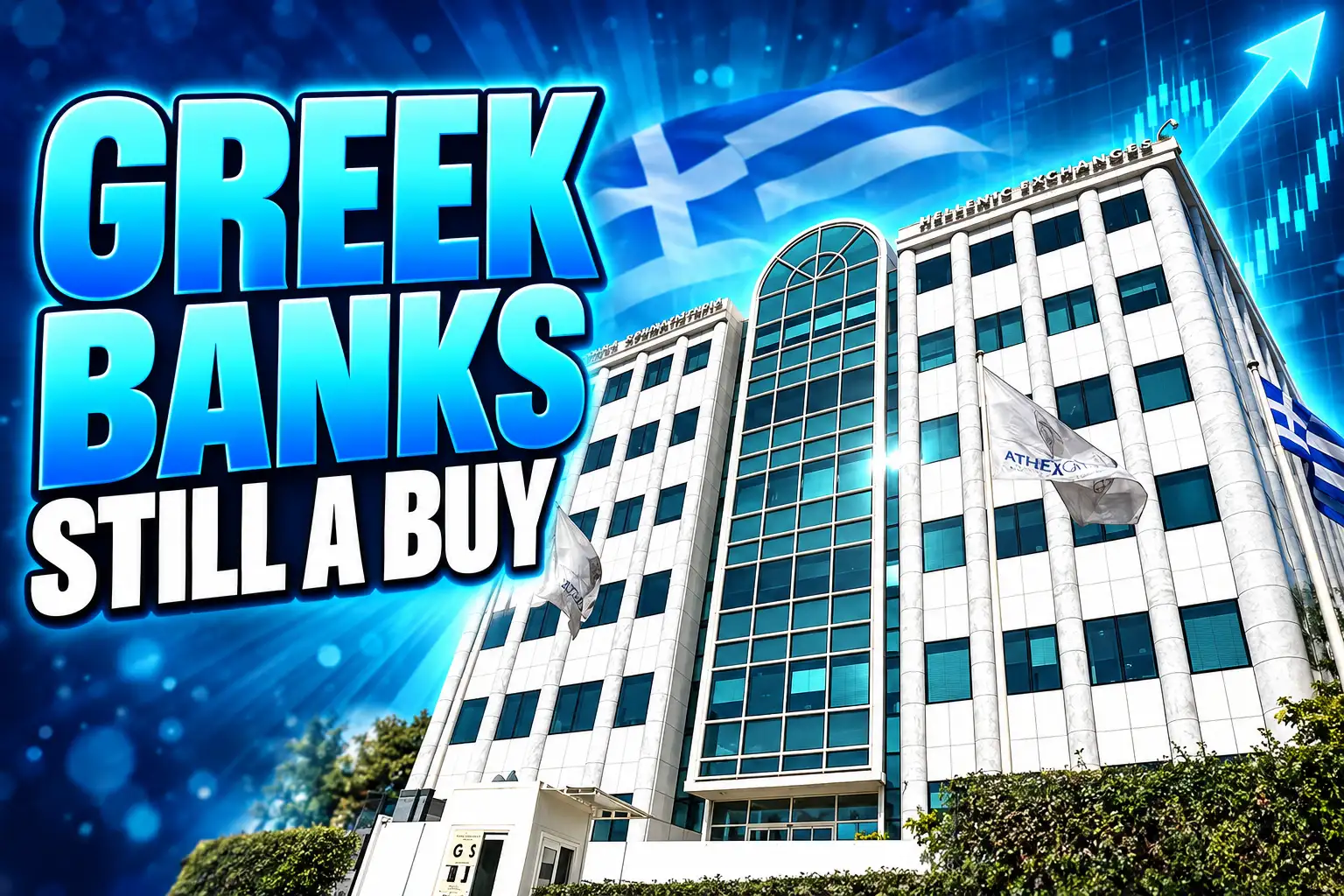
Four Banks Join the Stoxx Europe 600
STOXX Ltd. said on September 1 that Greece’s shift from emerging to developed status, first announced in April, would take effect with the third-quarter review. At the open on September 21, Greek companies became eligible for developed European benchmarks, and the review four Greek banks added to the STOXX Europe 600 alongside five other Greek issuers. STOXX had cut Greece to emerging status in September 2016, after capital controls. The same nine names also entered the broader EURO STOXX index.
FTSE Russell moved in parallel. Its FAQ for the single-tranche September review put the change at the open on Monday, September 21, and listed Alpha, Eurobank, National Bank and Piraeus in the Mid segment. CrediaBank screened as Small. Greece’s projected weight in the FTSE Developed Index was 0.072 percent, based on August 21 closing prices. Sixty-two Greek companies moved into FTSE developed indices.
THE NINE GREEK NAMES IN THE STOXX EUROPE 600
- National Bank of Greece: The largest estimated passive bid among the banks.
- Eurobank: Added with the other systemics, and Morgan Stanley’s second-ranked pick.
- Piraeus Bank: The domestic-focused lender on the overweight list.
- Alpha Bank: The firm’s top Greek pick, now inside the pan-European benchmark.
- Public Power: The utility joining on the same review.
- Metlen Energy & Metals: The multi-utility added beside the banks.
- GEK Terna: The construction name in the nine-stock Greek group.
- Motor Oil (Hellas): The refiner on the developed-market add list.
- Jumbo: The retailer completing the Greek cohort.
JPMorgan put passive inflows tied to STOXX Europe 600 inclusion at about $1.015 billion, with the four banks taking $887.8 million of that. National Bank was seen taking $288.6 million, Eurobank $232.5 million, Piraeus $220.1 million and Alpha $146.6 million. Those are mechanical allocations, not a verdict on credit quality.
A Record Auction, Then a Two-Day Slide
Index funds that track emerging-market benchmarks had to sell Greek shares, and developed-market trackers had to buy them. A large part of that swap hit the Friday, September 18 close, when Athens turnover reached a record €4.26 billion. On September 21 the bank index closed at 3,227.07, up 0.67 percent on the day and 40.7 percent year to date, 14.5 points ahead of the general index’s 26.2 percent.
By then Piraeus was up 53.7 percent year to date, Eurobank 38.4 percent, National Bank 34.2 percent and Alpha 32.5 percent. CrediaBank was down 38.4 percent. The inclusion looked like a victory lap. Index demand can lift a tape for a session. It cannot, on its own, pay for 2028 book value.
FROM INITIATION TO THE FIRST SELL-OFF
- June 16, 2026: Morgan Stanley starts Greek bank coverage with three overweight names and two equal-weight names.
- September 2, 2026: It raises targets on the four large listed banks and cuts CrediaBank’s target to €1.09.
- September 18, 2026: The rebalancing auction pushes Athens turnover to €4.26 billion.
- September 21, 2026: FTSE and STOXX classify Greece as developed; four banks enter the STOXX Europe 600.
- September 28, 2026: The bank index hits an 11-year high as the general index closes at 2,707.83, with Alpha up 3.96 percent and Piraeus up 3.60 percent.
- September 30, 2026: Moody’s turns the outlook on Alpha’s and Piraeus’s Baa1 deposit ratings to Positive, after a Positive outlook on the Baa3 sovereign rating.
- October 2, 2026: A second down day leaves the general index at 2,636.54, off 3.7 percent in two sessions, with Piraeus at €10.18 and Alpha at €4.46.
The bank index closed October 2 at 3,135, down 2.77 percent, after a 3.6 percent drop the session before. Piraeus fell 4.41 percent, Alpha 4.09 percent, CrediaBank 2.97 percent, Eurobank 2.47 percent and National Bank 1.52 percent. September inflation at 5.1 percent sat in the same tape as higher energy prices and U.S. yields. Developed-market membership did not cancel a risk-off day.
Why Alpha Still Ranks Ahead of Piraeus
Piraeus was the 2026 winner among the four large listed banks into the upgrade, and it still has Morgan Stanley’s highest target at €12.30. The firm still prefers Alpha. It called Alpha a mid-cap top pick in Europe and pointed to an 8 times 2028 earnings multiple and 1.4 times tangible book for a 15 percent return on equity. Investor Day on November 5 is the near catalyst, with a business plan the note said should show more revenue and fees from recent deals.
UniCredit said in January it had converted a synthetic holding into shares, taking its direct stake and voting rights to about 29.8 percent. Morgan Stanley flagged UniCredit’s public comments on the possibility of taking full control and said Alpha still has among the lowest institutional holdings of the Greek banks, which leaves room for a deal. It also called Alpha the most wholesale-funded, and the least rate-sensitive, of the Greek names.
Eurobank’s case is geography. The note leans on Greece, Bulgaria and Cyprus, on liquidity, and on the Eurolife insurance book. It sees a 26 percent compound rise in dividends per share from 2025 through 2028, about 14 percent in earnings per share and 11 percent in tangible book, and a 19 percent return on tangible equity in 2028, excluding excess capital. Multiples cited were 7.9 times earnings and 1.8 times tangible book, a discount the firm put at about 15 percent to European peers. It conceded there is no immediate spark, and still argued the bank can beat both consensus and its own guidance.
Piraeus is the domestic play, with a low loan-to-deposit ratio and high rate sensitivity. Morgan Stanley put 2028 fee income 5 percent above consensus and 13 percent above management targets, from asset management, origination and leasing. At 8.6 times 2028 earnings and 1.7 times tangible book for an 18 percent return on tangible equity, it called the stock attractive and no longer unusually cheap.
National Bank is the quality name the firm will not overweight. It trades, in that note, at 9 times earnings and 2.1 times tangible book for an 18.5 percent return on equity, excluding excess capital, and is the most widely held Greek bank in institutional books. Excess capital of about €0.7 billion is a tool. The rating stays equal-weight because cheaper, higher-beta names still sit on the same tape. CrediaBank, the old Attica-Pancreta combination, keeps the fastest growth profile and an equal-weight label on the view that the growth is already in the price; the stock closed October 2 at €0.98, and the bank that day completed a 70 percent purchase of Pantelakis Securities.
The May 2027 MSCI Review Still Ahead
FTSE and STOXX have moved. MSCI has not. On March 31 it said the MSCI Greece indexes will shift from emerging to developed status in one step at the May 2027 Index Review, after a January 26 consultation. Some investors wanted more time, so MSCI pushed the date from the August 2026 review. Until May, Greek names can sit in European developed indices and still remain in MSCI emerging-market books.
No market in MSCI’s classification history has made this journey before. Greece was the first and remains the only developed market ever to be downgraded to emerging market status.
Raman Aylur Subramanian, Managing Director, MSCI Research
The 2013 cut left the standard index with two securities, no banks, and a market cap of $5.5 billion. A simulated developed-market standard index using February 2026 review data held seven names, with the four banks at about 80 percent of that weight: National Bank, Eurobank, Piraeus and Alpha, plus Public Power, Hellenic Telecommunications and Allwyn. That package was about 0.40 percent of MSCI Europe, against 57 basis points in MSCI Emerging Markets. Financials were about 59 percent of the MSCI Greece investable-market index, nearly three times the weight in MSCI Europe.
For emerging-market funds, the 2027 step is a sale of a concentrated bank sleeve. For European developed-market funds, it is a small, bank-heavy add on the scale of Austria or Portugal. That is the remaining mechanical bid Morgan Stanley is underwriting, and it is months away.
Houses Split on the Next Leg
Loan books are still growing. In the second quarter, National Bank’s loans were up 13 percent year on year, Piraeus 11 percent, and Eurobank and Alpha 10 percent. Moody’s Positive outlooks on Alpha and Piraeus assume that run of results holds for 12 to 18 months and that the sovereign can move as well. Other desks do not share Morgan Stanley’s order of preference.
WHERE HOUSES DISAGREE
- Morgan Stanley: Overweight Alpha, Eurobank and Piraeus, with Alpha first; equal-weight National Bank and CrediaBank.
- JPMorgan: Overweight all four large listed banks, with Eurobank and Piraeus first, and end-2028 targets of €6.10, €13.70, €5.80 and €20.70 respectively, implying 18 to 30 percent from September 16 closes.
- KBW: Outperform on Piraeus and National Bank, Market Perform on Eurobank, Underperform on Alpha, the reverse of Morgan Stanley’s top pick.
Autonomous Research is closer to KBW than to Morgan Stanley, with Outperform on Eurobank and National Bank, Neutral on Piraeus and Underperform on Alpha. After a 40.7 percent year-to-date run in the bank index into the upgrade, the argument has shifted from whether to own the sector to which ticker still has earnings the new holders have not paid for.
November’s Investor Day and Cash Returns
Alpha has said it intends an interim cash dividend of €124 million, with payment dated December 4, subject to approvals, and a 55 percent payout for 2026. Eurobank has a plan for €2.6 billion of distributions from 2026 through 2028, mixed between cash and buybacks. Piraeus has pointed to a 55 percent payout for 2026 and a €650 million distribution target for the year. Eurobank reports on October 29 and Piraeus on October 30. Alpha’s investor day is November 5.
Those dates will test the September targets against nine-month numbers, not against an index label. The overweight on Alpha, Eurobank and Piraeus is a bet that 2028 earnings, fees and payouts still justify a higher multiple now that the four names live inside the STOXX Europe 600 and before MSCI follows. The next numbered check of that wager is Alpha’s investor day on November 5, with MSCI’s review still set for May 2027.
Disclaimer: This article is news reporting and analysis of analyst ratings, index changes and listed-bank prices, and it is for information only. It is not investment advice, a recommendation to buy or sell any security, or a forecast of future returns on Alpha Bank, Eurobank, Piraeus Bank, National Bank of Greece, CrediaBank or any related index. Readers should consult a qualified financial adviser or licensed investment professional who can consider their own objectives, time horizon and risk limits before acting. Ratings, target prices, index membership and market figures reflect the cited firms and sessions as of the dates named in the piece and can change with the next review, print or trading day.

Saquon Barkley’s Hamstring Leaves the Eagles Thin in London

The Online US Passport Still Needs a Witnessed Oath

Ken Urker Died on His Birthday With No Cause Named

FOX Ices Portnoy After Ohio State’s Access Fight

Micron’s Record Memory Profits Lock RAM Tight Through 2028

Musk’s $914 Billion Lead Is a Public SpaceX Bet

Microsoft’s 96% Cyber Score Sits at 86.3% on the Board

Free Live Sports Streaming in 2026: What to Watch Without Cable

Endgame Encore’s $86 Million Trial for Infinity Vision

The Odyssey’s IMAX Film Run Hit a 41-Theater Limit
-
 BUSINESS4 months ago
Musk’s $914 Billion Lead Is a Public SpaceX Bet
-
 NEWS2 months ago
Microsoft’s 96% Cyber Score Sits at 86.3% on the Board
-
 SPORTS3 months ago
Free Live Sports Streaming in 2026: What to Watch Without Cable
-

 ENTERTAINMENT4 weeks ago
Sterling Point Holds No. 2 on Prime Video After 32 Days
-
 ENTERTAINMENT3 months ago
The Odyssey’s IMAX Film Run Hit a 41-Theater Limit
-
 ENTERTAINMENT3 months ago
Endgame Encore’s $86 Million Trial for Infinity Vision
-

 ENTERTAINMENT2 years ago
Andrew Garfield’s Spider-Man Films Are No Longer Free
-

 NEWS4 weeks ago
G20 Cheers AI Investment After Bailey’s Frontier Cyber Warning