Kawasaki Heavy Industries and Rorze Corporation settled their U.S. patent fight over semiconductor wafer-handling robots on August 3, 2026, ending nearly four years of litigation after a jury awarded Kawasaki $48.35 million and found willful infringement. Terms stay confidential. The case centered on technology invented by Kawasaki’s CEO that both companies sell into the same cleanroom lines.
The deal dismisses the Northern District of California suit. It leaves Kawasaki with a validated patent moat and Rorze with a contained write-down that management says will not alter its business or full-year outlook.
The Jury Set a Clear Floor in March
A federal jury in San Francisco returned its verdict on March 13, 2026, after a two-week trial. It unanimously found that Rorze Corporation and its U.S. subsidiary, Rorze Automation, Inc., willfully infringed Kawasaki’s U.S. Patent No. RE45,772.
- $16.65 million in lost profits
- $31.7 million in lost royalties
- $48.35 million total compensatory award
- Willful finding that opened the door to enhanced damages
Crowell & Moring represented Kawasaki and secured the $48 million jury verdict after a two-week trial. The firm noted the court could increase the award up to three times because of willfulness. Kawasaki later asked the court to enhance the award; Rorze sought a new trial. Neither motion reached a final ruling before settlement talks closed the case.
Kawasaki first sued on August 30, 2022, asserting multiple patents. Only the RE45,772 patent went to the jury.
The split itself tells a story about how the jury weighed the two damage theories. Lost royalties made up roughly two-thirds of the compensatory total, while lost profits made up the rest. That mix left both sides with a concrete number against which to bargain once post-trial motions loomed.
Because the willfulness finding kept enhanced damages in play, the practical ceiling the parties faced was far higher than the face verdict. Industrial Equipment News later noted the earlier push toward trebled damages near $145 million. Settlement talks therefore opened against a range that stretched from the $48.35 million floor up to that theoretical multiple.
The Patent That Protects the Transfer Step
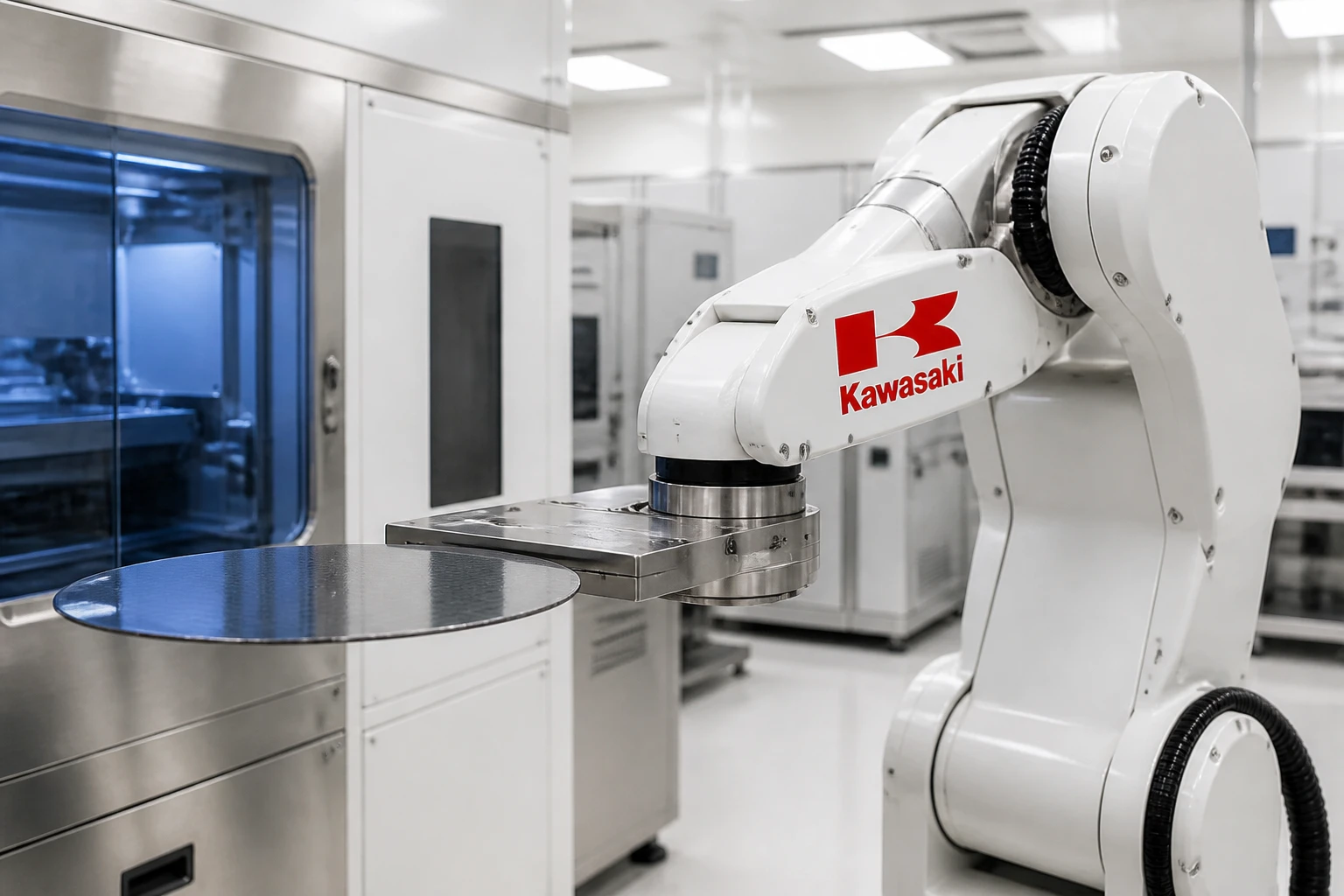
U.S. Patent No. RE45,772 covers wafer transfer apparatus and substrate transfer apparatus used in semiconductor manufacturing. Kawasaki’s CEO, Yasuhiko Joseph Hashimoto, is the inventor. Crowell described the technology as the gold standard for silicon wafer handling systems that cemented Kawasaki’s position as a global leader in semiconductor robotics.
These systems move fragile wafers between process tools, stockers and load locks while keeping particle counts near zero. Single-pivot designs and cleanroom-compatible arms reduce contamination risk at advanced nodes. Rorze sells competing purge wafer stockers and transfer robots that Kawasaki said practiced the claims.
- RE45,772: reissue patent on wafer and substrate transfer apparatus
- Inventor: Yasuhiko Joseph Hashimoto, Kawasaki president and CEO
- Core function: high-precision, low-contamination robotic handling inside fabs
Earlier court filings showed Kawasaki notified Rorze of the patent as early as 2017. The willful finding rested on that notice history and continued sales.
In practical terms the patent guards the moment when a wafer leaves one tool and enters another. That transfer step looks simple from outside the fab, yet it is where particles, vibration and positioning error can erase the value of every prior process. By covering the apparatus that performs the move, the claims reach both atmospheric and vacuum environments where Kawasaki and Rorze already compete.
Hashimoto’s status as both inventor and chief executive gave the enforcement campaign an unusual internal alignment. The same executive who signs strategy papers also stands behind the technical disclosure the jury upheld. That continuity matters when a company must decide whether to litigate for years or license early.
Confidential Deal Ends the Docket
Both companies announced the same day that they had signed a settlement agreement on August 3, 2026. The pending litigation will be dismissed. Neither side released the payment figure, license terms or any injunction language.
Kawasaki’s statement stressed that intellectual property remains an important management asset and that the company will keep protecting and using it to raise corporate value. Rorze’s notice confirmed the background of the 2022 filing and the March 2026 jury verdict, then stated simply that details stay confidential under the agreement.
Industrial Equipment News reported the settlement and noted the earlier push toward trebled damages near $145 million. Public filings give no confirmation of any enhanced amount actually paid.
The silence on terms is typical for industrial patent deals between suppliers that still share customers. Publishing a royalty rate or an injunction schedule can reshape bidding dynamics on the next tool order. Keeping the number private lets each side manage its own narrative with fabs and with investors.
Rorze Absorbs the Hit and Holds Its Forecast
Rorze had already prepared for a loss. In its settlement notice the company said it recorded a provision for litigation loss already recorded in the fiscal year ended February 28, 2026, based on estimated potential losses. After the settlement, any difference between that provision and the actual payment will appear as an extraordinary loss in the second quarter of the fiscal year ending February 28, 2027.
What we know
- Provision booked in FY ended Feb 28, 2026
- Difference booked as extraordinary loss in Q2 FY27
- No change to previously announced consolidated earnings forecast for FY ending Feb 28, 2027
- No expected future impact on business operations from the matter
What remains unconfirmed
- Exact settlement payment amount
- Whether any running royalty or cross-license exists
- Any product redesign or customer transition costs
Rorze president Yoshiyuki Fujishiro signed the notice. The company trades on the Tokyo Stock Exchange under code 6323. Management’s public message is that the litigation is fully resolved and operations continue without disruption.
By booking the provision before the settlement closed, Rorze converted an open-ended legal risk into a defined accounting event. The only residual uncertainty is the gap, if any, between that earlier estimate and the confidential payment. Management’s decision to hold the full-year forecast signals that the gap is not large enough, in its view, to rewrite guidance.
Kawasaki Walks Away with the Validated Lead
For Kawasaki the outcome validates years of enforcement. The jury rejected invalidity arguments and confirmed both infringement and willfulness. That combination strengthens the company’s hand in any future licensing talks or competitive situations involving the same transfer technology.
Hashimoto’s dual role as CEO and inventor adds an unusual personal stake. The firm’s robotics division supplies atmospheric and vacuum wafer handlers used in front-end and back-end fabs. Protecting that portfolio supports pricing power and customer confidence at a time when chipmakers demand higher throughput and lower defect rates.
Crowell partners Robert Mallin, Tadashi Horie, Mark Remus and Molly Jones led the trial team. The firm called the verdict a decisive victory that protects industry-leading technology.
A jury-tested patent carries different weight than an untested one. Competitors evaluating design-arounds now have a public record of claim scope that survived invalidity attack. Customers weighing dual-source strategies can see that Kawasaki was willing to try the case to verdict rather than accept a quiet license.
How Notice and Willfulness Shaped the Risk
The willfulness finding did more than unlock a higher damage range. It turned a long notice history into a central fact of the case. Kawasaki had flagged the patent to Rorze as early as 2017, five years before the complaint and nearly nine years before the verdict.
That timeline left little room for an innocent-infringement story once the jury accepted the claims. Continued sales after notice became evidence the jury could weigh directly. The unanimous willful verdict then raised the stakes on every post-trial motion that followed.
- 2017: Kawasaki notifies Rorze of the patent
- August 30, 2022: Kawasaki files suit in the Northern District of California
- March 13, 2026: Jury finds willful infringement and awards $48.35 million
- Post-verdict: Kawasaki seeks enhanced damages; Rorze seeks a new trial
- August 3, 2026: Parties announce a confidential settlement and plan to dismiss the case
Neither enhancement nor a new trial ever reached a final ruling. Settlement cut off that path. Still, the notice-to-verdict arc explains why both sides had reason to close the docket once the compensatory floor and the trebling risk were both on the table.
For other suppliers watching the case, the sequence is a reminder that early notice letters can compound. A letter sent in 2017 shaped a 2026 damages exposure that Industrial Equipment News linked to a potential figure near $145 million before the parties settled.
The Quiet Layer Every Fab Still Needs
Wafer-handling robots sit beneath the flashier equipment that etch, deposit and inspect chips. They determine how fast and how cleanly wafers move. Market research puts the global wafer handling robots market in the low billions and growing with advanced-node capacity additions.
| Company | Role / Note |
|---|---|
| Brooks Automation (Azenta) | Major pure-play automation supplier |
| RORZE Corporation | Japanese specialist, vacuum and atmospheric systems |
| Hirata Corporation | Key Japanese competitor |
| Kawasaki Heavy Industries | Precision Clean series, atmospheric and vacuum |
| DAIHEN Corporation | Significant share in handling systems |
One research house projects the wafer handling robots market size projected growth from roughly $1.71 billion in 2026 toward more than $3.2 billion by 2034. Vacuum robots alone often claim more than half of revenue because many process steps now run under vacuum. Both Kawasaki and Rorze appear on every major supplier shortlist.
- Atmospheric robots for ambient transfer and stockers
- Vacuum robots for load locks and process modules
- End-effectors and seals engineered for ultra-low particle generation
- Integration with OEM cluster tools at 300 mm and emerging larger formats
Public conversation on the settlement stayed thin. The dispute never generated the retail-investor noise common in consumer tech patent cases. That silence matches the industrial character of the market: a handful of specialized suppliers selling into capital-intensive fabs where downtime costs far more than any single robot.
Kawasaki leaves the fight with a jury-validated patent and a closed docket. Rorze leaves with a booked provision, an extraordinary-loss line item, and an explicit statement that its forecast and operations remain unchanged. The robots keep running in the same cleanrooms.
What Each Side Keeps After the Settlement
The confidential deal freezes the public record at the jury verdict and the dismissal. What each company retains, however, is visible from the statements already on file.
| Party | Retains or records |
|---|---|
| Kawasaki | Jury validation of RE45,772, infringement and willfulness findings, closed Northern District docket |
| Rorze | Provision from FY ended Feb 28, 2026, possible extraordinary loss in Q2 FY27, unchanged FY27 forecast |
| Both | Confidential payment terms, no public injunction text, continued presence on fab supplier shortlists |
Kawasaki can point to a unanimous verdict when it next discusses licensing or enforcement around the same transfer technology. Rorze can point to a held forecast and an explicit statement of no expected operational impact. Neither result required the market to learn the final number that changed hands.
That balance suits a sector in which the same customers buy from both firms. A public royalty schedule or a forced redesign headline would have traveled farther than a quiet dismissal. The robots, and the cleanroom lines they serve, continue without a change in the public competitive map.
Frequently Asked Questions
What exact patent did the jury find Rorze willfully infringed?
The jury found willful infringement of U.S. Patent No. RE45,772, a reissue covering wafer transfer apparatus and substrate transfer apparatus. It was the only patent of the original set that reached the verdict stage.
Who invented the patented wafer-handling technology?
Yasuhiko Joseph Hashimoto, who serves as president and chief executive officer of Kawasaki Heavy Industries, is named as the inventor. Crowell described the inventions as breakthrough work that helped establish Kawasaki’s leadership in semiconductor robotics.
How was the $48.35 million jury award split?
The jury awarded $16.65 million for lost profits and $31.7 million for royalties, totaling $48.35 million in compensatory damages. The willfulness finding allowed the court to consider an upward adjustment, though no final enhanced figure was entered before settlement.
When did Kawasaki first file the lawsuit against Rorze?
Kawasaki filed the patent infringement suit in the U.S. District Court for the Northern District of California on August 30, 2022. The case proceeded to a two-week jury trial that ended with the March 13, 2026 verdict.
Did Rorze change its earnings forecast after the settlement?
No. Rorze stated that the settlement produces no change to its previously announced consolidated earnings forecast for the fiscal year ending February 28, 2027, and that it expects no future impact on business operations from the resolved matter.