A six-layer extreme heat tech stack already exists, drawn from wearables strapped to construction workers, radiative cooling panels on commercial roofs, and solar cold-storage rooms on Nigerian farms. The Lancet Countdown’s 2025 annual report logged an average of 546,000 heat-related deaths annually between 2012 and 2021, a figure built on heatwaves the body cannot shake off day to day. Most employers, municipalities, and family decision-makers still have no consolidated picture of the solutions now commercially available.
That is the knowledge gap, and it is structural, not technological. The tools are shipping, and the people who control capital and procurement have yet to map them.
What Extreme Heat Does to Bodies and the Systems Around Them
Heat is more systemic than the headlines suggest. A 2025 analysis in the Proceedings of the National Academy of Sciences found that forest disturbances from fire in the 2023 to 2024 period were 2.2 times higher globally than the 2002 to 2022 average, the highest since monitoring began in 2001. When failures like that cascade into a power grid, populations lose cooling, refrigerated medication, and medical equipment in the same hour. Coral reefs fare worse: at 1.5°C of warming, 70 to 90 percent of reef-building corals are expected to die.
The economic weight is large enough to redraw labor markets. Nick Halla, founder and CEO of GigaClimate, has put the figure plainly: by 2030, heat stress is projected to reduce global working hours by 2.2 percent, equal to 80 million full-time jobs and $2.4 trillion in annual economic losses.
A common misconception treats heat as a single event. Dr. Manijeh Berenji, an occupational and environmental medicine physician, frames the medical reality differently. The body keeps score across consecutive hot days, not the single hottest afternoon, and chronic disease makes the cumulative load worse. The pattern shows up in the 2021 Pacific Northwest heat dome, where the British Columbia Coroners Service confirmed 619 heat-related deaths in a single week. It shows up in the 2024 Hajj, where at least 1,301 pilgrims died as temperatures hit 51.8°C, mostly unauthorised walkers in the open sun.
- 546,000 average annual heat-related deaths, 2012 to 2021 (Lancet Countdown 2025).
- 619 deaths in British Columbia across one week of the 2021 heat dome.
- 1,301 Hajj deaths in 2024 as temperatures hit 51.8°C.
- 2.2x higher global forest fire disturbance in 2023-2024 vs the 2002-2022 average (PNAS 2025).
- 2.2% of global working hours projected lost to heat by 2030 (GigaClimate).
Why the Knowledge Gap Persists
Hannah Safford, associate director of climate and environment at the Federation of American Scientists, names one structural reason. Heat leaves fewer visible scars than hurricanes or wildfires do, so it is harder to communicate as an acute threat. The second part of her explanation is the harder one: the suffering caused by extreme heat is deeply inequitable, and the people best positioned to close the gap are also the people least exposed to it. That imbalance shapes which solutions get funded.
Overreliance on AC strains power grids, leaves people more exposed to energy price spikes, and contributes to a vicious cycle by producing more of the emissions warming the planet.
A separate failure sits inside the design professions. Emily Dinino, co-founder of ThermoShade, says dependence on mechanical cooling has crowded out the passive design that protects people at bus stops, on worksites, and in public squares. Public-health messaging has tracked the same curve: heat is harder to dramatize than a hurricane or a wildfire, even when its cumulative death toll outruns both.
The Sensing Layer Catches Heat Before It Strikes
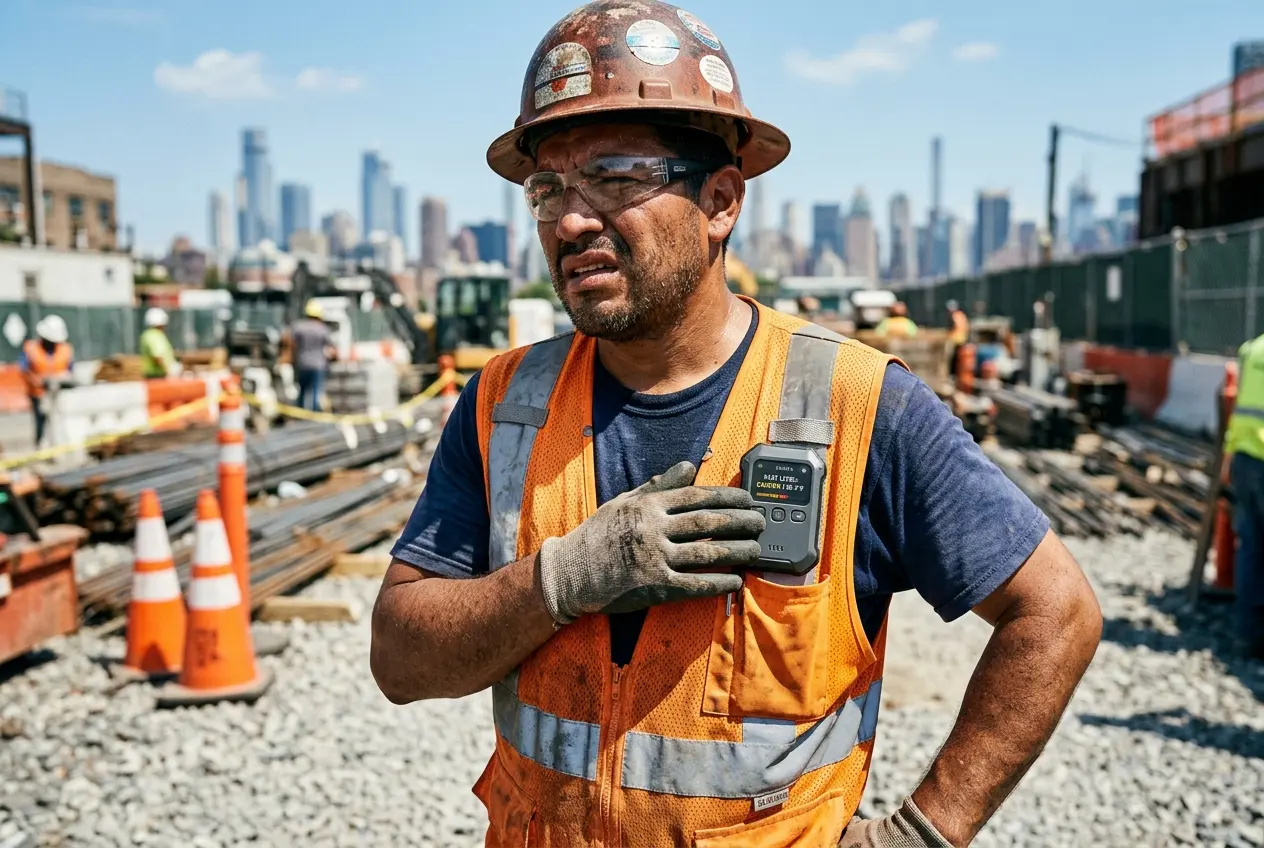
The first layer detects, quantifies, and warns. Physiological wearables that flag dangerous core temperatures before symptoms appear now ship at construction scale. VigiLife’s pilot with Rogers-O’Brien Construction, the Texas-based general contractor, reported zero heat-related illnesses and over $200,000 in savings in a single season. SlateSafety builds a parallel line of connected worker monitors for utilities and emergency response.
AI heat-forecasting platforms ingest satellite temperature, humidity, and historical mortality to score hours, blocks, and job sites for risk. Analytics tools then translate physical exposure into financial terms, the language a CFO or city budget officer understands. That translation is what unlocks the wider stack: investors underwrite what they can price, and until exposure hits the income statement, mitigation stays a cost center.
| Tool or Company | Function | Documented Outcome |
|---|---|---|
| VigiLife (Safeguard wearable) | Continuous core-temperature monitoring | Rogers-O’Brien pilot: 0 heat-related illnesses, $200,000+ saved in one season |
| SlateSafety | Connected vitals for utilities and emergency responders | Deployed across industrial sites in the US |
| AI heat-forecasting and exposure analytics | Translates physical risk into financial terms | Identified as the wedge that unlocks enterprise procurement |
Rogers-O’Brien is no anomaly. National Geographic documented the same zero-incident result across a full Texas summer. Pilots at other large contractors and several utilities report comparable numbers. Sensing has become the entry point for enterprise procurement, and a wedge for the rest of the stack.
The thermostat is no longer just on the worker. Public health agencies now subscribe to NOAA heat alerts tied to ZIP code. Cities are piloting street-level sensors that feed dashboards showing actual ground temperature rather than a regional forecast. The next horizon is occupational health surveillance at the city level, where ER visits for heat illness become a daily signal. None of it requires new physics.
Built-Environment Cooling That Does Not Overload the Grid
Mechanical cooling strains the grid at the exact moment the grid is most fragile. The lower-carbon alternative is shipping now.
SkyCool Systems has demonstrated 15 to 40% energy reduction in commercial refrigeration through radiative cooling panels, with backing from ARPA-E. ThermoShade deploys modular shade structures for transit stops, campuses, worksites, and events that combine passive radiative cooling with phase-change material. The economics are forceful: every dollar invested in passive cooling returns between $1.50 and $15, according to FAS research.
City-scale interventions can drop ambient temperature through cool roofs, tree canopy, and reflective pavement without drawing down grid capacity. These are tools that buy time during the worst hours of the worst days. Procurement officers in Phoenix and Athens are already specifying them in heat-action plans. The federal funding for cities that have not yet started now exists too.
Human Garments and the Cold Storage Chain
Even well-designed indoor environments leave people exposed outdoors. Dinino, the ThermoShade co-founder, makes the point plainly: the answer cannot be to retreat indoors, because people still need to wait for the bus, tend crops, attend school, and play sports. This is where the human-response and food-systems layers meet on the ground.
Mexar builds evaporative cooling garments co-designed with frontline outdoor workers. Becklar’s WorkerSafety Pro issues Wet Bulb Globe Temperature-based alerts that help employers meet OSHA heat standards. ColdVentures’ FDA-approved ColdVest reduces core body temperature by up to five degrees in under three minutes without electricity, the kind of device that turns a heatstroke call from a body bag into a triage. Layered together, these products buy field crews the minutes that decide the outcome.
The food and finance layer rides on top. ColdHubs in Nigeria and SokoFresh in Kenya are expanding solar-powered cold storage that lets smallholders keep produce saleable through the hottest stretches of the year. Elicit Plant closed a $48 million Series B to scale biostimulants that protect crops from heat stress. Without this systems layer, the cooling above protects people, but the produce, the income, and the insurance do not. A heatwave that kills a tomato also kills the loan that paid for the seed.
Heat-Hardened Grids and Roads
The roads, rails, and transmission lines that hold society together soften, expand, and overheat alongside everything else. The stack now responds at the asset level, and heat-resilient infrastructure is moving from pilot to procurement.
GridBeyond’s AI demand-response platform launched with Constellation Energy in the PJM market in July 2025, the kind of dispatch the grid needs during a heat-driven demand peak. Polymer modified bitumen is scaling across the US transport network, backed by $2 billion in federal IRA grants, to keep roads from rutting under summer traffic. Form Energy’s iron-air batteries are beginning to provide grid backup capacity at scale, the long-duration storage needed when solar briefly drops on a smoke-filled afternoon. The investment thesis is now consistent across categories: infrastructure that cannot take a heatwave is becoming an asset class in retreat.
The connectivity layer matters as much as the materials. Heat-resistant rail sensors and AI grid monitoring catch the silent failures that turn a heatwave into an outage. Form Energy’s storage systems are designed for 100-hour discharge, long enough to bridge the multi-day events that broke the 2021 Pacific Northwest grid. The signal goes to operators earlier than the failure curve would suggest.
None of this is theoretical. Polymer modified bitumen has been deployed on a growing share of US roads; rail sensor systems track heat expansion on heat-stressed corridors; long-duration battery projects have broken ground in multiple US states. The deciding factor is procurement speed, not technology readiness.
Ecosystems and the Monitoring That Binds the Stack
Unlike the other layers, ecosystem damage cannot be easily undone. Coral Vita grows heat-tolerant corals using assisted evolution at restoration sites where fish populations have already doubled. IntelliReefs has built an engineered substrate that improves coral settlement.
Monitoring is what makes any of it measurable:
- NOAA Coral Reef Watch issues daily satellite bleaching alerts from a 5 km virtual-station grid.
- WRI’s Global Forest Watch tracks forest loss and fire disturbance in near real time.
- The Allen Coral Atlas maps shallow reef habitat globally and flags bleaching threats at the same resolution.
The last layer is also the one that least tolerates delay. A coral that dies in 2026 is gone for a human lifetime.
What Leaders Can Do Now, From Boardrooms to Procurement
Heat resilience is now a board-level decision, not just an HR or facilities decision. The capital and policy infrastructure to act on it exists in pieces across the public and private sectors.
Cleantech 1.0 in the mid-2000s gave the world an early read on what climate-tech venture capital could carry. Climate adaptation technology is now on the same arc, with extreme heat the most immediate opportunity for action. Each sector within cleantech went through the same arc: early confusion about what the solutions were, then a gradual adoption of shared vocabulary.
Dinino calls for the missing infrastructure: more pilots, more field data, and easier procurement pathways for cities and public agencies. Funding programs can help by treating heat mitigation as essential infrastructure and creating faster ways for new technologies to be tested and adopted. The Federation of American Scientists’ HeatAgenda.US already catalogs more than 400 evidence-based policy solutions, with examples drawn from all 50 US states. Groups like the Health Action Alliance move employers from awareness to action.
Communication is part of the stack, not a wraparound. Climate Mayors has released an Extreme Heat Communications Toolkit to advance shared messaging across member cities. Not every heat solution comes with a clear ROI or a venture-backed company behind it, and the tech stack has limited value without enforceable labor standards and well-functioning public health.
Chronic disease and chronic heat don’t add, they multiply.
Dr. Manijeh Berenji, an occupational and environmental medicine physician, lands the closing point that way. Every decision made today about where to build, where to source, where to hire, and how to insure is already a heat decision, whether leaders recognize it or not. The window to map the universe of solutions is open, and it is small.
Frequently Asked Questions
What is the extreme heat tech stack?
The term refers to a six-layer set of commercially deployed technologies that detect heat risk, cool the built environment without overloading the grid, protect humans outdoors, secure food and financial systems, harden roads and grids, and restore ecosystems like coral reefs and forests.
How many people die from extreme heat each year?
The Lancet Countdown’s 2025 report recorded an average of 546,000 heat-related deaths annually between 2012 and 2021, a 63 percent rise from the 1990s baseline.
What is the largest documented workplace outcome in this stack?
VigiLife’s safeguard pilot at Rogers-O’Brien Construction in Texas logged zero heat-related incidents and saved the contractor more than $200,000 in a single season, as documented in the Texas contractor pilot coverage.
Which solutions scale fastest for cities?
SkyCool Systems’ radiative cooling panels (15 to 40 percent energy reduction, ARPA-E-backed), ThermoShade’s modular shade structures, and polymer modified bitumen for road resurfacing backed by $2 billion in federal IRA grants all sit in active procurement conversations today.
How does the stack address inequity?
HeatAgenda.US catalogs more than 400 evidence-based policy solutions with state-level examples. The Health Action Alliance moves employers from awareness to action. The tools exist, but the procurement pathways for lower-income municipalities remain the weak link in the chain.