Argentina’s national soccer team crest, with its three stars and gold laurel branches, has been worn in three World Cup winning campaigns and is one of the most recognizable emblems in the sport. Few outside Argentina’s Jewish sporting world know that the crest was designed 50 years ago by Norberto “Toto” Rud, a Buenos Aires businessman and club soccer player at Jewish sports club Club Náutico Hacoaj. Toto Rud died in 2010 and never saw the third star added to his shield after Argentina’s 2022 triumph in Qatar.
On Tuesday, his crest was back on the chest of Lionel Messi as Argentina fought back from 2-0 down to beat Egypt 3-2 in Atlanta and reach the World Cup quarterfinals. His son Oliver watched the late comeback in a tournament where neither Israel nor the Palestinians are playing, against a Round-of-16 opponent whose coach had made the Palestinian flag the defining image of Egypt’s previous match. The crest’s Jewish roots, and the politics swirling around Messi’s team, sat side by side on a July evening in Atlanta. Oliver told the Jewish Telegraphic Agency this week that his father’s design still surprises him every time he sees it (how Toto Rud came to design Argentina’s crest).
The Designer Behind the Shield
Rud was in his late 20s in 1976, a Buenos Aires businessman and longtime member of Club Náutico Hacoaj in Tigre, when he proposed the design to the Argentine Football Association. He drew on the branding and graphic design skills he used throughout his career to draw a vertical shield, the design that has remained the visual identity of the reigning world champions ever since. A laurel wreath was added at the bottom of the design for the 1982 World Cup, and two stars went above the shield in 2004 to mark Argentina’s 1978 and 1986 titles. A third star was added after the 2022 title in Qatar. Replica jerseys bearing the crest, with Messi on the back, now travel with Argentine fans to every corner of the planet.
Rud told his family he developed the design after watching international soccer on black-and-white television in the early 1970s. He concluded that the national team needed a visual identity equal to its footballing tradition. The 50-year-old design is now closing in on a fourth World Cup campaign.
The Argentine captain who wears the crest today, Lionel Messi, is 39 and widely expected not to play in another World Cup after this one. A loss to Egypt would have ended his World Cup career. Argentina next faces the winner of Switzerland against Colombia in the quarterfinals.
Why a Crest in 1976
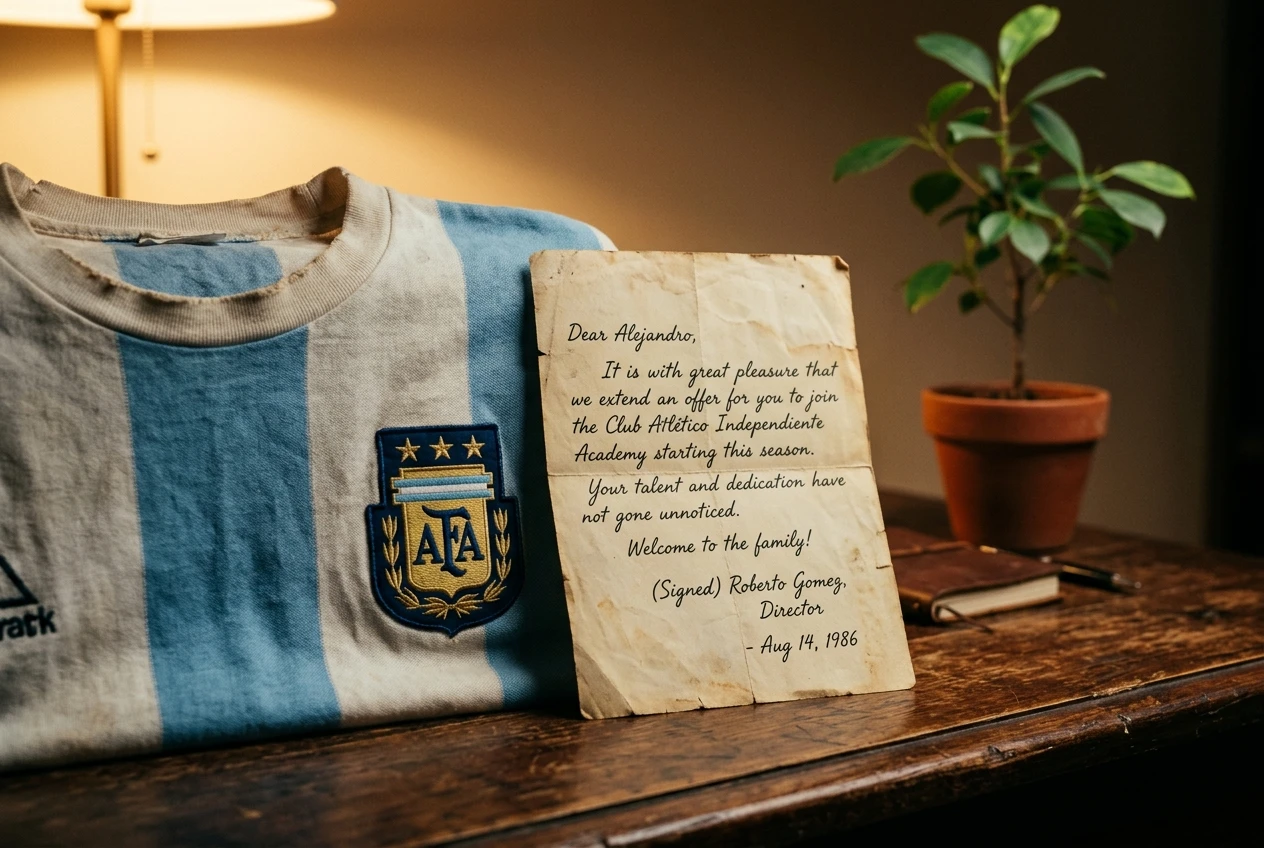
Argentine jerseys in the early 1970s were defined by their sky blue-and-white vertical stripes and not much else. The team’s only visual marker, beyond the colors, was the AFA emblem stitched onto jackets rather than shirts. Rud, watching the 1974 World Cup on a black-and-white set, reached the conclusion that his country’s national team needed a visual identity equal to its footballing tradition. The problem was obvious enough that he sat down with a sketchpad.
European teams had long used crests to stand out on the field, and the gap was plain to anyone watching the 1970s broadcasts. West Germany’s eagle, the Soviet Union’s CCCP lettering, and the simpler shields of Brazil and Italy made those jerseys instantly recognizable to television audiences around the world. Argentina, with no emblem on its shirt, was indistinguishable from any club side in light blue and white. Rud, a businessman who used his graphic design skills throughout his career, treated the problem as a branding exercise. He sketched the crest as a single image that could be reproduced on a small badge and recognized across a stadium.
He brought his ideas to the Argentine Football Association, and the executive committee approved the crest quickly. Argentina won its first World Cup while wearing the new crest, beating the Netherlands 3-1 in the 1978 final at home.
The crest has appeared on the shirts of every Argentine World Cup squad since, including the 1986 champions led by Diego Maradona, the 2022 champions led by Messi, and the current squad now chasing a fourth title. The Argentina crest is also one of the most widely worn national team logos in the world, with replica Messi jerseys popular across the globe. The basic design has not been fundamentally redrawn since 1976.
- November 28, 1976: the date the crest made its competitive debut
- 0-0: the score of that debut friendly against the Soviet Union
- ~20: the number of design proposals Rud submitted to the AFA
- Estadio Monumental: the Buenos Aires venue where the crest first appeared
Hacoaj and the Jewish Argentine Roots
Club Náutico Hacoaj sits in Tigre, a city on the northern edge of Greater Buenos Aires (the founding and history of Club Náutico Hacoaj). Founded on December 24, 1935 by Jewish immigrants who had been turned away from a non-Jewish rowing club, Hacoaj has grown into one of the most important institutions of the Jewish community in Argentina. The name Hacoaj comes from the Hebrew word for strength.
The club has around 10,000 members and five facilities, with the main campus in Tigre and an additional gymnastics site in Buenos Aires city. It hosts football, tennis, hockey, swimming, rowing, golf, judo and more. Tennis star Diego Schwartzman, who reached two Grand Slam quarterfinals and was ranked inside the top 10, is among the club’s most famous athletes, and the club’s main tennis court is named after him.
A tree dedicated to Toto Rud is planted on the Hacoaj campus. Osvaldo Ofman, the president of the club, told JTA that Rud’s design carries a particular meaning for the Jewish community in Argentina.
For Hacoaj, it is a tremendous source of pride that one of our members was the creator of the Argentine Football Association’s crest. His design not only represents the jersey of the Argentina national team, the reigning World Cup champions, but also gives us the feeling that a small part of Hacoaj and the Jewish community lives on in an emblem recognized around the world.
Osvaldo Ofman, the president of Club Náutico Hacoaj, gave the comments to the Jewish Telegraphic Agency in the lead-up to Tuesday’s match.
Tuesday’s Match and a Geopolitical Backdrop
Argentina’s 3-2 win over Egypt on Tuesday came after the team had trailed 2-0 in Atlanta, with goals from Yasser Ibrahim and Mostafa Ziko putting the Pharaohs within minutes of one of the tournament’s biggest upsets. Cristian Romero pulled one back in the 79th minute, Messi equalised in the 84th, and Enzo Fernandez completed the comeback in stoppage time to send Argentina through. Fernandez’s goal was the 3,000th in World Cup history, per the official match report from Atlanta Stadium. Egypt goalkeeper Mostafa Shoubeir had saved a Messi penalty in the first half to keep his side’s lead intact.
Argentina’s coach, Lionel Scaloni, was overcome after the final whistle. The captain, Messi, is 39 and widely expected not to play in another World Cup, so a loss could have ended his World Cup career. Scaloni spoke to pitch-side reporters after the match.
I can’t look up, I’m sorry. I’m really emotional right now. What a group of players. That’s it, I’ve got to go.
Lionel Scaloni, the Argentina head coach, made the comments to pitch-side reporters after the 3-2 comeback over Egypt in Atlanta on July 7, 2026. The win books Argentina a place in the quarterfinals.
The Round-of-16 tie carried a political weight that went beyond the field. Egypt’s coach, Hossam Hassan, had walked across the pitch after his team’s penalty shootout win over Australia on Friday carrying a Palestinian flag, as chants of “Free, free Palestine” rang around the stadium. Footage of the moment went viral, and Hassan told reporters his “heart and soul” were with the Palestinian people (the post-match reaction from Egypt’s coach Hossam Hassan). FIFA said flags of all 211 member associations are permitted at its tournaments and did not sanction Hassan.
- 79′, 84′, 90+2′: the minutes of Argentina’s goals from Romero, Messi and Fernandez
- 3,000: the World Cup goal count reached by Fernandez’s winner
- 4-2 on penalties: Egypt’s shootout win over Australia that booked the Round-of-16 place
Messi, Israel and the Egypt Backdrop
Tuesday’s match was framed by both sides as a de facto Israeli-Palestinian showdown in a tournament in which neither Israel nor the Palestinians are playing. The Argentine government is a staunch supporter of Israel, and Messi has visited the country. The captain’s most-cited visit was a 2013 trip with FC Barcelona, during which he prayed at the Western Wall in Jerusalem’s Old City. The 39-year-old plays for Inter Miami during the regular season. Tuesday’s match was played in Atlanta.
The tension between Messi and parts of Egyptian public opinion goes back a decade. After the Argentine captain announced on an Egyptian television program in 2016 that he was donating his shoes to a charity in Cairo, presenters accused him of being Jewish and aligned with Israel, which he had visited three years earlier. Azmi Mogahed, then a spokesman for the Egyptian Football Federation, phoned in to the show to reject the gift. Mogahed died in 2020.
A poll by an Israeli magazine before this World Cup found that Argentina was the clear favorite among Israeli viewers, named by 38% of respondents as the team they hoped would win the tournament. After Tuesday’s win, Argentina will face the winner of Switzerland against Colombia in the quarterfinals. Egypt has been eliminated, ending a run that included the penalty shootout win over Australia and the flag display that went viral.
What the Crest Means to the Family Now
Toto Rud got to see his crest worn to two World Cup championships, in 1978 and 1986. He died in 2010 at age 61, before the 2022 title in Qatar, and is buried in La Tablada, Latin America’s largest Jewish cemetery, on the western outskirts of Buenos Aires. His mother had come to Argentina from Ukraine, joining the wave of Jewish migrants who arrived in the country in the first half of the 20th century.
Oliver Rud told JTA this week that his brother Guido and he had been talking about the 50-year-old design just days before Tuesday’s match. Oliver said he feels a piece of his father every time he sees the crest on television. The crest Oliver watches now carries the same three stars his father never saw added, and Toto’s 1976 sketchpad drawing, retrieved by his family after his death, remains the only original record of how the shield first took shape.
Frequently Asked Questions
Who designed Argentina’s national soccer team crest?
Norberto “Toto” Rud, a Jewish Buenos Aires businessman and member of Club Náutico Hacoaj, proposed the crest to the Argentine Football Association in 1976.
When did the Argentina crest make its debut?
The crest was first worn on November 28, 1976, in a 0-0 friendly against the Soviet Union at Estadio Monumental in Buenos Aires.
What is Club Náutico Hacoaj?
Club Náutico Hacoaj is a Jewish sports and cultural club in Tigre, on the northern edge of Greater Buenos Aires, founded in 1935 by Jewish immigrants. The club has more than 10,000 members and counts tennis star Diego Schwartzman among its most famous alumni.
What was the score of Argentina vs Egypt at the 2026 World Cup?
Argentina beat Egypt 3-2 at Atlanta Stadium on July 7, 2026, scoring three unanswered goals from the 79th minute on after trailing 2-0. Cristian Romero, Lionel Messi and Enzo Fernandez scored for Argentina.
Why did Egypt’s coach wave a Palestinian flag?
Hossam Hassan walked across the pitch with a Palestinian flag after Egypt’s penalty shootout win over Australia on July 3, 2026, saying his “heart and soul” were with the Palestinian people. FIFA said flags of all 211 member associations are permitted at its tournaments and did not sanction Hassan.