A drone in flight is hardware. What keeps it airborne, decides where it goes, and converts the camera feed into business value is drone software. For technology companies weighing a drone program in 2026, that distinction is what determines scope, cost, and how much of the work is theirs to build.
The global market for unmanned aerial vehicles sat at $44.54 billion in 2025 and is projected to reach $186.79 billion by 2034, a CAGR of 17.36% per Wezom’s November 2025 industry report. Inside that growth, software is the layer that decides whether a drone flies once and disappears, or keeps producing value across a fleet for years.
Why Software Now Sits at the Center of Drone Value
A drone’s airframe, motors, and batteries are the most visible parts. The flight controller, the ground station, and the cloud pipeline are not, but they decide what the airframe can actually do. The cost of building, integrating, and maintaining that software layer is now larger than the cost of the airframe in most enterprise programs, per drone software development cost in 2026.
The market data lines up with the cost reality. Wezom’s November 2025 industry report puts the global UAV market at $44.54 billion in 2025, headed to $186.79 billion by 2034 at a 17.36% CAGR. Inside that figure, the share spent on flight controllers, ground control software, fleet management, and AI processing is growing faster than the share spent on airframes. For technology companies building a drone program, the headline is that software, not hardware, is the line item that decides scope.
A drone program that treats software as a one-time setup line item will under-budget, miss compliance milestones, and find itself locked into a vendor’s roadmap within a year. A program that treats software as a platform, with its own architecture, integrations, and update cycle, is the one that survives contact with operations.
- Global UAV market in 2025: $44.54 billion
- Projected global UAV market by 2034: $186.79 billion
- Projected 2025 to 2034 CAGR: 17.36%
The Architecture: Three Layers Drones Cannot Fly Without
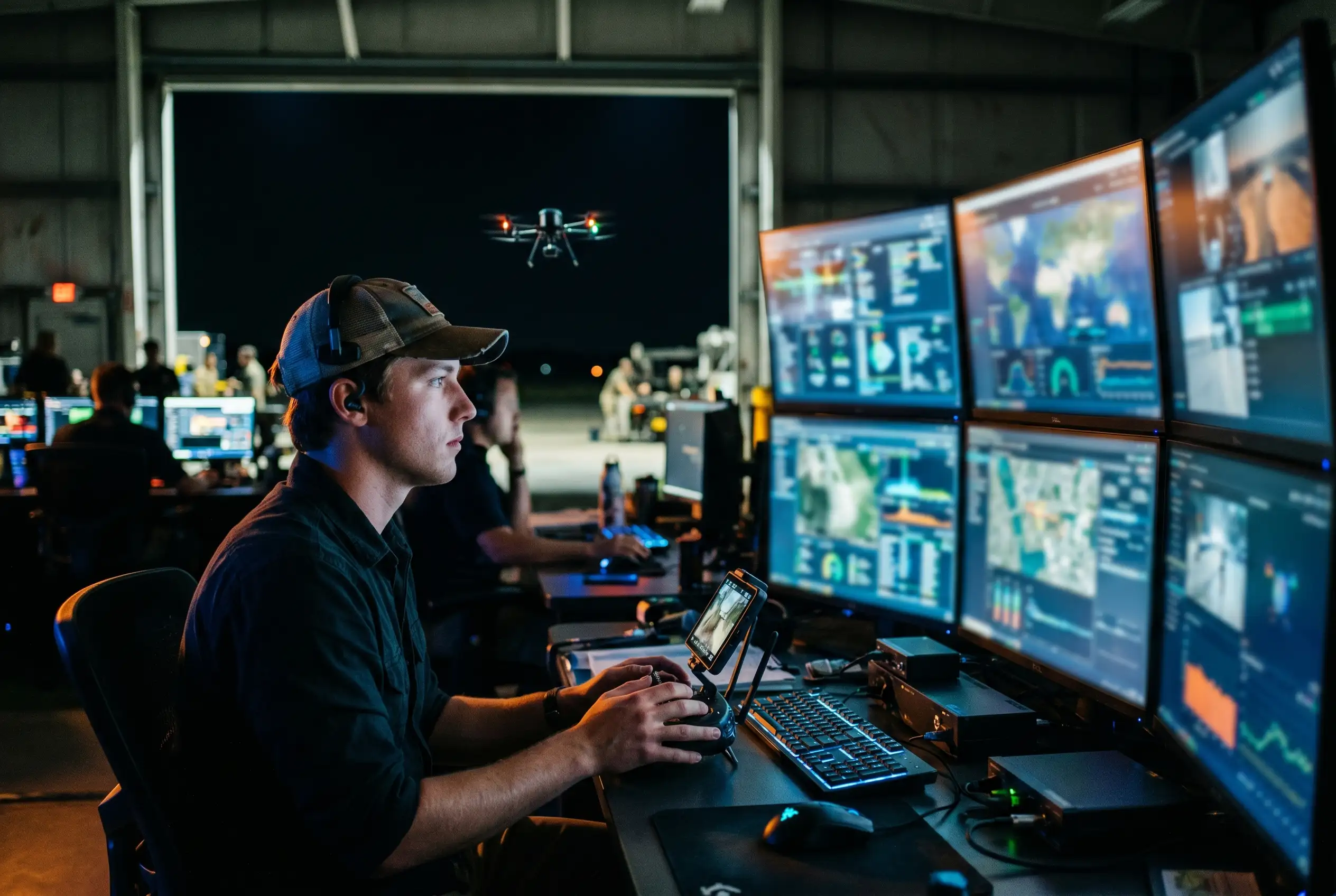
A working drone stack is built from three software layers, and they have to talk to each other in real time. The first is the flight stack, the embedded software that runs on the aircraft itself. The second is ground control, the operator-facing application used to plan missions and monitor flights. The third is the cloud and AI layer, where captured data is stored, processed, and turned into reports.
The flight stack is the most heavily engineered of the three. PX4, one of the two leading open-source autopilots, runs as a collection of modules that communicate through a publish-subscribe message bus called uORB, per the PX4 flight stack and middleware architecture. Each module can be started, stopped, or replaced at runtime, and the system as a whole runs on a POSIX-compliant real-time operating system such as NuttX.
IMU drivers sample at 1 kHz, integrate the data, and publish to the rest of the system at 250 Hz, fast enough for stable flight and for control loops that respond to wind and battery changes within milliseconds. The middleware layer underneath PX4 includes device drivers for sensors, GPS, cameras, and radios, plus a simulator that lets flight code run on a desktop for testing.
MAVLink, a lightweight header-only messaging protocol, is what carries telemetry and commands between the flight stack and the ground. It is the de facto standard for both PX4 and ArduPilot, the other major open-source autopilot, per the MAVLink messaging protocol for drones. If a technology company is building a ground control application that has to work across drone brands, supporting MAVLink is non-negotiable.
| Layer | Where it runs | Primary job | Common technology |
|---|---|---|---|
| Flight stack | Onboard the drone | Stabilize flight, execute missions, avoid obstacles | PX4 or ArduPilot on NuttX |
| Ground control | Operator laptop, tablet, or web client | Plan missions, monitor telemetry, control multiple drones | MAVLink-based GCS or vendor SDK |
| Cloud and AI | Cloud servers and onboard edge processors | Store, process, and analyze captured data | AWS or Azure, edge AI accelerators |
Ground Control and the Operator Experience
Ground control software is what a pilot or fleet manager actually touches. It is also the layer where the gap between consumer-grade and enterprise-grade drone software shows up first. A consumer ground control station shows a map and a live video feed, while an enterprise station adds route planning, geofencing, real-time telemetry, fleet health monitoring, and a user interface designed for use with gloves in bright sunlight.
The cost of building that layer runs from $30,000 to $80,000 for a focused single-drone controller, per Wezom’s 2026 pricing guide. The project price rises fast if the operator needs GPS-denied flight via visual odometry or a custom command interface. Latency and positioning accuracy are the two metrics that drive most of the engineering time. Those same metrics are the two the regulator will look at when the program needs Part 107 or EASA certification.
Cloud, AI, and the Data Pipeline
A drone inspecting a power line or a wind farm can produce thousands of images in a single mission. The job of the cloud and AI layer is to take that flood of raw data, prioritize what matters, and surface the result to an engineer who has better things to do than scroll through photos.
AI-enabled drone software can identify infrastructure defects, classify equipment failures, monitor construction progress, and assess crop health without a human in the loop. Machine learning models improve as the dataset grows. AI-powered drones are also moving from analysis to detection, with thermal imaging and onboard AI cameras now spotting early-stage bushfires in New South Wales before the first emergency call, per AI drones in NSW bushfire response.
- Object and defect recognition (infrastructure cracks, panel damage, equipment failure)
- Crop health and yield assessment using multispectral imaging
- Autonomous obstacle avoidance and dynamic re-routing
- Inventory counting and barcode reading in warehouses
- Predictive maintenance based on in-flight sensor data
Edge computing has moved a lot of that work back onto the aircraft. With 5G and onboard AI accelerators, drones can process 4K video and LiDAR point clouds locally and send only the events that matter, an approach Wezom’s industry team calls critical for beyond-line-of-sight missions where the round trip to a central cloud server is too slow. Offloading the processing also lowers the cloud bill, which Wezom’s 2026 pricing guide puts at $500 to $3,000 per month for a fleet of just ten active drones. AI-based drone software is also where the development budget climbs fastest: Wezom’s 2026 guide puts the starting cost at $100,000 for projects that include neural network training, with the final budget driven by the volume and quality of the training datasets.
A real example of the data pipeline in production comes from a Wezom case study. The system delivered inference at 0.3 s/image and reduced analyst effort by 90% through automation, with the model fully retrainable on new datasets.
The Off-the-Shelf Ceiling
Off-the-shelf drone software, from a vendor SDK like DJI’s, is the fastest way to get a working program in the air. It comes with tested stabilization, navigation, and safety modules, and a development team can usually reach a minimum viable product in 2-3 months. For a one-off inspection or a marketing shoot, the math works.
The ceiling shows up the moment the program has to integrate with a real enterprise. A Wezom article on custom UAV software for critical industries puts it bluntly: off-the-shelf software solutions may be sufficient for solving simple problems, but the higher the cost of error, the fewer the benefits of using them. The same article lists the failure modes, including performance issues from feature bloat, integration friction with existing ERP and asset management systems, security gaps, and a total cost of ownership that climbs with each new seat. The deeper problem is vendor lock-in; if the manufacturer restricts API access or leaves the market, the software stops working.
What Custom Development Actually Changes
Custom drone software is what a technology company builds when the off-the-shelf ceiling gets in the way of the business case. The investment buys three things an SDK cannot: a software architecture that grows with the drone fleet, full ownership of the source code, and the freedom to swap drones and sensors without a license negotiation.
The cost tiers in Wezom’s 2026 guide give a useful starting point. A simple, focused app runs $15,000 to $45,000 and ships in 2-3 months. A mid-level solution with custom data processing and cloud storage integration starts at $50,000 and can reach $150,000 over 4-7 months, while an enterprise system with AI analytics, GIS integration, and SOC 2 or GDPR compliance starts at $200,000, with the cycle usually running more than twelve months.
The hourly rates behind those numbers vary widely by region. United States and Canada teams start at $230/hour, driven by compliance overhead and military-domain expertise. United Kingdom and Germany teams start at $87/hour. Ukraine and Poland average $55/hour, which Wezom’s 2026 guide attributes to a large pool of engineers with field-tested experience in electronic warfare and counter-UAV software.
Beyond the build, the running cost is real. Maintenance and security patches run 15-20% of the initial development budget each year for SDK-based programs, per the same guide, while cybersecurity including end-to-end encryption and protection against GPS signal spoofing adds another 10-15% on top, and cloud infrastructure for a fleet of ten active drones runs $500 to $3,000 per month.
| Tier | Typical cost | Timeline | Best fit |
|---|---|---|---|
| Simple app | $15,000 to $45,000 | 2-3 months | Single-drone monitoring MVP, narrow field use case |
| Mid-level solution | $50,000 to $150,000 | 4-7 months | Custom data processing, cloud integration, multiple drones |
| Enterprise system | From $200,000 | More than 12 months | Drone swarms, AI analytics, GIS integration, SOC 2 or GDPR |
Regulations, Risk, and Real-World Constraints
The regulator is now part of the software stack. The FAA requires all registered drones, including those flown for recreation, business, or public safety, to comply with the Remote ID rule, per the FAA Remote Identification requirements. Compliance can be met with a drone that has built-in broadcast capabilities, with a drone paired to a Remote ID broadcast module, or with a Letter of Authorization from the FAA for specific operations like drone light shows or aeronautics research.
Security and data protection sit alongside aviation rules. Enterprise drone software is expected to meet SOC 2 or GDPR, which adds documentation, audit trails, and access controls that off-the-shelf platforms may not provide out of the box. Wezom’s own delivery practice is certified to ISO 27001 for information security management, a useful benchmark for any technology company evaluating a vendor. The same compliance overhead is what pushes a project’s QA cost up: Wezom’s 2026 guide notes that adding Remote ID and no-fly-zone logic late can easily double the QA phase cost.
Field testing is the third constraint software programs routinely underestimate. The 2026 pricing guide flags renting testing grounds, replacing prototypes, and validating fail-safe behaviors like automatic return-to-home on signal loss as the line items that swing a project from on budget to over.
What Tech Companies Should Weigh Before Building
A drone program that survives the first eighteen months starts with a clear list of business objectives, not a list of features. Wezom’s 2026 guide frames the choice as three architectures: SDK-based, which is fast and cheap but locks the program into a vendor’s roadmap; fully custom, which is expensive and slow but produces a business asset the company owns; or hybrid, which uses an existing core like the DJI SDK or PX4 and adds custom modules where the off-the-shelf layer stops fitting. The TCO formula the guide offers, Budget equals Hours times Rate plus Hardware testing plus twelve months of Cloud and Support, is a useful forcing function for the budget conversation.
The team that builds the software is the second decision. The skills that matter, per Wezom’s industry team, are C, C++, and Python, knowledge of MAVLink or equivalent secure protocols, hands-on experience with PX4 or ArduPilot, and a working understanding of flight physics and sensors. A vendor that can also build the cloud pipeline, the integration with ERP and GIS, and the AI models is rarer than the marketing pages suggest. The right one will run a detailed requirements analysis before quoting a number, not after.
- Define the business objective in one paragraph before any feature list. A drone program that cannot be summarized in a sentence is a research project, not a platform.
- Choose the architecture (SDK, custom, or hybrid) on the basis of the five-year roadmap, not the three-month demo.
- Pick the team and the region on the basis of the specific skills required. Computer vision engineers in a market with active defense work command a premium that is worth paying.
- Budget for the running cost from day one: 15-20% annual maintenance, 10-15% cybersecurity uplift, and $500 to $3,000 per month in cloud spend for a small fleet.
- Build compliance into the architecture. Remote ID, no-fly-zone logic, and SOC 2 or GDPR controls are cheaper to add during development than to retrofit in production.
Frequently Asked Questions
How much does drone software development cost in 2026?
Per Wezom’s 2026 pricing guide, simple drone apps run $15,000 to $45,000, mid-level solutions with custom data processing start at $50,000 and reach $150,000, and enterprise systems with AI analytics and GIS integration start at $200,000. Cloud spend for a fleet of ten active drones runs $500 to $3,000 per month on top of the build cost.
PX4 or ArduPilot: which should a tech company pick?
Both are open-source autopilots, and the decision usually comes down to hardware support and team familiarity rather than capability. PX4 uses a publish-subscribe middleware called uORB and runs on NuttX, Linux, macOS, or QuRT, per the PX4 flight stack and middleware architecture guide. ArduPilot has a longer history in fixed-wing and traditional helicopter platforms. The right choice is usually the one the engineering team can debug in-house.
What is MAVLink used for in drone software?
MAVLink is a lightweight, header-only messaging protocol. It carries telemetry and commands between the flight stack and the ground control station, and between onboard components. Per the MAVLink messaging protocol for drones guide, it is the de facto standard for both PX4 and ArduPilot, the two open-source autopilots behind most non-proprietary drone software.
Do commercial drone programs have to comply with FAA Remote ID?
Yes. The FAA Remote Identification requirements page lays out three paths to compliance: build Remote ID broadcast into the drone, attach a separate broadcast module, or hold a Letter of Authorization from the FAA. The rule applies to every registered drone, whether flown for recreation, business, or public safety.
How long does a custom drone software project usually take?
Per Wezom’s 2026 guide, a simple focused app ships in 2-3 months, a mid-level solution with cloud and integration work runs 4-7 months, and a fully custom enterprise program with AI analytics and SOC 2 or GDPR compliance runs more than 12 months. Maintenance and security patches add another 15-20% of the initial budget each year for SDK-based programs.