Microsoft has reportedly not ruled out spinning off its Xbox gaming business, with options on the table ranging from a wholly-owned subsidiary to a joint venture or outright sale. The disclosure lands as the gaming division prepares for major layoffs in July and confirms an internal margin figure of roughly 3% for the current fiscal year.
A report from The Information, citing three people with direct knowledge of the discussions, said Microsoft has no imminent plans to restructure Xbox but has not closed the door. A wholly-owned subsidiary would let Microsoft retain ownership while giving Xbox its own budget and direction, a structure Microsoft already uses for LinkedIn and GitHub. A joint venture or sale would mark a more dramatic break with 25 years as a first-party console maker. The report lands the same week that Xbox CEO Asha Sharma told staff the division’s ‘heavy spending and declining revenue cannot continue.’
The Three Options Microsoft Is Weighing
The Information’s report, which is paywalled, was first reproduced in gaming outlets including Pure Xbox. It frames the discussion as a series of options, with no choice yet made. The three people with direct knowledge of the discussions described a menu of structural changes Microsoft could still pursue.
At one end of that menu sits a wholly-owned subsidiary, a legal structure Microsoft already uses for two of its other businesses. Under that model, Microsoft would keep full ownership and final say, while Xbox ran its own budget and its own direction day to day. The model would also make a future sale easier to execute, since the unit would already operate as a standalone business. The Information’s report flagged the appeal directly, noting that a wholly-owned subsidiary ‘could make it easier to sell.’ Either move would mark a sharp break with Microsoft’s 25-year run as a first-party console maker.
Further along the spectrum is a joint venture with another company, an arrangement that would dilute or split ownership. The most aggressive option on the table is an outright sale of the Xbox business. ‘Microsoft doesn’t have any imminent restructuring plans, but those options are on the table,’ the people with knowledge of the discussions told The Information.
The 3% Margin and the $20 Billion Hole
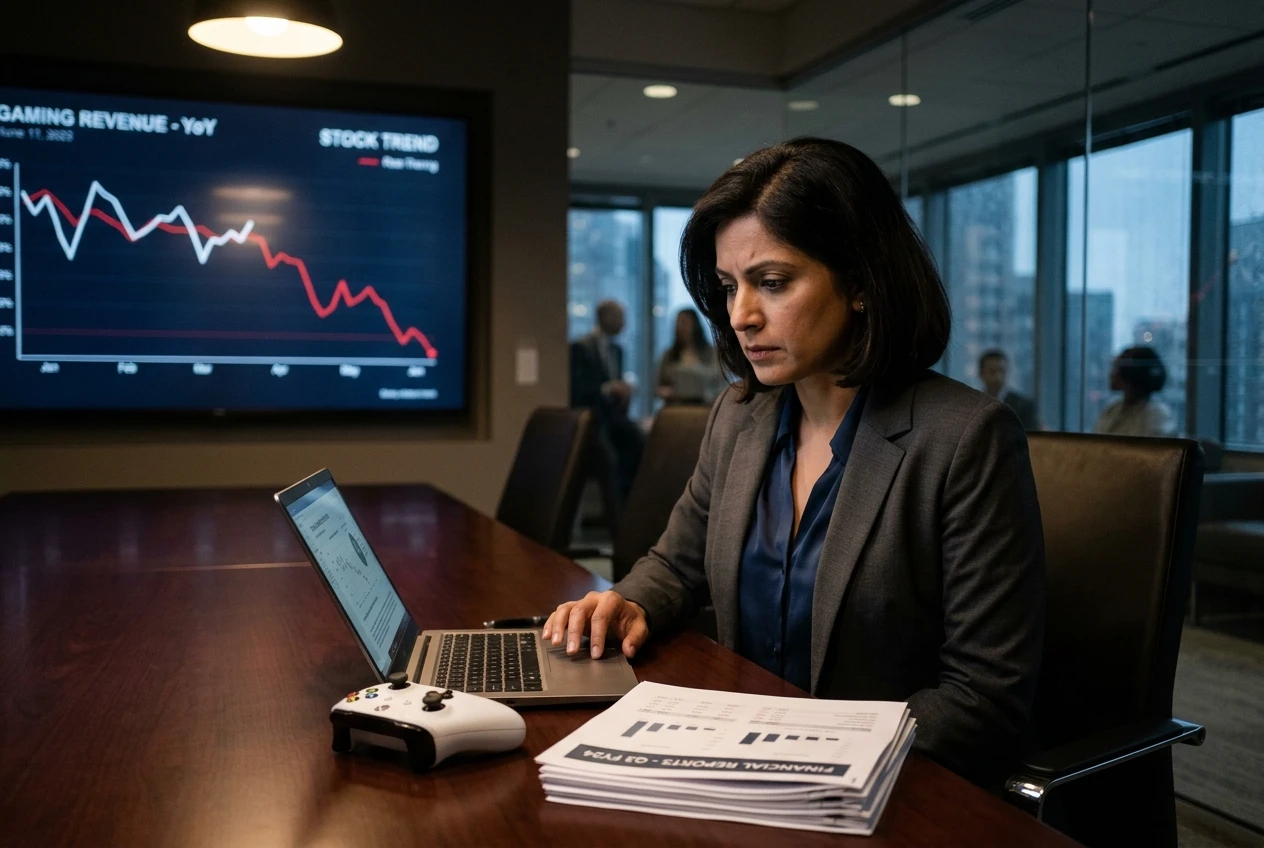
Xbox will finish the fiscal year at roughly a 3% margin by an internal Microsoft measure, Sharma told employees in her June 10 memo, per GeekWire’s read of the note. The figure is the clearest number yet on how thin Xbox’s profitability has become inside a company whose cloud and AI businesses run at multiples of that return.
The thin margin sits on top of more than $20 billion in cumulative spending on content, platform, and hardware subsidies over the past five years, according to figures cited by The Information and reported by the Next Web. The five-year spending figure is, in effect, the size of the hole Microsoft is now weighing how to fill.
Annual revenue at the gaming unit, meanwhile, declined by nearly half a billion dollars over the same window, per the Next Web’s summary of the same Information figures. Microsoft’s broader business has been ploughing payroll and capital expenditure into AI infrastructure, a strategic tilt the Next Web says makes the gaming division’s economics harder to defend internally.
Microsoft is also planning major layoffs in July, with significant cuts to marketing and other budgets, according to the same reports. Bloomberg separately reported the layoffs are scheduled for next month, framing them as part of Sharma’s first major reset inside her first 100 days.
Xbox by the numbers
- 3% margin projected for the current fiscal year, per Sharma’s June 10 memo
- $20 billion+ spent on content, platform, and hardware subsidies over the past five years
- Annual revenue fell by nearly half a billion dollars over the same window
- More than 500 million monthly active users across Xbox, Bethesda, and Activision Blizzard
- Nearly 40 studios under the Microsoft Gaming umbrella
Sharma’s 100-Day Plan for Xbox
Sharma took the Xbox job in February 2026, replacing longtime head Phil Spencer, who retired after 38 years at Microsoft and 12 years leading gaming. Microsoft’s announcement of her appointment named her Executive Vice President and CEO of Microsoft Gaming. Her June 10 memo, which came the same day as Nadella’s Hard Fork appearance, is the clearest public statement of how she plans to approach the business, laying the ground for layoffs paired with a heavier bet on tentpole franchises. Sharma’s plan has the backing of Microsoft CEO Satya Nadella and Chief Financial Officer Amy Hood.
Sharma said in the memo that she will spend the next 100 days taking what she called a fresh look at the business, per GeekWire’s read of the internal note. The plan she laid out, and that Nadella and Hood have signed off on, pairs the coming layoffs with heavier investment in the division’s biggest franchises, including Halo, Fallout, and The Elder Scrolls. The Information’s report on the same day named the same three franchises as the centrepiece of the spending plan.
Halo has not had a new release since 2021, when Halo Infinite launched. The last mainline Fallout was Fallout 4 in 2015. The Elder Scrolls 6 was announced in 2018 and remains in development. The pattern is one of the reasons Microsoft is now weighing structural options for the unit, since those franchises have gone years between major releases.
Sharma has also confirmed that Gears of War: E-Day and Clockwork Revolution will be Xbox exclusives, reversing a recent trend of putting Microsoft games on rival platforms like PlayStation 5 and Nintendo’s Switch. The two confirmed exclusives keep the core Xbox value proposition in place, alongside the major franchises getting the new investment.
Sharma’s stated priorities line up with the structural options now reportedly under review. If the big franchises cannot carry the unit, Microsoft has signalled it is willing to consider every legal form available, including ones that would push Xbox out of the corporate parent entirely. The Next Web, summarizing the report, framed the moment as a ‘last attempt’ to make Xbox work inside Microsoft. Sharma herself has not commented on the structural options publicly.
Nadella’s ‘Sustainable’ Pitch on the Hard Fork Podcast
Nadella made his most direct public comments on Xbox’s future during a Wednesday evening taping of The New York Times’ Hard Fork podcast, recorded at the Hard Fork Live event on June 10 and released the following Friday. The conversation, hosted by Kevin Roose and Casey Newton, came a few hours after Sharma’s memo was sent to staff. Nadella framed the moment as a turning point for a business that has been investing for a quarter-century without finding a sustainable footing inside Microsoft.
No one can accuse Microsoft of not having invested for the last 25 years. And now we have to turn this into a sustainable business.
He did not offer a specific solution on the podcast, but his language echoed the structural discussion The Information reported the same day. With a chuckle, the Microsoft CEO told Roose and Newton that ‘in fact, there’s more monetization of Xbox games happening on YouTube than at Microsoft.’ One pressure on the business is temporary, a run-up in component prices driven by the global shortage of memory and semiconductors, which he said Microsoft will get through, and the other is lasting, the question of what the Xbox business model should be going forward. That memory pressure is already reshaping Xbox’s next console plans.
The LinkedIn and GitHub Blueprint
Two of the three structural options reportedly on the table, wholly-owned subsidiary and joint venture, already have working models inside Microsoft. The Information’s report explicitly cited LinkedIn and GitHub as potential templates for what an Xbox subsidiary could look like, a structure that would let Microsoft retain ownership while giving the gaming unit day-to-day autonomy. The Next Web, summarizing the same report, noted that both continue to operate with their own leadership and brand identity years after being folded into Microsoft. Both also continue to report into Microsoft on the consolidated financials, even as they run their own product roadmaps and pricing. The structure is a familiar one inside Microsoft, and a wholly-owned subsidiary is the option that most closely mirrors how those two businesses already run.
Unlike a sale, a wholly-owned subsidiary would keep Xbox inside Microsoft’s consolidated revenue, even as it ran its own profit and loss statement. The Information’s report flagged the appeal directly, noting that a wholly-owned subsidiary ‘could make it easier to sell.’ The structure is also a hedge: it preserves Microsoft’s optionality to divest the unit later, without forcing a sale today.
How Microsoft’s wholly-owned subsidiaries work today
| Subsidiary | What it does | How it operates |
|---|---|---|
| Professional network | Wholly-owned, own leadership, own brand | |
| GitHub | Developer platform | Wholly-owned, own leadership, own brand |
| Xbox (reported option) | Console and game publisher | Wholly-owned, own leadership, own brand |
The joint-venture route would be more drastic. It would split Xbox’s ownership between Microsoft and an outside partner, a structure the gaming industry has not widely used. A sale would be the most disruptive option of the three, ending Microsoft’s 25-year run as a first-party console maker. The Information’s report does not name any potential partner or buyer. It also does not estimate what a sale of the gaming unit might fetch, given the unit’s recent margin and revenue trajectory.
What the $69 Billion Activision Bet Looks Like Now
Any serious discussion of an Xbox spin-off has to grapple with the $69 billion Activision Blizzard deal Microsoft completed in 2023. The acquisition was meant to be the foundation of a stronger Xbox, adding franchises including Call of Duty, World of Warcraft, Diablo, and Candy Crush to a portfolio that already included Halo, The Elder Scrolls, and Minecraft. Those same franchises are now the strongest argument for keeping Xbox inside Microsoft: they are the IP Sharma has been told to double down on.
Sharma’s June 10 memo and the Information report land together for a reason. The Information said Sharma plans to pair the July layoffs with heavier investment in Halo, Fallout, and The Elder Scrolls, a plan Nadella and Hood have approved. Fallout and The Elder Scrolls are both Bethesda-developed franchises, while Halo is an in-house Xbox franchise. The mix shows that the franchise investment goes beyond what Bethesda alone can deliver, and that the Halo franchise still has a major role in Microsoft’s plans.
If the bet on the big franchises fails to pull Xbox back to a sustainable margin, the structural options now on the table suggest Microsoft is prepared to let the unit go in some form. A sale of Xbox would unwind the $69 billion Activision Blizzard deal that closed in 2023, a turn that would reshape both Microsoft’s identity and the wider console industry’s competitive structure. The original Xbox architect has publicly warned about where the brand is heading.
For now, the path forward is set: layoffs in July, heavier investment in the three focus franchises, and a 100-day review under Sharma. Behind that operational reset, The Information’s report shows Microsoft is also weighing the legal and corporate structures that would let Xbox continue to exist outside Microsoft’s direct control. The joint-venture and sale options remain more theoretical, with no partner or buyer publicly identified.
Frequently Asked Questions
Has Microsoft confirmed it is spinning off Xbox?
No. The Information reported on June 12, 2026, citing three people with direct knowledge of the discussions, that Microsoft has not ruled out spinning off or restructuring Xbox as a wholly-owned subsidiary, joint venture, or outright sale. Microsoft has no imminent restructuring plans, the report said, but the options remain on the table.
Why is Xbox reportedly in financial trouble?
Xbox will finish the current fiscal year at roughly a 3% margin by an internal Microsoft measure, according to a June 10 memo from Xbox CEO Asha Sharma. The division has spent more than $20 billion on content, platform, and hardware subsidies over the past five years while annual revenue declined by nearly half a billion dollars, per figures cited by The Information and reported by the Next Web.
Who is Asha Sharma?
Asha Sharma became Executive Vice President and CEO of Microsoft Gaming in February 2026, replacing Phil Spencer, who retired after 38 years at Microsoft and 12 years leading gaming. Sharma previously served as Chief Operating Officer at Instacart and as a Vice President at Meta, and joined Microsoft in 2024.
What franchises is Microsoft focusing Xbox on?
According to The Information’s report, Xbox plans to invest more heavily in Halo, Fallout, and The Elder Scrolls in the fiscal year beginning in July. Halo has not had a new release since 2021’s Halo Infinite, the last mainline Fallout was Fallout 4 in 2015, and The Elder Scrolls 6 was announced in 2018 and is still in development.
What would a wholly-owned Xbox subsidiary look like?
The Information cited LinkedIn and GitHub as potential templates. Both operate as wholly-owned Microsoft subsidiaries with their own leadership, brand, and product roadmaps while still reporting into Microsoft’s consolidated financials. The same model would give Xbox day-to-day autonomy, keep it inside Microsoft’s revenue, and make a future sale easier to execute.