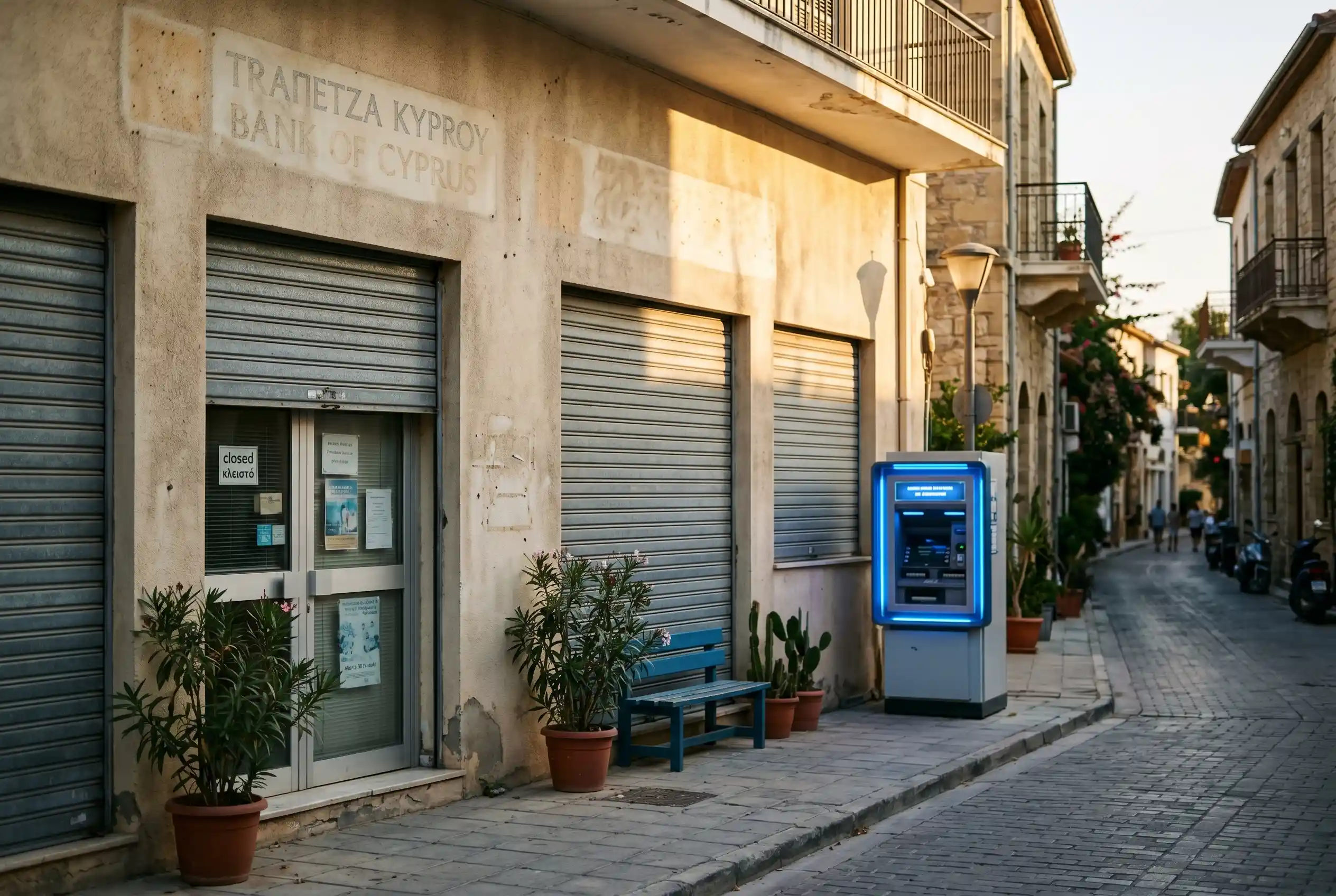
Cyprus bank branch closures have continued for a decade, with 370 branches shut and 4,634 jobs cut between 2015 and 2025, according to the branch and staff data from the ECB. The branch network now stands at 193 island-wide. Staff numbers are down a further 259 compared with 2024, the data showed.
The contraction traces back to the 2012 and 2013 financial shocks, when Laiki Bank and the cooperative credit institutions collapsed. It continues today as everyday banking has moved onto apps and ATMs. Voluntary exit schemes are still running at Bank of Cyprus and Eurobank. The ECB’s data on the EU as a whole shows Cyprus sits inside a bloc-wide branch decline.
A Decade Lost From the Branch Map
Cyprus entered the 2010s with one of the most over-branched banking systems in the European Union. By 2025, the island had shed 4,634 banking jobs and shut 370 branches over the previous ten years, the ECB data showed. Staff numbers fell from a peak of 12,853 to 6,349 by 2025, a halving of the workforce in a single decade.
Of those who left, 6,504 departed through voluntary redundancy schemes or retirement rather than forced layoffs. The 2024-to-2025 shift alone removed 259 employees, even as the branch count held flat at 193. The cuts are not finished. Bank of Cyprus approved fresh departures in 2025 and announced a further small scheme in early June 2026, while Eurobank Ltd, the Cyprus unit of the Greek banking group, opened a 300-employee scheme on March 9, 2026.
- 370 branches closed over the ten years to 2025
- 4,634 banking jobs cut in the same period
- 193 branches remain across Cyprus at end-2025
- 6,349 staff in the island’s banks at end-2025
- 12,853 staff at the pre-crisis peak
The Crisis That Started the Contraction
The decade-long contraction did not start as a digital story. It started as a crisis story. The collapse of Laiki Bank in March 2013 and the wind-down of the cooperative credit institutions closed the largest single block of branches on the island.
Since 2012, 657 branches have shut across the island. From the 2012 peak of 12,853 staff to the 6,349 in 2025, 6,504 employees left through voluntary redundancy schemes or retirement. As the surviving banks retooled for a digital-led market, branches kept closing.
Both waves of cuts, the 2013-14 crisis wave and the digital wave that followed, have run through voluntary exit schemes rather than layoffs. The post-crisis shrinkage came from the Laiki Bank closure and the wind-down of the cooperative credit institutions. The ECB’s 6,349 year-end figure is the most recent published count for the island. The Eurobank 300-employee scheme, open in 2026, runs through the same voluntary-exit pipeline that has been in use since 2013.
- 2012: Cyprus banking sector at peak staff of 12,853.
- March 2013: Laiki Bank closed, cooperative credit institutions wound down.
- 2013-2024: 657 branches shut and 6,504 staff exited via voluntary schemes or retirement.
- 2025: Branch count at 193, staff at 6,349, voluntary exit schemes still running.
Why Customers Rarely Walk In Anymore
Bank executives describe the post-crisis decade as a digital rebuilding. “Credit institutions have been investing in technology upgrades to offer faster and more accessible services with fewer staff,” Phileleftheros reported, and everyday transactions are now conducted largely through e-banking and ATMs. The branch is no longer the first stop for routine banking.
For most routine tasks, deposits, transfers and account openings happen in apps, on call centres, or at machines. Banks have closed the physical counters and reallocated the work to digital channels, a pattern mirrored across most of the European Union. The 2024-to-2025 year was a pause, not a reversal: branch numbers held steady at 193, but staff numbers kept falling. The 193 branches that remain are running with 6,349 staff, the most recent year-end count the ECB has published for the island.
Exit Schemes Still Open in 2026
Voluntary exit schemes remain the only practical route for Cyprus banks to reduce headcount, in line with the long-standing convention on the island. Bank of Cyprus approved approximately 110 full-time employees for departure in 2025 under a small-scale controlled scheme. In early June the bank announced a further scheme of “very limited scope” targeting about 40 staff.
Eurobank Ltd, the Cyprus unit of the Greek banking group, opened a significantly expanded scheme on March 9, 2026, that targets about 300 employees. The total compensation package can reach €200,000, depending on position and years of service, with an additional 10 per cent on top of the regular entitlement, and the bank extended the application deadline to March 28, 2026, according to Eurobank’s extension of the scheme deadline. Participation requires a minimum of five years’ service, and applicants must be over 35 years old at the time the scheme comes into effect.
The schemes cover all corners of the merged groups. Eurobank’s programme applies for the first time to staff from CNP, the former Eurobank Cyprus, and the former Hellenic Bank, the result of the post-merger integration. A 2025 voluntary scheme at the same bank had approved 154 employees, about 7 per cent of the workforce at the time, and was expected to generate annual savings in personnel costs of roughly €11.2 million, according to the Eurobank voluntary exit scheme details. The 300-employee scheme is the larger of the two voluntary programmes the bank has run in 2025 and 2026.
- Bank of Cyprus 2025 scheme: approximately 110 employees approved for departure.
- Bank of Cyprus early June 2026 scheme: approximately 40 staff targeted.
- Eurobank March 2025 scheme: 154 employees approved, about 7% of workforce, roughly €11.2 million annual savings expected.
- Eurobank March 2026 scheme: approximately 300 employees targeted, up to €200,000 compensation, deadline March 28, 2026.
Cyprus Tracks an EU-Wide Branch Decline
Cyprus is not an outlier. Across the European Union, the number of bank branches fell 2.62 per cent compared with the end of 2024, with declines recorded in 23 of the 27 member states, ranging from -0.2 per cent to -12.16 per cent. The total EU branch network stood at 122,889 at the end of 2025, of which 86.13 per cent were in the eurozone.
EU banking employment fell 0.80 per cent in the same period, with 16 of the 27 member states reporting declines. Total EU banking employment stood at 2,130,467 in 2025, of which 1,742,928 worked in the eurozone. Cyprus’s contraction is sharper than the bloc average, but the trajectory is the same: fewer branches, fewer staff, and transactions that have moved online or to ATMs. The ECB data also shows the bloc’s banking market is increasingly concentrated, with the share of assets held by the five largest credit institutions in each member state ranging from 34.37 per cent at the low end to 95.2 per cent at the high end, with an EU average of 69.33 per cent at the end of 2025.
The concentration range captures both fragmented and tightly held banking markets, with the EU average at 69.33 per cent for the top five lenders. Cyprus sits inside that range with one of the more concentrated banking markets in the bloc. The branch network is steady at 193, and staff numbers keep falling.
| Metric (end-2025) | Cyprus | European Union |
|---|---|---|
| Branches | 193 | 122,889 (86.13% in eurozone) |
| Annual branch change vs 2024 | Steady | -2.62% (range -0.2% to -12.16%) |
| States with branch decline | n/a | 23 of 27 |
| Banking employees | 6,349 | 2,130,467 (1,742,928 in eurozone) |
| Annual staff change vs 2024 | -259 | -0.80% |
| States with staff decline | n/a | 16 of 27 |
Five Banks Now Hold Most Lending
Fewer branches are not the only sign of a smaller, more concentrated system. The ECB tracks the share of assets held by the five largest credit institutions in each member state, and the figure for the EU as a whole runs from 34.37 per cent at the low end to 95.2 per cent at the high end, with an average of 69.33 per cent at the end of 2025. Cyprus is among the smaller banking markets in absolute terms, with 193 branches and 6,349 staff at end-2025, and its figures sit inside the EU concentration range. The 2026 ECB data is not yet published.
For customers, that means a branch network with fewer outlets, run by a smaller group of large lenders, with everyday transactions handled almost entirely online. For staff, the ECB data shows, it means a workforce that has roughly halved in a decade, with voluntary exit schemes still paying out and still open as of June 2026. The 6,349 staff figure for 2025 is the most recent reading, and the same names have been pitching a decade of reform in Brussels.
Frequently Asked Questions
How many bank branches has Cyprus lost in a decade?
Cyprus banks closed 370 branches over the ten years to 2025, according to the branch and staff data from the ECB. The total shut since 2012, including the post-crisis wave, is 657.
What happened to Laiki Bank?
Laiki Bank was closed in March 2013 as part of the resolution of the Cypriot financial crisis, one of the events that drove the 657 branch closures since 2012.
Are Cyprus banks still cutting staff in 2026?
Yes. Eurobank’s voluntary exit scheme, launched on March 9, 2026, targets approximately 300 employees, and the bank extended the application deadline to March 28, 2026. Bank of Cyprus announced a further scheme of very limited scope in early June 2026, targeting approximately 40 staff.
Why do Cyprus banks use voluntary exit schemes?
Cyprus’s banks and semi-governmental organisations operate under an unwritten convention that they cannot make staff redundant, according to the unwritten convention behind voluntary exit schemes. They can only offer a voluntary exit scheme, and the final decision rests with the individual worker.
Are branch closures happening across the EU?
Yes. The number of bank branches fell 2.62 per cent across the EU compared with the end of 2024, with declines recorded in 23 of the 27 member states. Banking employment fell 0.80 per cent across the bloc, with declines in 16 of the 27 member states.
Disclaimer: This article is for informational purposes only and does not constitute financial, investment, or career advice. Figures cited are accurate as of the publication date and reflect ECB data analysed by Phileleftheros. Job and branch counts are subject to revision as further ECB updates are released.