Cinegy will spend IBC2026 arguing its playout software needs a quarter to an eighth of the memory a Windows setup requires, just as global chip prices climb toward fresh highs. The German software maker’s stand at the RAI Amsterdam, running September 11 through 14, will center on shifting Cinegy Air’s back end onto Linux and Docker containers instead of Windows servers.
Server memory contract prices are forecast to keep climbing this quarter, according to TrendForce, the Taiwan based market intelligence firm, continuing a run of increases that started in early 2026. Broadcasters without a hyperscaler’s budget are left absorbing that curve one server rack at a time.
A Memory Price Shock Reaches the Broadcast Rack
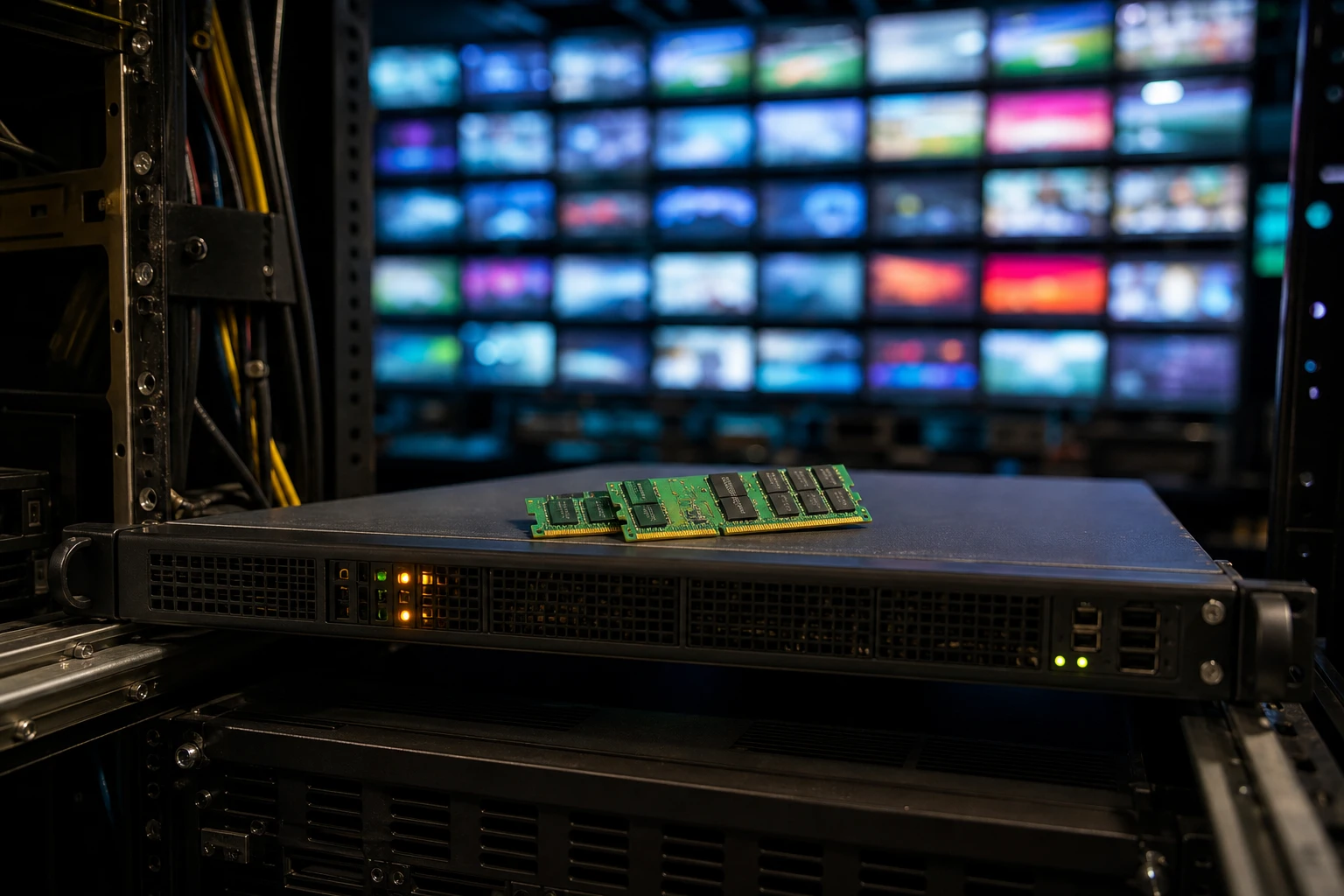
Memory chips do not usually make broadcast trade press. That is changing fast. DRAM, or dynamic random-access memory, is the chip type inside every server, and its price has moved more in the past two quarters than most broadcast IT budgets were built to handle.
TrendForce forecast conventional DRAM contract prices would rise 55% to 60% quarter over quarter heading into the first quarter of 2026, then climb a further 58% to 63% in the second quarter. By the third quarter, the pace has cooled but not stopped, with contract prices still rising 13% to 18% quarter over quarter, alongside a 10% to 15% jump for NAND Flash storage.
| Quarter | Conventional DRAM Price Change (QoQ) |
|---|---|
| Q1 2026 (forecast) | +55% to 60% |
| Q2 2026 (forecast) | +58% to 63% |
| Q3 2026 (forecast) | +13% to 18% |
The driver is not broadcast at all. Cloud service providers are racing to build out AI data centers, and memory makers are shifting production toward the server chips those centers need, leaving less capacity for everyone else. Capital keeps chasing that build-out too. One AI hardware startup, Aina, raised $5.5 million on the bet that AI hardware still has room to run, a small sign the demand behind the memory squeeze shows no sign of easing.
Cinegy Squeezes More Channels Into a Quarter of the RAM
- Software-defined media – broadcast infrastructure built primarily as software on standard IT hardware rather than purpose-built broadcast appliances, letting operators reconfigure or add channels without buying new dedicated boxes.
Cinegy Air is the company’s playout and broadcast automation engine, already running multi-channel operations for broadcasters, OTT platforms and government agencies. At IBC2026, Cinegy will show the software’s core back end running inside Docker containers on Linux rather than Windows, a change the company says needs only a quarter to an eighth of the RAM and a much smaller processor footprint than a comparable Windows deployment.
Jan Weigner, Cinegy’s chief technology officer and founder, said efficiency has always mattered to the company, but with today’s costs for processors, memory and storage, it has become more critical than ever. The pitch is not just about trimming resource use. Cinegy points to three concrete gains from moving channel deployment into Docker.
- Instant scalability, spinning up a fully configured broadcast channel in seconds instead of provisioning new hardware.
- Fast migration, moving an existing channel setup between on-premises racks and cloud instances without rebuilding it.
- Total channel templatization, turning one configured channel into a repeatable template for every new market or client.
None of that requires operators to change how they work day to day. Weigner said the switch happens without staff even noticing anything has changed on the operational side.
Why Broadcasters Stopped Trusting the Cloud’s Promises
Broadcasters have tested versions of this promise for two years, with mixed results. Thorsten Sauer, chief executive of rival vendor Pixel Power, told trade publication NewscastStudio that “cloud storage is a stubbornly expensive proposition,” pointing to growing camera file sizes and the sunk cost of on-premises gear stations already own.
Mark Donnigan, head of strategic marketing at chipmaker NETINT, has argued the fully cloud-only broadcast workflow has been oversold, predicting a more balanced hybrid approach would define 2026 as organizations pull some workloads back from public cloud. A case study published by monitoring vendor TAG Video Systems described a major sports broadcaster that lifted its entire on-premises playout workflow into the cloud exactly as built, workarounds included. Six months later, costs were higher than before the move and no new capability had been gained.
That is the backdrop Cinegy is selling against. Its claim is narrower than a full cloud migration: keep the workload on infrastructure you already own, or move it to the cloud on your own terms, but shrink what it costs to run either way.
Cinegy Pushes Back on Rivals’ Novelty Claims
We see newcomers to the server and playout market claiming that ‘breaking the one channel to one server’ concept is novel. We have been using virtualization and other methods to pack many more channels into small footprints for over 15 years.
Weigner said that in Cinegy’s IBC2026 announcement, taking a direct shot at competitors framing containerized playout as a new idea.
The claim has some backing. At IBC 2024, trade coverage described Cinegy’s stand demonstrating a containerized back end delivering 64 channels of HD playout from a single physical server, two years before Docker on Linux became this year’s headline feature. The company frames the current move to Linux as the next step in that same long-running effort, not a pivot forced by a newcomer’s idea.
Desktop Bets on Safe Access From Anywhere
Cinegy’s IBC stand will not be only about Air. Cinegy Desktop, a cross-platform production tool built for sports, news, reality TV and other fast-turnaround work, connects to Cinegy’s local or cloud-based media asset management system to give editors instant access to unlimited channels of live camera or video feeds while they are still being recorded or uploaded.
Remote production is another area where software’s promised freedom has proven harder in practice than in a sales deck. Cinegy Desktop tries to close that gap with what the company calls a zero-trust, zero-install client architecture, letting staff connect securely over any internet connection without an administrator installing software or managing devices.
How Big Will IBC2026 Actually Be?
IBC2026 is on track to be one of the largest editions yet, with organizers expecting roughly 1,300 exhibitors and 45,000 attendees from more than 170 countries at the RAI Amsterdam. That scale is exactly the audience Cinegy needs to prove its memory savings hold up outside a demo booth.
Michael Crimp, chief executive of IBC, called the coming edition a defining moment for the global media and entertainment industry. The show’s Future Tech area, which spotlights AI, cloud native workflows and next-generation production tools, is expanding by roughly 30% from last year, organizers said, a sign the industry’s cost pressures have not slowed its appetite for new technology.
Weigner has framed this year’s push as preparation for a bigger milestone. By next year’s IBC, he said, Cinegy will be well into celebrating 25 years in business, and the case it wants to make this September is that maximizing existing hardware and minimizing cloud cost can coexist with adding services and holding quality steady. Cinegy will spend four days at stand 7.A01 in Hall 7 finding out whether that math convinces the rest of the industry.
Frequently Asked Questions
When and Where Is IBC2026 Being Held?
IBC2026 runs September 11 through 14 at the RAI Amsterdam in the Netherlands, with Cinegy exhibiting at stand 7.A01 in Hall 7, one of the show’s three premium halls by exhibitor demand.
Why Are Memory and RAM Prices Rising in 2026?
Prices are climbing because cloud service providers are racing to build AI data centers and memory makers are shifting production toward the higher margin server chips those centers need. That has pushed conventional DRAM contract prices up by double digit percentages every quarter since the start of 2026, even as consumer demand for PCs and phones stays weak.
What Changes When Broadcast Playout Runs in Docker on Linux?
Docker packages an application and everything it needs into a lightweight container that runs the same way on any compatible machine. For Cinegy, moving Cinegy Air’s back end into Docker containers on Linux rather than Windows cuts the processor and memory footprint sharply and lets operators spin up a fully configured broadcast channel in seconds instead of provisioning a new server.
Will Memory Prices Keep Rising Into 2027?
Likely, though at a slower pace. TrendForce expects total RDIMM bit supply to grow only 15% to 20% a year, well short of server CPU shipment growth, with a server DRAM shortage already anticipated for 2027 as cloud providers keep signing long-term supply deals to lock in future capacity.
What Else Is Cinegy Showing at IBC2026?
Alongside Cinegy Air, the stand features Cinegy Desktop, a cross-platform production tool for sports, news and reality TV that connects to Cinegy’s media asset management system, plus a presentation area called Cinegy Studio hosting a running program of talks and debates through the show.