Michael Burry spent July 21 amplifying a number bigger than almost anything he has flagged before: $1.65 trillion. The hedge fund manager known for his bet against the 2008 housing market reposted a Nikkei Asia study on X pointing to hidden debt at five U.S. tech giants. Five companies are carrying that much completely off their balance sheets, Nikkei found. It is up eightfold in four years, and now bigger than the $1.35 trillion the same five actually report.
That debt did not vanish. It moved onto other books, mostly held by private credit firms, insurers and bond investors that few people watching Big Tech’s quarterly earnings ever look at.
Data Center Leases Don’t Count as Debt Until They Do
Nikkei’s analysis covered Alphabet, Microsoft, Amazon, Meta and Oracle. Burry, who posts under the X display name “Cassandra Unchained,” flagged the study in a July 21 post, repeating its warning that the hidden debt is “exceeding actual debt and making it tougher for investors to assess risk.”
The obligations behind that figure are mostly multi-year GPU supply contracts and long-term data center leases signed to lock in AI computing capacity. Under current accounting rules, those commitments do not count as reported debt until the leased facility actually starts operating, even though the company is on the hook to pay for it regardless of demand.
The structure resembles the special-purpose entities Enron used to hide debt before its collapse more than two decades ago. Tighter disclosure rules make today’s version legal. Once a facility switches on, its lease rolls onto the balance sheet at once, and if AI demand does not match the buildout, the loss lands on whoever financed the facility rather than on the tech company whose name is on the building.
Where the $1.65 Trillion Actually Sits
Nikkei did not spread this debt evenly. Its analysis found that off-balance-sheet debt swelled eightfold in four years across the group, with two companies carrying a disproportionate share of it.
| Company | Off-Balance-Sheet (Hidden) Debt | Growth Over Four Years | Main Driver |
|---|---|---|---|
| Meta | $420 billion | Nearly triple its reported debt | Data center leases and joint-venture financing |
| Oracle | $273.3 billion (as of end of May) | Up roughly 30-fold | Data center leases tied to OpenAI’s Stargate buildout |
| All five combined (Alphabet, Microsoft, Amazon, Meta, Oracle) | $1.65 trillion | Up eightfold, versus $1.35 trillion reported | GPU supply contracts and data center leases |
Meta has spent a decade selling investors on a net-cash balance sheet, an image this number complicates. Oracle’s growth rate tells the sharper story. A 30-fold increase in four years, landing at $273.3 billion, traces almost entirely to one relationship: its data center buildout for OpenAI’s Stargate program.
Meta’s Hyperion Deal Reveals the Real Lenders
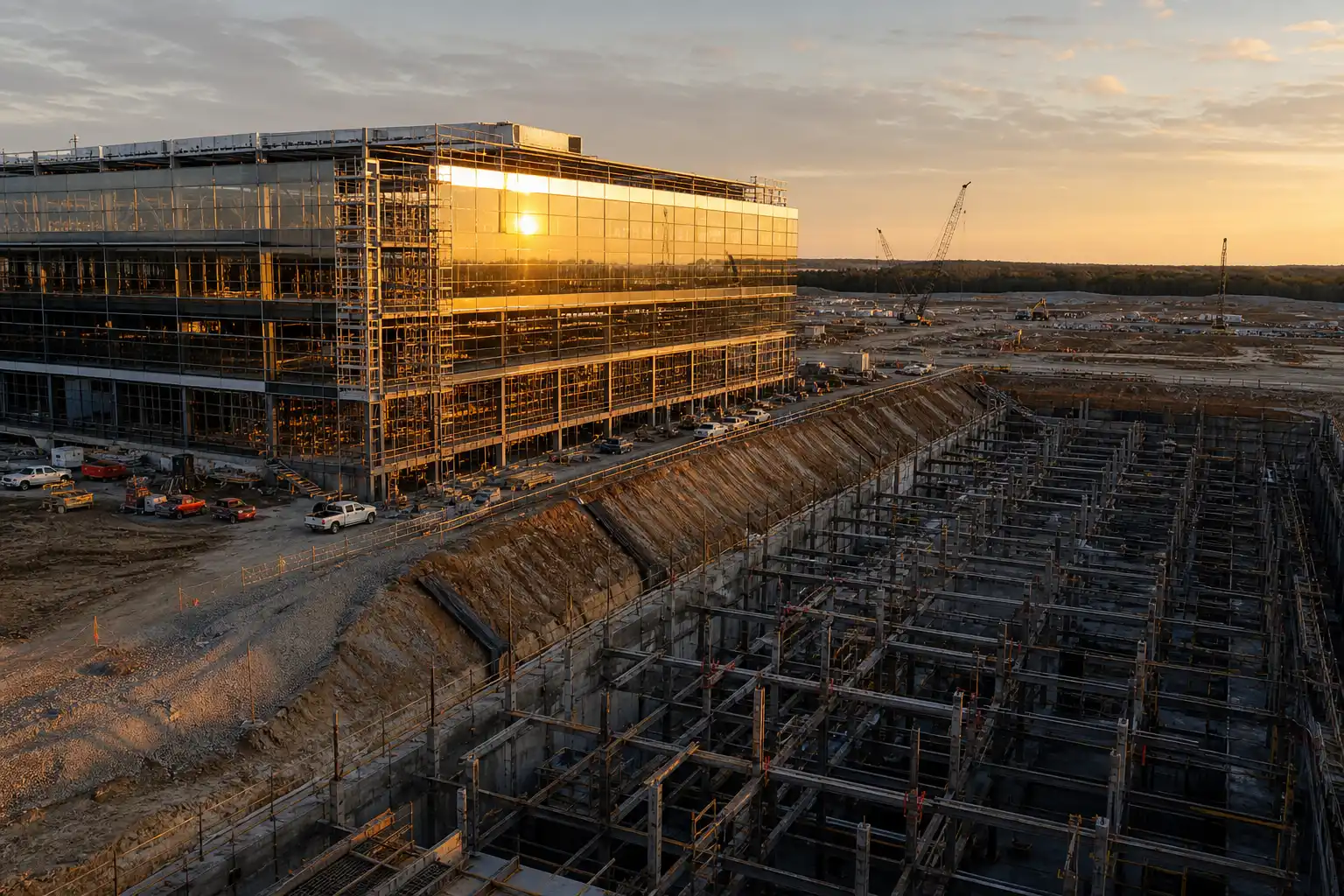
Meta’s $420 billion is not an abstraction. Much of it traces to Hyperion, a data center campus under construction in Richland Parish, Louisiana, built through the joint venture financing Hyperion’s data center campus with private credit firm Blue Owl Capital. The setup lets Meta record an operating lease instead of a construction loan.
- Blue Owl Capital – funds managed by the private credit firm own 80% of Beignet Investor, the special purpose vehicle financing Hyperion, while Meta keeps the remaining 20%
- PIMCO – anchored a large share of the bond sale that funds the campus, alongside other private securities buyers
- BlackRock – purchased more than $3 billion of the bonds issued by the joint venture
- Morgan Stanley – arranged the financing and advised Meta on the transaction
The arrangement lets Meta treat the spending as flexible operating expense while a small group of institutional lenders absorbs the credit risk of a campus that will not fully switch on for years. Rating agency analysis of the deal treats the debt as barely a notch below Meta’s own credit grade, both during construction and once Hyperion is running, effectively pricing it as Meta-adjacent risk. That means PIMCO, BlackRock and the other bondholders behind Beignet Investor are underwriting Meta-sized exposure without it ever touching Meta’s own balance sheet.
Oracle Is Betting the House on OpenAI’s Math
Oracle’s relationship with OpenAI carries a risk the other four companies do not share. Oracle is building data centers specifically to serve OpenAI’s Stargate program, and collecting on those leases depends on OpenAI’s own finances holding up. OpenAI’s leaked 2025 financial statements, first published by journalist Ed Zitron and independently verified by the Financial Times, show a business still burning far more cash than it brings in.
What we know
- OpenAI’s leaked 2025 financials show a $20.92 billion operating loss on $13.07 billion in revenue, a business spending roughly $1.60 for every $1 it earns, with $17.2 billion of its total costs paid directly to Microsoft for Azure and compute.
- OpenAI cut its long-term Stargate spending pledge from $1.4 trillion to $600 billion earlier this year, shifting toward leasing capacity from multiple providers rather than building exclusively with Oracle.
What’s unconfirmed
- Whether OpenAI’s cash flow will cover Oracle’s lease payments once the underlying data centers switch on and the cost shifts onto Oracle’s own balance sheet.
- Whether OpenAI’s expected public listing arrives on a timeline that gives Oracle and its lenders clarity before more of that debt comes due.
The risk does not stop at Oracle. OpenAI buys much of its computing power from NVIDIA, directly and through Oracle’s own infrastructure, while NVIDIA also holds an investment stake in cloud provider CoreWeave, another OpenAI supplier. If OpenAI cannot pay Oracle on schedule, the chain runs further than one contract.
Alphabet Chose Shareholders Over Lenders
Alphabet took a different route. In June, the company moved to raise $80 billion in fresh equity rather than adding debt, on or off its balance sheet, to fund its AI buildout. Warren Buffett’s Berkshire Hathaway anchored the deal with a $10 billion private placement, split evenly between $5 billion of Class A shares at $351.81 apiece and $5 billion of Class C shares at $348.20 apiece, both priced below where the stock closed that day, according to Alphabet’s own filing on the sale of stock to Berkshire Hathaway. The rest of the raise splits between a $30 billion underwritten offering and a $40 billion at-the-market program set to begin in the third quarter.
The choice avoids something the other four companies did not. Equity dilutes existing shareholders in full public view. It requires no special purpose vehicle, no private credit partner and no rating agency’s Meta-adjusted math to make the risk legible.
The Next Six Weeks Test These Bets
Four of the five companies in Nikkei’s study report quarterly earnings within roughly two weeks. Their reported debt figures will look clean. The trillion-dollar-plus sitting in lease footnotes will not show up in a headline number.
Microsoft and Amazon have both carried out layoffs this year, moves that critics have linked to preserving cash for continued AI spending, though neither company has confirmed that connection. Oracle has already felt a version of this pressure. S&P has cut the company’s credit rating over stretched leverage, according to reporting on the Nikkei findings, with Morgan Stanley and Moody’s flagging similar concerns.
Burry’s own bet is not yet settled. His bearish positions against NVIDIA and Palantir stock have produced mixed results so far.
Earnings reports from four of the five companies land within two weeks. The clean numbers come first. The trillion-dollar gap stays in the footnotes, waiting for the next lease to switch on.
Frequently Asked Questions
What counts as Big Tech’s hidden or off-balance-sheet debt?
It mainly means multi-year GPU supply contracts and long-term data center leases signed to secure AI computing capacity. Under current accounting rules, those obligations do not count as reported debt until the leased facility is actually running, even though the company must pay for it regardless of demand.
How is Oracle’s cloud computing deal with OpenAI structured?
OpenAI has described its Stargate partnership with Oracle as exceeding $300 billion over five years, while a separate agreement reported by the Financial Times values roughly 4.5 gigawatts of computing capacity at about $30 billion a year. Oracle Chief Executive Safra Catz has pointed to $455 billion in total remaining performance obligations, most of it tied to AI contracts.
Is Michael Burry still betting against NVIDIA and Palantir stock?
Burry holds bearish positions against both companies, though results have been mixed so far. Because his fund, Scion Asset Management, discloses holdings only through quarterly 13F filings, the public sees his positions well after he has placed or adjusted them.
Why did Alphabet raise equity instead of borrowing more money?
Alphabet said the $80 billion raise helps fund its AI buildout while keeping a healthy balance sheet. The company has guided to $180 billion to $190 billion in 2026 capital spending, with a further increase expected in 2027, and chose open dilution over debt or off-balance-sheet vehicles.
How much is Big Tech expected to spend on AI data centers by 2028?
Industry estimates cited alongside the Nikkei findings put total AI data center spending across the sector above $3 trillion through 2028, much of it financed against the value of the chips installed inside those facilities.
Disclaimer: This article is for informational purposes only and does not constitute investment advice. Equity, credit and derivatives markets carry real risk, and readers should consult a licensed financial adviser before acting on any figures here, which are accurate as of publication in July 2026.