
NEWS
ASPI Tracker Finds Lab Monopolies Beyond China’s 69-Field Lead
ASPI’s Critical Technology Tracker puts China first in 69 of 74 fields, with lab monopoly risk in 41 and a US high-risk pocket in neuroprosthetics.

China leads high-impact research in 69 of 74 critical technologies, the Australian Strategic Policy Institute’s tracker showed after its 2025 expansion and two 2026 refreshes. The United States leads the other five. In neuroprosthetics, the same tool now rates a high monopoly risk on the American side.
ASPI’s 1 December 2025 release added 10 fields and put China first in 66, the cut behind China’s December 2025 research-lead scoreboard. By the 2021 to 2025 window, China had also taken natural language processing, genetic engineering, and nuclear medicine and radiotherapy. The tracker is not a factory census. It is a map of the top 10 percent of cited papers, and of the labs that write them.
The Tracker Scores High-Impact Papers
Jenny Wong-Leung and Stephan Robin, data scientists at ASPI, and junior researcher Linus Cohen wrote that the tracker “measures not a country’s overall strength in critical technologies but its research performance in them.” A country’s five-year record is treated as a lead indicator of later science and technology capability. High-impact work means papers in the top 10 percent of citations in that field in that year, drawn from Clarivate’s Web of Science, with labs cleaned through the Research Organization Registry and researcher careers through ORCID.
ASPI has also said a research lead does not necessarily equal the same lead in building and selling the technology. China can sit first in papers because it is still chasing products other countries already ship. The December 2025 authors still treated the citation table as the early warning. That is the split the later 2026 cuts make sharper: the scoreboard is clustering, and clustering is how a partner ends up buying from one country’s labs.
THE TRACKER’S EXPANDING SCOREBOARD
- 1 March 2023: Launch covers 44 technologies, with China first in 37.
- 28 August 2024: The set grows to 64 technologies and 21 years of papers. China is first in 57 in 2019 to 2023, up from 52 in 2018 to 2022. In 2003 to 2007, China led in just three of 64 while the United States led 60.
- 1 December 2025: Ten fields are added, taking the set to 74. China leads 66 of 74 on 2020 to 2024 papers. The full file holds more than 9 million papers from 2005 to 2025, or 7.7 million once duplicates across fields are stripped.
- 25 March 2026: The complete 2025 dataset is loaded. China leads 69 of 74 on 2021 to 2025 papers. High monopoly risk covers 41 fields, eight more than in 2020 to 2024.
- June 2026: The 2021 to 2025 window is refreshed. China still leads 69 of 74. Brain-computer interfaces stay China-led but drop from high to intermediate monopoly risk. Neuroprosthetics, already a US lead, is rated high risk for the United States.
Former prime minister Kevin Rudd cited the 69-of-74 figure in a National Press Club speech in September 2026, and ASPI said further tracker updates were still coming. Paper tables keep getting read as a finished industrial ranking. That overreads what the method counts.
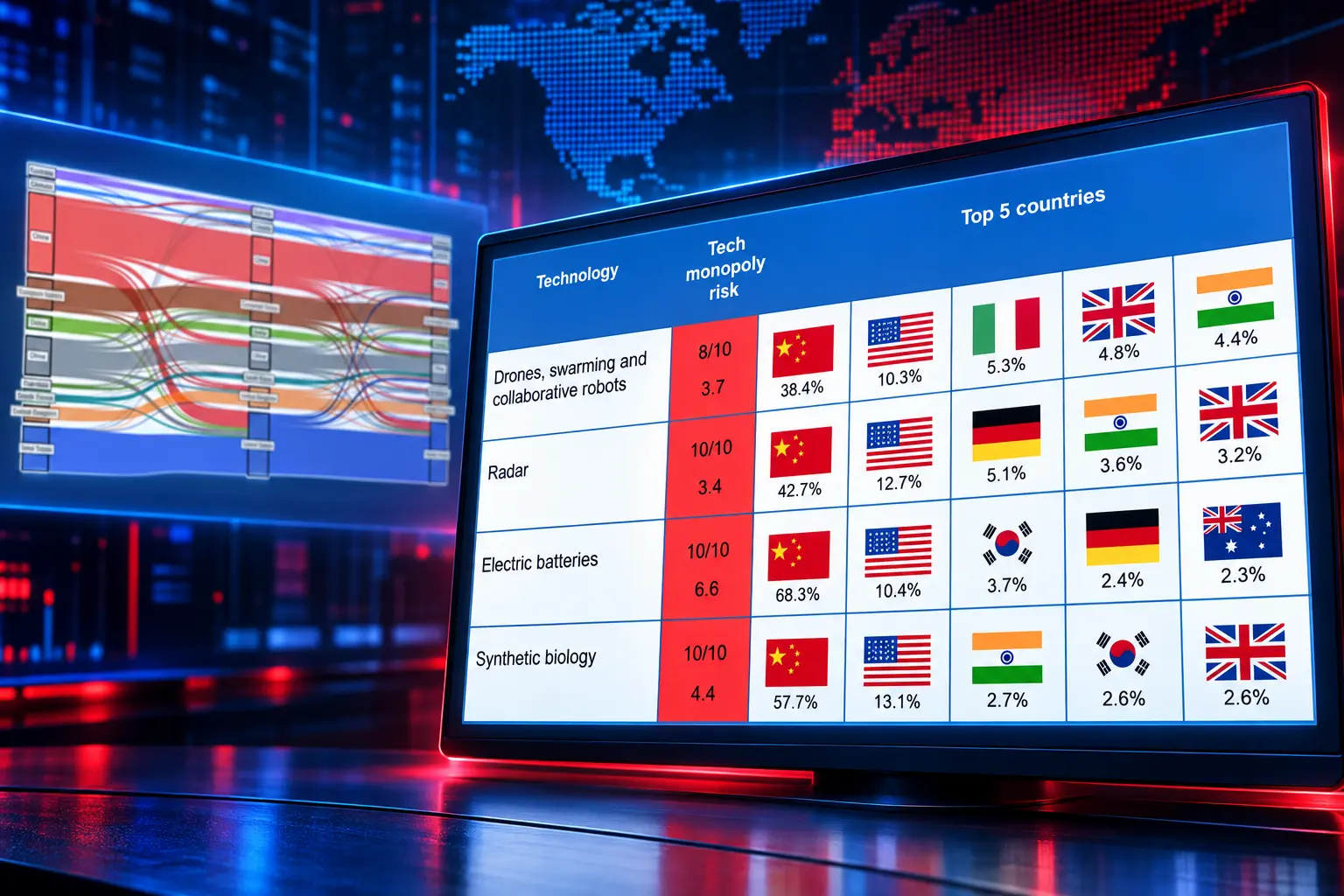
Eight of the Ten New Fields Went to China
The 2025 expansion pulled in advanced computing and communications, artificial intelligence, and neurotechnologies used in human-machine work. China had a clear lead in eight of those ten. Four of the new fields already carried a high technology monopoly risk rating: cloud and edge computing, computer vision, generative AI, and grid integration technologies. The other two US holds among the new ten were neuroprosthetics and geoengineering.
Neuroprosthetics was the only field in the whole tracker with no Chinese lab in the top 10. The seven groups with the greatest research effort were all American. China, in the same cut, took the lead in small satellites, a field the United States had held.
THE 10 TECHNOLOGIES ADDED IN 2025
| Field | December 2025 monopoly risk | Country lead, 2020 to 2024 |
|---|---|---|
| Cloud and edge computing | High | China |
| Computer vision | High | China |
| Generative AI | High | China |
| Grid integration technologies | High | China |
| Digital twins | Medium | China |
| Brain-computer interfaces | Medium | China |
| Neuroprosthetics | Medium | United States |
| Precision agriculture | Medium | China |
| Extended reality | Low | China |
| Geoengineering | Low | United States |
Those ratings moved after December. Digital twins rose to high monopoly risk by March 2026. Brain-computer interfaces rose to high that same cut, then fell back to intermediate in June. Neuroprosthetics moved the other way, to high monopoly risk in favour of the US. ASPI called that a reminder that concentration risk is not only a China story.
How ASPI Scores a Monopoly Risk
ASPI rates monopoly risk from two tests that both must pass. High risk means at least three times as many high-impact papers as the next country and eight or more of the top 10 labs. Medium is a two-times paper lead and five of those labs. Miss either test and the rating stays low.
Wong-Leung wrote in March 2026 that a high rating means other countries will now find closing the gap difficult. In the 2021 to 2025 window, China’s high-risk count reached 41 fields. In artificial intelligence, the high-risk stack doubled to four when advanced data analytics and machine learning joined it. Advanced robotics and autonomous systems operation technologies moved from medium to high. So did advanced radiofrequency communication. In wide and ultrawide bandgap semiconductors, the base technology for high-power electronics, China accounted for 51.7 percent of global high-impact papers, and that field carried a high rating too.
HOW A HIGH MONOPOLY RISK IS SCORED
- The paper test: The leading country publishes more than three times as much high-impact research as its nearest competitor.
- The lab test: That same country is home to eight or more of the world’s top 10 institutions in the field.
- The medium bar: A two-times paper lead and five or more of the top 10 labs, with both still required.
- The default: Low, including cases with a large paper lead but too few of the top labs, or the reverse.
ASPI, pointing to OECD figures, said China was projected to overtake the United States in public research and development spending by 2028, and that the crossover was likely to arrive earlier. The tracker authors told governments they needed to raise research and technology spending to avoid later strategic dependence, because one country was still pulling away across a wider set of fields.
The Chinese Academy of Sciences Tops 30 Rankings
Country totals hide how tight the lab list is. In December 2025 the Chinese Academy of Sciences ranked first in 31 technologies, then first in two of the ten new fields, even after it lost the top spot in quantum sensors and in novel antibiotics and antivirals to other Chinese universities. By March 2026 it held first place in 30 technologies. Among universities, Tsinghua in Beijing placed first in five fields in the December cut.
WHERE THE LABS CLUSTER
- CAS: First in 31 fields in December 2025 and in 30 in March 2026, the heaviest single-institution lead in the tracker.
- Tsinghua University: First among universities in five technologies in the December 2025 cut.
- Nanyang Technological University: Global leader in extended reality, in the top 10 for 14 fields in December and 17 in March, and the strongest institution outside China.
- MIT: The top US performer, in the top 10 for 10 fields in December and eight in March.
Germany’s Helmholtz Association and Delft University of Technology each appeared in the global top 10 in five technologies in December, and TU Delft was first in quantum computing on high-impact papers. In the United States, no other university matched MIT’s spread. The March cut also left Nanyang first in extended reality, a field whose country lead still sat with China.
India Is Second in 16 China-Led Fields
India does not lead any of the 74 fields. It now occupies the slot just behind China in a growing list. In December 2025 it ranked in the top five for 50 technologies, up from 43, and had overtaken the United States as the second-ranked country in five. By March 2026 it was in the top five for 56, and second, ahead of the United States, in 16 of the 69 China-led fields.
FIRST-PLACE AND TOP-FIVE COUNTS, TWO CUTS
| Measure | December 2025 (2020 to 2024) | March 2026 (2021 to 2025) |
|---|---|---|
| China first-place fields | 66 of 74 | 69 of 74 |
| United States first-place fields | 8 | 5 |
| India in the top five | 50 | 56 |
| United Kingdom in the top five | 48 | 40 |
| South Korea in the top five | 32 | 36 |
| Germany in the top five | 30 | 27 |
South Korea replaced the United States in second place in hydrogen and ammonia for power and reached the top five in 36 fields by March. The United Kingdom had jumped from 36 to 48 top-five slots in December, including eight of the ten new fields, then fell to 40 in March. The European Union as a bloc led four fields in December and three in March, after losing first rank in small satellites. Italy rose from 14 top-five slots to 16. France dropped from four to two. Japan, once in the top five in eight fields, held four in December and three in March.
Iran remained in the top five across eight technologies, including overtaking the United States in smart materials and biofuels, and ranked third in air-independent propulsion for submarines. Its strongest group is Islamic Azad University in Tehran. Saudi Arabia reached the top five in five fields in December and four in March. Singapore was in the top five in only two fields in December, then one (metamaterials) in March, while Nanyang still outranked labs in much larger states.
Talent Still Collects in American Labs
The December 2025 talent-flow cut, built from ORCID profiles of authors on the top 1 percent and top 10 percent of cited papers from 2020 to 2024, found that the United States still employs the largest share of that top-tier cohort. Second place was a tight contest between China and EU countries as a group, with China holding a slight edge in the top 1 percent. The United Kingdom ranked fourth as an employment destination in both flows.
That is the second chart sitting under the 69-of-74 headline. Papers and first-place labs have moved toward China. The people who write the most-cited papers are still, as a group, on American payrolls. ASPI also tracks where those researchers trained, because the employment node is only the last stop.
The number of technologies where that lead is now monopolistic (41 of 74, up from 33) means that in a substantial portion of critical domains, the question is no longer how to compete, but how to avoid future technology dependency.
Jenny Wong-Leung, data scientist, ASPI, 31 March 2026
ASPI posted the full 2025 dataset the week before that March essay, with the 69-of-74 count and the new monopoly-risk maps attached.
ASPI’s Critical Technology Tracker now includes the full 2025 dataset — offering the most comprehensive picture yet of global tech competition.
This update highlights 🇨🇳’s expanding lead, concentration risks and shifting talent flows.
🔎 Explore key findings ⤵️ 🧵 1/4 pic.twitter.com/iSYPVpzQZJ
— ASPI (@ASPI_org) March 25, 2026
The June refresh left that country count unchanged and tightened the US hold on neuroprosthetics. It also lifted AI hardware and accelerators, and biological manufacturing, from intermediate to high monopoly risk on the Chinese side. The talent chart from December was not rewritten in the June note. Until it is, the employment finding and the paper finding still point at different countries.
Tasmania, Melbourne and a $54 Million Brain Bet
Australia appeared in the global top five countries in seven technologies in December 2025, then eight in March 2026. It had dropped out of the top five in critical minerals processing, electric batteries, and advanced protection in the December cut, then regained electric batteries in March while losing hydrogen and ammonia for power and gaining geoengineering. Only a handful of its universities crack the global top 10. The University of Tasmania ranked fourth in geoengineering. The University of Melbourne ranked eighth in neuroprosthetics in December. In March, the University of New South Wales ranked fifth in protective cyber security technologies.
Brain-computer interfaces were one of the ten new fields, and the December authors spent time on the commercial queue. Devices that link the brain to an external machine are expected on the market as early as 2030. Three firms lead that queue.
THE BCI GROUPS ASPI FLAGGED
- Synchron: Australian-based, and the only one of the three with a device inserted through the bloodstream rather than open brain surgery.
- Blackrock Neurotech: US-based, with a US Food and Drug Administration Breakthrough Device designation, as have the other two.
- Neuralink: Also US-based, with the same FDA marker for devices treating serious medical conditions.
On 7 November 2025, Australia’s National Reconstruction Fund announced A$54 million into Synchron’s brain devices. Wong-Leung, Robin and Cohen noted Apple exploring BCI links with iPads and other consumer hardware, and OpenAI treating the same class of device as a path to cognitive AI. They also pointed back to earlier ASPI work on the privacy, cognitive-freedom, and cyber risks of a machine that can decode intent.
Geoengineering, the other new field they unpacked, is still small and spread out. The United States holds a large lead, while the UK and Germany are major contributors, and the EU as a bloc outpaced the United States in both overall output and high-impact papers. The authors flagged stratospheric aerosols and ocean fertilisation as tempting climate tools whose long-run global effects remain poorly understood.
In September 2026 ASPI launched a China Little Giants Tracker of more than 19,000 designated firms, cross-linked with the Critical Technology Tracker and the China Defence Universities Tracker. That file moves the same question from cited papers to the companies Beijing has already picked.

The Court Revisits the Climate Nuisance Door It Left Open

ChatGPT Now Compiles Live Interfaces With GPT-6

A Tanker Attack Moves the War Into Qatar’s Waters

Personio Buys Circula to Own the DATEV Channel

Bluesky Files for .bsky and Enters the Registry Queue

Microsoft’s 96% Cyber Score Sits at 86.3% on the Board

Musk’s $914 Billion Lead Is a Public SpaceX Bet

The Odyssey’s IMAX Film Run Hit a 41-Theater Limit

Free Live Sports Streaming in 2026: What to Watch Without Cable

Endgame Encore’s $86 Million Trial for Infinity Vision
-
 NEWS3 months ago
Microsoft’s 96% Cyber Score Sits at 86.3% on the Board
-
 BUSINESS5 months ago
Musk’s $914 Billion Lead Is a Public SpaceX Bet
-
 ENTERTAINMENT3 months ago
The Odyssey’s IMAX Film Run Hit a 41-Theater Limit
-
 SPORTS4 months ago
Free Live Sports Streaming in 2026: What to Watch Without Cable
-
 ENTERTAINMENT4 months ago
Endgame Encore’s $86 Million Trial for Infinity Vision
-

 ENTERTAINMENT2 years ago
Andrew Garfield’s Spider-Man Films Are No Longer Free
-

 NEWS5 months ago
Singapore’s 3×3 and Surfing Debuts Miss the Medal Stand
-

 NEWS7 months ago
White Sands Footprints Put People in Ice Age New Mexico