A wave of Android phones bought between 2022 and 2023 are reaching the end of their promised software support in 2026. The list spans Samsung’s Galaxy Z Fold4, Galaxy Z Flip4, Galaxy S23 series, and Galaxy A53 5G, plus the Pixel 6, OnePlus 10T, Sony Xperia 5 V, and several Motorola models. Some owners will keep getting security patches for years. Others will lose both major updates and ongoing protection this year. None of the affected phones stop making calls the day support ends, but the rules of what they receive from here on change sharply by model.
The shift is uneven because manufacturers made different promises when those phones launched. Samsung committed to four major Android updates and up to five years of security patches for its 2022 foldables, and the Galaxy Z Flip 4 received One UI 8 as its fourth and final major OS update on October 6, 2025. Other makers promised less. Buyers weighing a discounted 2022 or 2023 Android phone in 2026 now have to read the small print to know what remains.
A 2026 Support Cliff Spans Multiple Brands
Samsung’s official security update scope page lists the Galaxy Z Fold4, Z Flip4, S23 series, A54 5G, and A57 5G as still receiving monthly security patches. The same page moves the Galaxy S22 series and Galaxy A14 to the quarterly tier, and Samsung quietly removed its bi-annual security update category altogether in 2026.
That pruning matters because Samsung is not the only phone maker scaling back 2022-era devices this year. Google set a five-year support commitment when the Pixel 6 launched in October 2021, and that clock runs out in October 2026. Motorola, OnePlus, and Sony have each trimmed several of their 2022 and 2023 devices from active support lists, leaving owners weighing an upgrade question. The result is a support cliff that hits buyers of mainstream phones, not just budget holdouts.
Some owners will keep getting security patches through 2027 or longer. Others will lose both major updates and ongoing protection in 2026. The difference depends on which maker built the phone, when the buyer got it, and which support tier the manufacturer slotted it into.
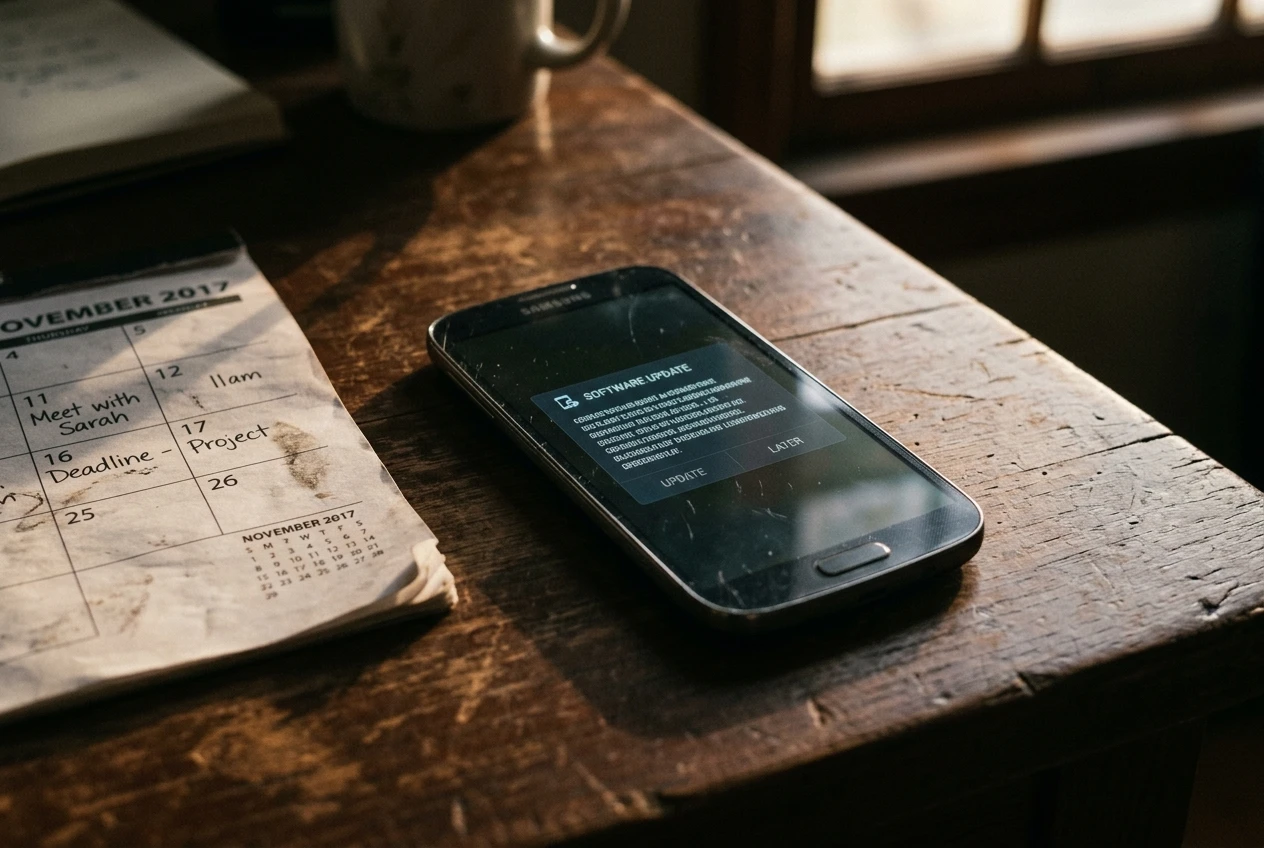
Samsung’s 2022 Foldables Already Received Their Last Major Android Update
The Galaxy Z Flip 4 launched on August 25, 2022, alongside the Galaxy Z Fold 4 at Samsung’s August 2022 Unpacked event. Wikipedia documents that the Z Flip 4 received Android 16 with One UI 8 as its final major version on October 6, 2025. Samsung’s official security update scope page still lists both foldables for monthly security patches, so the phones are not abandoned, but their upgrade runway is finished.
The same Samsung commitment that produced four major Android updates for the 2022 foldables also governs the Galaxy S23 series launched in 2023, now in its final year of OS upgrades. Owners who bought the Fold4 or Flip4 at full price in late 2022 received four major Android versions across roughly three years. Discounted units on the refurbished market today still deliver solid hardware, but the years of free software ahead of them are shorter than on newer Galaxy devices.
The Galaxy S23 Series Stops at One UI 8
The Galaxy S23, S23+, and S23 Ultra launched in 2023 with Android 13. Samsung’s official security update scope page lists the trio for monthly security patches as of mid-2026.
The S23 family is set to stop at Android 16 (One UI 8), its fourth and final major OS update. Samsung’s January 2024 policy reset gave newer flagships a seven-year window, but the S23 family was launched under the older four major Android updates / five-security commitment that defined Samsung’s pre-2024 lineup. The Galaxy S24, launched in 2024, is the first Samsung flagship entitled to seven years of OS and security support, with coverage running through 2031 per UpTrade.
Samsung’s monthly tier still covers the S23 family, so security patches continue in 2026. The Galaxy S22 series, however, was demoted from monthly to quarterly security-only in early 2026, the first time Samsung has shifted an active S series device between tiers mid-cycle. For S23 owners, an equivalent step-down is likely scheduled for 2027, when Samsung’s original five-year security commitment runs out. The S24 series, by contrast, runs on the longer seven-year clock that began with the January 2024 policy reset.
Galaxy A53 and A54 Sit in Different Tiers
Samsung’s mid-range phones follow a different cadence than the flagships. The Galaxy A53 5G now sits on Samsung’s quarterly security update list under the Enterprise Models tag, while the Galaxy A54 5G remains on the monthly tier alongside the flagship S series.
The A53 5G launched in 2022 under a shorter commitment than Samsung’s flagship foldables. The A54 5G arrived on March 24, 2023 and inherited a longer policy applied to newer Samsung mid-range devices. Both phones still appear on Samsung’s official scope page, though the cadence difference already reflects how Samsung splits its tiers.
The Galaxy A14, which launched on May 22, 2023, sits on Samsung’s quarterly security update list as well. Budget A-series owners share the slower cadence with the older A53 5G, and neither phone has been removed from Samsung’s coverage.
Samsung’s tiered approach means an owner of a 2022 mid-range phone and an owner of a 2023 mid-range phone face very different update stories a year apart. The A53 5G is in its final stretch of OS upgrades, the A54 5G has more runway ahead, and the A14 stays on the slower cadence with quarterly security patches as its remaining lifeline.
Other Manufacturers Are Losing Phones in 2026
Samsung is not the only maker trimming its support list in 2026. BGR documents five phones from other brands reaching the end of their promised support windows this year, spanning four lineups across the Android market. The specifics are in the table below.
| Model | Brand | Launch | Support ends |
|---|---|---|---|
| Pixel 6 / 6 Pro | October 2021 | October 2026 | |
| Moto G Stylus 5G (2023) | Motorola | June 2023 | End of June 2026 |
| OnePlus 10T | OnePlus | August 2022 | August 2026 |
| Sony Xperia 5 V | Sony | 2023 | August 1, 2026 |
| Motorola Edge (2023) | Motorola | October 2023 | End of September 2026 |
Each maker used its own commitment structure. Google set a five-year OS and security window from launch. Motorola offered one major update and three years of security on some mid-range devices, and two major updates plus three years on others. OnePlus promised three major updates and four years of security. Sony follows its own end-of-life clock for each model. Mobilemasr notes several additional Motorola devices launched between 2022 and 2024 have already lost or will lose support in 2026, particularly across the Moto G, Edge, and Razr lines.
The phones share a 2026 deadline but different policy origins, and buyers weighing any of them should match the remaining support window against the discount, not just the price. Each phone keeps working after its end-of-support date, but the experience narrows over time as apps and security features evolve.
What Buyers Should Check Before Picking Up a Discounted Phone
A discounted 2022 or 2023 Android phone can still offer strong hardware for the price, but the years of free software behind it vary. Buyers considering a refurbished Galaxy S22, a used Pixel 6 and 6 Pro, or a clearance OnePlus 10T should compare the remaining support window against the discount, not just the price tag.
Samsung’s official scope page and the endoflife.date tracker both treat update tier as the deciding factor, not the phone’s launch year alone. The same logic applies to Motorola, OnePlus, and Sony devices that lose support in 2026.
The checklist below captures the same questions Samsung, Google, and BGR use to define a phone’s remaining support window.
- Promised Android version upgrades still expected (and which is the last one)
- Length of security support remaining, in years or months
- Current update frequency (monthly, quarterly, or none)
- Original launch date, since most support windows count from launch
- Manufacturer’s published update policy for the specific model
- Current security patch date inside Settings, then About phone
The Security Stakes When Patches Stop
Phones that stop receiving security patches do not stop working, but they do accumulate exposure. Zimperium, a mobile security firm, told Forbes in January 2026 that threats now bypass signature-based defenses using advanced evasion and dynamic payload delivery, and that timely patching is the only reliable defense. Forbes separately reported that, at any given point in the year, over 50% of mobile devices run outdated OS versions, and that around 33% of Android phones no longer have access to fixes at all.
The 2026 cohort includes mainstream phones, not just budget holdouts. Galaxy S22 series owners who lost monthly patches in early 2026, plus Pixel 6 owners whose five-year clock runs out in October, now sit in that 33% category.
Owners who keep using an unsupported device can reduce exposure by installing app updates promptly, sticking to trusted app stores, and removing unused apps. No user habit replaces a manufacturer security patch. Samsung’s own scope page notes that patch frequency can change as devices age, so a quarterly tier today can mean no tier tomorrow.
By the numbers
- Over 50% of mobile devices run outdated OS versions, per Zimperium via Forbes (January 2026).
- Around 33% of Android phones no longer have access to security fixes, per Zimperium via Forbes (January 2026).
- Samsung committed to extending Galaxy security updates up to 7 years of software support starting January 2024.
- The Galaxy Z Flip 4 received its final major Android update on October 6, 2025.
How Samsung’s 7-Year Support Pledge Reshapes the Math
Samsung’s January 2024 announcement extended security support for Galaxy devices to up to seven years, but the pledge only applies to phones launched from that point forward. Galaxy devices launched in 2022 and 2023 remain on the older four-OS / five-security commitment.
As of January 2024, we are extending our security update support for Samsung Galaxy devices by up to 7 years, to help our users enjoy the latest Galaxy experiences longer and securely.
Samsung’s official security update scope page carries the same wording on its monthly and quarterly device list. UpTrade notes the Galaxy S24, launched in 2024, will continue to receive the latest Android OS and security updates until 2031 under the new policy. The implication for 2026 buyers is a sharp split: a discounted Galaxy S22 offers roughly two remaining years of quarterly security support, while a discounted Galaxy S24 offers another five years of monthly updates. The hardware gap between the two generations is real, and so is the gap in remaining software runway.
Frequently Asked Questions
Will my Samsung Galaxy phone stop working in 2026?
No. Per UpTrade, even if a Galaxy phone stops receiving software support in 2026, it still powers on and handles calls, texts, Wi-Fi, photos, and apps already installed. What ends is the flow of new Android versions and, eventually, security patches. The phone’s hardware and basic apps continue to function until something else breaks.
Which Android phones are losing software support in 2026?
BGR lists five phones from outside Samsung: the Pixel 6 and 6 Pro (October 2026), Moto G Stylus 5G (2023) (end of June 2026), OnePlus 10T (August 2026), Sony Xperia 5 V (August 1, 2026), and Motorola Edge (2023) (end of September 2026). On the Samsung side, the Galaxy Note 20 series exited support in late 2025, and the Galaxy Z Fold4, Z Flip4, and Galaxy S23 series received their final major Android update with One UI 8 in late 2025.
How do I check when my Android phone stops getting updates?
Open Settings, then About phone, then Software information to see the current security patch level. For the official end date, check the manufacturer’s support page. Samsung publishes its monthly and quarterly security update list on its security update scope page. Google, Motorola, OnePlus, and Sony each publish similar support schedules.
Can I keep using an Android phone after it stops getting updates?
Yes, but the device will not receive future security patches. Zimperium told Forbes in January 2026 that over 50% of mobile devices run outdated OS versions and around 33% of Android phones no longer have access to fixes at all. Apps may also stop working correctly over time as their minimum Android version requirements rise.
Should I upgrade my phone just because it loses support?
Not always. If the phone still meets your needs and you do not use it for sensitive tasks like banking, you can keep using it with extra caution. For users who rely on a phone for work, banking, or sensitive data, the loss of patches is a stronger signal to upgrade or replace the device.