Athens began the first systematic cleaning of its all-marble Panathenaic Stadium on August 10, 2026, a private-funded scrub that echoes the merchant gifts which rebuilt the venue for the 1896 Olympics and now readies the Kallimarmaro for elite track meets and the flame handover to Africa’s first Youth Games.
The U-shaped stadium, the only one in the world built entirely of white Pentelic marble, has hosted marathon finishers, rock concerts, the 1896 Games and every modern Olympic flame departure from Greece. Dirt, weeds, blackened gum and the wear of millions of visitors had dulled its gleam for more than a century.
The work now under way treats that dulling as a surface problem, not a structural one. Conservators aim to lift the film left by weather and crowds so the stone can again read as the bright cavea that gave the stadium its familiar nickname.
Crews Move Across 47 Steep Marble Tiers
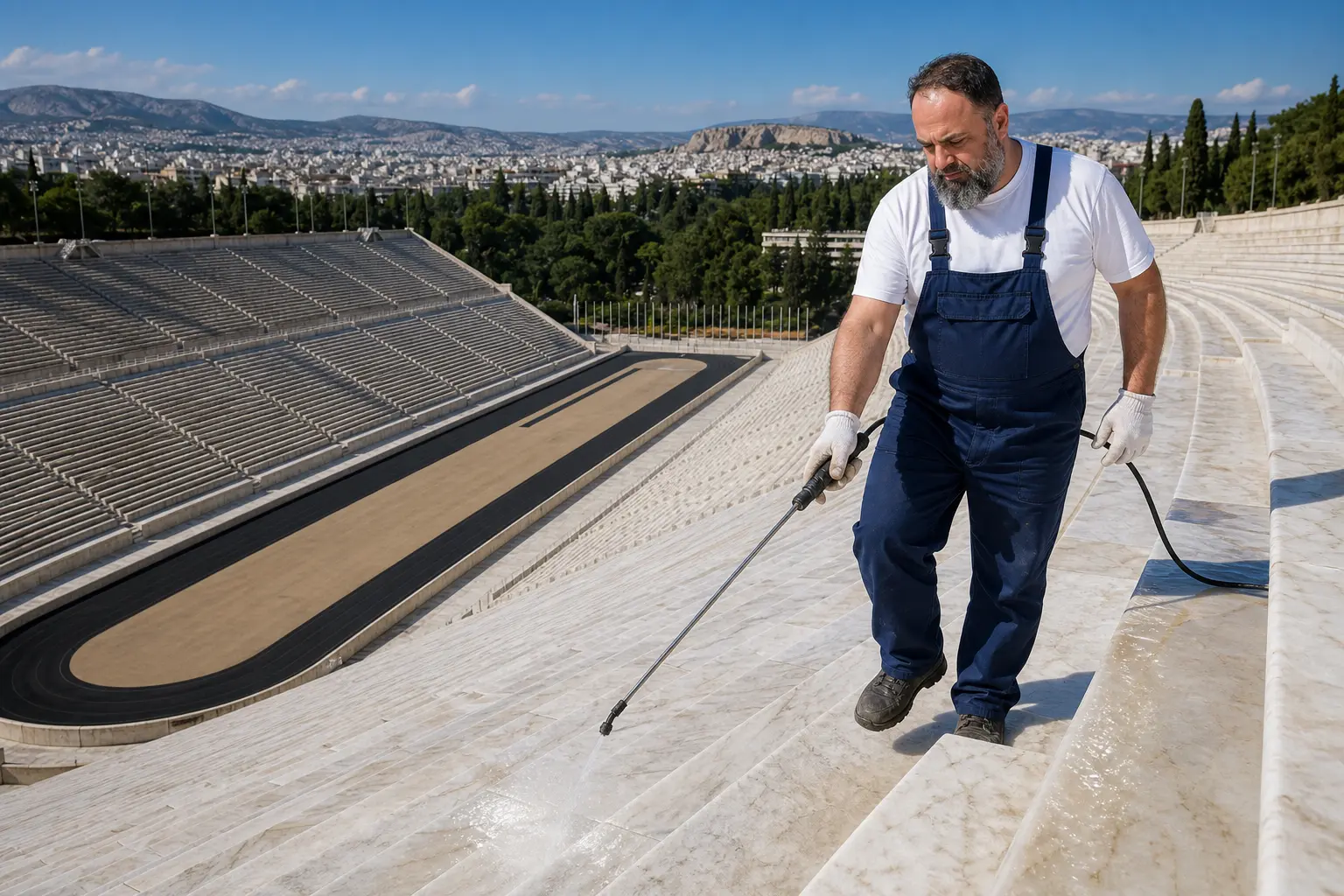
Cleaners in white and blue overalls work the 47 steep tiers with thin spray lances. They use only clean water at carefully controlled low pressure. Machines vacuum the runoff immediately.
“The goal of cleaning is not to make everything white. It’s to remove the dirt and the first layers of organic material that are deposited on the surface,” said Dimitris Selemis, a senior conservator at the site. Areas that receive less direct sunlight hold more weeds and grime.
Steam lifts blackened chewing-gum blotches. Stadium officials list the main modern stains:
- Chewing gum that darkens over years
- Scuffs and scratches from high heels
- Soft-drink and other liquid spills
- Organic buildup and weed growth in shaded zones
Those four categories explain why the same seat can look mottled while its neighbour stays relatively clear. Shade slows the natural wash of rain. Foot traffic and discarded gum finish the job.
Work started on the curved end known as the sphendone so that section will be ready by September 10. The full stadium clean continues through the end of 2026. The official start of the marble cleaning works was announced by the Hellenic Olympic Committee with Culture Ministry conservators guiding every step.
Progress is therefore staged rather than uniform. Visitors who climb the open tiers during the campaign will see a bright curve at one end while other banks still wait their turn under the lances.
The Same Stone as the Parthenon
The seats and structure use Pentelic marble quarried from Mount Penteli north of Athens, the identical stone that clads the Parthenon and other Acropolis monuments. That shared origin makes every cleaning decision delicate.
Architect and archaeologist Manolis Korres, honorary adviser to the Hellenic Olympic Committee, supervised the approach. Laser cleaning was considered and set aside. The chosen method sprays clean water through specialized equipment at controlled pressure. It removes surface dirt without stripping the marble’s natural patina or stressing the surface.
“It is a gentle intervention that does not cause any side effects,” Korres said. “The method being used… ensures a good result that is immediately visible.”
Conservators stress the aim is clarity, not bleach-white perfection. Once the outer film lifts, the original brilliance that earned the nickname Kallimarmaro, “beautiful marble,” begins to return.
Because the stone matches the Acropolis monuments, the same caution that governs those sites applies here. Pressure, water purity and the decision to reject laser tools all serve one rule: lift what settled on the marble, leave what belongs to the marble.
Three Private Fortunes Kept the Marble Alive
The stadium’s life is a repeating story of private wealth meeting Olympic need.
- c. 330 BC, Athenian statesman Lycurgus builds the first monumental stadium of poros stone in the natural ravine for the Panathenaic Games.
- 144 AD, Herodes Atticus, the wealthy Athenian Roman senator, rebuilds the entire cavea in white Pentelic marble, creating the form still visible today and a capacity of roughly 50,000.
- 1869-70, Ernst Ziller excavates the buried ruins; Zappas Olympics use the site in 1870 and 1875.
- 1895-96, Greek-Egyptian merchant Georgios Averoff donates 920,000 drachmas so architect Anastasios Metaxas can reconstruct the stadium in fresh Pentelic marble for the first modern Olympic Games. Capacity reaches about 60,000. Opening day draws an estimated 60,000 spectators.
- August 10, 2026, Capital Maritime & Trading Corp., founded by shipping magnate Evangelos Marinakis, funds the first systematic marble conservation since that 1896 rebuild, plus a new track, LED lighting and facility upgrades.
The capacity figures alone show how the marble cavea grew with each major private act:
| Phase | Patron or driver | Reported capacity |
|---|---|---|
| Herodes Atticus rebuild (144 AD) | Herodes Atticus | Roughly 50,000 |
| Averoff reconstruction (1895-96) | Georgios Averoff | About 60,000 |
| Opening day, 1896 Games | Averoff gift in use | Estimated 60,000 spectators |
Petros Synadinos, Hellenic Olympic Committee member and chef de mission for Los Angeles 2028, called the current work “a second revival of the iconic Panathenaic Stadium. Just as in 1896, when it was restored through sponsorship… today… a series of interventions are being carried out that will protect this iconic historic monument and restore its appearance to the form it had in 1896.”
The pattern is unbroken: when the marble needs saving for a new Olympic chapter, a private Greek fortune steps forward.
A Shipping Magnate Writes the Next Chapter
In December 2025 the Hellenic Olympic Committee named Capital Maritime & Trading Corp. its gold sponsor. The company and its chairman Evangelos Marinakis undertook the comprehensive renovation so the venue can again stage international athletics to Diamond League standards.
The Panathenaic Stadium is far more than a sporting venue. It is a symbol of timeless Greek ideals, fair competition, sportsmanship, and friendship among peoples. These values were born in ancient Greece, were revived with the first modern Olympic Games of 1896 in this very stadium and continue to inspire the world today. Our goal is to support this monument over the long term and keep it alive.
Marinakis said that in the announcement of the Capital Maritime gold sponsorship deal. HOC President Isidoros Kouvelos thanked him as a sponsor “without time or financial limitations” who seeks no reciprocal benefit.
Kouvelos later told reporters the clean would let the stadium “show all its brilliance and will once again be the foremost monument of humanity for the Olympic Movement.” The project is overseen by the HOC with Ministry of Culture experts; no public budget figure has been released.
That absence of a published public cost underlines the character of the gift. The state supplies expertise and custody. The shipping company supplies the means to act on a timetable set by the flame and by the athletics calendar.
New Track and Lights for Diamond League Ambition
Marble cleaning is only one strand. Parallel work already under way includes:
| Project element | Purpose | Status note |
|---|---|---|
| Marble conservation | Remove century of dirt and organics while protecting patina | Sphendone first by 10 Sept 2026; full stadium by end 2026 |
| New synthetic track | Meet World Athletics specs for elite and Diamond League meetings | Already underway |
| High-definition LED lighting | Better athlete and broadcast conditions; lower energy use; night-time visitor route | Part of the package |
| Electromechanical upgrades | Protect and modernize support systems | Included |
The goal is a working competition venue that still reads as a monument. After 2004, when the stadium hosted archery and the marathon finishes without major rebuild, and after decades of concerts and ceremonies, the infrastructure had aged. Similar Olympic venues elsewhere have needed heavy intervention; Calgary’s Olympic Oval pipe rescue showed how quickly legacy ice facilities can fail. Athens chose a lighter, privately financed path focused on marble and track.
The track and lighting packages answer a practical gap left by that lighter path after 2004. Elite meetings demand certified surfaces and broadcast-ready light. The marble work answers the visual and conservation gap. Together they aim at Diamond League readiness without a full structural rebuild.
The Flame Leaves for Africa’s First Youth Games
The immediate deadline is September 10. That day the Youth Olympic flame will be lit at the cleaned sphendone and handed over for Dakar 2026, the first Olympic competition ever hosted on the African continent (31 October-13 November). IOC President Kirsty Coventry, the Zimbabwean swimming gold medalist, is expected to attend.
The Youth Olympic flame lighting on 10 September will mark the start of a 30-stage journey across Senegal. Greece’s own athletes and many African teams, including Namibia’s squad for the Dakar Games, will compete under that flame. The same stadium will later send the flame toward Los Angeles 2028.
The sequence keeps the Kallimarmaro in its long role as the Greek point of departure for Olympic fire. One cleaned curve serves the Youth Games handover. The wider conservation program then carries the venue forward to the next senior Games cycle.
The Stadium Holds Monument and Meeting at Once
Few Olympic sites must function as both open tourist monument and certified competition bowl in the same season. The Panathenaic Stadium has done so for decades, staging flame ceremonies, concerts and race finishes while daily visitors climb the same tiers.
The current package tries to keep that double life intact. Marble conservation restores the look that earned the Kallimarmaro name. The new synthetic track and LED lighting answer the technical bar for elite athletics and clearer night broadcasts. Electromechanical upgrades support both uses without rewriting the historic form.
After 2004 the stadium proved it could host archery and marathon finishes without a major rebuild. The years of concerts and ceremonies that followed left the support systems older and the stone duller. The privately funded path now chosen treats those as separate problems with matching tools: water and care for the Pentelic seats, modern surfaces and light for the athletes.
Success will be measured in two registers at once. The stone should read brighter under the Athenian sun. The track should meet the standards required for Diamond League meetings. Neither goal requires the other, yet both ride on the same sponsorship.
Tourists Still Climb the Open Tiers Daily
Tourists already climb the tiers daily. General admission is €12. A 2017 peak saw more than 220,000 visitors, many of them school groups. Once the full clean and lighting are finished, night visits and competition nights will add new layers of use without turning the marble into a museum piece under glass.
The staging of the clean matters for that daily traffic. Crews began at the sphendone to meet the September flame date, then continue around the U through the end of 2026. Open sections remain part of the visitor route while closed banks receive the lances and vacuum lines.
School groups have long used the stadium as a living classroom for the 1896 revival and the older Panathenaic story. A brighter cavea and safer night lighting give those visits more hours and a clearer view of the stone Averoff’s gift restored. The admission price stays the public threshold; the private fortune underwrites the fabric those tickets unlock.
In that sense the tourist flow and the Olympic calendar reinforce each other. Crowds keep the monument in active use. The flame dates and the Diamond League ambition justify the depth of the conservation now under way.
On the newly washed lower seats the white stone already catches the Athenian sun the way Averoff’s gift did in 1896. The rest of the curve waits its turn. The pattern holds: when the Olympics need the beautiful marble, a Greek shipowner or merchant still answers.