Floodwater tore through Telavi, the capital of Georgia’s eastern Kakheti region, in the early hours of July 12, after the local Telaviskhevi river burst its banks under heavy rainfall. A mudflow carrying stones and debris swept through the city’s lower streets, and a bridge connecting two streets was destroyed. Thousands of residents lost electricity and natural gas.
Kakheti governor Platon Kalmakhelidze said the damage was “quite extensive” but stressed that residents were not in danger. Officials approved a plan at an emergency operations headquarters to prevent the disaster from spreading further.
When the Telaviskhevi River Burst Its Banks
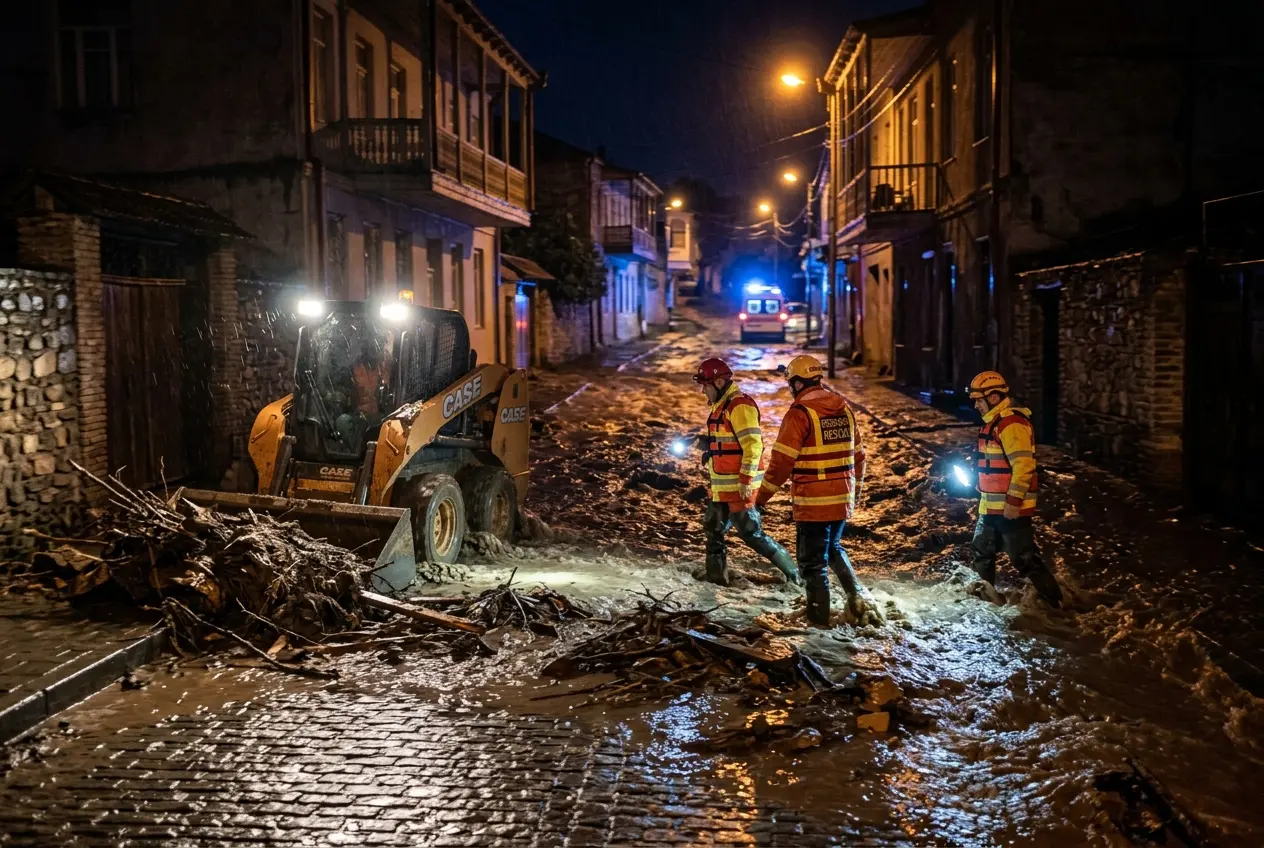
Continuous rainfall pushed the Telavi ravine past its banks around 3:00 a.m. on July 12. Sections of Kavkasioni and Alazani avenues, two main streets in the lower part of the city, were submerged as the river changed course.
Muddy water carrying torn trees, soil, and stones invaded homes, the ground floors of apartment buildings, and commercial premises including shops and pharmacies. Cars were damaged and power transmission lines came down. Citizens were evacuated from the agricultural market area for safety reasons, and several families living near the ravine were moved out as flood levels rose.
I have lived here for so many years and never seen anything like this. The river carried torn trees, soil, stones, it was terrible.
A local woman, on TV Pirveli.
Around a hundred pieces of equipment were deployed to handle the immediate cleanup. Heavy machinery worked along Kavkasioni Street by morning, clearing stones and debris, and traffic was suspended in several central areas.
Officials Call the Damage ‘Extensive’
Governor Platon Kalmakhelidze toured the city and told journalists that natural gas and electricity supplies were being restricted for safety reasons and would be restored periodically. “The damage caused by the disaster is quite extensive. Most importantly, residents are not in danger,” he said in remarks carried by Interpressnews, the Georgian wire service (the Kakheti governor’s full assessment of the damage).
Environment and Agriculture Minister David Songulashvili inspected the affected areas and called the disaster “massive.” “A prompt response from the state is particularly crucial right now,” he told Sova news. He said all relevant ministries had been mobilized to assess and calculate the damage as quickly as possible and begin cleanup operations. The minister noted that damage to agriculture would be assessed separately from the infrastructure tally. Infrastructure restoration work is “actively underway,” he said.
A ruling Georgian Dream lawmaker, Irakli Kadagishvili, arrived at the scene and described the disaster to TV Pirveli in stark terms.
The disaster is indeed of an unprecedented scale. The city infrastructure has been very seriously damaged.
Irakli Kadagishvili, Georgian Dream MP, on TV Pirveli.
Infrastructure Minister Revaz Sokhadze pledged that authorities would “do everything to eliminate the effects of the disaster as quickly as possible, while simultaneously planning preventive measures to help reduce similar risks in the future.” Sokhadze defended Telavi’s existing debris-control infrastructure, arguing the dams “fulfilled their function” in this latest disaster. He accused critics of “taking advantage” of the disaster to push unrelated grievances. The dams were last renovated in 2022, he said.
Damage Beyond the City Streets
The Telavi damage is concentrated in the city’s streets. In the surrounding villages of Tsinandali, Kesiskhevi, and Kurdgelauri, ravines and gorges filled with floodwaters and mudflows, and farmland and vineyards were inundated. Locals say that hectares of vineyards have been completely destroyed, leaving them without this year’s harvest. Photos from those villages circulated on social media and were published by Netgazeti. The description of crop loss comes from local testimony published by Interpressnews.
Tsinandali sits in the heart of the Kakheti wine region. About 65% of Georgia’s vineyards lie in Kakheti, and 15 of the country’s 20 wine appellations (PDOs) sit in the region, per Tsinandali’s place in Kakheti, Georgia’s largest wine region. Kakheti is split into the Telavi and Kvareli subregions. Tsinandali is the name of one of the region’s signature white wines, a blend of Rkatsiteli and Kakhetian Mtsvane grapes grown along the right bank of the Alazani river. The leading red variety is Saperavi, often called “black wine” by locals because the dark color of its pulp carries into the glass. The same Kakheti villages are the centre of the Qvevri winemaking method, fermenting in clay vessels buried underground, which UNESCO added to its intangible cultural heritage list in 2013.
A Pattern Going Back Decades
Critics are circulating a 2020 Formula TV report in which hydrologists from the Caucasus Environmental NGO Network, known as CENN, warned that Telavi residents were “living on a mine” unless issues with special debris-control dams built after a similar 1977 disaster were addressed. The warnings pointed to risks tied to the narrowing of the Telaviskhevi riverbed closer to the city and to construction along the riverbed itself, per the 1977 debris-control dams and the 2020 hydrologist warning.
Kadagishvili suggested that a small bridge over the Telaviskhevi had obstructed the flow and caused the flooding in this latest event, adding that the riverbed needed to be “completely redesigned.” Sokhadze responded that “natural disasters happen in every country” and dismissed the political criticism. He pledged an “adequate” response if any illegal or risky construction near the river is uncovered. The same pattern, where drainage and debris-control failures amplify a flood, played out recently in a U.S. city where Atlanta’s clogged storm drains amplified the Downtown Connector flood.
Cleanup and prevention work continues. A coordination council is overseeing recovery, and heavy machinery is still clearing mud and debris. Sokhadze pledged that authorities would carry out flood prevention works to reduce the risk of similar events in the future. Full restoration will begin once the damage assessment is complete, Kalmakhelidze said.
- 3:00 a.m. on July 12: when continuous rainfall overflowed the Telaviskhevi river and sent a mudflow through Telavi’s lower streets.
- Around 100 pieces of equipment were deployed to handle the immediate cleanup.
- Zero casualties or injuries have been reported.
- Several hectares of vineyards were destroyed across three surrounding Kakheti villages.
- 2022: the year Telavi’s debris-control dams were last renovated, per Infrastructure Minister Sokhadze.
Frequently Asked Questions
When did the Telavi flood start and how large was it?
The flooding began around 3:00 a.m. on July 12, when continuous rainfall overflowed the Telaviskhevi river’s banks and sent a mudflow carrying stones and debris through Telavi’s lower streets. Sections of Kavkasioni and Alazani avenues were submerged, a bridge connecting two streets was destroyed, and thousands of residents lost electricity and natural gas, per Imedi TV.
Why does Kakheti matter for Georgian wine?
Kakheti is Georgia’s largest wine region. About 65% of the country’s vineyards are in Kakheti, and 15 of Georgia’s 20 appellations of origin (PDOs) are located there. The two main subregions are Telavi and Kvareli. The leading grapes are Rkatsiteli for whites and Saperavi for reds, and Kakheti is the centre of the Qvevri method of fermenting wine in clay vessels buried underground, which UNESCO added to its intangible cultural heritage list in 2013, per the Kakheti wine region guide.
Has Telavi flooded like this before?
Yes. A 1977 flood in Telavi prompted the construction of special debris-control dams that were last renovated in 2022, per Infrastructure Minister Revaz Sokhadze. In 2020, hydrologists from the Caucasus Environmental NGO Network (CENN) warned that Telavi residents were “living on a mine” unless issues with those dams and the narrowing of the riverbed closer to the city were addressed, per a 2020 Formula TV report cited by Civil Georgia.