At 11:59 PM on June 30, 2026, two Section 202(c) emergency orders signed by Energy Secretary Chris Wright took effect across PJM Interconnection, the country’s largest wholesale electricity market. The orders authorize PJM to push data centers and other large energy users onto their own backup generators within 15 minutes of an emergency signal, and to dispatch specified generating units past their normal sulfur dioxide and nitrogen oxide permit ceilings through July 3. PJM had applied for the orders on June 27 and June 29, anticipating that a heat dome building over the eastern United States would compress operating reserves. The action covered 13 states plus the District of Columbia, a territory serving about 67 million people. Electric school buses equipped for vehicle-to-grid charging were already helping to meet the moment.
PJM projected peak loads of 166,147 MW for July 2, which would top the all-time summer record of 165,563 MW set in 2006. The grid operator recalled generator and transmission maintenance outages and issued Maximum Generation, Load Management, Low Voltage, and Hot Weather alerts across its territory. Wright, announcing the orders, called maintaining affordable, reliable, and secure power in the PJM service territory non-negotiable. Against that strain, the World Resources Institute’s Electric School Bus Initiative estimates about 230 electric school buses in fully deployed V2G projects can supply roughly 8 MWh of stored power back to utilities at any given time.
Two Federal Emergency Orders and a 20-Year Demand Record
The two orders were numbered 202-26-32 and 202-26-33, and they were issued the same day PJM applied. Order 202-26-33 authorizes the grid operator to direct backup generation resources as a last resort before declaring an Energy Emergency Alert level 3, and to call on transmission owners and electric distribution companies to implement the directive. Order 202-26-32 allows PJM to dispatch specific generating units beyond their normal environmental permit restrictions.
Both orders took effect at 11:59 PM ET on June 30 and expired at 11:59 PM ET on July 3, 2026. DOE extended 202-26-33 on July 3 under the same authority, and the extension runs through 11:59 PM ET on July 7. The full DOE text frames the action as a last-resort step to keep the lights and air conditioning on while PJM faces its tightest summer on record. Heat-driven demand is one pressure. Data center growth is another, and the two together have pushed reserve margins into a band where the grid operator needs federal authority to act before a voltage reduction or controlled load shed, not after.
The federal action was unusually specific in its mechanisms. The Backup Generation Order directs PJM to compel large energy users, defined as facilities with at least 50 MW of peak load, to switch to their own on-site generation within 15 minutes of an emergency signal, freeing grid capacity for residential and commercial customers. Hospitals, 911 call centers, water treatment plants, air traffic control towers, and defense installations are exempt. The Generation Dispatch Order separately allows power plants to run past sulfur dioxide and nitrogen oxide permit ceilings, with compliance required only to the maximum extent feasible during the emergency.
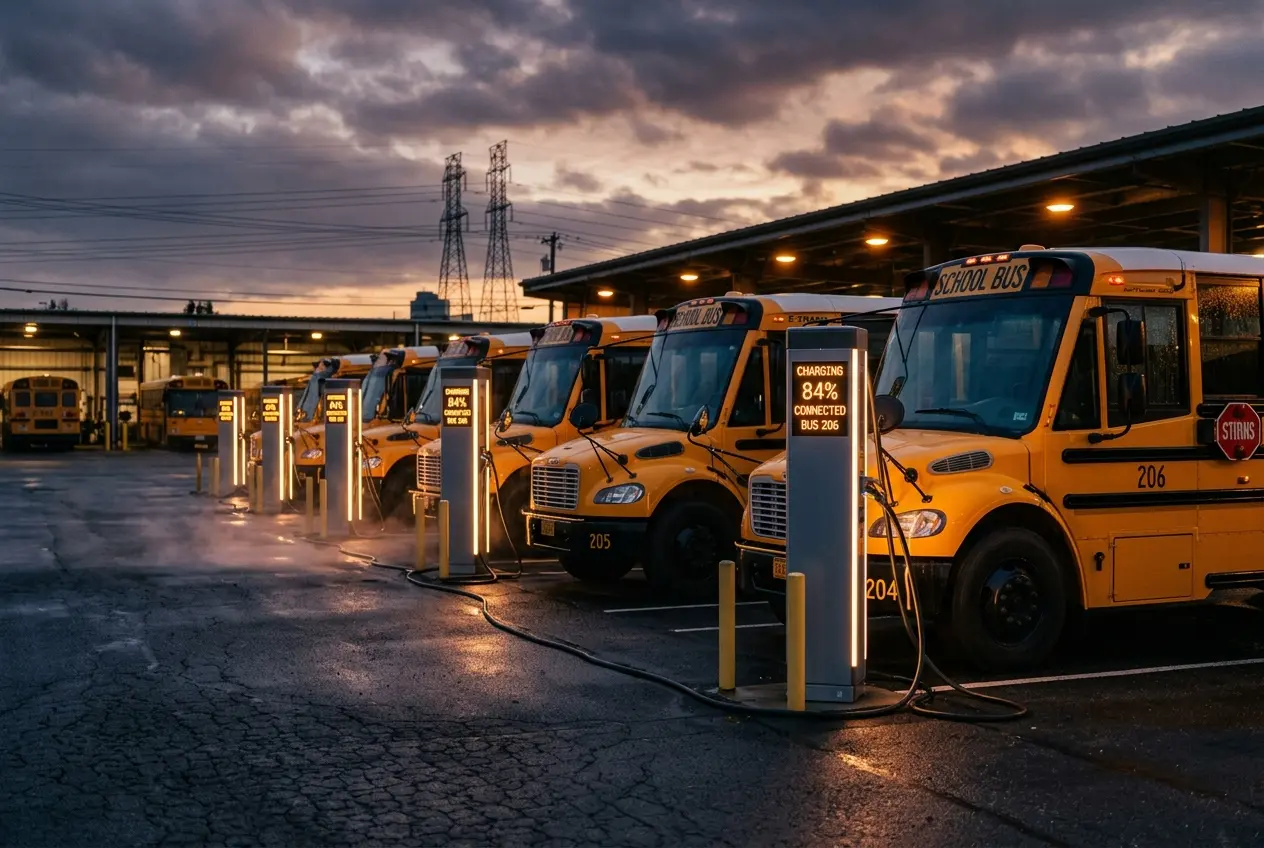
What 230 Electric School Buses Returned to the Grid
Against that strain, the V2G school bus fleet made a measurable, if modest, contribution. Electrek reported on July 5 that the World Resources Institute’s Electric School Bus Initiative estimates the 230 buses in fully deployed V2G projects can supply roughly 8 MWh of electricity back to the grid at any given time. That is enough to power about 1,600 typical U.S. homes for up to four hours and shave peak load demand for the utilities involved.
The number is small relative to PJM’s 166,147 MW peak forecast. That total is a rounding error on a single hot afternoon in the eastern United States. What is new is the shape of the resource: distributed, dispatchable, mobile, and arriving on demand without burning additional fuel. Each bus charges overnight on cheap off-peak power, sits parked for long stretches of the summer day, and connects to a bidirectional charger that reverses flow on a utility signal.
The 8 MWh figure is also a moving target. There are roughly 6,700 electric school buses already in service on U.S. roads, and not all of them carry V2G-capable chargers. Most sit at single depots, where one interconnection point serves an entire fleet. The vehicles themselves carry battery packs that can exceed 200 kWh, large enough to make per-bus discharge meaningful even when only a fraction of a fleet is wired to discharge. WRI’s count captures only the V2G-enabled subset of a much larger electric school bus population that is growing every quarter.
Steve Letendre, senior advisor to the Vehicle Grid Integration Council, spoke to Electrek about the moment. Letendre said:
It’s very early days, (but) school buses will be a critically important backbone of V2G capacity.
Letendre was describing a national fleet measured at scale for the first time during a real heat emergency. The WRI data underwrites that framing. The fleet is small today, but more V2G-capable buses are arriving each quarter.
Why School Buses Fit the Grid
School buses are an unusually good fit for bidirectional charging. They carry large battery packs, often in the 100 to 200 kWh range. They follow rigid daily schedules that fleet managers already control. They sit idle in depots for long stretches during the school day and across summer break, which is exactly when electricity demand peaks in much of the country. They aggregate at a single depot, so each site requires one interconnection point rather than thousands of residential hookups, and they are publicly owned vehicles whose depreciation is already on the district’s books.
The mechanics are simple in principle. A bidirectional charger and a utility-approved control system let a fleet operator push stored electricity back onto the grid on a utility signal, then recharge the bus when demand and prices ease. National Grid demonstrated the principle in Beverly, Massachusetts in 2021 with a single bus returning power to the grid for more than 50 hours over the summer at peak demand, and Con Edison ran a five-bus White Plains pilot with Lion, Nuvve, and National Express in the year that followed.
Oakland and the 74-Bus Blueprint
California now hosts the country’s largest deployment. Oakland Unified School District operates 74 bidirectional electric school buses, each with its own charger, managed through an AI-enabled virtual power plant. PG&E supplies 2.7 MW of capacity to the depot, which the utility said it delivered in record time and a year ahead of schedule. The fleet was assembled through a layered public-funding stack.
The federal and state funding stack behind Oakland’s 74-bus fleet is unusually layered. Each program contributed to the cost of vehicles, chargers, or both. The five largest partners are:
- U.S. Environmental Protection Agency’s Clean School Bus program
- California Air Resources Board
- Heavy Vehicle Incentive Program (HVIP) vouchers
- Bay Area Air Quality Management District
- Clean Mobility Options programs
The EPA alone committed more than $35 million to support Zum’s work in Oakland. PG&E Corporation CEO Patti Poppe called the partnership a blueprint for schools across California and the nation. Ritu Narayan, founder and CEO of Zum, said the buses will also send untapped energy from bus batteries back to the grid, boosting Oakland’s power infrastructure. Zum has set a company goal of electrifying 10,000 bidirectional school buses, which it estimates could supply 300 GWh of energy to local power grids annually. Plans are already underway for Zum to deploy 100% electric fleets in San Francisco Unified and Los Angeles Unified in the coming years.
The Scaling Math Runs to 100 MWh and Beyond
What V2G has measured so far is a snapshot of where the technology stands today. If half of the roughly 6,700 electric school buses already on U.S. roads were V2G-equipped and matched the current per-bus discharge rate, the available flexible energy at peak would run to well over 100 MWh on any given hot afternoon. That is more than ten times the current V2G fleet’s measured output.
San Francisco Unified is set to launch next month with 104 buses returning about 3 GWh annually during peak hours, with the fleet scheduled to more than double to 238 electric buses by 2028. In Connecticut, Branford Public Schools will add 46 V2G-capable buses in August. In North Carolina, the Cherokee Boys Club operates 21 electric school buses for Cherokee Central Schools under a Duke Energy V2G test program. The pattern is that districts order electric buses in volume; whether the chargers and rate structures are in place to make those batteries dispatchable is the open question.
Other states are testing the technology against different threats. Florida’s Glades County School District plans to use 13 Blue Bird electric buses as mobile cooling centers when the next hurricane strikes. Transportation supervisor Angie White-Banda told Electrek the buses can serve a function generators cannot: they can drive to a neighborhood, park, and supply electricity for phones, medical devices, and air conditioning while the grid is offline. The same bidirectional hardware that returns power to the grid in normal summer operations becomes emergency resilience equipment during disasters. White-Banda framed the dual use directly.
White-Banda, speaking to Electrek, described the moment plainly. She said:
If we have a hurricane, and God forbid we do, but if we do and there’s no power in the community, we can bring our buses to specified locations and the community can charge their phones. They can charge their devices. They can come in with, and sit down for a little while and cool off with cold AC.
White-Banda, transportation supervisor for Florida’s Glades County School District, was describing a fleet designed to work as both a transportation asset and a community power source. That dual-use framing is starting to show up in procurement documents in California and elsewhere. Whether it scales depends on the same constraint set: chargers, rate design, and equity.
What Stands Between Today and the 10,000-Bus Plan
Three constraints will decide how fast V2G school bus fleets scale. The first is hardware: bidirectional chargers cost more than standard units, require utility-grade interconnection, and remain concentrated in California because PG&E and a few other utilities have built the program infrastructure. The second is rate design: school districts face demand charges that can spike if a bus charges during a high-cost window, and existing tariffs do not consistently compensate districts for energy they return. The third constraint is equity, and the three design principles for utility V2G programs rank equity-first partner selection ahead of pure technical optimization.
The Portland Clean Energy Fund has used V2G to create electric-school-bus resiliency hubs in low-income communities. California’s state electric school bus funding now requires V2G capability on vehicles purchased through state programs, a regulatory pull no other state has matched. Battery degradation, warranty terms, and the absence of a universal V2G technology standard sit in the same constraint bucket. Zum’s stated goal of 10,000 bidirectional buses supplying 300 GWh annually is a forecast from a private operator, not a regulatory target. Whether that goal materializes depends on whether utilities, ratepayers, and school districts align around the same set of incentives.
Frequently Asked Questions
What is vehicle-to-grid (V2G) technology?
V2G lets compatible electric vehicles send stored electricity back to the power grid through bidirectional chargers. Standard EV charging moves electricity one way, from the grid to the vehicle. V2G reverses the flow on a utility signal and recharges the vehicle when conditions ease.
How much power did V2G electric school buses actually supply during the July 2026 heat wave?
The World Resources Institute’s Electric School Bus Initiative estimates about 230 electric school buses in fully deployed V2G projects can supply roughly 8 MWh of electricity back to the grid at any given time. That figure is small relative to PJM’s 166,147 MW forecast peak, but it is the first time the V2G school bus fleet has been measured at scale.
Which school districts run V2G bus fleets today?
The largest U.S. deployment is at Oakland Unified School District, with 74 bidirectional buses managed through an AI-enabled virtual power plant, returning an estimated 2.1 GWh of energy to the California grid annually. San Francisco Unified is set to launch next month with 104 buses and a target of 3 GWh returned annually.
Can regular EV owners participate in V2G?
Limited participation is available. Bidirectional charging requires compatible vehicles, approved chargers, and utility programs that compensate owners for energy returned. Most V2G deployments today run through fleet operators like school districts; residential V2G programs remain at the pilot stage.
What does V2G do during a power outage?
In Glades County, Florida, the school district is preparing 13 electric buses to operate as mobile emergency power stations after hurricanes or other disasters. The buses can drive to specified locations and supply electricity to charge phones, run medical devices, and cool buildings with air conditioning while the grid is offline.