South Africa’s digital economy just landed what President Cyril Ramaphosa called its clearest vote of confidence yet, with Google, Amazon Web Services, Microsoft and Mastercard stacking up as named partners in Ramaphosa’s Monday newsletter to the nation. The letter, dated 6 July 2026, frames global tech investment as the country’s most concentrated week of digital commitments since the cloud era reached South African shores.
The Google anchor is the company’s first African Cloud Summit, held at the Sandton Convention Centre on Wednesday 1 July 2026 and built around a “Building for Africa” investment package. The numbers Ramaphosa cited are striking: Google estimates its Johannesburg Cloud Region could add approximately R1.7 trillion in additional gross economic output by 2030, while supporting approximately 315,000 jobs. A separate figure in the same letter puts the small-business upside from cloud adoption at more than R185 billion by the same year.
What Google Just Announced at Sandton
Ramaphosa’s Monday letter confirmed that Google hosted its first-ever African Cloud Summit in Johannesburg. The Sandton Convention Centre summit drew about 3,000 business leaders, developers and public sector officials, according to TechNation’s reporting on the event. Google’s “Building for Africa” initiative, the theme of the summit, is designed to support cloud adoption and equip local ecosystems for AI-driven innovation.
Google announced five specific investments under the umbrella. The most consequential is a new Digital Exchange Port in the Eastern Cape, the first of four connectivity hubs Google has committed to building across the continent, which TechNation reported will link South Africa to Australia via the Umoja subsea cable and to India via a new route. Africa’s first applied AI lab will sit at the Accra AI Community Centre in Ghana, pairing African founders with Google researchers and opening applications on 31 August 2026. A third commitment is a partnership with The Akuna Group, founded by actor Idris Elba, backed by more than $1 million in Google.org funding for AI creative education aimed at underrepresented creators.
- A Digital Exchange Port in the Eastern Cape, the first of four connectivity hubs Google has committed to build across the continent, designed to anchor a new subsea cable corridor between South Africa, Australia and India.
- Africa’s first applied AI lab, based at the Accra AI Community Centre in Ghana, pairing African founders with Google researchers and offering early access to the company’s AI models. Applications close on 31 August 2026.
- A partnership with The Akuna Group, founded by Idris Elba, backed by more than $1 million in Google.org funding for AI creative education aimed at underrepresented creators.
- A R3 million digital innovation centre at South West Gauteng TVET College in Soweto, built in partnership with WeThinkCode, according to TechNation.
- The 2026 South African cohort of the Google for Startups Accelerator, opening for applications on 21 July 2026, with 15 local start-ups set to receive AI training, mentorship and non-dilutive funding.
Where AWS and Microsoft Already Stand
The Google commitments do not stand alone. AWS, Microsoft and Mastercard have all made South Africa a named destination in their respective cloud build-outs, and the broader stack is what Ramaphosa described as growing investor confidence.
Microsoft was the most recent of the three before this week. On 6 March 2025, the company announced the ZAR 5.4 billion South Africa infrastructure commitment to be spent by the end of 2027. Microsoft Vice Chair and President Brad Smith said the investment builds on the company’s prior ZAR 20.4 billion over three years, which established South Africa’s first enterprise-grade datacentres in Johannesburg and Cape Town.
The Microsoft package is paired with a skills programme. Microsoft said it would pay for 50,000 young South Africans to take certification exams in high-demand digital skills over the next 12 months, covering AI, Data Science, Cybersecurity Analysis and Cloud Solution Architecture. Smith framed the company’s 30-year presence in the country as a partnership built to help young workers build a future where technology drives prosperity. In 2024 alone, more than 150,000 people were trained in digital and AI skills through Microsoft’s Skills for Jobs programme, with 95,000 certified and 1,800 securing employment.
AWS committed earlier and at a larger scale. In 2023, Amazon Web Services announced plans to invest R30.4 billion, equivalent to US$1.8 billion, in South African cloud infrastructure by 2029. The investment sits on top of the AWS Africa (Cape Town) Region, AWS’s only African infrastructure region in Cape Town, which the company launched in 2020.
| Company | Announced commitment | Stated horizon | Focus area |
|---|---|---|---|
| “Building for Africa” package with five investments (no single rand headline disclosed) | 2026 and beyond | Cloud region, AI lab, subsea cable, skills | |
| Microsoft | ZAR 5.4 billion | By end of 2027 | Hyperscale cloud and AI infrastructure, plus 50,000 paid certifications |
| Amazon Web Services | R30.4 billion (US$1.8 billion) | By 2029 | AWS Africa (Cape Town) Region cloud infrastructure |
| Mastercard | Africa Cybersecurity Centre of Excellence (no rand figure given) | Phased rollout starting 2026 | Cyber resilience, starting in South Africa and Nigeria |
Mastercard’s Cybersecurity Centre Joins the Lineup
The fourth corporate name in Ramaphosa’s letter is Mastercard, which the president said launched its Africa Cybersecurity Centre of Excellence last week. The centre will begin with a phased rollout in South Africa and Nigeria, the two biggest economies on the continent. Ramaphosa described the move as part of the same investor confidence story, citing cyber resilience as a prerequisite for any cloud-heavy digital economy. He did not put a rand figure on the Mastercard commitment in his letter. Mastercard’s centre adds a cybersecurity offering to a stack otherwise dominated by compute, storage and AI infrastructure commitments.
Mastercard framed the centre as a way to enable more secure digital growth across Africa. The launch lands alongside growing public concern in South Africa about cross-border data flows and the regulatory gaps that come with them.
The four companies now cover different rungs of the digital stack. Google and AWS are extending compute and network reach. Microsoft is paying for skills alongside its hyperscale push. Mastercard is putting a flag in cybersecurity at a moment when more South African state and private data sits in foreign-controlled clouds.
The Numbers Google Is Pitching
The most eye-catching projections in Ramaphosa’s letter are Google’s own economic estimates for the Johannesburg Cloud Region. He cited Google’s figures directly: the region could contribute approximately R1.7 trillion in additional gross economic output by 2030. That sits on top of the R30.4 billion and ZAR 5.4 billion that AWS and Microsoft have already committed.
Google also forecasts the region will support approximately 315,000 jobs by the same year. The Presidency newsletter does not specify how those positions break down by sector or skill level.
A separate study cited in the same letter puts the small-business upside at more than R185 billion by 2030. The figure refers specifically to the potential economic unlock from SMME adoption of cloud computing, not to broader GDP gains. Ramaphosa described cloud as a tool that can help small businesses spend less on IT costs, improve productivity and become more competitive. The Presidency did not name the underlying study, and Ramaphosa’s framing of the figure as a “potential unlock” carries the source’s own hedge.
Ramaphosa’s broader pitch rests on a structural claim about South Africa’s data centre footprint. His letter said South Africa “currently houses a significant proportion of Africa’s large data centre capacity and is the continent’s largest cloud market.” TechNation’s reporting on the summit placed that proportion at about 70% of the continent’s hyperscale data centre capacity. The two figures agree on South Africa’s leading position; they differ on how exactly to size it.
Microsoft said it trained more than 150,000 South Africans in digital and AI skills in 2024, certified 95,000 of them, and helped 1,800 secure employment through its Skills for Jobs programme. The company’s datacentres in Johannesburg and Cape Town already host enterprise-grade Azure capacity for the region, and the ZAR 5.4 billion commitment announced in March 2025 is meant to expand that footprint through the end of 2027. Brad Smith, Microsoft’s Vice Chair and President, framed the company’s South African presence as a partnership that has run more than 30 years. Ramaphosa, speaking at the Microsoft announcement, said South Africa is “a favourable place to do business where their investments are secure.” The same language carried into his Monday newsletter, which cited the Microsoft commitment as evidence of broader investor confidence.
- R1.7 trillion in projected additional gross economic output from Google’s Johannesburg Cloud Region by 2030 (Google estimate cited by Ramaphosa)
- 315,000 jobs projected to be supported by the same region by 2030 (Google estimate cited by Ramaphosa)
- R185 billion in potential economic unlock from South African SMME cloud adoption by 2030 (per a study cited by Ramaphosa, unnamed)
- R30.4 billion committed by Amazon Web Services to South African cloud infrastructure by 2029
- ZAR 5.4 billion committed by Microsoft to South African cloud and AI infrastructure by end of 2027
Sovereignty Comes With the Check
The same Monday letter that named Google, AWS, Microsoft and Mastercard as partners also carried Ramaphosa’s most explicit warning about digital sovereignty. He said the country must learn from places “where vast amounts of sensitive public and private data have been held by private firms and outside national jurisdictions.” That framing puts the corporate commitments and the regulatory concerns in the same paragraph, and it shifts the tone of the announcement from celebration to negotiation.
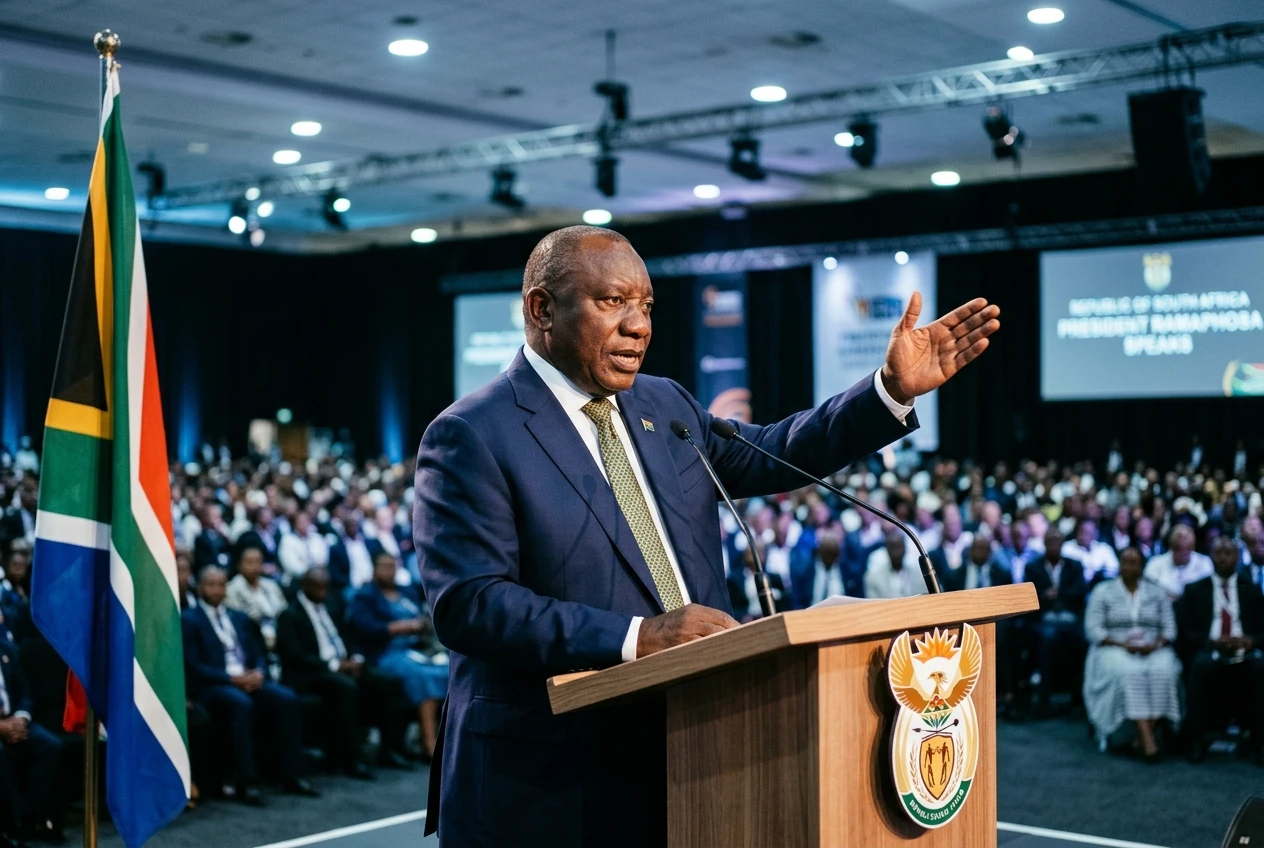
The lever Ramaphosa named is government cloud capacity, not rhetoric. He said the state is investing in its own cloud infrastructure through institutions such as the Council for Scientific and Industrial Research (CSIR). At the Sandton summit itself, TechNation reported, Ramaphosa called on Google and other cloud providers “to work with government to build sovereign digital and AI capacity that draws on both state institutions and private sector dynamism.” Ramaphosa’s framing keeps the foreign capital welcome and the policy framework under negotiation.
In the digital age, sovereignty is measured not only by territorial borders. It is increasingly measured by a nation’s ability to secure its data, develop its own digital capabilities and exercise meaningful control over the technologies on which its economy depends.
Where South Africa Sits on the Cloud Map
South Africa’s standing on the continent is what makes the four-corporate stack possible. The Presidency newsletter said the country “currently houses a significant proportion of Africa’s large data centre capacity and is the continent’s largest cloud market.” TechNation’s reporting placed that proportion at about 70% of Africa’s hyperscale data centre capacity, with Cape Town ranking third among African startup ecosystems on the Global Startup Ecosystem Index. Vodacom, Discovery, Pepkor and Naspers are already building and deploying autonomous agents on the Johannesburg Cloud Region, TechNation reported. James Manyika, Google’s Senior Vice President for Research, Labs, Technology and Society, said the new investments target infrastructure, African-led innovation, and education and skill building. The base of corporate users and the new investment cycle now sit inside Ramaphosa’s policy pitch as one loop.
The risk is that the same loop runs in reverse under different policy conditions. Ramaphosa warned that the digital transition “must be a just one” and that South Africa cannot allow digital poverty to widen the gap between the haves and the have-nots. The companies named in the letter have not, in their public statements, engaged with that distributional question at the same level of detail.
Google has opened applications for its 2026 South African Accelerator cohort on 21 July, with fifteen start-ups to be selected for AI training and non-dilutive funding. Applications for Africa’s first applied AI lab in Ghana close on 31 August 2026. Mastercard’s phased rollout in South Africa and Nigeria will begin to show what its cybersecurity centre actually does in practice. The CSIR-led government cloud build is what Ramaphosa pointed to as the domestic counterweight in his letter.
Frequently Asked Questions
When did Google host its first African Cloud Summit?
Google hosted the inaugural African Cloud Summit at the Sandton Convention Centre in Johannesburg on Wednesday, 1 July 2026. The summit was opened by President Cyril Ramaphosa and drew about 3,000 attendees, according to TechNation’s reporting.
What is the 2026 South African cohort of the Google for Startups Accelerator?
Applications for the 2026 South African cohort of the Google for Startups Accelerator open on 21 July 2026. Fifteen local start-ups will be selected for AI training, mentorship and non-dilutive funding, Ramaphosa said in his Monday newsletter.
How much is Microsoft investing in South Africa?
On 6 March 2025, Microsoft announced plans to spend ZAR 5.4 billion by the end of 2027 to expand cloud and AI infrastructure in South Africa. The investment builds on the company’s prior ZAR 20.4 billion, which established enterprise-grade datacentres in Johannesburg and Cape Town.
What is the Amazon Web Services commitment to South Africa?
Amazon Web Services announced in 2023 plans to invest R30.4 billion, equivalent to US$1.8 billion, in South African cloud infrastructure by 2029. The investment sits on top of the AWS Africa (Cape Town) Region, which launched in 2020 and remains AWS’s only infrastructure region on the continent.
What is Mastercard’s Africa Cybersecurity Centre of Excellence?
Mastercard launched its Africa Cybersecurity Centre of Excellence in the week before Ramaphosa’s 6 July 2026 newsletter. The centre begins with a phased rollout in South Africa and Nigeria, the two biggest economies on the continent.