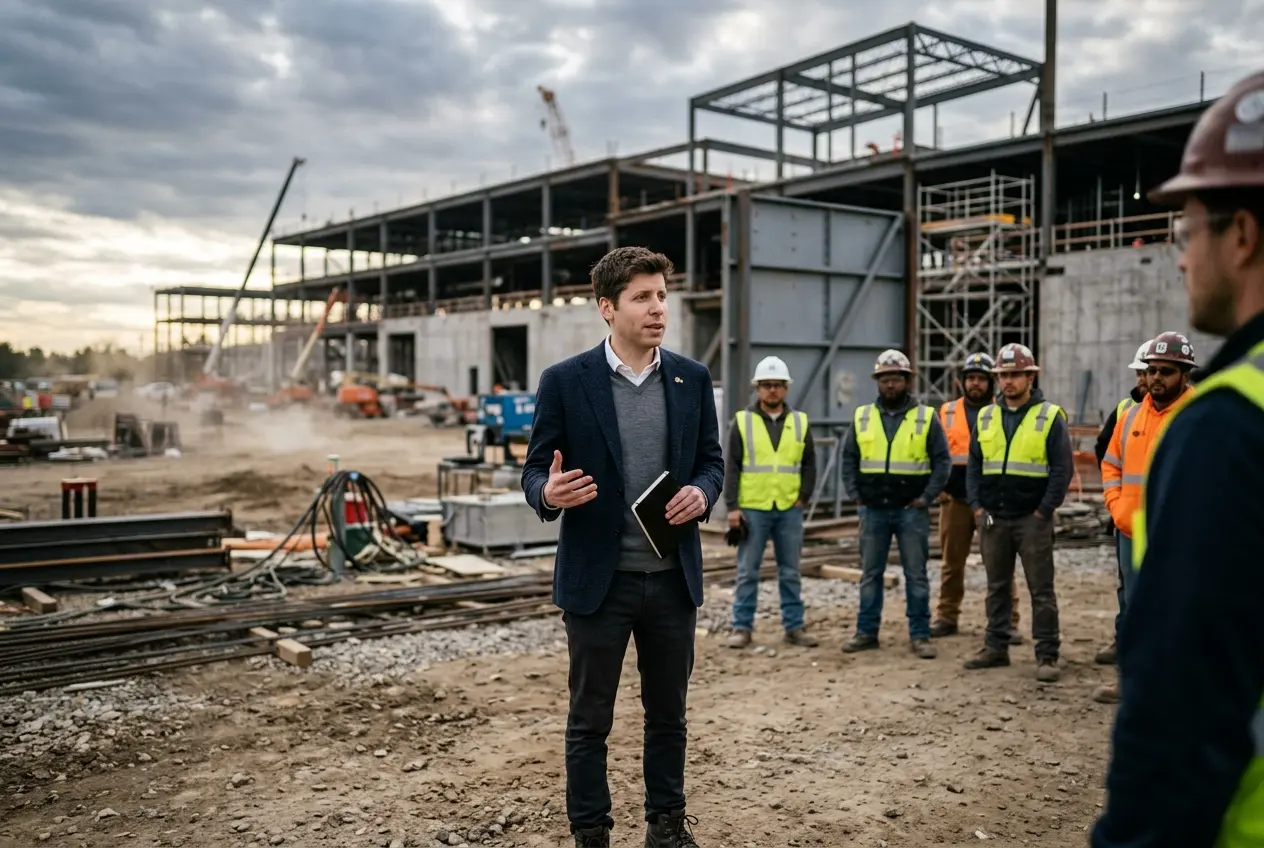
A year ago, Ford CEO Jim Farley stood at the Aspen Ideas Festival and said AI would “replace literally half of all white-collar workers in the U.S.” On June 1, OpenAI CEO Sam Altman told Altman’s June 1 interview transcript with David Faber the industry’s instinct had been wrong. “I think our industry underestimated how much we’re going to be able to keep people at the center of everything in an economy that is and a world that is based on people,” Altman said from OpenAI’s Stargate campus in Saline, Michigan.
That softer line is now the default inside the C-suite. The harder data, for workers, looks different. Through the first half of 2026, Challenger, Gray & Christmas found, AI was cited in 101,743 U.S. job cut announcements, roughly 23% of all cuts. The shift in tone, and what it leaves out, is the real story for anyone whose job is on the line.
From Doom to “People at the Center”
For most of 2024 and 2025, the loudest voices on AI and work were the loudest warnings. Amazon CEO Andy Jassy told employees in June 2025 that AI would shrink Amazon’s corporate workforce “in the next few years” as efficiency gains spread. Anthropic CEO Dario Amodei told Axios in May 2025 that AI could eliminate half of all entry-level white-collar jobs, sending unemployment as high as 20% inside five years. Farley’s literally half of all white-collar workers line landed on the same arc that earlier tech CEOs admitting AI is replacing people had been sketching for two years.
The arc is bending. Altman, speaking to CNBC’s David Faber at OpenAI’s Stargate data center site, credited the change to what he had seen inside companies using coding tools. “The companies that I know that have adopted A.I. the most are also the ones hiring the most,” Altman said, pointing to the firms talking up AI layoffs as the ones adopting it least. He called it “a positive update” for his own prior framing.
I think our industry underestimated how much we’re going to be able to keep people at the center of everything in an economy that is and a world that is based on people.
Sam Altman, CEO of OpenAI, speaking to CNBC on June 1, 2026.
The Worker Is the Stakeholder This Story Skips
The voice that has been quieter in this whole story is the worker. A Pew survey of 5,273 U.S. workers found only 6% of workers believe AI will lead to more job opportunities for them in the long run. About a third, 32%, think it will lead to fewer opportunities. Half of workers, 52%, said they were worried about the future impact of AI in the workplace. Coverage of the CEO pivot has had little to say about how that 52% is reading it.
For most workers, a softened executive message does not change the daily experience. It does not change whether the team is hiring junior staff this quarter. It does not change whether an open role is being refilled or merged with another. It does not change whether expectations are quietly rising while headcount stays flat. The closer a worker’s role sits to routine documentation, basic analysis, scheduling, and content production, the more exposed that worker is, regardless of the executive tone. A 31% slice of workers told Pew the technology would not make much difference to their job either way, a quieter kind of risk, the kind that shows up as scope creep rather than a pink slip.
- 6%: workers who think AI will create more job opportunities (Pew, Feb 2025)
- 32%: workers who think AI will mean fewer opportunities (Pew, Feb 2025)
- 52%: workers worried about AI’s future workplace impact (Pew, Feb 2025)
AI Still Leads the Reasons for Layoffs
The June 2026 Challenger report is the cleanest read on what companies are actually doing. U.S. employers announced 45,849 job cuts in June, down 53% from May but still the kind of total that compounds. AI was the leading reason cited, with 14,029 cuts attributed to it in the month, or 31% of all June cuts. Through the first half of 2026, AI was cited in 101,743 cut announcements, approximately 23% of the year-to-date 443,604 total. Past coverage of the 2025 tech layoff pattern tracks the same arc, with AI moving from a quiet mention in notices to a top-line reason over twelve months.
Technology led all sectors, announcing 15,503 cuts in June for a 139,156 total through the year, up 83% from the same point in 2025. Andy Challenger, the firm’s chief revenue officer, said AI is “the dominant force as companies are restructuring around it, automating roles, and reallocating budgets toward new capabilities.” That is restructuring, not replacement, but the bottom-line headcount effect can look the same to the person no longer on the payroll. Transportation, with 40,970 year-to-date cuts, and Health Care, with 33,175, sit just behind Tech, which now accounts for nearly a third of all job cuts announced in 2026.
The most uncomfortable data point for the “AI just helps us grow” pitch is Altman’s own caveat. The companies, he told CNBC, that are “talking about doing layoffs because of A.I. are the ones adopting A.I. the least.” In other words, the loudest layoffs-AI rhetoric may come from firms with the least AI in production, which makes the Challenger data a noisier signal than the headline number suggests.
It is worth noticing what the Challenger report does not claim. AI was the leading reason cited, but not every one of those 14,029 June cuts was caused by an AI deployment. Some companies are using AI as a convenient explanation for cuts that would have happened anyway. That makes the trend directionally real and quantitatively uncertain at the same time, which is exactly the kind of mixed signal workers should hold both sides of rather than take either executive comfort or headline dread at face value.
| Sector | June 2026 cuts | Year-to-date 2026 |
|---|---|---|
| Technology | 15,503 | 139,156 |
| Services | 4,296 | 21,361 |
| Food producers and manufacturers | 3,955 | 13,075 |
| Health Care and health products | 2,761 | 33,175 |
Source: Challenger, Gray & Christmas, June 2026 report.
Job Redesign First, Job Loss Second
The phrase “AI job losses” suggests a single event: a role is replaced by software. The most recent academic work suggests a different shape. An HBS working paper on AI-native firms by Hyunjin Kim and Rembrand Koning, drawing on Y Combinator batches and U.S. venture-backed startups from 2020 to 2024, classified each firm as “AI-native” and matched it with comparable non-AI peers. AI-native firms were 25% smaller than their non-AI counterparts in the same industry cohort. Their share of engineers was 13% greater. Their shares of entry-level workers and managers were each roughly 15% lower. Valuations were comparable, suggesting more value per employee.
| Workforce measure | AI-native firms vs non-AI peers |
|---|---|
| Headcount | 25% smaller |
| Engineer share | 13% greater |
| Entry-level worker share | roughly 15% lower |
| Manager share | roughly 15% lower |
| Valuation | comparable |
Source: HBS Working Paper No. 26-090, Kim and Koning, June 2026.
The pattern is redesign, not replacement. Junior tasks, the kind of work that used to be the on-ramp for new graduates, get absorbed into senior workflows or automated outright. The Kim and Koning paper described this as a “process channel,” where AI changes how people work inside the firm, and a “product channel,” where AI is built into what the firm sells. For workers, that means the entry-level rung is getting weaker even when the firm is not technically firing anyone, and the broader global AI-led tech layoffs pattern points the same way. For employees in any industry where AI tools can touch a workflow, the question is whether the redesign is shrinking the bottom of the org chart, the middle, or both, before it touches anyone’s title.
AI Fluency Is Becoming a Hiring Filter
There is, however, a countervailing signal for individual workers. An Oxford Internet Institute hiring experiment with 1,725 active recruiters across the United States, United Kingdom, and Germany found that candidates whose CVs listed AI skills were invited to interview at rates 8 to 15 percentage points higher than otherwise identical candidates. The pattern held across the three occupations tested: software engineering, office assistance, and graphic design.
The boost was strongest in administrative roles and weakest in creative ones, where some recruiters still viewed AI skills with suspicion. The same study found that AI skills could partially or fully offset hiring penalties tied to older age or lack of an advanced degree. For older workers, that is one of the rare signals that the labor market is starting to value adaptability over pedigree. Formal AI credentials produced only a modest additional lift over self-declared skills, which means the real interview boost comes from the AI label on the CV, not from a course completion badge.
The practical implication is that vague AI language on a resume will not move the needle. Candidates who listed specific AI tools, named the workflows they touched, and showed a concrete result got nearly the same interview lift as those who listed formal certifications. The signal that recruiters reward is not “knows AI.” It is “uses AI to ship something better, faster.” For workers watching the CEO pivot and weighing whether to lean in or lean out, that distinction is the one that pays.
What Workers Should Watch Next
The shift in CEO tone is real, but it is also incomplete. A softer message about “keeping people at the center” tells workers that the companies building the technology now want them to feel included. It does not tell them whether their next role will exist. That is still being decided, deal by deal and org chart by org chart, in the rooms workers cannot see.
For workers trying to read the room, the practical signal is in five places:
- Job postings: are AI tools named explicitly in required skills?
- Junior headcount: is the entry-level rung being refilled when someone leaves?
- Backfills: when a role opens, is it closed or merged with another?
- Productivity targets: are individual output expectations quietly rising?
- Layoff language: are companies naming AI as the reason, or burying it inside “restructuring”?
If those patterns are visible, AI is already reshaping the work, even when no one is using the word “replace.” The right move is to take the new CEO optimism as a starting hypothesis and the Challenger layoff data as the correction, then build AI fluency where it matters in the role, before the next round of disruption arrives.
Frequently Asked Questions
Why are tech CEOs changing their message on AI job losses?
OpenAI’s Sam Altman told CNBC on June 1, 2026, that the AI industry “underestimated how much we’re going to be able to keep people at the center of everything.” Altman pointed to companies that have adopted AI heavily as the ones still hiring, and said companies naming AI in layoff announcements are often the least AI-forward. The shift reflects what executives have seen inside their own companies, not a change in the underlying technology.
What is the leading reason for layoffs in 2026?
Artificial Intelligence is the leading reason cited for U.S. job cuts in 2026, according to Challenger, Gray & Christmas. AI was the top reason in June, with 14,029 cuts attributed to it, or 31% of the month’s total. Through the first half of 2026, AI was cited in 101,743 cut announcements, approximately 23% of all cuts tracked.
Do AI skills actually help workers get hired?
A 2026 hiring experiment from the Oxford Internet Institute, run with 1,725 recruiters in the U.S., U.K., and Germany, found that candidates who listed AI skills on their CVs were invited to interview at rates 8 to 15 percentage points higher than otherwise identical candidates. The effect was strongest in administrative roles and weakest in creative ones.
How worried should workers be about AI replacing their jobs?
Workers have reason to stay cautious even as CEO messaging softens. A Pew Research Center survey found only 6% of workers believe AI will lead to more job opportunities for them, while 32% think it will lead to fewer opportunities. Risk varies sharply by task mix: roles heavy on routine documentation, basic analysis, scheduling, and content production are more exposed than work built on judgment, trust, or cross-functional accountability.
What should workers do to protect their careers from AI disruption?
The Oxford study suggests AI fluency is becoming a hiring filter, not a differentiator. Workers who can show, with specifics, how they use AI to improve quality or output are reporting stronger interview results. Building visibility around that fluency, before the next round of disruption, is the part most under workers’ control.