Tesla began shipping FSD V14 Lite to older Hardware 3 vehicles on June 29, 2026, the first FSD update of any consequence those cars have seen since early 2025. The build, firmware 2026.20.5.1, was confirmed by Tesla AI chief Ashok Elluswamy from his account, where he said the update distills the driving behavior from the V14 series built for newer Hardware 4 into the camera and compute configuration of AI3. Owners of those cars are running software that compresses a neural network sized for newer silicon onto a chip with about one-eighth the memory bandwidth, a feat that closes a small part of the promise Tesla sold them years ago without delivering the larger one.
For years, Tesla sold Hardware 3 vehicles on an explicit Autonomy Day promise from April 2019: every car had all the hardware needed for Full Self-Driving. Some buyers paid up to $15,000 for the FSD package expecting that promise to mature into unsupervised autonomy. In April 2026, on the Q1 2026 earnings call, Elon Musk admitted in a single sentence that the underlying silicon cannot deliver it, and class actions on three continents have been building ever since.
What FSD V14 Lite Actually Delivers
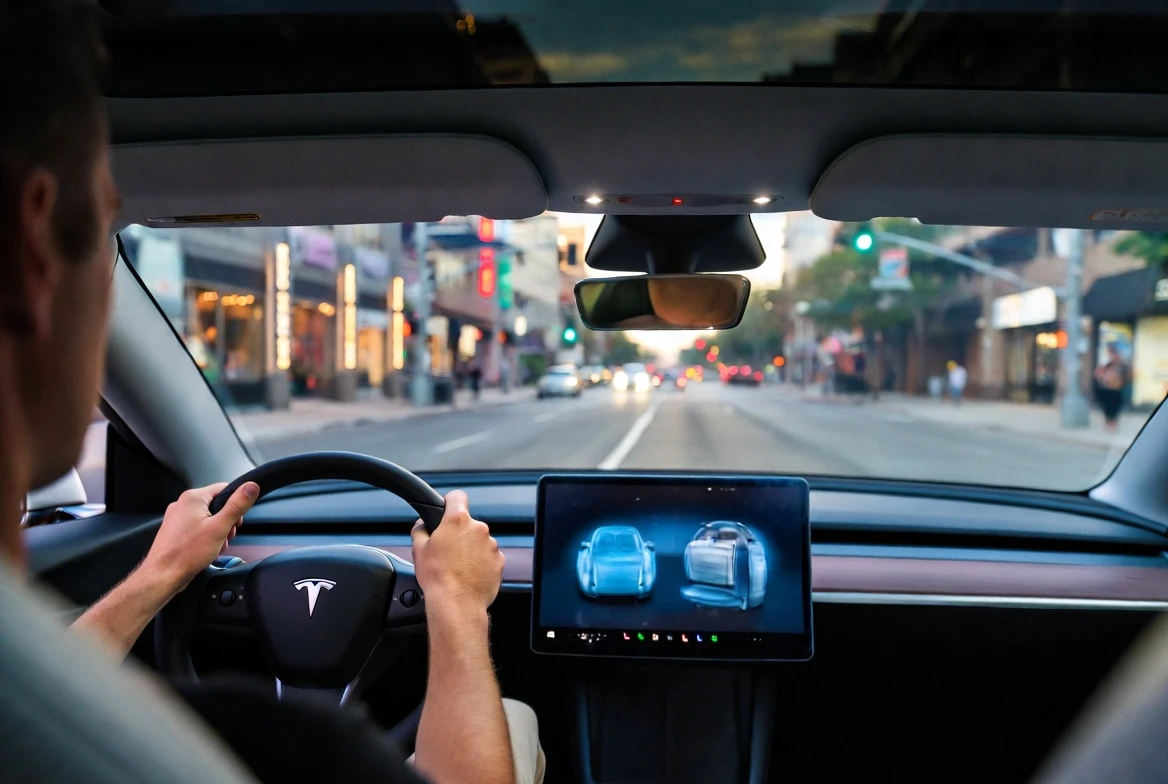
Tesla started rolling out FSD V14 Lite on June 29, 2026 as firmware build 2026.20.5.1, the first FSD build for Hardware 3 (also called AI3 internally) since Tesla stopped updating that fleet at v12.6 in early 2025. Elluswamy posted from his account that the build distills the driving behavior from AI4’s v14 series into the camera and compute config of AI3, with destination options, speed profiles on city roads, and significantly improved safety, in his words. The build also adds Start FSD from Park, Arrival Options for choosing where to park at a destination, and automatic shifting between Drive and Reverse. Tesla’s release notes say the older AI3 computer can directly learn how to handle scenarios using HW4 V14 as a guide.
Early feedback from Early Access drivers has landed warmly. One tester wrote that on a Model 3 with HW3, the new build feels as good as V14 does on an AI4 vehicle, and praised the highway performance. Another early-access driver, posting as Zack, reported zero interventions on a drive from Culver City to Hollywood that ended with autonomous parking at the Tesla Diner Supercharger.
| Feature | v12.6.4 on AI3 | FSD V14 Lite on AI3 |
|---|---|---|
| Start FSD from Park | Not available | Available |
| Arrival Options (parking selection) | Not available | Available (lot, street, driveway, curbside) |
| Automatic Drive and Reverse shifting | Not available | Available |
| Speed Profiles | Not available | Available (Sloth included; Mad Max excluded) |
| Pedestrian and cut-in handling | Baseline behavior | Significantly improved per Tesla release notes |
| Traffic-light behavior at complex intersections | Baseline behavior | Rebuilt using harder RL examples |
Why AI3 Drivers Have Been Waiting
For most owners of HW3 cars, V14 Lite is the first update of consequence since early 2025. Tesla stopped releasing to the AI3 fleet at FSD v12.6, sending the V13 and V14 builds exclusively to AI4 vehicles. The gap grew conspicuous as V14 reached the Model 3 and Model Y in the United States and, more recently, in right-hand-drive markets like Australia and New Zealand. Drivers describe V14 Lite as a leap in capability because their benchmark is v12.6.4, the only version their cars have run since the freeze began in early 2025.
Not every HW3 owner sees the build right away. Tesla is releasing V14 Lite first to its Early Access Group of high-Safety-Score drivers, with the wider rollout happening over the next few weeks.
The technical challenge was significant. AI3 has roughly 15 percent of the effective memory bandwidth of AI4, by Musk’s own estimate, a gap that made porting V14 onto the older chip impossible without compression. The full V14 model needs roughly 12.5 gigabytes of addressable memory to run without degradation, and HW3 carries 8 GB of RAM, so Tesla applied quantization, converting floating-point parameters down to INT8 integers, which fits the model onto the older silicon at the cost of some inference accuracy. The hardware tier difference between the two systems shows up in the Tesla Autopilot hardware reference. The result is a supervised Level 2 system owners can install today. The unsupervised version remains unreachable on this hardware.
The 2019 Promise Meets the 2026 Reality
Unfortunately, Hardware 3, I wish it were otherwise, but Hardware 3 simply does not have the capability to achieve unsupervised FSD. We did think at one point it would have that, but relative to Hardware 4 it has only 1/8th of the memory bandwidth of Hardware 4. And memory bandwidth is one of the key elements needed for unsupervised FSD.
The admission closed a promise Tesla had been making since its April 2019 Autonomy Day, when the company told buyers that every vehicle produced at the time had all the hardware necessary, compute and otherwise, for Full Self-Driving. Buyers who took that statement at face value paid between $8,000 and $15,000 for the FSD package over the following years. Many held their cars through a decade of delays, reassured by Musk’s repeated claim that the gap between the product and the promise was a software problem future updates would close.
Musk said the silicon ceiling was real on Tesla’s Q1 2026 earnings call on April 22, 2026, the first time he admitted it publicly. The gap appears to have been a hardware problem Tesla knew about in advance. In June 2026, Electrek reported that Tesla had retroactively added the word “Supervised” to FSD purchase agreements that owners had signed years earlier, in some cases making the original contract documents inaccessible. Tesla also deleted a 2016 blog post that asserted every vehicle leaving its factory had the hardware needed for full self-driving capability at a safety level substantially greater than that of a human driver; the post remains on the Internet Archive. California ruled in December 2025 that the company’s use of “Autopilot” and “Full Self-Driving” in marketing constituted deceptive advertising under state law.
Even the consolation has limits. V14 Lite is what Tesla could squeeze through the AI3 hardware bottleneck. The unsupervised capability Tesla sold cannot be shipped on this chip.
Three Continents of Lawsuits, One Silicon Ceiling
Owners did not wait for the announcement to organize. A Dutch collective claim over Tesla’s broken HW3 promises has grown to nearly 7,000 verified participants, with Dutch law firm Kennedy Van der Laan backing the action for a formal lawsuit across 29 countries. A separate estimate puts the value of disputed FSD purchases in that claim at around 6.5 million euros. In the United States, a federal class action filed on June 4, 2026 in the Northern District of California (Waller v. Tesla, Case No. 3:26-cv-5350) targets owners of Hardware 1 through Hardware 3 vehicles and uses Musk’s April 22 admission as its central exhibit.
- 4 million Hardware 3 vehicles sold on the unkept 2019 promise.
- About one-eighth – AI3’s effective memory bandwidth compared with AI4’s.
- Up to $15,000 paid per car for the FSD package buyers hoped would mature into unsupervised autonomy.
- Nearly 7,000 owners in the Dutch collective claim as of June 2026.
A second, separately certified California class covers buyers who purchased FSD between October 2016 and August 2024 and opted out of arbitration, with Judge Rita F. Lin finding in August 2025 that evidence showed Tesla failed to deliver on its promised autonomy. A California arbitrator has already ordered Tesla to refund $10,600 to one FSD buyer. Combined global litigation exposure is estimated at up to $14.5 billion.
Courtroom results so far have been bruising. A $243 million jury verdict against Tesla in the Benavides wrongful-death case was upheld by a federal judge on February 20, 2026. Tesla faces an ongoing Department of Justice criminal probe into its self-driving marketing claims. In Australia, owners filed a separate class action in October 2025 over the same broken hardware promise. In China, ten owners attended a Beijing court hearing in May 2026, seeking $583,000 in damages plus triple compensation under Chinese consumer protection law. The legal pressure spans three continents and stems from the same hardware ceiling Musk described on the Q1 2026 call.
Australia and New Zealand Sit in the Queue
For HW3 owners in Australia and New Zealand, V14 Lite lands at the end of a layered wait. The first layer is that V14 was not available to them at all until V14.3.3 (build 2026.16.6) started going out on June 19, 2026. That build only went to Hardware 4 cars: Australian Model 3s built since the September 2023 facelift, and Model Ys built since late January 2024. Tesla Australia and New Zealand confirmed the rollout on the same day it began, framing it as a step-change from previous behavior. The two markets had been receiving FSD only since V13 launched there on September 18, 2025, the first right-hand-drive markets in the world to get it. The second layer is HW3 itself, with one local owner having replied to Elluswamy’s June 29 post with a one-line request: please bring it to Australia and New Zealand for HW3 owners.
Tesla confirmed in April 2026 that V14 Lite would reach international markets, though the company has not set a date. International rollout depends on technical verification, regional adaptation, and regulatory approval, and Tesla’s overseas paperwork to date has generally covered AI4 hardware only. The FSD subscription in Australia runs at A$149 per month, and Tesla ended the outright purchase option at A$10,100 on March 31, 2026. New Zealand buyers pay the equivalent of NZ$159 per month.
What the Retrofit Would Actually Involve
The retrofit, when it eventually arrives, involves more than a chip swap. Moving an HW3 car to unsupervised-capable silicon requires replacing the AI3 computer, fitting higher-resolution 5-megapixel cameras, and rewiring the internal harness to handle the increased data throughput the newer chip demands. That work involves partial vehicle disassembly with new camera mounts, more invasive than Tesla’s earlier in-house hardware upgrades. Musk’s answer to the scale problem is to build microfactories in major metropolitan areas, dedicated facilities for the conversion.
Two offers sit in front of HW3 owners, and neither has firm specifics. The first is a discounted trade-in toward a new HW4-equipped vehicle. The second is the physical retrofit described above. The FSD Transfer Program, which had previously let owners move their FSD license to a new car, was closed on March 31, 2026.
For now, HW3 owners are running software that is real and worth installing on its own terms, the first concrete improvement to their cars’ autonomy stack in over a year, on hardware that cannot deliver the capability they paid for. V15, the next major FSD architecture, will run only on AI4 and the upcoming AI5 silicon Tesla has confirmed. Tesla has not announced pricing, locations, or a timeline for the retrofits it floated in April.
Frequently Asked Questions
What does FSD V14 Lite do on Hardware 3 vehicles?
It brings HW3 cars features that were previously limited to Hardware 4: Start FSD from Park, Arrival Options for choosing where to park at a destination, automatic Drive and Reverse shifting, and the Speed Profiles that govern how aggressively the system picks speeds and gaps. Tesla’s release notes also describe improved navigation handling, merges and forks, pedestrian interactions, and traffic-light handling at complex intersections. The build remains FSD (Supervised), a Level 2 driver-assistance system that requires attentive hands-on driving.
Will Hardware 3 cars ever get unsupervised Full Self-Driving?
No. On Tesla’s Q1 2026 earnings call on April 22, 2026, Elon Musk said that Hardware 3 does not have the capability to achieve unsupervised FSD, with the gap set by the silicon: AI3 has only about one-eighth the effective memory bandwidth of AI4, and that constraint cannot be closed through software updates alone. Tesla has confirmed that the next FSD architecture, V15, will run only on AI4 and AI5 vehicles.
When will FSD V14 Lite reach Hardware 3 cars in Australia and New Zealand?
Tesla confirmed in April 2026 that V14 Lite would reach international markets after the US, but the company has not set a date. International rollout depends on technical verification, regional adaptation, and regulatory approval, and Tesla’s overseas paperwork to date has covered AI4 hardware only. Australian and New Zealand owners have already asked Tesla for the build online.
What options does Tesla offer Hardware 3 owners who paid for FSD?
Two options: a discounted trade-in toward a new Hardware 4-equipped Tesla, or a hardware retrofit that replaces the AI3 computer, installs higher-resolution cameras, and rewires the harness. Tesla says the retrofit work will require dedicated microfactories in major metropolitan areas. No retrofit locations, pricing, or timeline have been announced.
How much does FSD Supervised cost in Australia today?
FSD Supervised is subscription-only in Australia as of April 1, 2026, at A$149 per month. Tesla ended the outright purchase option on March 31, 2026; the last outright price was A$10,100. New Zealand buyers pay the equivalent of NZ$159 per month.