A global tech sell-off on June 23, 2026 erased more than $1 trillion from the Nasdaq 100 in a single session, dragged South Korea’s Kospi index down 10%, and turned the stocks that had led this year’s rally into the day’s biggest losers. The rout began overnight in Asia and accelerated through the European open before U.S. trading, with chipmakers, AI-platform names, and Elon Musk’s SpaceX carrying the heaviest losses. Traders said the trigger was a familiar cocktail: stretched valuations, two more high-profile AI researchers leaving Alphabet, and nerves ahead of Micron’s earnings report on Wednesday.
Sky-high valuations did the inviting. Investors were already questioning whether the AI-fueled capital spending wave can keep producing the returns that have powered 2026’s record run. SK hynix and Samsung, both up triple digits this year, both lost more than 12% on Tuesday. Sandisk, the best-performing stock in the S&P 500 going into the day, fell 13%. For all the damage, the year’s winners remain the year’s winners, and the day’s biggest debate is whether this is a reset or the trade turning.
How Bad the Day Got, by the Numbers
By 11:45 a.m. ET, the Nasdaq Composite was down more than 2% and the Nasdaq 100 had plunged more than 3%, per CNBC. The S&P 500 slid 1.5% and the Russell 2000, which tracks small and mid-cap stocks that often avoid the volatility in major tech names, was down 1%. The Dow rose briefly at the open before turning negative, dragged by Nvidia, Caterpillar and Cisco.
Outside the U.S., the day’s cross-asset backdrop was almost as striking as the equity moves. The 10-year Treasury yield sat at 4.48%, down only slightly from 4.51% on Monday, suggesting bond traders were not yet reading the rout as a growth scare. WTI crude traded at $73 a barrel and Brent at $77, both down from the eve of the Iran war at $67 and $73 respectively. Gold futures fell more than 1% to $4,155 a troy ounce, and Bitcoin slipped to $62,400 from above $65,000 the prior day.
Below is a snapshot of the day’s index and asset moves, all from primary reporting on the session.
| Index or asset | Tuesday’s move |
|---|---|
| Nasdaq Composite | down more than 2% |
| Nasdaq 100 | down more than 3% |
| S&P 500 | down 1.5% |
| Kospi (South Korea) | down 10% (intraday low 10.5%) |
| Stoxx 600 (Europe) | down around 1% (Technology index down 3%) |
| DAX (Germany) | down 1.1% |
| Nikkei 225 (Japan) | down 3.55% |
| Hang Seng (Hong Kong) | down 1.8% (Chinese equities entered a bear market) |
| 10-year Treasury yield | 4.48%, down from 4.51% on Monday |
| Brent crude | $77.40 a barrel, down 0.6% |
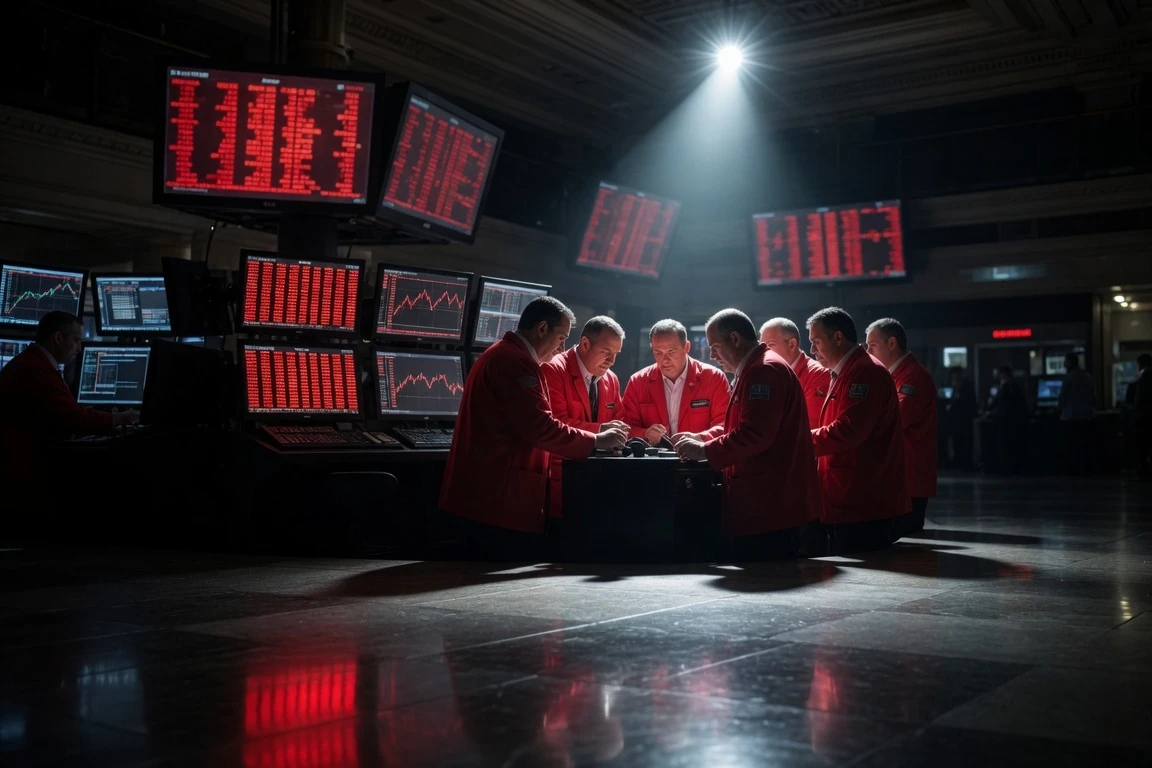
Why the Rout Spread from Seoul to New York
The day’s pain started in Korea, where the chip-heavy Kospi fell as much as 10.5% and triggered a 20-minute trading halt by the exchange operator. SK hynix and Samsung, the country’s two largest companies and the world’s two largest memory-chip makers, each lost more than 12%. Lee Chan-jin, who leads South Korea’s financial regulator, said on Monday he regretted letting single-stock leveraged ETFs tracking the two names debut earlier in the year, comments Fortune reported as the regulator weighed whether single-stock leveraged products had overheated the rally.
The Asian leg then spread to Japan and Hong Kong. Tokyo’s Nikkei 225 closed down 3.55%, and the Hang Seng fell 1.8%, with Chinese equities in Hong Kong entering a bear market. European markets opened lower: the pan-European Stoxx 600 shed around 1%, with the Stoxx 600 Technology index down 3%. Germany’s DAX fell 1.1% led by Infineon, down more than 6%; ASMI and STMicroelectronics were both down more than 7%. By the time the U.S. opened, futures were already pointing lower, and the opening bell delivered the rest.
How the rout cascaded, in order:
- Korea: Kospi circuit-breaker halt; SK hynix and Samsung each down more than 12%.
- Japan: Nikkei 225 closes down 3.55%.
- Hong Kong: Hang Seng down 1.8%; Chinese equities enter a bear market.
- Europe: Stoxx 600 down around 1%; Stoxx 600 Technology index down 3%; DAX down 1.1%.
- United States: Nasdaq Composite down more than 2%; Nasdaq 100 down more than 3%; S&P 500 down 1.5%.
The macro backdrop, the same Strait-of-Hormuz shock that pushed oil toward $100 earlier in the year, had eased enough by Tuesday for crude to fall 0.6% on the day, with the U.S. issuing a 60-day licence allowing Iran to sell oil internationally. The relief on oil removed one pressure point; it did not remove the pressure on rate expectations, which new Federal Reserve chair Kevin Warsh has been pushing higher.
The Same Stocks That Led the Year Led the Drop
The single most under-told fact of the day is that the names bleeding most on Tuesday are the names investors piled into for most of 2026. Micron, the S&P 500’s second-best performer year-to-date going into the session, fell 10% to 11%. Sandisk, the S&P 500’s top performer, fell 12% to 13%. Western Digital, third, fell 9% to 10%.
The same pattern held overseas. SK hynix, up almost 900% over the past 12 months, lost 12.5% on Tuesday. Samsung, up 412% over the past 12 months and 160% year-to-date, lost 12.3%. The Roundhill Memory ETF (DRAM), up 190% since launching in early April and worth $23.4 billion as of Monday, fell about 12% on Tuesday, its biggest one-day drop since the post-Iran-war volatility in early June.
Micron specifically had climbed 298% year-to-date going into the session, per Reuters’ Wall Street Week Ahead preview. SK hynix, briefly Korea’s most valuable company on Monday, was worth over 2.1 quadrillion won ($1.35 trillion), just ahead of Samsung at $1.34 trillion, before Tuesday’s drop. That single session undid a chunk of the lead.
The Roundhill ETF’s holdings line up neatly with the day’s damage. Sandisk was down 12%, Micron down 11%, Western Digital down 10% and Seagate down 7%, with SK hynix and Samsung contributing another 44% of the fund’s weight through Korean listings. The fact that an AI-themed thematic ETF lost 12% in a single session underscores how concentrated the trade had become. The flip side, Wedbush’s Dan Ives argues, is that even after Tuesday the AI trade has further to run. He frames the sell-off as another gut-check moment with the AI Revolution in the third inning.
Year-to-date and 12-month gains versus Tuesday’s drop:
| Stock or fund | 12-month gain | 2026 year-to-date gain | Tuesday’s drop |
|---|---|---|---|
| SK hynix | almost 900% | n/a | down 12.5% |
| Samsung Electronics | 412% | 160% | down 12.3% |
| Micron Technology | more than 790% | more than 280% (298% per Reuters) | down 10% to 11% |
| Sandisk | n/a | top S&P 500 performer | down 12% to 13% |
| Western Digital | n/a | 2nd-best S&P 500 stock | down 9% to 10% |
| Roundhill Memory ETF (DRAM) | n/a (launched April) | up 190% | down about 12% |
SpaceX’s Post-IPO Slide Became the Canary
The single biggest individual name in Tuesday’s story was a company that had been public for less than two weeks. Elon Musk’s SpaceX, whose June 12 debut was the biggest IPO in history, has now erased more than $900 billion of value from its intraday peak above $225 a share one week ago, according to Bloomberg figures cited in the day’s reporting. On Monday alone, shares fell nearly 17%, erasing $400 billion in value, described as the second-largest one-day wipeout for any stock on record.
The trigger for Monday’s leg lower was a fresh bond offering. SpaceX filed Monday for what Bloomberg reported is a roughly $20 billion debt sale, on top of the $85.7 billion it raised in the IPO. The company said in a filing it held about $100.8 billion in cash and equivalents as of June 19, and that proceeds would repay a bridge loan tied in part to the $60 billion all-stock acquisition of AI-coding startup Cursor. Reuters and Axios reported separately that bankers were preparing for at least $20 billion in bonds. A Société Générale note Tuesday tied the bond move to the wider AI debt story.
By Tuesday morning, SpaceX shares had fallen as low as $147, briefly below the $150 first-day open, before recovering to trade in the $155 to $165 range. Morningstar put SpaceX’s market cap above $2 trillion on Tuesday, having briefly ranked as the world’s fourth-largest company last week at close to $3 trillion. Even after the slide, shares remain nearly 30% above the $135 IPO price.
Morningstar analysts lowered its fair value estimate for SpaceX to $62 from $63, citing a “sizable dilution” of SpaceX shares following the Cursor deal, noting a best-case scenario would price shares at $169 should its AI revenue improve.
That $169 best-case number is the through-line. SpaceX traded below it on Tuesday morning, and the question now is whether the bond-driven dilution has already been priced in or whether the next leg down is a re-test of the IPO open.
Alphabet’s Talent Drain and Microsoft’s Quiet Gain
Monday’s setup for the rout was Alphabet’s worst day in over a year. Shares of Google parent Alphabet closed down about 5% on Monday, the steepest slide since a roughly 7% decline in May 2025. The trigger: two high-profile AI researchers announcing departures in five days. Noam Shazeer, Google’s VP of engineering and a co-lead on Gemini, said Wednesday he was leaving for OpenAI, less than two years after returning to Google via the Character.AI deal.
On Friday, John Jumper, DeepMind VP and engineering fellow, said he was leaving for Anthropic after nine years. Jumper co-created AlphaFold, the breakthrough AI that has predicted more than 200 million protein structures, and won a 2024 Nobel Prize alongside Demis Hassabis. Alphabet extended the slide another 1% in early Tuesday trading, per the CNBC recap of Alphabet’s worst day in over a year on AI talent exits.
The Magnificent Seven did not move as a block. Microsoft rose roughly 1% to 2% intraday on Tuesday, the only member of the cohort in the green, after CEO Satya Nadella told the Wall Street Journal in a Sunday interview that the AI market was “commoditized” and called for less dependence on “AI giants.” Alphabet, Nvidia, Tesla, Amazon, Meta and Apple all traded lower. The same pattern, but milder, played out across the prior AI-fear sell-off in software: the names with the most concentrated AI bets absorb the most damage.
What the Trading Desks Are Saying
The framing on Tuesday was almost uniformly reset, not reckoning, with one clear dissent. JPMorgan traders told clients in a note that “Gravity strikes,” a single phrase meant to capture the snap of the move across Asian indexes and U.S. and E.U. futures. In a separate note, JPMorgan analysts said the selling could reflect “anxiety” ahead of Micron’s Wednesday afternoon report, a view repeated by Wedbush’s Dan Ives. Saxo Bank’s Neil Wilson argued the move was less about AI’s prospects and more about the rate outlook under new Fed chair Kevin Warsh, telling clients that “tech, being a long-duration sector, is on the front line” and that a Fed rate hike could be on the table as soon as July.
On the other side, BNY strategist Geoffrey Yu warned in a client note that “if today’s price action points to AI exhaustion, fears will grow concerning the global economy’s ability to generate a clear and diversified growth narrative amid tighter funding and fiscal constraints.” Morningstar’s Javier Correonero called the setup “a lot of froth in the markets” and read the move as profit-taking. Tom Hulick, CEO of Strategy Asset Managers, told CNBC from London that he was not concerned about a looming catastrophe, noting that markets are “very fluid” right now and that “the earnings momentum is very strong.”
The named voices and their framing on Tuesday:
- JPMorgan traders: “Gravity strikes,” with anxiety framed around Micron’s report.
- Wedbush’s Dan Ives: a “gut check moment” in the third inning of the AI trade.
- Saxo’s Neil Wilson: a reset against a higher rate outlook, with a possible July Fed hike.
- BNY’s Geoffrey Yu: a warning that AI exhaustion would expose funding constraints.
- Morningstar’s Javier Correonero: profit-taking after a year of froth.
- Strategy Asset Managers’ Tom Hulick: not a catastrophe, given liquidity and earnings momentum.
Why Wednesday’s Micron Print Now Matters More Than Usual
Micron reports its fiscal third-quarter results on Wednesday, June 24, 2026, after the close. Per the company’s own IR release confirming the June 24 earnings date, the call is scheduled for 2:30 p.m. PT. The Street is treating the print as the test of the memory-chip trade.
Reuters’ Wall Street Week Ahead preview flagged Micron as the “pulse check” for AI-rally momentum. Visible Alpha consensus has revenue around $7.6 billion, within the company’s prior guidance of $7.4 billion to $7.8 billion per S&P Global. Micron raised its full fiscal-2026 capex outlook to more than $25 billion, from prior guidance of $20 billion. The question for the print is whether AI-memory demand holds up at the run rate the stock’s 280%-plus 2026 gain implies.
Even with Tuesday’s drop, Micron enters the report as the S&P 500’s third-best performer year-to-date. The sell-off lifted implied options volatility across the memory complex, and the Roundhill Memory ETF’s 12% drop is the cleanest single read on the trade’s sensitivity to the print. As Wedbush’s Ives put it, “we will continue to go through a number of gut check moments in the tech trade as the AI Revolution remains in the third inning.” Wednesday’s report is the next one.
What Micron’s Wednesday report is being asked to confirm:
- That AI-memory demand is holding the run rate implied by the stock’s 298% year-to-date gain.
- That the $25 billion fiscal-2026 capex outlook is funded without further dilution.
- That revenue lands inside the $7.4 billion to $7.8 billion guidance band, near the Visible Alpha consensus of $7.6 billion.
- That the broader memory complex, including SK hynix, Samsung, Sandisk and Western Digital, can hold the gains the trade has already booked.
Frequently Asked Questions
What triggered the global tech sell-off on June 23, 2026?
A confluence: stretched valuations across AI and memory-chip names, an overnight 10% drop in Seoul’s Kospi led by SK hynix and Samsung, two more AI researchers leaving Alphabet for OpenAI and Anthropic, SpaceX’s post-IPO slide deepening after a roughly $20 billion bond offering, and anxiety ahead of Micron’s Wednesday earnings report.
How much has the Nasdaq 100 lost in this sell-off?
More than $1 trillion in market value was erased on Tuesday alone, per Reuters. The Nasdaq Composite was down more than 2% at the open, and the Nasdaq 100 was on pace to lose more than 3% by mid-morning.
Why did the Kospi fall 10% on Tuesday?
SK hynix and Samsung, both up triple digits in 2026, each lost more than 12%. The drop triggered a 20-minute trading halt, and South Korea’s financial regulator said on Monday it regretted letting single-stock leveraged ETFs tracking the two names debut earlier in the year.
How much has SpaceX lost since its IPO?
Shares are down more than $900 billion from the intraday peak above $225 reached in the first week of trading. On Monday alone, SpaceX fell nearly 17%, erasing $400 billion, the second-largest one-day wipeout for any stock on record. Shares remain nearly 30% above the $135 IPO price.
Why does Micron’s Wednesday earnings report matter?
Micron is the S&P 500’s third-best performer year-to-date, up more than 280%. The print will be read across the entire memory-chip complex, including SK hynix, Samsung, Sandisk and Western Digital. Visible Alpha consensus has revenue near $7.6 billion, inside the company’s prior $7.4 billion to $7.8 billion guidance band.