Sweden’s Mattias Svanberg came off the bench in the 84th minute of Sweden’s World Cup opener against Tunisia in Monterrey on June 14, 2026, and the match ball he would soon sweep into the net was already gathering data. Eighteen seconds after his introduction, Svanberg scored, and the assistant’s flag went up for offside. The referee, Yael Falcon, waited. After a check, the offside call was reversed, and the goal stood.
Buried inside the Adidas Trionda was a 500Hz motion sensor that registered a faint touch from Alexander Isak on the way through. Football’s ‘Snicko,’ a cricket-style graphic, made its debut on the broadcast to confirm the contact. None of the technology behind the call came from a blockchain. And the crypto industry, which spent the last cycle buying naming rights, fan tokens, and arena deals across elite sport, was not in the room.
Sweden ran out 5-1 winners in the end, with Yasin Ayari opening the scoring in the seventh minute, Isak doubling the lead on the half-hour, and Viktor Gyökeres adding a third in the 60th. The fourth, Svanberg’s, was the one that needed help.
The 18-Second Goal and the Touch That Decided It
The sequence, in order, was straightforward:
- Ayari swung a free kick in from the right.
- The ball brushed Isak’s boot in the box.
- Svanberg, just substituted on, swept the ball into the net.
- The assistant raised a flag for offside.
- The VAR team checked the ball sensor and found the Isak touch.
- The referee overturned the offside call, and the goal stood.
The Svanberg strike arrived 18 seconds after he entered the match, the second-fastest goal by a substitute at a World Cup since 1966, behind Richard Morales’s 16-second goal for Uruguay against Senegal in 2002, per the BBC. The Guardian’s live blog noted that confirmation of the touch was shown on the broadcast as a spike graphic, the same visual language cricket has used for a decade in its Snickometer reviews. The graphic from BBC Sport showed a clean spike at the moment Isak’s right boot made contact.
Inside the 500Hz Sensor
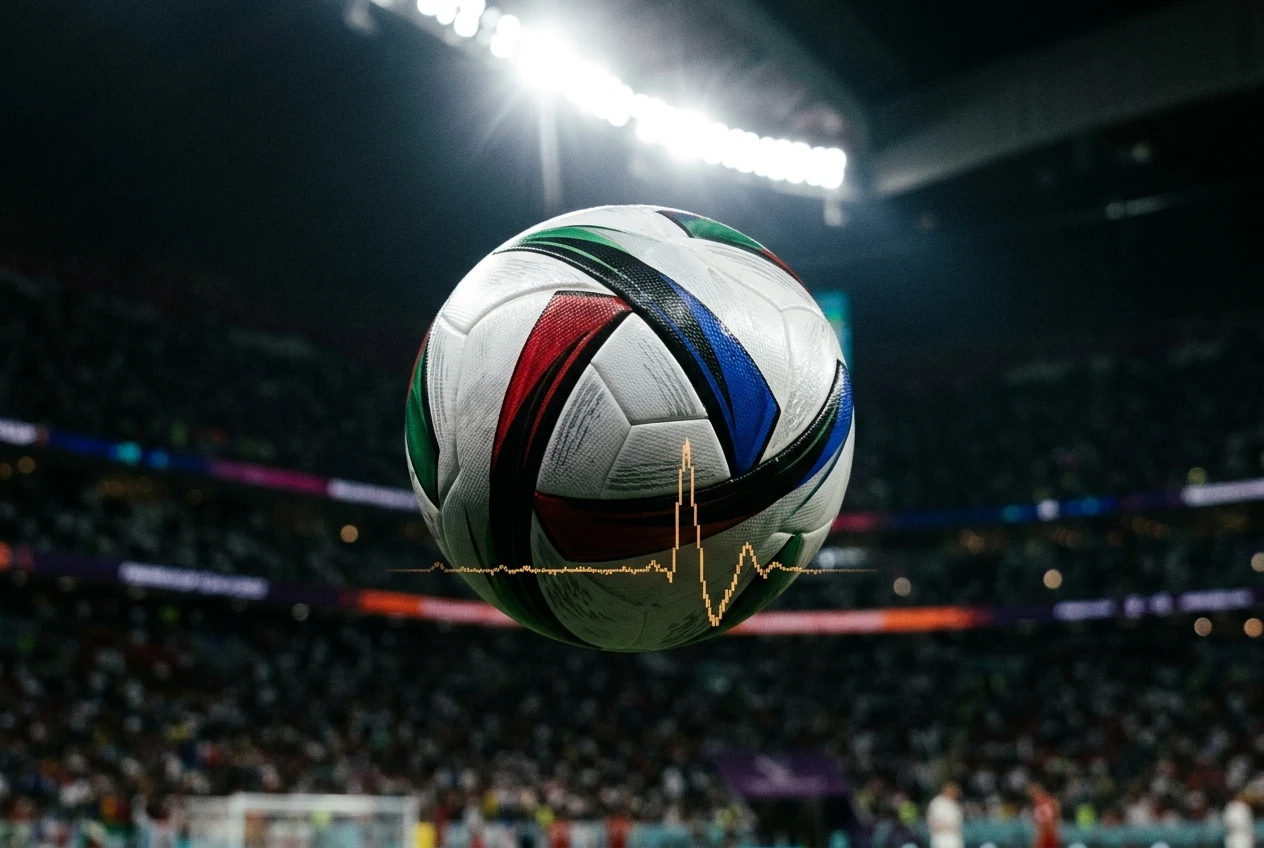
The Trionda is the first World Cup match ball to carry Adidas’s connected ball technology with the sensor mounted in a side panel rather than suspended in the center. Kinexon, the German sports technology company that developed the chip with Adidas and FIFA, says the inertial measurement unit captures the ball’s acceleration and movement in three dimensions 500 times per second. The chip sits inside a specially created layer of one of the four panels, with counter-balances across the other three keeping the ball’s flight stable. Each match ball has to be charged before kickoff, since the sensor is a powered device.
That data feeds the Video Assistant Referee system, where it is combined with optical player tracking and run through an artificial intelligence model that helps officials pinpoint the precise moment a ball was touched, per the tournament’s official match ball page. Adidas’s own release says the system can also aid match officials in identifying each individual touch of the ball, “resulting in less time spent resolving specific incidents, including possible handball.”
The same logic was applied in reverse four years ago. After Cristiano Ronaldo celebrated what he said was a touch on Bruno Fernandes’s cross in Portugal’s 2-0 win over Uruguay at the 2022 World Cup, FIFA said in a statement that ‘no external force on the ball could be measured as shown by the lack of heartbeat in our measurements’ and credited the goal to Fernandes. The system that ruled out Ronaldo’s claim is the same one that confirmed Isak’s touch on Sunday.
A Cricket Spike on a Football Pitch
The graphic FIFA showed to viewers looked like a cardiac monitor, a flat trace with a single sharp peak at the moment the ball brushed Isak’s right boot. To cricket fans, the image was instantly familiar. The Decision Review System used in test cricket since the early 2000s produces the same kind of audio-visual spike when a ball passes the bat. The Snickometer and UltraEdge have settled hundreds of marginal catches and lbw decisions in the game’s longest format.
The football version is built differently. Cricket’s Snicko relies on sensitive microphones at the base of the stumps to pick up the sound of contact. The Trionda’s version reads motion, not sound, through a chip embedded in the ball itself, and the result is a similar on-screen spike, and a similar feel for the viewer: a moment of contact that the eye could not catch, made visible to a TV audience in real time.
The Blockchain-Shaped Gap in the Stack
The connected ball sits inside a wider 2026 officiating stack that includes semi-automated offside, goal-line, optical player tracking, and a referee body-camera system. None of it is decentralized. The sensor’s data, the player tracking, the AI model, and the VAR review are all run through hardware and software controlled by FIFA and its commercial partners, including a newly signed technology partner in Lenovo. Anyone wanting to verify a touch can only do so by trusting the system. Adidas designed the chip, Kinexon built it, and FIFA runs the review.
That is the gap the blockchain industry has spent a decade arguing it could close. Distributed ledgers, in theory, are good at producing tamper-evident records of events, running tokenized incentive systems for participants, and letting outside parties audit a decision.
The ball-tracking data that the Trionda generates is exactly the kind of input the crypto industry has said sports need to put on-chain. None of that infrastructure is in place for the World Cup. The sensor is proprietary, the data is centralized, and the verification chain runs through FIFA’s own officials. The crypto industry’s offer, by contrast, is built around a different problem.
| Connected ball (Trionda) | Chiliz/Socios fan tokens | |
|---|---|---|
| Primary purpose | Officiating and touch detection | Fan engagement and trading |
| Data captured | High-frequency motion data from an embedded sensor | Vote records, transfers of token holdings |
| Where it sits | Embedded in the match ball | On the Chiliz Chain (now also Solana and Base) |
| Who runs the verification | FIFA and its match officials | The Chiliz protocol and Socios.com |
| Used to decide a World Cup goal | Yes (Svanberg’s) | No |
The two systems solve different problems. When football’s most consequential officiating moment of the year arrived, the technology on the field came from sensor hardware, not distributed infrastructure, a pattern that mirrors how FIFA has commercialized the rest of the tournament’s tech stack.
What Fan Tokens Were Actually Built For
Chiliz, the company behind the Socios.com fan token platform, marked the fifth anniversary of the original Juventus Fan Token in late 2024. The company’s own review of that period noted that Socios.com had grown to nearly 2.5 million users, that the number of Fan Token holders was rising at what it called an impressive rate of 215 percent annually, that 75 brands across five sports verticals and 23 countries use Chiliz-created digital assets, that the average market cap of all Fan Tokens in 2024 stood at 260 million euros, and that daily trading volumes ran above 150 million, per the company’s five-year retrospective.
The uses for those tokens, as described by Chiliz and its partners, are largely non-binding. CoinDesk’s account of Chiliz’s April 2026 expansion listed what holders can actually do with tokens for clubs like Paris Saint-Germain, Barcelona, Manchester City, and Juventus. Chiliz has said the platform has run more than 17,000 fan polls and 33,000 rewards since 2019.
- Vote on club issues such as the colour of the players’ warm-up kit
- Enter draws for signed jerseys, VIP tickets, and meet-and-greets
- Take part in polls about kit designs, squad numbers, and the names of new facilities
- Trade the tokens on supported exchanges, with prices moving on news and match results
We are extremely proud of what we’ve achieved in these five years. We knew we could develop a truly transformative tool that would bring value to both fans and brands, and we’ve done just that.
Alexandre Dreyfus, founder and CEO of Chiliz and Socios.com, in the company’s 5-year anniversary post. The Chiliz ecosystem runs on its own chain, the Chiliz Chain, which the company describes as the first blockchain built specifically for the sports industry, and it was not built to be queried by a VAR room.
The Industry’s Pivot to Volume Catalysts
The clearest signal of where the sports blockchain industry is putting its energy this year is not on the pitch. In April 2026, Chiliz said it would expand its roster of over 70 fan tokens to Solana and Base, the Ethereum layer-2 network developed by Coinbase, per Chiliz’s fan token expansion to Solana and Base. The company said the move was designed to give its tokens ‘a major trading volume boost ahead of this summer’s FIFA World Cup.’
The expansion uses what Chiliz calls an Omnichain Fungible Token standard. Each fan token will exist on each supported chain with a unified supply, eliminating wrapped tokens and fragmented liquidity pools. Chiliz already offers tokens representing the Argentina and Portugal national teams, with more expected to be unveiled in June. The pitch to holders is access to faster trading, deeper liquidity, and lower fees at the moment World Cup interest peaks.
Where the Sports Blockchain Pitch Stands Now
The connected ball worked, and it did so without asking anyone to hold a token, run a node, or verify a hash. The Svanberg goal stands, the broadcast graphic lives on. The sports blockchain industry’s argument has always been that some part of this stack belongs on a ledger, that data integrity, fan ownership, and decentralized governance are the missing pieces of the modern game.
The 2026 World Cup is, so far, not buying it. Chiliz’s leadership, for its part, sees the World Cup itself as the catalyst, and has framed the tournament as the moment fan token trading volumes break out. The Solana and Base expansion was rolled out in April ahead of the World Cup to chase that volume. The connected ball’s debut is a different kind of result, and it lives in a different ledger.
Frequently Asked Questions
What is the ‘Snicko’ technology used at the 2026 World Cup?
Football’s ‘Snicko’ is the broadcast name for the touch-detection readouts coming from a 500Hz motion sensor embedded in the Adidas Trionda match ball. When a player makes contact with the ball, the sensor registers a spike in the ball’s motion data, and broadcasters display the spike as a graphic, in the same style as the Snickometer and UltraEdge systems used in cricket for ball-to-bat decisions. The debut call was Mattias Svanberg’s fourth goal for Sweden against Tunisia on June 14, 2026, which was initially flagged for offside before VAR used the sensor data to confirm Alexander Isak had brushed the ball on the way through.
How does Adidas’s connected ball work?
The Trionda carries an inertial measurement unit, a motion-sensing chip developed by Adidas with Kinexon and FIFA. The chip captures the ball’s acceleration and direction at high frequency and sends the data to the Video Assistant Referee system in real time. Match officials combine that feed with optical player tracking and an artificial intelligence model to identify the precise moment the ball was touched, which helps confirm or rule out offside and other contact calls. The match ball has to be charged before kickoff because the sensor is a powered device.
Is any blockchain technology being used at the 2026 World Cup?
FIFA has not announced any blockchain integration for the officiating or sensor systems at the 2026 World Cup. The connected ball, semi-automated offside, goal-line, and player tracking systems all run on centralized hardware and software controlled by FIFA and its commercial partners. Chiliz, which runs the Socios.com fan token platform, has expanded its tokens to Solana and Base ahead of the tournament, a move aimed at trading volume rather than at officiating data. Crypto exchange Kraken is the tournament’s Official Crypto Exchange Supporter for fan-facing activations, not match-day officiating.
What do fan tokens actually let supporters do?
Fan tokens issued through Socios.com and the Chiliz ecosystem give holders the right to take part in non-binding club polls, enter draws for merchandise and experiences, and trade the token on supported exchanges. Chiliz has said holders have voted on issues including kit designs, squad numbers, and the naming of new club facilities, with more than 17,000 fan polls and 33,000 rewards issued through the platform since 2019. The tokens do not confer governance rights over club decisions, and Chiliz’s own coverage lists the canonical example as voting on ‘minor issues such as the colour of the players’ warm-up kit.’