Nvidia’s RTX Spark superchip, unveiled at Computex 2026 in Taipei this week, is the most technically ambitious challenge the Windows PC camp has mounted against Apple’s MacBook since the M-series era began in 2020. The chip pairs a 20-core ARM-based Grace CPU with a Blackwell GPU carrying 6,144 CUDA cores and up to 128GB of unified memory into a slim laptop chassis, and eight major manufacturers, from Dell to Microsoft’s own Surface division, have committed to shipping devices powered by it this fall. That hardware profile, backed by Nvidia’s CUDA software ecosystem, gives Windows laptop makers their most credible shot at the MacBook in years.
Behind the announcement is a coalition wager. The companies making it haven’t shipped a laptop yet. Apple sold out its $599 MacBook Neo within days of its March launch, posted its best-ever first week for new Mac buyers, and still ran supply shortages into May.
Seven Years of Apple’s Hardware Lock
Apple introduced the M1 chip in November 2020 and within two years had redefined what a laptop could deliver on battery. MacBook Air units outlasted Windows competitors on a single charge, matched or beat them on CPU performance for creative workloads, and managed all of it in a chassis that didn’t run hot. Each subsequent generation, M2, M3, M4, and M5, widened the lead as Intel- and AMD-powered Windows machines chased specifications Apple had already surpassed.
The Mac Mini’s rise as a local AI workstation added a second pressure point. When OpenClaw, a local-and-cloud hybrid AI tool, surged in popularity earlier this year, Mac Mini units sold out across tech-heavy markets because Apple Silicon handles those workloads natively, without GPU configuration headaches or compatibility layers.
Then Apple removed the last pricing argument its rivals held. The MacBook Neo, announced March 4 and on sale by March 11, starts at $599 for general buyers and $499 with education pricing. It uses the A18 Pro chip, the same silicon inside the iPhone 16 Pro, with a 16-core Neural Engine for on-device AI. Tim Cook, Apple’s chief executive, called it the company’s “best launch week ever for first-time Mac customers” in a late March post on X. Apple capped purchases at two per customer and still ran short.
The market data shows how wide the gap has grown. MacBooks account for more than half of premium laptop purchases above $1,000 in the United States, according to Counterpoint Research data. Apple’s U.S. enterprise market share reached 11 percent in full-year 2025, up 2.4 percentage points from the prior year, according to Omdia. Market research firm Sigmaintell projects Apple will become the third-largest laptop maker globally this year by volume, with MacBook Neo expected to contribute roughly 10 million of a projected 28 million MacBook shipments.
Apple’s move to its own silicon displaced two longtime hardware partners. MacBooks ran Intel processors until the M1 transition in 2020, and earlier Mac configurations included Nvidia graphics hardware. Both are now absent from the lineup. Nvidia, pushed out when Apple went in-house, is now building a chip designed to challenge the machine that replaced its hardware.
Blackwell in a Laptop Chassis
Jensen Huang, Nvidia’s founder and chief executive, said at his Computex keynote on June 1: “The PC is being reinvented.” The architecture behind that phrase is one Nvidia has not previously put in a personal computer.
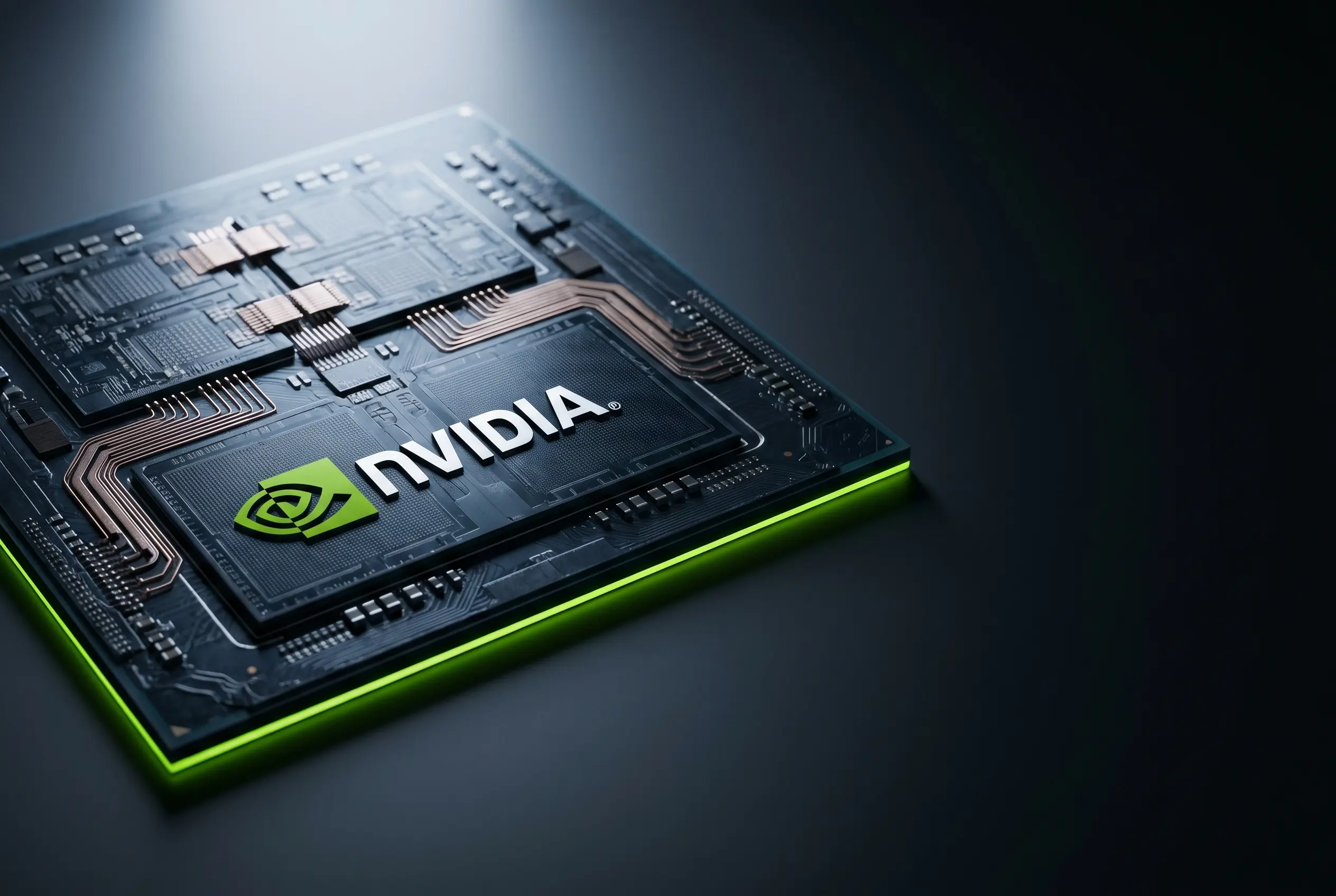
The RTX Spark superchip, per Nvidia’s GTC Taipei announcement, connects a Grace CPU, co-developed with MediaTek (which contributed CPU core design, power management, and memory system architecture), to a Blackwell GPU via Nvidia’s NVLink-C2C chip-to-chip interconnect. That structure gives the CPU and GPU access to a single large memory pool without transfer overhead, mirroring the unified memory architecture inside Apple Silicon.
- 6,144 CUDA cores, Blackwell GPU with fifth-generation Tensor Cores and FP4 precision
- 128GB LPDDR5X unified memory at 300 GB/s bandwidth; lower-tier SKUs cap at 64GB on a 128-bit interface
- 1 petaflop of FP4 AI compute, Nvidia’s peak theoretical figure measured with sparsity
- 120-billion-parameter language models runnable locally, with context windows stretching to 1 million tokens
CUDA (Compute Unified Device Architecture, Nvidia’s programming platform for GPU-accelerated AI) is the differentiator that goes beyond the spec sheet. Machine learning frameworks including PyTorch and TensorFlow are built against CUDA by default. Developers who fine-tune models, run inference pipelines, or write AI code professionally do it on Nvidia hardware. An RTX Spark laptop would run those workloads natively, on the same software stack that powers Nvidia’s data center GPUs, without a translation layer.
Nvidia’s GTC Taipei announcement cited open-source AI projects including OpenClaw and Hermes Agent as having reached record usage numbers on platforms like GitHub and OpenRouter, with broad local adoption limited mainly by users’ inability to run agents on their primary PCs. RTX Spark is designed to remove that constraint. Nvidia also committed to a three-generation roadmap at Computex: a Vera Rubin Spark iteration with LPDDR6 memory follows the first-generation chip, then a Rosa Feynman generation. Publishing three generations publicly is a signal to OEM (original equipment manufacturer) partners that this is a multi-year platform investment.
The OEM Coalition Behind the Bet
Microsoft’s involvement goes further than endorsement. The company launched the Surface Laptop Ultra, its own RTX Spark device, through the Windows Experience Blog, targeting creators and professionals who need sustained AI performance across rendering, compiling, and local AI workflows, a positioning that puts it squarely against the MacBook Pro’s existing audience. Nvidia and Microsoft are partnering on OS-level security primitives and a framework called NVIDIA OpenShell to run local agents securely within Windows. Microsoft confirmed at Build that RTX Spark delivers a 3x performance uplift for agent-related workloads compared to the NPUs in current Copilot+ PCs.
At Microsoft Build 2026, held June 2-3 in San Francisco, one day after Nvidia’s Computex keynote, Satya Nadella, Microsoft’s chief executive, framed the shift plainly:
There’s a real platform shift. We’re moving from building operating systems and devices for apps to AI Agents.
Eight brands have confirmed RTX Spark products:
- Microsoft Surface Laptop Ultra
- Dell XPS Creator Edition
- Lenovo Yoga Pro 9n
- ASUS ProArt P16 and ProArt P14
- HP (specific model unannounced at launch)
- MSI Prestige N16 Flip AI+
- Acer (model to follow)
- GIGABYTE (model to follow)
Every major Windows OEM with a premium or creator-focused line appears on that list. The Snapdragon X push in 2024 had narrower OEM buy-in and no comparable software story behind it. Nvidia arrives with eight partners, a three-generation roadmap, and the CUDA ecosystem on a platform where Microsoft is simultaneously building the OS story. It’s also the first Windows-on-ARM push with a coherent developer argument: CUDA gives AI developers a native reason to choose the platform, and RTX Spark ships inside Windows machines that run it.
The Time Windows Tried This Before
Intel launched the Ultrabook initiative at Computex 2011, almost exactly 15 years before this week’s announcement in the same Taipei convention circuit. The plan: subsidize PC manufacturers to build slim, long-battery laptops that could match the MacBook Air on form factor and price. Intel spent heavily. OEMs shipped dozens of Ultrabook models. Consumer awareness grew.
The MacBook Air held its category lead through the mid-2010s anyway. Reviewers consistently found that Ultrabooks matching the Air on thinness fell short on trackpad quality, display calibration, or software polish, problems Intel’s chip couldn’t fix.
Qualcomm’s Snapdragon X made a more recent run. Shipping in Windows laptops through 2024, it delivered genuine ARM performance gains and narrowed the benchmark gap with Apple Silicon on CPU-bound tasks. App compatibility under x86 emulation remained a friction point in enterprise environments, slowing broader adoption.
| Windows Challenge | Core Bet | Outcome |
|---|---|---|
| Intel Ultrabook (2011) | Slim x86 laptops at MacBook Air price and form factor | MacBook Air held category leadership; Intel subsidized OEM partners to build the Ultrabook form factor |
| Qualcomm Snapdragon X (2024) | ARM performance gains matching Apple Silicon | Benchmark progress real; x86 app translation gaps slowed enterprise adoption |
| Nvidia RTX Spark (2026) | CUDA AI ecosystem, 128GB unified memory, in slim chassis | Devices not yet shipping |
Nvidia’s case rests on CUDA. Developers who build AI workflows in PyTorch or TensorFlow have a concrete, platform-specific reason to pick an RTX Spark machine: the same code running in the cloud runs locally, without a translation layer. That specificity sets this bet apart from prior campaigns that asked buyers to trust benchmark numbers against Apple hardware they couldn’t outperform on the metrics most buyers cared about.
What Could Still Sink the Bet
Pricing is unannounced. Nvidia’s RTX Spark product listings currently invite buyers to register for availability notifications rather than offering a purchase option. The enterprise DGX Spark, built on the same GB10 chip architecture, costs between $3,500 and $4,700. Consumer RTX Spark laptops are expected to start above $1,500, with 128GB configurations climbing considerably higher. Developers who run AI workloads locally have a specific reason to pay that premium. A buyer comparing the RTX Spark entry price to a MacBook Air at $1,099 works with a narrower argument.
The software timeline is a constraint. RTX Spark machines are scheduled for a 2026 launch, but Windows 12, which Nvidia’s Computex roadmap names as the platform where full agentic AI capability arrives, is expected in 2027. Early buyers get the chip before the complete OS story it’s designed for. Qualcomm spent two years reducing Windows-on-ARM app translation friction through its Prism emulator without eliminating it. The ceiling for RTX Spark depends on how much of the professional app catalog runs cleanly on ARM by the time the first reviews appear.
Nvidia also confirmed RTX Spark systems won’t support discrete GPUs, positioning the chip for creators and developers who want capable gaming alongside AI workloads in a slim machine. Buyers who need maximum GPU performance for high-end 3D rendering or competitive 4K gaming have Nvidia’s separate discrete RTX laptop lineup for those use cases.
Inside a thin chassis, thermals remain an open question. Sustaining a 1-petaflop AI workload generates heat. Apple has years of experience tuning M-series chips to specific thermal envelopes in fanless and near-fanless laptop designs. RTX Spark laptops will use active cooling, and how that translates to battery life, fan acoustics, and sustained performance under prolonged workloads is an answer reviewers get when units ship.
The Mac’s Standing Advantage
Apple heads into the fall with its M5-generation laptop lineup already on shelves, targeting the same creative and AI workflows RTX Spark is designed for. The MacBook Pro already reaches 128GB of unified memory in its top configuration, the same ceiling RTX Spark advertises, in machines reviewers have benchmarked through multiple quarters. Apple’s vertical integration, full control over CPU, GPU, Neural Engine, and the operating system that runs on them, is exactly what makes the Mac difficult to compete with in a fragmented ecosystem where hardware and software decisions belong to different companies.
For the open-source AI toolchain, CUDA is still the working standard Apple can’t quickly replicate. Nvidia has kept it proprietary. Apple’s Core ML and Apple Neural Engine handle on-device inference capably for workloads Apple has optimized, but most open-source AI development builds against CUDA. Apple’s developer tools have advanced, and the CUDA ecosystem’s head start runs a decade deep. Shifting the AI development community off it is a years-long proposition. Ahead of WWDC 2026, Apple was already expanding Apple Intelligence, including AI agent capabilities inside the App Store, available across its Mac lineup through macOS updates.
RTX Spark needs to produce laptops reviewers find compelling on battery life, build quality, thermals, and software experience, at prices buyers can justify, against a competitor that has spent six years perfecting the machines they’ll need to beat. The first RTX Spark laptops reach shelves this fall.