Microsoft wants to hang an AI assistant around your neck. At its Build 2026 developer conference on June 2, the company unveiled Project Solara, a chip-to-cloud platform for a new class of devices built to run AI agents instead of apps. The reference hardware is a wearable badge and a desk companion, both designed for agents, with no traditional software installed. Microsoft calls it a step toward “the next computer,” and it pitched the whole thing to developers and hardware makers, not shoppers.
Here is the part that sat underneath the demos. Solara runs on a fork of Android. The gamble rests on a feature called just-in-time UI, Microsoft’s answer to the same app problem that buried Windows Phone almost a decade ago.
What Microsoft Put on Stage at Build
Solara is a chip-to-cloud platform, which in Microsoft’s framing means the operating system is “liminal,” living partly on the device and partly in Azure, the company’s cloud. A lightweight slice of intelligence runs at the edge while the heavier state and memory sit in the cloud and follow you across hardware. That structure is laid out in Microsoft’s own breakdown of the Solara platform.
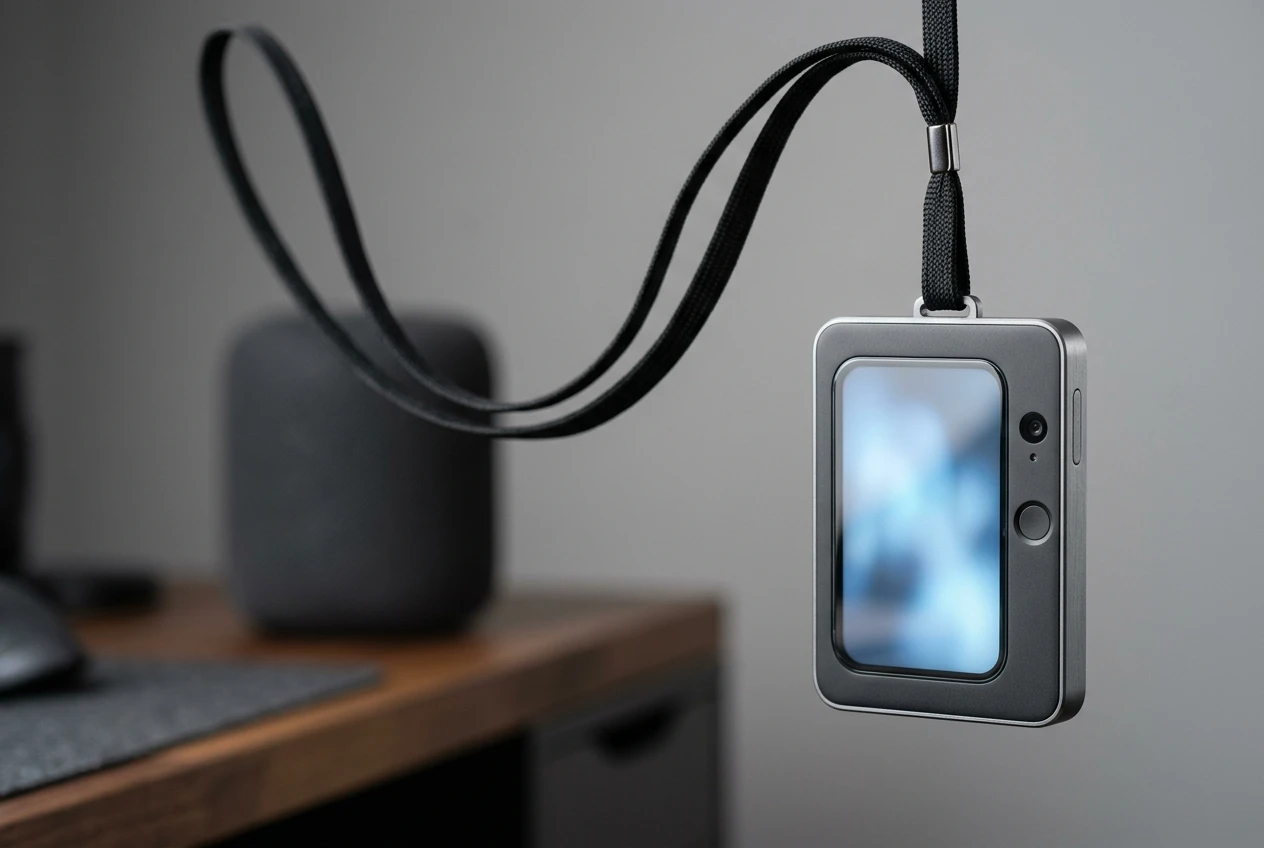
To show what that looks like, Microsoft built two concept devices. Both carry a touchscreen, a microphone, cameras, and speakers, and both are built around agents rather than installed programs.
| Reference device | Chip | What it does |
|---|---|---|
| Wearable badge | Qualcomm wearable silicon | Reimagines the employee ID card. A fingerprint button wakes the agent in one press, a single tap records and transcribes a conversation, and the camera lets the agent act on what the wearer sees. |
| Desk companion | MediaTek IoT silicon | Sits beside a PC, takes voice commands, signs the user in by facial recognition, and surfaces the day’s pressing items from Microsoft 365. Attach a monitor and it becomes a gateway to a full Windows machine streamed from the cloud through Windows 365. |
Steven Bathiche, corporate vice president and technical fellow in Microsoft’s Applied Sciences Group, framed the idea as a single system spread across many gadgets.
The next computer is not one device; it is all these devices working together as one system, with agents showing up closer to where and when you need them.
Both chips are off-the-shelf parts, not custom Microsoft silicon. That choice matters for how cheap and how fast partners can build their own versions.
The Android Bet Beneath Solara
The detail Microsoft did not put on a slide: Solara is built on a fork of Android. Specifically it runs on the Microsoft Device Ecosystem Platform (MDEP, an enterprise build of Android the company already ships on Teams meeting-room hardware), which is based on the Android Open Source Project that MDEP forks from. Microsoft did not pick Windows for the device that is supposed to define its next computing era.
That reads as an admission. Microsoft killed Windows Phone in 2017 after years of fighting an “app gap,” the problem where developers would not build for a third mobile platform because too few people used it, and too few people used it because the apps were not there. Windows on phones never escaped that loop.
Android already has the developers, the drivers, and the chip support. Building on it lets Microsoft skip the cold-start trap that sank its phones and focus on the agent layer instead of begging anyone to port software. The company is betting that the platform war over operating systems is over, and that the next fight is about which agents you trust, regardless of what they run on.
How Just-in-Time UI Is Supposed to Work
The technical heart of the bet is just-in-time UI (user interface). Instead of a developer hand-building screens for every device size and input method, an AI model generates the interface on the fly from code, fitting it to whatever hardware the agent lands on. Microsoft describes it as a spectrum, from responsive layouts with fixed structure to fully generative ones the model assembles in the moment.
“An agent can adapt across devices and modalities without requiring developers to redesign everything for every new form factor,” Bathiche said. The pitch is that the same agent can render itself as a voice flow on the badge, a touch panel on the desk hub, or a visual layout on a future screen, with no separate build for each.
If it works, it removes the exact tax that made supporting a new device class expensive, the redesign-for-every-screen burden. It also leans hard on Microsoft’s existing agent work, including the Copilot agents Microsoft has been wiring into its products. The catch is that generative interfaces are still young, and an agent that draws its own buttons can also draw the wrong ones.
The Graveyard of Agent-First Gadgets
Microsoft is not the first to sell a screenless or near-screenless AI gadget, and the recent history is grim. The two most hyped consumer attempts both collapsed inside a year.
- Humane AI Pin launched in November 2023 at $699 plus a $24-a-month subscription, drew brutal reviews for being slow and hot, and was sold to HP in February 2025 for $116 million, far below the more than $230 million the startup had raised. The pins stopped working that same month.
- Rabbit R1, the $199 orange box from CES 2024, promised an agent that could book an Uber or a restaurant for you. It moved about 100,000 units, then hit heavy returns.
Microsoft’s setup differs in ways that matter. It is selling reference designs to enterprises with IT (information technology) budgets, not $700 gadgets to consumers. The heavy compute lives in Azure, so the device itself can stay cheap and simple. And it is recruiting hardware makers rather than manufacturing a single hero product whose flop would end the story. None of that guarantees the agents are good enough to trust on a hospital floor. It does mean a slow pilot will not bankrupt anyone.
Why Nurses Come Before Consumers
Microsoft built the badge for frontline workers who cannot sit at a desk: IT staff, nurses, retail and warehouse employees. In one Build demo, Bathiche used the badge to record the audience and asked Copilot to edit the clip into photos for a social post. In another, the badge ran a hospital patient check-in and captured vitals for documentation.
“These new devices are not meant to run traditional apps. They are designed for agents,” Bathiche said, adding that hundreds of Microsoft employees already use the concept devices in their workday. The company says the same foundation can be retargeted at retail, industrial, hospitality, financial services, and legal work.
The pilot list reads like a deliberate spread across industries, and it lines up with the move of AI agents into everyday enterprise workflows in 2026. Microsoft says these companies will trial Solara-based hardware in the coming months:
- AccuWeather
- Best Buy
- CVS Health
- Levi’s
- Target
Starting with employers solves the trust problem from a different angle. A nurse does not choose the badge; the hospital does, and the hospital can write the rules for what the camera records and where the data goes.
What Microsoft Hasn’t Priced or Promised
For all the stagecraft, this is an early platform pitch with large blanks. There is no price, no ship date, and a clear statement that the badge and the desk hub are reference designs Microsoft does not plan to manufacture. The plan is to extend work with silicon partners on reference designs across portable, ultra-portable, wearable, and desktop categories, then hand those to OEMs (original equipment manufacturers, the firms that actually build and brand the hardware) to ship.
That is the soft spot in the bet. Solara only becomes real if outside chipmakers and device builders commit, if just-in-time UI proves reliable enough for a working shift, and if enterprises decide an agent badge beats the phone already in every pocket. Microsoft hinted at a wider lineup someday, including smart glasses, headphones, and watches, but showed none of them shipping.
Microsoft has set no price and no launch window; the pilots begin in the coming months, and whether Solara grows past a Build keynote depends on whether OEMs build the hardware Microsoft just sketched.