The US Environmental Protection Agency (EPA, the federal agency that approves pesticides) is reviewing a request from Google to release up to 32 million sterilized mosquitoes across California and Florida over two years, and the public has until June 5 to comment on the experimental plan.
Sterilizing mosquitoes to crash their own population is a decades-old idea. What Google adds is an AI-run production line able to breed, sort and release the insects by the tens of millions, and that industrial scale, far more than the underlying science, is the part that has researchers paying attention.
What the EPA Is Weighing Before June 5
Google’s request sits inside the Federal Insecticide, Fungicide and Rodenticide Act (FIFRA, the law that governs how pesticides are tested and approved). The company is not asking for full commercial clearance. It wants an experimental use permit, the regulatory equivalent of a controlled field trial, before any wider rollout.
The notice posted to the federal experimental use permit docket lays out the scope in plain numbers. Here is what is actually on the table:
- Volume: up to 16 million sterile male mosquitoes a year, 32 million across the two-year trial
- Locations: field sites in California and Florida
- The insect: Culex quinquefasciatus males, a common house mosquito, treated with a strain of the bacterium Wolbachia
- The target: West Nile virus, which Culex mosquitoes spread
- The deadline: public comments close June 5 under docket number EPA-HQ-OPP-2025-3951
The agency will decide whether to grant the permit only after the comment window closes. Its legal bar is whether the release would cause any unreasonable adverse effect on people or the environment, the same standard it applied to earlier mosquito products.
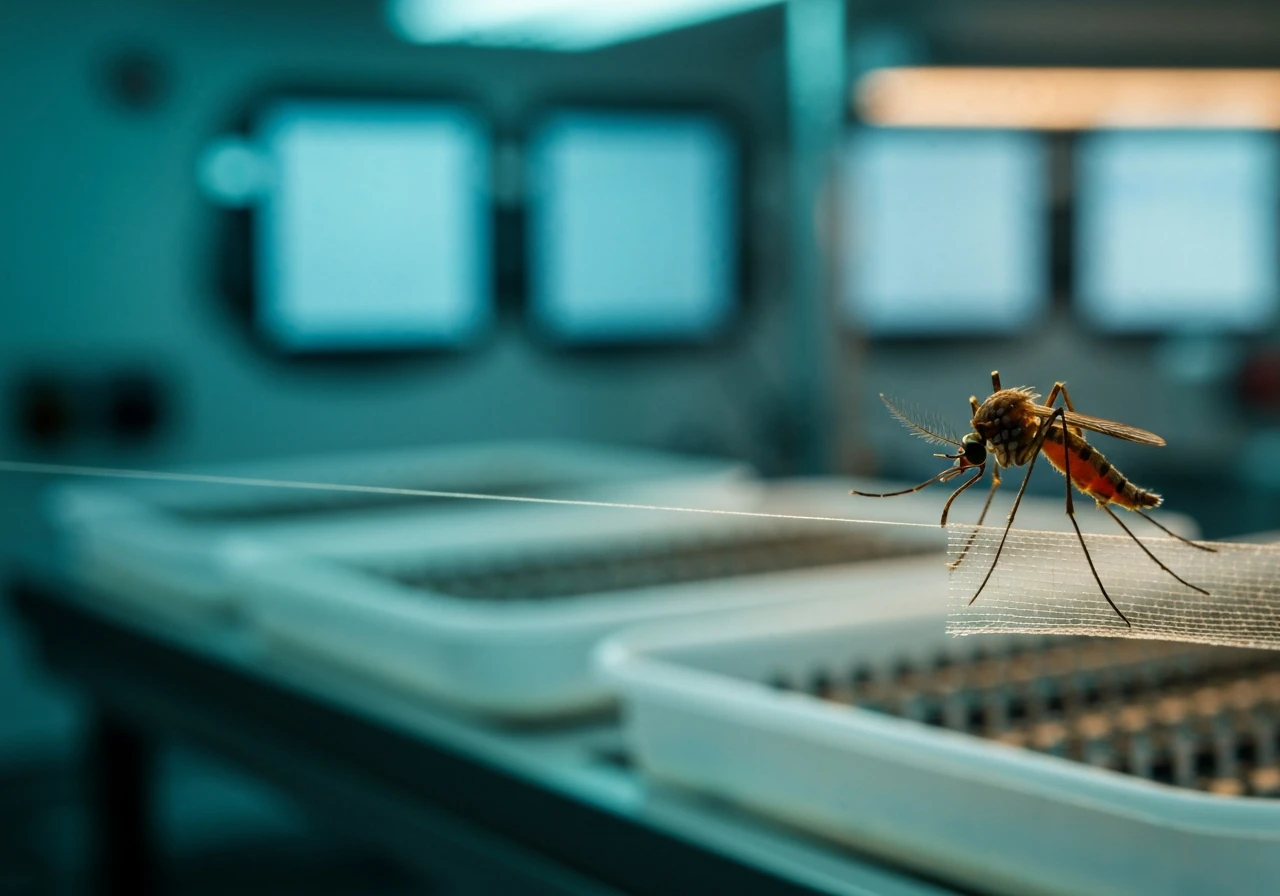
How Sterile Males Shrink a Mosquito Population
The biology is straightforward. Wolbachia is a naturally occurring bacterium that already lives inside many insects. When males carrying it mate with wild females that carry a different strain, the females’ eggs never hatch, a quirk biologists call cytoplasmic incompatibility.
Only males get released, and that detail matters for anyone worried about more bites. Male mosquitoes do not bite and do not carry disease; they feed on nectar. Each wave of sterile males that mates with wild females removes a slice of the next generation, so the population gets smaller with every cycle.
None of this is new. The broader sterile insect technique, which once relied on radiation to make males infertile, has been used on farm pests for more than half a century. Eric Caragata, an assistant professor at the University of Florida who studies mosquito-microbe interactions, has noted that the Wolbachia version has been in use for roughly 15 years. Scientists are still finding fresh ways to turn microbes against insects, including a newly identified bacterium that blocks malaria inside mosquitoes.
The Bottleneck Google Is Trying to Automate
If the method is old and proven, why has it stayed niche? The answer is cost, and the cost lives in the factory. Producing tens of millions of insects a week, then screening out every female before release, is slow, fragile and expensive work.
That sorting step is the real chokehold. Females bite, so a release batch contaminated with them defeats the purpose. Traditional programs lean on complicated mechanical sex-sorting machines, which raises the price and limits how far the technique can travel from a big rearing facility.
This is where a search-and-data company has an unusual advantage. Google’s engineers are building automated rearing systems run by sensors and data analytics, and using AI-powered computer vision to separate males from females faster and more reliably than older hardware. The stated goal is to release the right insects, in the right place, in the right numbers, at a scale that earlier players could not reach. Google’s Debug effort began exploring this roughly a decade ago, and the pitch has never been a better bug. It has always been a better assembly line.
The Companies Already Doing This
Google is walking into a field that several outfits have worked for years. The competition shows both how proven the science is and how hard the scaling has been.
| Player | Method | Main target | US status |
|---|---|---|---|
| MosquitoMate | Wolbachia sterile males | Aedes aegypti, Aedes albopictus | EPA-registered nationwide; its WB1 product cleared on April 14, 2024 |
| Oxitec | Genetically engineered males with a self-limiting gene | Aedes aegypti | Operated under experimental use permits in Florida and California |
| World Mosquito Program | Wolbachia population replacement, releasing both sexes | Aedes aegypti | Active in 15 countries; nonprofit owned by Monash University |
| Debug by Google | Wolbachia sterile males, AI-sorted | Aedes aegypti, now Culex in the US trial | Seeking an experimental use permit |
The split in strategy is worth understanding. MosquitoMate and Oxitec aim to suppress, knocking numbers down with repeated releases of sterile or self-limiting males. The World Mosquito Program’s population-replacement approach does the opposite, seeding a local population with Wolbachia so the surviving mosquitoes simply lose the ability to pass on dengue. Google sits firmly in the suppression camp, which is why its whole bet rides on cheap, repeatable production. The EPA’s own summary of emerging mosquito control technologies treats all of these as variations on a theme regulators already understand.
Singapore Is the Proof, With an Asterisk
Google did not start this campaign in California. It started it in Singapore, and the results there are the strongest argument in its filing.
The Numbers Behind the 80% Result
Citing Singapore’s National Environment Agency, Google reported that releasing millions of Wolbachia males drove deep declines in the disease-carrying population.
- 80% to 90% suppression of the local Aedes aegypti population after 6 to 12 months of releases
- More than 70% reduction in dengue cases over the same window
- Weekly releases that grew from about 6 million insects in 2024 to more than 10 million now
Debug has supported the agency’s Wolbachia project since 2018 and opened its first end-to-end production facility there in 2022. In May it said it would expand the site again. The reasoning was set out by Linus Upson, head of Debug, in the Singapore expansion announcement:
When we first launched Debug in Singapore, our goal was to advance mosquito production and releases through technology and bring Debug to more communities in Asia, where 70% of the global dengue burden occurs. Our success in Singapore gives us the confidence to expand.
Why the US Trial Targets a Different Enemy
Here is the asterisk. The Singapore win was scored against Aedes aegypti, the species behind most dengue and Zika. The American permit now under review covers Culex quinquefasciatus, a different mosquito tied to West Nile virus. A method that flattens one species in a dense tropical city does not automatically repeat against another species in California suburbs or Florida wetlands. The platform may travel; the result is not guaranteed to.
The Cost Problem Behind Perpetual Releases
The suppression model carries a built-in catch. Knock the population down and it climbs back, because wild mosquitoes keep breeding from the edges of the treated zone. There is no one-time cure here.
That means the releases have to keep coming, season after season, which turns the whole thing into a running operating cost rather than a single intervention. It is also exactly why automation is the heart of Google’s case. Cheaper insects, produced faster, are the only way the math works over years instead of months. Google signaled it is serious about that long haul when it fully acquired the Debug program from Verily, an Alphabet health and AI subsidiary, in December 2024, pulling the effort directly under the parent company.
Then there is the public. Releasing millions of lab-reared insects into neighborhoods invites questions no spreadsheet answers, and the open comment period is where those questions land. If the EPA clears the trial after June 5, the California and Florida sites become the first real test of whether Google’s production line can do in American suburbs what it did in Singapore. If regulators hold back, the most automated mosquito factory yet built stays parked behind a method that has worked for years but never paid for itself at scale.
Frequently Asked Questions
Do the released mosquitoes bite people?
No. Only male mosquitoes are released, and males do not bite or spread disease because they feed on nectar rather than blood. Biting is done by females, which the program screens out before release.
Is releasing sterile mosquitoes safe for humans and the environment?
The EPA approves these releases only if it finds no unreasonable adverse effect on people or the environment, the same standard it used to register MosquitoMate’s Wolbachia products nationwide. Wolbachia is a naturally occurring bacterium already found in many insects, not a chemical pesticide.
How can I submit a public comment on Google’s plan?
Comments can be filed through the federal eRulemaking portal at regulations.gov using docket number EPA-HQ-OPP-2025-3951. The comment window for that application closes on June 5.
Which mosquito and disease does the US trial target?
The application under the June 5 deadline covers Culex quinquefasciatus, a common house mosquito that carries West Nile virus. That differs from Google’s Singapore work, which targeted Aedes aegypti, the main carrier of dengue and Zika.
Does this permanently get rid of mosquitoes in an area?
No. The sterile-male method suppresses a population but does not eliminate it for good, because untreated mosquitoes keep breeding nearby. Sustained results require repeated releases over time, which is why low-cost, automated production is central to the approach.