
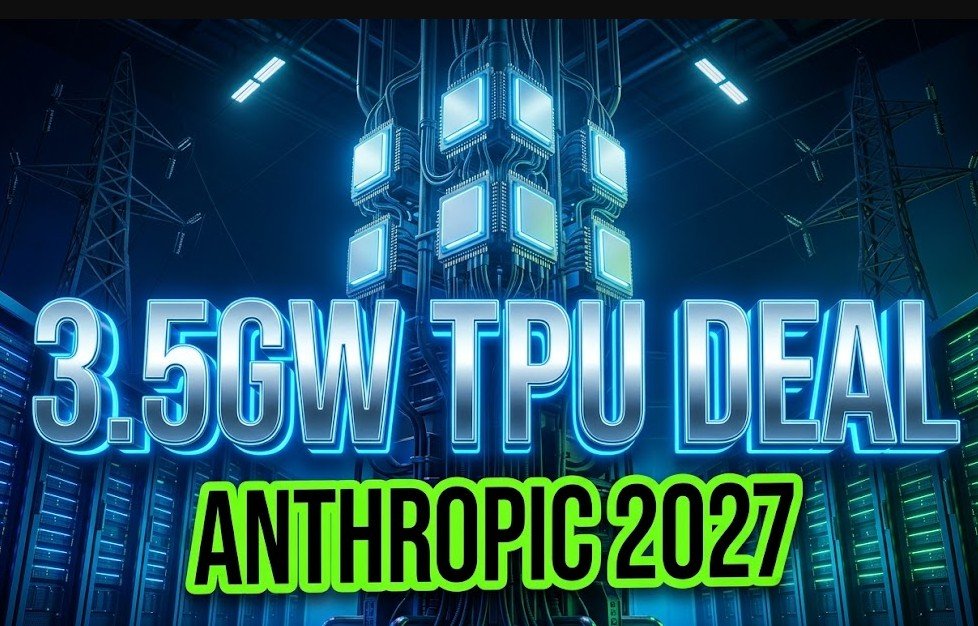
Anthropic has locked in a major deal for 3.5 gigawatts of next-generation TPU computing power through an expanded partnership with Google and Broadcom. This infrastructure boost arrives as the company’s annualized revenue run rate surges past 30 billion dollars. The move signals strong confidence in continued explosive demand for its Claude AI models.
The Landmark Compute Partnership
Anthropic announced the agreement this week. It builds on existing ties with Google Cloud and gives the company access to multiple gigawatts of advanced tensor processing units. Most of the new capacity will come online starting in 2027.
Broadcom plays a key role here. The semiconductor giant helps design and supply Google’s custom TPUs. A recent securities filing from Broadcom outlines a long-term supply assurance deal running through 2031. This covers future generations of the chips and related networking components.
The 3.5 gigawatts allocated to Anthropic form part of a larger commitment. Earlier plans already included about one gigawatt coming online this year. The expanded deal reflects the intense need for specialized AI hardware beyond traditional GPUs.
Revenue Explodes Past 30 Billion Dollars
Anthropic’s financial momentum tells a compelling story. Its annualized revenue run rate has jumped from roughly nine billion dollars at the end of 2025 to more than 30 billion dollars now. That represents a dramatic tripling in just a few months.
This growth shows how quickly businesses are adopting Claude across real operations.
Enterprise spending drives much of the surge. More than 1,000 companies now each pay over one million dollars annually. That number has doubled in recent weeks from around 500 earlier this year.
Such rapid scaling highlights Claude’s strength in practical applications. Companies use the models for coding, data analysis, customer service, and complex workflow automation. The steady, high-value contracts create more predictable revenue than consumer-only approaches.
Why TPUs Give Anthropic A Strategic Edge
Google’s tensor processing units offer a powerful alternative to dominant GPU technology. These custom chips excel at the matrix math that powers large language models. They often deliver strong performance per watt in training and inference tasks.
By securing dedicated TPU capacity, Anthropic reduces dependence on any single hardware supplier. This diversification helps control costs and ensure reliable access during chip shortages. It also aligns with Google’s push to make its AI infrastructure available to select partners.
The deal supports Anthropic’s focus on building safe, reliable frontier models. Ample compute allows careful testing and alignment work before wider deployment. At the same time, it meets surging demand from paying customers who want faster responses and higher usage limits.
Industry observers note the broader significance. AI data centers already strain power grids in many regions. A single gigawatt roughly equals the electricity needed for hundreds of thousands of homes. Scaling to multiple gigawatts underscores the massive energy investments required for next-generation AI.
US-Based Build Strengthens Domestic AI Leadership
Most of the new infrastructure will be constructed in the United States. This choice reflects strategic priorities around security, supply chain resilience, and policy support for American technology leadership.
Domestic data centers bring jobs and economic benefits to local communities. They also allow closer collaboration with US-based cloud providers and regulators. Amazon remains Anthropic’s primary cloud partner, but the Google TPU expansion adds valuable flexibility.
Power availability stands as a critical factor. Utilities and developers race to bring new generation capacity online, often turning to renewables, natural gas, or advanced nuclear concepts to meet AI-driven demand. Deals like this one accelerate planning for the massive facilities needed.
What This Means For The AI Race
Anthropic’s progress puts pressure on competitors. The company has carved out a distinct position through its enterprise focus and emphasis on responsible development. Strong revenue growth without heavy consumer marketing shows the power of solving real business problems.
The TPU partnership also highlights evolving hardware dynamics. While Nvidia still leads the market, custom silicon from big tech players gains ground. Broadcom benefits too, as its design and manufacturing expertise becomes central to large-scale AI builds.
Looking ahead, the ability to secure and deploy gigawatts of compute could determine which AI labs lead in 2027 and beyond. Training bigger models, serving more users, and iterating faster all require enormous resources. Anthropic appears well-positioned after this latest move.
Yet challenges remain. Energy costs, regulatory questions, and technical hurdles around very large clusters will test every player. Success will depend on execution as much as ambition.
Anthropic’s latest deal marks another milestone in the rapid maturation of the AI industry. From nine billion dollars in run-rate revenue to over 30 billion in months, the company demonstrates real commercial traction for advanced AI. The multi-gigawatt TPU commitment with Google and Broadcom ensures it can keep delivering as demand grows. This story goes beyond one company. It reflects how artificial intelligence now shapes serious infrastructure decisions and economic futures. The coming years will show which organizations turn this compute power into lasting value for businesses and society. What are your thoughts on the pace of AI infrastructure growth? Drop your comments below and share how these developments might affect your work or industry.