A custom solid walnut desk built to order runs $2,500 to $6,500. The flat-pack equivalent stocked at any big-box runs $400 to $900. The math only gets interesting when the comparison stretches across 15 years of daily use, folds in three or four flat-pack replacement cycles, and accounts for the IRS Section 179 immediate-expensing rules a sole proprietor can legally apply in the year of purchase.
For property placed in service in 2026, Section 179 carries a deduction limit of $2,560,000 with a phase-out threshold at $4,090,000 of total qualifying property. A single $5,000 desk sits four orders of magnitude inside the safe expensing zone, which is why the upfront-versus-replacement comparison most home-business owners run on a kitchen calculator misses the after-tax answer entirely.
Why the 15-Year Math Beats the Sticker Price
At first glance, $600 versus $4,000 is not a close decision. The picture changes when an owner draws the timeline out to a realistic operating run rather than a single purchase cycle.
Flat-pack joinery loosens at 2 to 4 years of daily use. Particleboard and medium-density fiberboard (MDF, an engineered panel of wood fiber bound by resin) retain roughly 70 percent of structural integrity after three assembly-and-disassembly cycles, per furniture industry testing. A daily-use office burns through three or four flat-pack desks across a 15-year window, landing the total cash outlay at $1,600 to $3,600 before disposal costs.
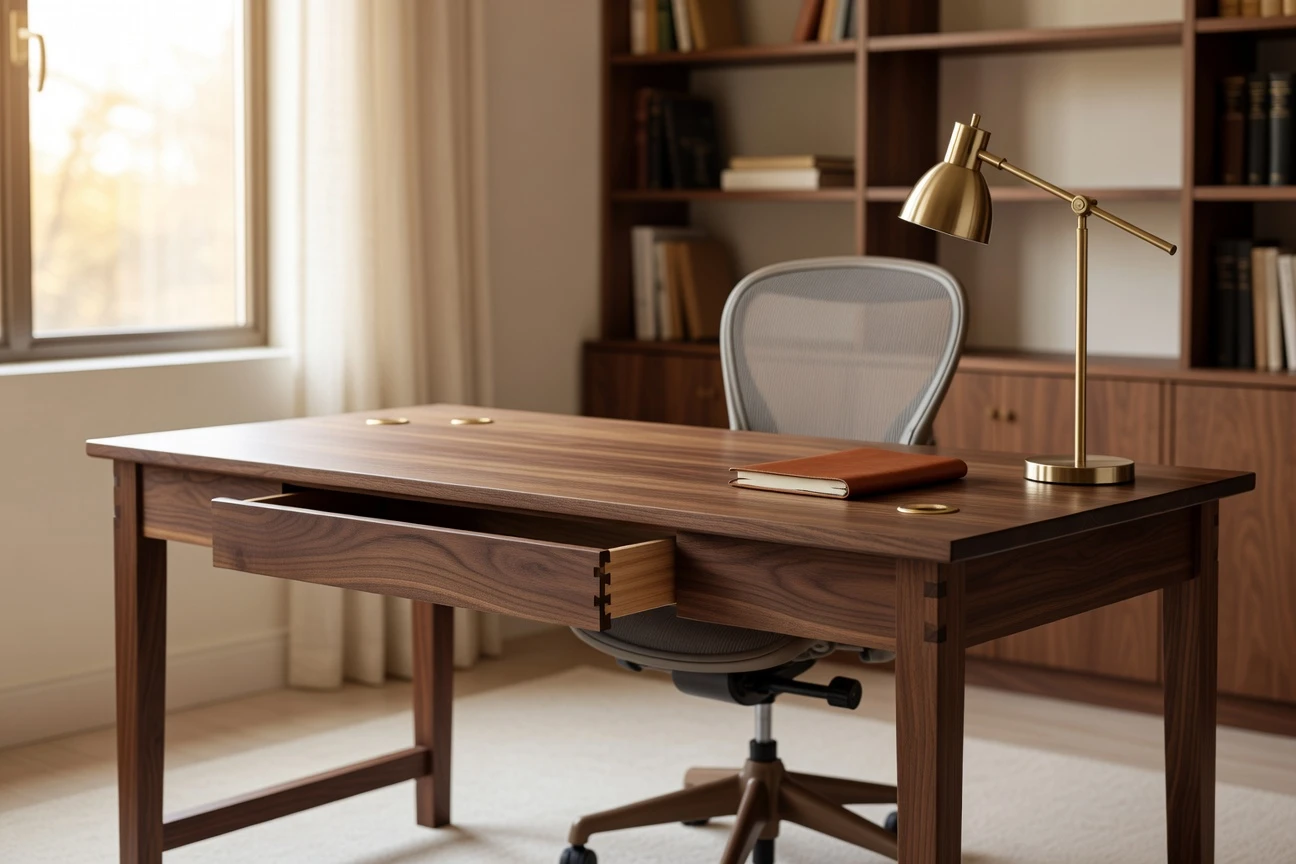
A solid hardwood desk built with mortise-and-tenon or dovetail joinery commonly serves 30 to 100 years with light upkeep. Refinishing a scratched walnut top costs $200 to $400 every decade or so. The 15-year total for the custom route lands at $2,500 to $6,500. Resale on the secondary market reliably returns 50 to 70 percent of the original price for a quality custom piece, against under 20 percent for the flat-pack equivalent.
The headline gap of $1,900 collapses to a few hundred dollars on a 15-year basis. Daily ergonomics and the absence of three or four assembly weekends do the rest of the work.
How Custom Solid Wood Differs From Flat-Pack
Five attributes separate the categories, and the gap shows up in different places depending on the budget tier and the operating tempo of the home business.
| Attribute | Flat-Pack Furniture | Custom Solid Wood |
|---|---|---|
| Joinery | Cam locks, dowels into particleboard | Mortise-and-tenon, dowel, dovetail |
| Material lifespan | 3 to 10 years | 30 to 100+ years |
| Upfront cost (desk and storage) | $400 to $900 | $2,500 to $6,500 |
| 15-year total spend | $1,600 to $3,600 | $2,500 to $6,500 |
| Repairability | Replacement on joint failure | Sand, refinish, re-glue indefinitely |
| Resale at year 15 | Under $200 | $1,500 to $3,500 |
Mortise-and-tenon joints transfer load through interlocking wood rather than through hardware. Cam locks and dowels in particleboard carry the same load through compressed fibers that weaken on every reassembly. The difference is invisible on day one and dispositive at year five.
Solid walnut, oak, maple, and cherry also gain character with age and can be sanded back to a fresh surface as many times as the wood allows. Particleboard and MDF degrade visibly at the screw holes and crumble at exposed edges once moisture finds a path in. A custom maker builds to the workspace’s actual dimensions, surface finish, and cable plan. Flat-pack offers fixed sizes only, which forces compromise on every desk that has to share an awkward alcove or face a window.
The Section 179 Angle Most Home-Business Owners Miss
The Section 179 deduction closes most of the price gap on an after-tax basis, and it is the line item that quietly rewrites the buying decision for any owner with a profitable year.
The eligibility rules matter. The home-office space must be used exclusively and regularly for the business under IRS Publication 587 on business use of the home. The furniture must be used in that space. A sole proprietor reports the deduction on Form 4562 and the home-office portion on Form 8829. An LLC taxed as a pass-through entity follows similar mechanics.
The after-tax math runs cleanly. A self-employed operator in a combined 32 percent federal-and-state bracket who buys a $5,000 custom desk recovers roughly $1,600 through the year-one deduction. Net effective cost lands near $3,400, which sits inside the 15-year flat-pack replacement total at its upper end.
One trap: the simplified home-office method ($5 per square foot, capped at 300 square feet for a $1,500 ceiling) does not allow depreciation or Section 179 expensing for the dedicated space. Owners who want to deduct the furniture should use the regular method and keep receipts. A CPA review before the year-end purchase is worth the fee.
Five Selection Mistakes That Nullify the Premium
Spending $5,000 on a desk does not buy ergonomic comfort or workflow fit by itself. Five mistakes recur for home-business owners and quietly undercut the investment.
- Wrong-size desk for the actual work surface. A 60-inch top looks generous on paper and forces clutter the moment a second monitor and a printed layout share the space. Measure the planned workflow first, then size the desk to the workflow rather than the room.
- Mismatched chair budget. A $3,500 desk paired with a $200 chair fails on the part of the system that actually contacts the spine for eight hours a day. The OSHA computer workstation eTool recommends a chair with adjustable height, lumbar support, and a seat pan deep enough for full thigh contact.
- Cable management treated as an afterthought. Custom makers integrate grommets, troughs, and routing channels at design time. Bolting an aftermarket cable kit onto a finished desk reads messy and defeats the visual case for the upfront spend.
- Lighting plan absent. Natural light from a window, a task lamp at the work surface, and an ambient ceiling fixture work as a three-layer system. A custom build can place power outlets and lamp mounts where they belong; flat-pack imposes its own constraints.
- Storage shortfall. A desk without a matched credenza or integrated drawer bank forces visible clutter or a mismatched second purchase six months later. Plan the full storage layout at the time of the desk order.
None of these is exotic. Each one nevertheless costs an owner the daily payoff the custom premium was supposed to deliver, which is why most cabinet shops walk new clients through a workflow interview before quoting the build.
When Flat-Pack Is the Right Call
The custom-wood case does not hold for every home business. Three signals point the other way and an honest assessment saves thousands.
- The operation is a one- or two-year stretch with no clear continuation plan
- The owner does not work at the desk most days (a roving consultant who travels four days a week)
- The workspace is rented and likely to change inside three years
In any of those, the break-even on the upfront premium never lands. Mid-tier flat-pack at $400 to $900, paired with a serious chair in the $400 to $700 range, delivers most of the ergonomic upside without committing to a 15-year piece.
The refurbished commercial-grade market is the most under-rated middle path. A used Steelcase or Herman Miller desk from a corporate liquidation costs $300 to $800, ships in commercial-grade steel and laminate that survives a decade, and pairs cleanly with a used Aeron chair around $400 to $600. Owners who want quality without the custom commitment should look there before defaulting to either end of the spectrum.
Sizing the Order: Lead Times, Wood Species, Budget
Three decisions shape the order itself, and getting any one wrong sets the project back by months.
Wood species sets the ceiling on cost and the visual register of the room. Black walnut is the editorial favorite for home offices: dark, warm, dent-resistant within reason, and stable through humidity swings. Expect $4,000 to $7,000 for a 60-inch walnut desk with two drawers. White oak runs 15 to 25 percent less, handles heavy daily use better with a Janka hardness around 1,360 lbf, and reads more modern. Hard maple is the lightest and most uniform of the three, lands at the same price tier as oak, and shows scratches more readily on a clear finish.
Lead time runs longer than most owners expect. Production-only shops quote 1 to 3 weeks for stock builds. Full custom commissions with design collaboration land at 8 to 14 weeks from order to delivery, longer for live-edge slabs that need extra drying and grain matching. The order should sit on the calendar three to four months before the planned workspace transition.
Budget allocation across the desk-and-chair pair is the third decision. A working ratio is 60 percent desk, 40 percent chair, with the chair never falling below $400. A $5,000 budget pencils to roughly $3,000 on the desk and $2,000 on the chair (a new Herman Miller Aeron or Steelcase Leap lands in that range; used Aerons come in lower). A $3,000 budget pencils to $1,800 on the desk and $1,200 on the chair. The break-even against repeated flat-pack replacement cycles still arrives at year 8 to 10, which is the number to keep in mind when the upfront quote feels heavy.
Frequently Asked Questions
How Long Does a Custom Wood Desk Take to Build?
Most custom makers quote 6 to 14 weeks from order to delivery, depending on the wood species, the complexity of the build, and whether live-edge slabs require additional drying. Production-only shops can ship in 1 to 3 weeks but offer fewer customization options. Plan the order around the planned workspace transition rather than around the move-in date.
Can a Home-Business Owner Deduct Office Furniture Under Section 179?
Yes, in most cases. Furniture used exclusively and regularly in a qualifying home office generally qualifies as Section 179 property up to the 2026 deduction limit of $2,560,000 in total qualifying property placed in service. The home-office space must meet the exclusive-use test in IRS Publication 587. Owners using the simplified $5-per-square-foot method cannot also expense furniture for that space; the regular method is required.
Which Wood Species Holds Up Best for Daily Office Use?
White oak is the most dent-resistant of the three common picks, with a Janka hardness around 1,360 lbf. Walnut reads warmer and hides scratches better, though it is softer and asks for a touch more care. Hard maple is the most uniform finish and the easiest match for modern interiors but shows surface scratches more readily on a clear coat.
Is Custom Furniture Worth It for a Two-Year Home-Business Run?
Usually not. The break-even on the upfront premium sits around year 8 to 10. A short-run operation is better served by mid-tier flat-pack or refurbished commercial-grade furniture from the secondary market, where a used Steelcase or Herman Miller desk and Aeron chair pair can be assembled for $700 to $1,400.
What Is the OSHA-Recommended Desk Height for a Home Office?
OSHA’s computer workstation guidance recommends desk surface height adjustable between 20 and 27 inches (50 to 69 cm), with leg clearance of 20 to 28 inches under the work surface. Monitor placement should be at least 20 inches from the eye and at eye height, with elbows resting at a 90 to 120 degree angle.
Does Refinishing a Solid-Wood Desk Cost Less Than Replacing Flat-Pack?
Yes. A full sand-and-refinish on a solid hardwood desk runs $200 to $400 every decade or so and restores the surface to near-original condition. Replacing a failed flat-pack desk costs $400 to $900 plus disposal and a weekend of assembly, and resets the lifespan clock to year zero each time.